
The phrase “lifestyle-friendly specialty” is wildly misleading if you do not understand cross-coverage and call pools. That is where the lifestyle either gets protected—or quietly destroyed.
You can match into dermatology and still be miserable if your group’s call pool is a joke. You can be a hospitalist with an excellent life if your nocturnist model is sane and your cross-coverage rules are tight. The difference is not the field alone. It is the structure: who covers what, when, and how.
Let me walk you through how this actually works, specialty by specialty, from a residency-insider perspective.
The Three Levers That Really Control “Lifestyle”
Forget the glossy brochure talk about 8–5 clinics and no trauma. The underlying levers that shape your daily life are remarkably consistent across fields:
Cross-coverage:
How many other people’s patients you are responsible for when it is “your shift.”Call pool structure:
How often you are on the hook for emergencies and what “being on call” truly means (home vs in-house, phone vs scrub-in).
3. Staffing model and redundancy:
How many human bodies share the workload, how back-up is triggered, and whether the system bends or simply breaks when someone is out.
If you want a stable lifestyle, you do not just ask “Is this a lifestyle specialty?” You ask:
- Who do I cross-cover at night and on weekends?
- How big is the call pool? Is there secondary/backup call?
- What actually happens when stuff hits the fan—do they call me, or is there a buffer?
Let us break it down by the usual “lifestyle-friendly” suspects: dermatology, radiology, pathology, anesthesia (to a point), EM, outpatient subspecialties (allergy, rheum, endo), and hospitalist medicine. I will also show you what this looks like in residency vs attending life, because those are not the same game.
Basic Call and Coverage Models: The Reality Map
Before we zoom into each field, you need a quick mental framework for the different kinds of call structures. They repeat everywhere with minor variations.
Types of Call
In-house call:
You are physically in the hospital for the duration. Classic for EM, some anesthesia, some radiology nights, hospitalist nights.Home call:
You are at home but must be reachable (and often within 20–30 minutes if procedures are involved). Common in derm (Mohs complications), some radiology, a lot of subspecialties.Pager/phone call “only”:
You are expected to answer calls, manage issues by phone or telehealth, but rarely come in after hours. Often allergy, rheumatology, some psych, some derm.Shift work:
Discrete blocks. When your shift ends, responsibility ends (in theory). EM and hospitalist are textbook examples. Radiology is increasingly shift-based.Cross-coverage:
You cover not just “your” patients, but all patients assigned to your service (or sometimes multiple services) during call hours. This is where things can explode.
Here is how these structures tend to distribute across the “lifestyle-friendly” fields:
| Specialty | Call Type | Cross-Coverage Intensity |
|---|---|---|
| Dermatology | Home/Phone | Very low |
| Radiology | In-house/Home | Moderate |
| Pathology | Home | Very low |
| Emergency Med | In-house Shifts | None (pure shift) |
| Anesthesia | In-house/Home | Moderate to high |
| Hospitalist | In-house Shifts | Moderate to high |
| Allergy/Immuno | Home/Phone | Very low |
| Rheumatology | Home/Phone | Low |
You will notice something important: “Lifestyle-friendly” does not mean “no call.” It means the ratio of pain-to-compensation and predictability is acceptable—if the call pool is built correctly.
Dermatology: The Mythically Chill Field (Mostly True)
Dermatology is where people imagine zero call, banker hours, and long weekends in wine country. There is some truth here, but not because emergencies do not exist. It is because:
- Most derm practices carefully limit what they are responsible for after hours.
- Hospital-based derm is often consult-only and rarely urgent.
Residency Derm Call
In derm residency, you typically rotate through:
- Outpatient clinic (bread-and-butter visits, biopsies, minor procedures).
- Inpatient consults (rashes on medicine/surgery patients, drug eruptions, bullous diseases).
- Mohs and procedural days.
Call usually looks like:
- Home call, 1–2 weekdays per week and some weekends, depending on program size.
- Primarily phone triage from ED teams or inpatient services.
- Rare middle-of-the-night trips in; more commonly, “We will see them tomorrow morning.”
Cross-coverage is minimal. If you are on call, you handle all derm issues for the hospital, but the volume is so low it barely counts as “cross-cover” in the internal medicine sense.
Attending Derm: How Call Pools Really Work
Most outpatient derm groups do one of three things:
No after-hours coverage at all.
Patients are directed to urgent care/ED. Follow-up is the next business day. True in many pure cosmetic or elective practices.Rotating phone-only call between partners.
You take 1 week at a time, or 1 in X weekends. The “emergencies” are almost all:- Drug rashes
- Wound concerns post-procedure
- Simple triage: “Go to ER” vs “See us Monday”
Academic call for hospital consults.
One attending is “on” for consults for a block (a week) at a time, backed by fellows/residents. Still largely low volume.
Cross-coverage: you are rarely, if ever, cross-covering hospitalized patients long-term, because you do not own inpatient panels. You drop in, consult, document, and hand back to the primary team.
The lifestyle win: minimal night disruption and minimal “surprise work” outside planned clinical time. The limiting factor is not crosscoverage. It is clinic volume and admin burden.
Radiology: Call Pools, Nighthawks, and the Subspecialty Trap
Radiology looks laid back from the outside: dark room, coffee, no family meetings. That view ignores the violence a bad call structure can do to your schedule.
Radiology Residency Call
You will see two main systems:
Traditional in-house call:
- Residents on overnight shifts (e.g., 5 p.m.–7 a.m.) covering ED and inpatient stat scans.
- Attending back-up from home or in-house depending on volume and hospital size.
- Cross-coverage: You are reading for multiple services—ED, ICU, inpatient, sometimes outpatient add-ons.
Night float:
- Two weeks at a time on nights, then days/electives.
- Same functional role, just block-scheduled.
The key point: cross-coverage is built into radiology. If you are the night person, you are the choke point for every emergent CT, MRI, and X-ray. That is a different flavor of stress than “Who is my patient?”
Attending Radiology: Lifestyle Depends on Structure
Radiology groups typically have:
- Subspecialty daytime reading (neuro, MSK, body, etc.).
- A general ED/after-hours pool.
- Sometimes outsourced teleradiology coverage (“nighthawks”).
You will see three main models:
True shift work with dedicated nocturnists
You do mainly days, maybe a small number of evenings. Nights are handled by a dedicated subset who either:- Get premium pay, or
- Work fewer total hours.
Rotating night/weekend call pool
The group divides nights and weekends. For example, 12–14 full night shifts a year per radiologist, plus some weekends. The more partners, the better this gets.Hybrid or academic model
Residents and fellows do first-pass, attendings overread remotely or in-house. Call burden is diluted by trainees.
Cross-coverage: During after-hours shifts, you are not “covering a team” in the medicine sense but you are cross-covering all clinical services’ imaging needs. In a busy trauma center or stroke center, that can be intense.
What makes radiology “lifestyle-friendly” is when:
- There is dedicated 24/7 staffing, not “home call with 30 reads waiting when you wake up.”
- Call is equitably shared across a large group.
- Telerad absorbs overflow so you are not constantly stretched to 150 percent volume.
Pathology: Almost No Traditional Call, But a Hidden Gatekeeper Role
Pathology is a different universe. There are essentially two types of after-hours issues:
- True emergencies: frozen sections for emergent surgeries, massive transfusion protocols, transplant-related issues.
- Operational problems: lab down, critical values, blood bank issues.
Residency Path Call
Most pathology residents will:
- Take home call for blood bank and surgical pathology.
- Occasionally come in at odd hours for frozen sections—though many of these can be scheduled.
Cross-coverage: You may be covering multiple hospitals in a linked system from home, but the actual number of calls is modest in most settings. Volumes spike during specific crises (transplant nights, big traumas), but that is not the daily reality.
Attending Pathology Call Pools
Common structure:
- Blood bank/clinical pathology call: rotating weekly or nightly across attendings.
- Surgical pathology “real-time” issues: often covered during the day; complex off-hours pathology is rare.
Many pathologists will tell you they are truly “off” most nights. At worst, you get a limited number of phone calls and a very occasional “please come in.”
The lifestyle advantage is obvious: very low cross-coverage pain, minimal nighttime work, and extremely low chance you are suddenly drowning in 20 new tasks at 3 a.m.
Emergency Medicine: Pure Shift Work, Zero Longitudinal Cross-Coverage
EM is the cleanest example of a field where “call pool” is replaced by “shift grid.”
There is no traditional cross-coverage. You do not “own” panels of patients. You do not get paged about a lab result 24 hours after discharge. When your shift ends, your work ends. Full stop.
But that does not magically create lifestyle. It depends on:
- How many shifts per month.
- How many nights/weekends.
- How heavy the volume and acuity are per shift.
- How good sign-out culture is.
EM Residency
Residents typically work:
- 18–22 shifts per month early on, tapering later.
- Mix of days, evenings, nights, weekends.
- No “call” in the IM sense, but you can feel like you are always on because your circadian rhythm is never steady.
There is no cross-coverage of admitted patients. The hospitalists and specialists own that.
Attending EM
Lifestyle lives or dies with staffing:
- A well-staffed democratic group with 12–14 shifts per month, smart scheduling, and robust APP support can absolutely be lifestyle-friendly.
- A corporate shop with 18 shifts, high RVU pressure, and understaffing will chew you up.
There is no call pool. But there is “how many nights are you stuck in a chaos box with 2:1 boarders and zero inpatient beds.”
For many people, the lack of cross-coverage plus the sharp boundaries of shift work outweigh the shift intensity. For others, the circadian wreckage is a deal-breaker.
Anesthesiology: Good Lifestyle If the Call Pool Is Built for Humans
Anesthesia sits in the middle. It can be lifestyle-friendly—when call pools are rational. It can also be brutal if the hospital is understaffed and the call expectations are old-school.
Anesthesia Residency Call
Common pattern:
- In-house call every X nights (q4–q7) depending on program and PGY level.
- You cover:
- OB (epidurals, urgent sections).
- Emergent surgeries (orthopedic washouts, appendectomies, trauma).
- Occasionally ICU coverage depending on department structure.
Cross-coverage is built-in: you are “the anesthesia person” for multiple ORs and sometimes multiple physical sites after hours.
Attending Anesthesia: Call Pool Shapes Everything
Group models vary a lot:
OR-day-heavy with in-house or home call
- You do OR lists by day, then rotate through overnight call.
- Call can be:
- In-house for majors/trauma centers.
- Home call with a response-time requirement for smaller hospitals.
Dedicated OB or cardiac call
Subspecialists take their own flavored call: cardiac or OB.Shift-based “24/7” models
Some larger groups have more of an EM-style shift wheel. Less traditional but growing.
Cross-coverage: After hours, if you are the anesthesiologist on call, you are responsible for:
- Active cases that run over.
- New emergent cases.
- OB epidurals and sections.
- Sometimes ICU airway consults or code responses.
If the call pool is 1:8 or 1:10 with reasonable elective OR overflow rules, anesthesia can be quite livable—especially in community settings with limited trauma and minimal 3 a.m. redo sternotomies.
If it is 1:3 call with chronic understaffing and surgeons who think “add-on case” means midnight spine fusions, the “lifestyle” part disappears.
Hospitalist Medicine: Cross-Coverage on Steroids
Hospitalist work is “lifestyle-friendly” when it sticks to the basic rules: block scheduling, predictable shifts, clear cross-coverage, and adequate staffing. It is a disaster when:
- Night coverage is thin.
- Admit caps are fake.
- Cross-coverage at night becomes unmanageable.
Hospitalist Residency Experience
As a resident, you get early exposure to the hospitalist reality under attending supervision:
- Day teams: 10–20 patients, sometimes more if the hospital is abusive.
- Night float: cross-covering multiple teams’ patients plus taking new admissions.
Let me be explicit: night cross-coverage is not a small add-on. It completely changes the mental load. You are:
- Answering pages for 30–60+ patients.
- Admitting new patients from ED.
- Handling codes and rapid responses.
The structure that saves you: clear triage rules and real backup. The structure that kills you: “Just call if you need anything” from an attending at home who is asleep.
Attending Hospitalist: Call Pools vs Shift Grids
Most hospitalist models are now shift-based, not traditional home call. But there are key variants:
7-on/7-off, pure in-house
- You work 12–14 shifts per 7-day block (days plus some nights).
- Nights may be:
- Covered by dedicated nocturnists.
- Shared among daytime docs with rotating night coverage.
Dedicated nocturnist group
- Night cross-coverage is performed by a smaller crew who work exclusively nights.
- Day hospitalists hand off all responsibility at sign-out.
Hybrid with home backup call
- Rare now, but some places still expect home call as backup for codes, cross-coverage overflow, or ICU.
Cross-coverage is the central issue at night. A typical scenario:
- One nocturnist covering:
- All cross-cover issues for 50–80+ patients.
- New admissions from ED (anywhere from 6 to 20 per night).
- Codes and rapid responses for multiple floors.
That is a call pool in functional terms, even if it is shift-based. It either works (if there is adequate staffing and caps) or it is soul-crushing.
The hospitalist job becomes lifestyle-friendly when:
- Nocturnists exist and are not absurdly outnumbered by patients.
- Admission caps are hard, not just on recruitment brochures.
- There is an ICU team that takes its own cross-coverage and procedures.
Outpatient Subspecialties: Allergy, Rheumatology, Endocrinology
These are the quiet killers in the “lifestyle-friendly” rankings because people underestimate how civilized the call and cross-coverage can be.
Call and Cross-Coverage Structure
Most of these fields share several features:
- Clinic-heavy, weekday-centric.
- Elective hospital consults rather than admission ownership.
- Phone-based after-hours care.
Call pool in a typical medium-sized group:
- 1 in 4 or 1 in 5 weekends.
- Shared weekday phone call.
- Calls are usually:
- Medication questions.
- Flare management (steroids, DMARD adjustment).
- Lab results.
Cross-coverage is usually just: you take calls for your partners’ patients when it is your turn on the rotation. Some groups add a shared inpatient consult pager; again, volume is modest in most settings.
You rarely have the brutal “60 inpatients and 10 admits” problem that hospitalists or general internists have.
Of course, there are outliers—big academic referral centers managing complex vasculitis, transplant immunology, or brittle endocrine disasters. But the average allergy or rheumatology practice has very mild overnight burdens.
The Hidden Variables That Ruin (or Rescue) Lifestyle
Field matters. But the local implementation matters more. I have seen “lifestyle” specialties used as cheap labor because nobody asked hard questions before signing.
When you interview for residency or jobs, you need to get very specific about:
Call frequency with real numbers
Not “call is reasonable.” Ask:- How many calls per month?
- How many nights? Weekends?
- In-house vs home vs purely phone?
Cross-coverage scope
- At night, how many patients is one person covering?
- Across how many services or hospitals?
- Who responds to codes, rapid responses, or procedural emergencies?
Backup and escalation
- Is there a second person on backup call?
- How often do they actually get called in?
- Who physically has to come in for a deteriorating patient or complication?
Nocturnist / nighttime structure
- Is there a dedicated night team or just “whoever lost the schedule lottery”?
- Is there protected sleep time for home call? (In some derm/rads/anesthesia models.)
- Are night shifts clustered or sprinkled (both have very different impacts on life)?
Here is how this looks when you lay it out simply:
| Domain | Critical Question |
|---|---|
| Frequency | How many nights/weekends per month? |
| Intensity | How many patients or scans am I covering at night? |
| Location | In-house vs home vs phone-only? |
| Backup | Is there a second on-call and how often used? |
| Ownership | Do I own inpatient panels or just consult/ED work? |
How This Feels in Real Life: A Few Concrete Scenarios
Let me put meat on the bones with some side-by-side contrasts.
Scenario 1: Hospitalist vs Allergy Call
Hospitalist nocturnist:
- 7 p.m.–7 a.m., 7 nights in a row.
- 60 cross-cover patients, 8 new admits.
- Responds to 3 rapid responses and a code.
- By 4 a.m., barely time to pee.
Allergy attending on weekend call:
- Phone rings twice on Saturday:
- One severe urticaria flare (managed via med change and outpatient follow-up).
- One “Is this a reaction?” post-biologic injection (reassurance).
- No inpatient consults; everything deferred to Monday.
- Phone rings twice on Saturday:
Both are “internal medicine subspecialties,” but the lived experience is unrecognizably different.
Scenario 2: Radiology vs EM Night
Radiology night attending:
- 10 p.m.–7 a.m., reading ED and inpatient stat studies.
- Peak 15–20 cases/hour during busy times; down to 5–8/hour overnight.
- Interprets images, minimal direct patient interaction, but high cognitive load.
EM night attending:
- 10 p.m.–7 a.m., 2–3 new patients/hour + 10–15 boarders.
- Manages full resuscitations, family discussions, disposition battles.
- Walks 5+ miles in the ED without trying.
Same timeframe, very different physical and emotional footprints. But both are “no cross-coverage panels,” just acute flow.
Visual: How Call Frequency and Cross-Coverage Stack Up
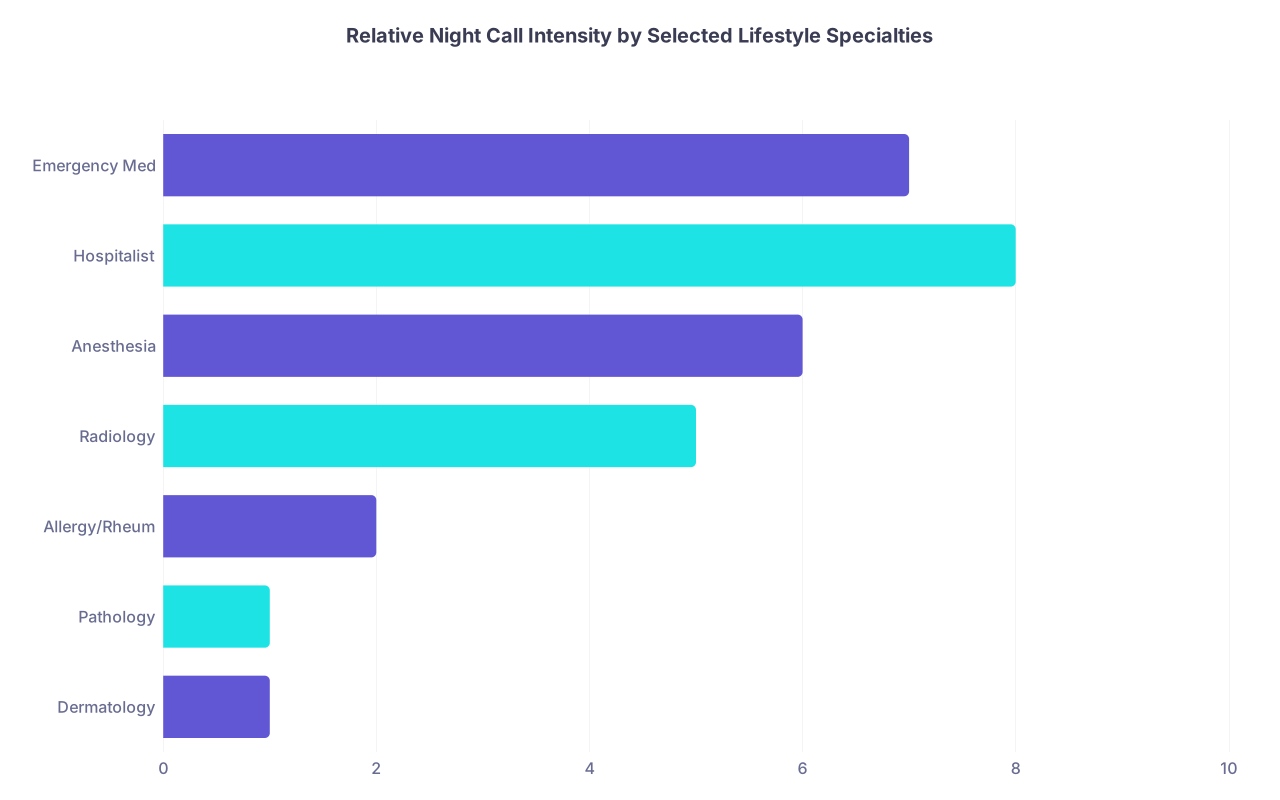
| Category | Value |
|---|---|
| Dermatology | 1 |
| Pathology | 1 |
| Allergy/Rheum | 2 |
| Radiology | 5 |
| Anesthesia | 6 |
| Hospitalist | 8 |
| Emergency Med | 7 |
Scale of 1–10, rough, combining frequency and “pain per call.” You can argue the exact numbers, but the pattern is right: derm/path/allergy are genuinely low-intensity; hospitalist/anesthesia/EM depend heavily on local staffing and design.
How Residency Previews and Distorts the Reality
One last nuance: residency often exaggerates or distorts how bad (or good) call is in a field.
Derm/rads/path:
Residency call is often heavier relative to eventual practice, because you are the cheap night labor. Attending life is usually better.Hospitalist/internal medicine:
Residency sometimes hides the true attending burden if your program has strong night float and good backup. Community hospitalist gigs can be harsher.Anesthesia and EM:
Residency is closer to reality, but you often have a bit more backup than in some private groups.
So when you are rotating, you should mentally adjust:
- If it feels tolerable now as a resident with less control, it will probably be better as an attending in lifestyle-friendly fields.
- If it already feels like the edge of what you can stand, be very careful about where and how that field is practiced.
A Quick Structural View: Who Actually Has It Best?

| Step | Description |
|---|---|
| Step 1 | Choose Lifestyle Specialty |
| Step 2 | Derm, Allergy, Rheum |
| Step 3 | Radiology, Pathology |
| Step 4 | Anesthesia, EM, Hospitalist |
| Step 5 | True Lifestyle Friendly |
| Step 6 | Burnout Risk |
| Step 7 | Field Type |
| Step 8 | Call Pool Design |
You can absolutely screw up your lifestyle in a “cushy” field by choosing a group with:
- Tiny call pool.
- Chronic understaffing.
- Nocturnist coverage gaps.
- Vague or exploitative cross-coverage expectations.
You can also have a very solid life as a hospitalist, anesthesiologist, or EM doc in a well-structured, well-staffed practice with clear rules and enough bodies.
Visual: Typical Monthly Night/Weekend Burden
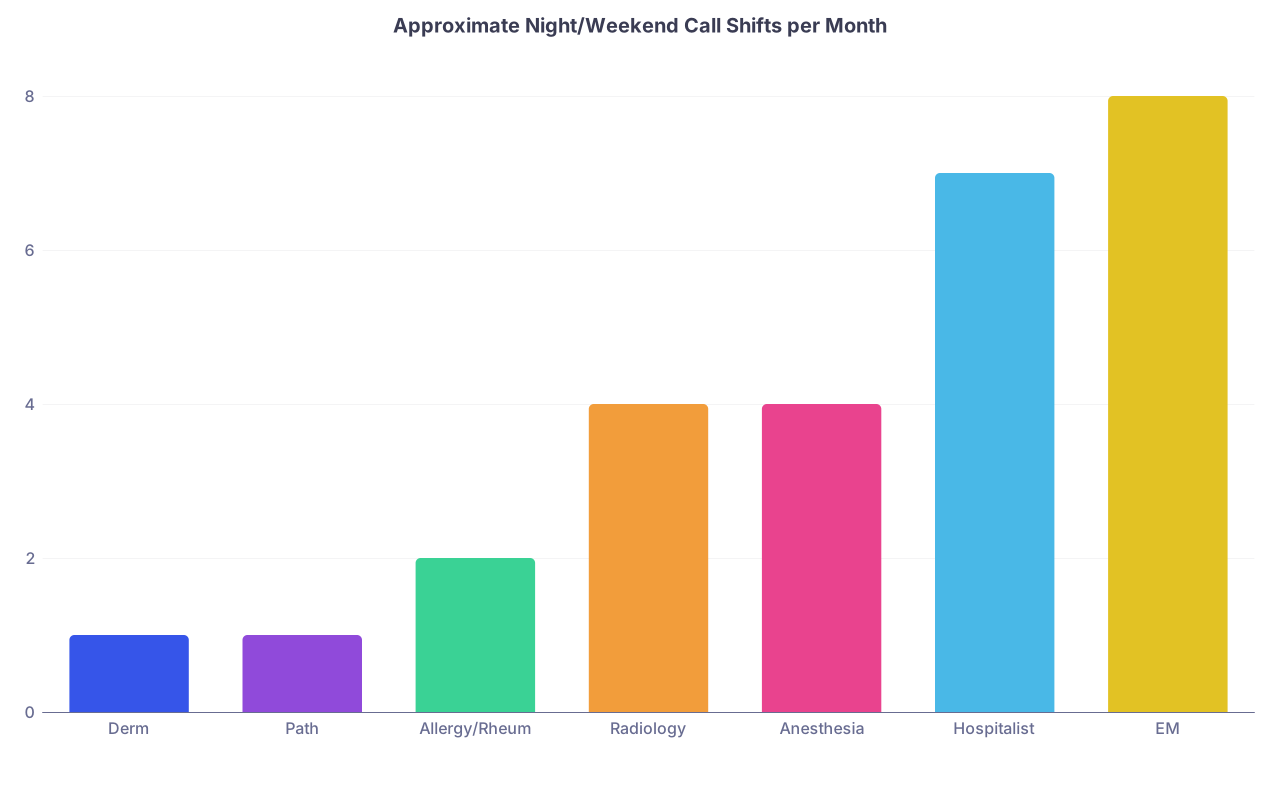
| Category | Value |
|---|---|
| Derm | 1 |
| Path | 1 |
| Allergy/Rheum | 2 |
| Radiology | 4 |
| Anesthesia | 4 |
| Hospitalist | 7 |
| EM | 8 |
Again, not universal, but directionally accurate when you factor in shift work (EM/hospitalist) vs home call.
Bottom Line: How to Actually Use This Information
You are not choosing a magical field that guarantees lifestyle. You are choosing:
- A category of work (clinic vs imaging vs procedural vs acute care).
- A likely call structure.
- A range of possible cross-coverage models.
If you want maximum protection:
- Dermatology, pathology, and outpatient subspecialties (allergy, rheum, endo) are the clearest lifestyle wins. Call and cross-coverage are genuinely light in most settings.
- Radiology is very good if you land in a group with rational night coverage or telerad support.
- Hospitalist, EM, and anesthesia can be solid if—and only if—the local call pools and shift grids are humane and adequately staffed.
Three key takeaways:
- “Lifestyle-friendly” is mostly about how call and cross-coverage are structured, not just the name of the specialty.
- Always get hard numbers on call frequency, cross-coverage scope, and backup before you believe any lifestyle promise.
- Within the classic lifestyle fields, derm/path/allergy/rheum are truly low-intensity for call; radiology is moderate but manageable; hospitalist, EM, and anesthesia depend absolutely on whether the call pool was designed for humans or martyrs.