
You were sold a “lifestyle” specialty. You got a bait‑and‑switch.
Let me be blunt: plenty of programs in so‑called lifestyle friendly specialties run like mini-surgical residencies with better PR. The problem is not that you chose wrong specialty. The problem is you need a rescue plan for a bad fit program, bad culture, or bad expectations.
This is fixable. But not if you just keep grinding and hoping “it gets better next year.”
This is the playbook I wish more residents had in hand the moment they realize: “This is not what I signed up for.”
Step 1: Diagnose the Problem Precisely (Not Vaguely)
“Lifestyle is terrible” is not a diagnosis. It is a symptom.
You have to separate three things:
- Specialty reality
- Program-specific dysfunction
- Your own mismatch in expectations or coping tools
Until you know which one is the main culprit, you cannot design a way out.
A. Separate specialty vs. program problems
Different “lifestyle” specialties have different baselines. Quick reality check:
| Specialty | Typical Hours/Week | Call Type | Outpatient/Inpatient Mix |
|---|---|---|---|
| Dermatology | 40–55 | Minimal / home | Heavily outpatient |
| PM&R | 50–60 | Some home/inhouse | Mixed |
| Psychiatry | 50–60 | Night float / home | Mostly inpatient early |
| Radiology | 55–65 | Night float | Reading room + call |
| Anesthesiology | 55–70 | Early mornings, OR call | OR-heavy |
| Ophthalmology | 55–65 | Home call | Mixed clinic/OR |
If you are working 85 hours every week in psychiatry at a mid-sized community program with no trauma center, the issue is probably your program.
If you are in anesthesia at a big tertiary trauma center with transplant, hearts, and OB, and you are averaging 60–65 hours with some rough call weeks? That is closer to specialty reality.
Write down answers to these:
- Over the last 4 weeks, what were your actual hours per week?
- How often were you:
- Staying >2 hours late?
- Called in from home?
- Post-call but still working past noon?
- How often are you doing work from home (notes, orders, following up) after leaving?
Get numbers, not vibes. People normalize abuse if “everyone is suffering.” You need data.
B. Clarify the type of pain you are feeling
Different problems demand different fixes. Identify which ones hit:
- Volume problem: too many patients, too few residents, constant throughput pressure.
- Schedule chaos problem: call schedules change weekly, days off canceled, no predictability.
- Culture problem: attendings yelling, shaming, no support, gossip, retaliatory behavior.
- Educational problem: you are a service mule; no teaching, no feedback, no OR/clinic time.
- Support problem: no senior help, unsafe coverage, cross-covering too many units.
- Personal problem: burnout, sleep, depression, relationship stress, physical health.
On paper, a 60‑hour week can feel sustainable in a supportive, sane program.
The same 60 hours in a chaotic, hostile one will break you.
You need to know which you are actually fighting.
Step 2: Compare Reality vs What You Were Sold
Before you go to war, gather receipts.
Pull out:
- Your interview notes
- Program website screenshots (duty hour claims, call descriptions)
- Any recruitment emails about “lifestyle,” “protected time,” “wellness focus”
- Your contract (duty hours clause, call expectations, moonlighting rules)
Then map them against your actual life.
| Category | Promised / Implied | Actual Experience (Last 4–8 Weeks) |
|---|---|---|
| Average weekly hours | 55-60, per PD on interview | 70–80 consistently |
| Call frequency | Q6 home call, light | Q4, frequent call-ins |
| Post-call policy | Out by noon | Often staying until 5 pm |
| Didactics | Protected 3 hours weekly | Regularly canceled for service |
| Wellness/support | Retreats, mentorship | None this year |
You are looking for specific discrepancies, not “vibes were off”:
Attending said: “Home call is very light, maybe once a month you get called in.”
Reality: “I am getting called in 3–4 times per month, sometimes multiple times a night.”
Website: “Residents never exceed 80 hours; most rotations are 55–60 hours.”
Reality: “Multiple residents did 85+ hours for several weeks straight on ICU.”
This matters because it tells you:
- What to bring up concretely with leadership (“You told us X, what changed?”)
- Whether this is temporary (staffing crisis, new service) or structural (chronic lies)
Step 3: Decide Which Path You Are On: Fix, Escape, or Pivot
There are only three real routes:
- Fix your current situation enough to be livable
- Transfer to another program in the same specialty
- Pivot to a different specialty / path entirely
You do not choose all three at once. You pick a main objective and a backup.
Let me walk you through each.
Step 4: Attempt Local Fixes First (Smart, Targeted, Not Naïve)
You start with what you can control inside the current system. Not because the system deserves it, but because it is the lowest-friction option.
A. Micro-fixes: What you can change this month
These are small but high-yield.
Create hard lines in your schedule
- One truly protected off-day per week. Non-negotiable unless literal catastrophe.
- One “no residency” block nightly (e.g., 9–11 pm phone on silent unless on call).
- A hard bedtime for post-call; zero productivity expectations.
Stop doing free emotional labor for the system
- Do not volunteer for every committee, project, or optional teaching gig.
- Say: “I cannot add this now; my current workload is at capacity.”
- Drop “extra” charting help that is not your assigned work.
Change how you handle notes and follow-up
- Batch inbox / patient messages twice a day; do not nibble at them all day.
- Build templates aggressively. Residents who write from scratch burn out faster.
- Finish as many notes as possible before leaving the hospital. Late-night EMR kills you slowly.
Triage your perfectionism
- Identify one or two rotations where “good enough” beats “perfect.”
- Drop your internal standard on low-yield tasks: discharge summaries, routine consult notes, daily progress notes in stable patients.
None of this solves a toxic program. It buys you bandwidth. You will need that for bigger moves.
B. Mesoscale fixes: Engage leadership strategically (not emotionally)
You cannot walk into the PD’s office and say, “This sucks.” You need a case.
Use a three-part structure:
Describe the situation factually
- “On the inpatient psych rotation, our logs show 75–85 hours per week over the past 4 weeks. We cover 30–35 patients per resident most days.”
Describe the impact
- “People are skipping didactics to finish notes. We are leaving past 7 pm regularly. Two residents have had to seek medical care for stress-related issues.”
Propose specific, realistic changes
Examples:- Cap patient lists per resident.
- Hire or reassign an NP/PA.
- Shift some social work / disposition tasks to appropriate staff.
- Make didactics truly protected by having a float resident.
- Convert some call shifts to nocturnist coverage or tele-coverage.
When you meet:
- Bring written log of hours (not just your memory).
- Frame changes as patient safety + education, not “I want an easy life.”
- Ask: “What has to be true for us to implement [concrete suggestion]?”
Sometimes leadership is clueless but not malicious. Those programs can adjust.
Sometimes they are fully aware and do not care. That tells you you are in the wrong program, period.
Step 5: Decide If You Need to Transfer Programs
If after 3–6 months of attempts you see:
- No meaningful change, and
- Multiple residents across years are miserable, and
- Leadership either gaslights or shrugs
…then you start working on an exit.
Transferring residencies is not fun. But I have seen it work, and it can absolutely save your career.
A. Reality check: When is transfer realistic?
You have a higher chance of transfer if:
- You are still in PGY‑1 or early PGY‑2
- You are in a field with moderate training spots and some flux (psych, IM prelim, PM&R, anesthesia in some regions, radiology)
- Your:
- Evaluations are solid
- USMLE/COMLEX scores are decent
- No professionalism red flags
Harder (not impossible) if:
- Very niche or small fields (derm, ophtho)
- You are PGY‑3+ and heavily embedded
- You have poor evaluations or documented conflicts
B. Quietly gather intel and allies
You do not post in a public forum “I want to leave my program.” You move carefully.
Identify a safe faculty mentor
- Someone not in direct line of authority over your evals.
- Ideally known as fair and resident-friendly.
Have a direct conversation
- “I am seriously considering transferring programs. Here is why. Here is what I have tried. Do you think that is reasonable? Would you support me with a letter if needed?”
Clarify internal politics
- Some PDs react vindictively when they hear about transfers.
- Others are surprisingly helpful and will make calls for you.
Your mentor can tell you which category yours falls into.
C. Hunt for open positions methodically
You are looking for off-cycle PGY positions, not re-entering the Match if you can help it.
Where to look:
- Specialty-specific listservs (e.g., APDR, ACGME postings for rads/PM&R/psych)
- Resident-run social media groups (but careful with identifying details)
- Direct emails to PDs in cities/regions you are open to:
- “I am a current PGY‑1 in [specialty] at an ACGME-accredited program, interested in transferring due to program fit. Do you anticipate any PGY‑2 openings for [year]?”
Do not trash your current program in writing. Ever. Keep it neutral:
- “Seeking a program with stronger educational focus and more stable inpatient volumes.”
- “Looking for a program that aligns better with my career goals in [subspecialty/setting].”
D. Prepare your transfer packet
You will likely need:
- Updated CV
- Personal statement (short, focused on fit and goals)
- Exam scores
- Summaries of rotations and letters from current faculty
- A letter from your current PD (sometimes required, sometimes not early on)
If PD letter is unavoidable and you expect blowback:
- Time your request after you have at least one interested program.
- Frame it as “exploring family relocation / geographic change” if that is even remotely true.
Step 6: Consider a Specialty Pivot – Without Burning Everything Down
Sometimes the problem is not just your program. It is the cognitive and emotional load of the work itself. “Lifestyle specialty” does not mean “emotionally easy.”
- Psychiatry: high suicide risk, chronic severe illness, limited acute wins.
- Radiology: constant pressure for speed, isolation, medico-legal fear.
- Anesthesia: vigilance fatigue, high-stakes brief encounters, OR culture.
- Derm / ophtho: business pressures, cosmetic vs medical identity friction, high patient expectations.
Ask a hard question:
If I were in a good program in this specialty, would I still want this work long-term?
If the honest answer is no, you look at a pivot.
A. Map realistic pivot options by specialty
You are not starting from scratch. Your current skill set matters.
| Current Specialty | Likely Pivot Options |
|---|---|
| Psychiatry | Neurology, FM, research, admin |
| PM&R | Neurology, non-op ortho, pain, EMG lab |
| Radiology | Pathology, clinical informatics, IT |
| Anesthesia | Pain, critical care, EM, urgent care |
| Derm | Primary care derm, telederm, research |
| Ophthalmology | Non-op eye care, industry, research |
Notice: some pivots keep you in clinical medicine; some shift you toward research, admin, or tech.
B. Build a “pivot hypothesis” before making a leap
You do not blow up your residency based on a fantasy of another field.
Steps:
- Shadow or moonlight (if allowed) in target fields.
- Talk to 5+ attendings in that field about their actual weeks. Ask:
- “What are your real hours like?”
- “What is the worst part of this job?”
- “What do people underestimate about burnout risk here?”
- Identify what you would have to give up:
- Future earning potential
- Certain procedures
- Academic vs community career trajectory
Then ask:
- Does this pivot fix the core of what is making me miserable now?
- Or just change the scenery?
If your main problem is toxic people, shifting fields but staying in toxic programs will not help. You need to optimize for culture and control, not just brand of residency.
Step 7: Protect Your Career While You Survive the Next 6–12 Months
You might be stuck where you are for a bit. That does not mean you sit passively.
A. Guard your professional reputation even when the program is a mess
Program may be dysfunctional. Your name should not be.
Non-negotiables:
- Show up on time or early.
- Communicate clearly when you are drowning:
- “I have 12 new admits and 15 follow-ups. I can safely manage X more tasks; beyond that, I will miss important details.”
- Do not blow up over email. Difficult conversations are in person or phone.
- No social media venting with any identifying program details. Screenshots live forever.
You are building credibility for letters and for any future job/transfer.
B. Build a micro-network outside your program
You want at least two attendings outside your program who know your work reasonably well. Could be from:
- An away rotation
- Electives at affiliated hospitals
- Research collaborations
- Local professional societies / QI projects
These people can:
- Write you letters for fellowships / jobs
- Give you informal advice about regional programs and reputations
- Offer you per diem or part-time work after residency if you want an escape ramp
Do not underestimate how much one well-placed ally can change your trajectory.
Step 8: If All Else Fails – Design an Exit That Leaves Doors Open
There is a nuclear option: leaving residency entirely or after completing only part of it.
I am not going to glamorize it. It is high-risk. But for a small minority, it is healthier than staying.
If you are getting to that point, you need to do it in a way that preserves maximum future options.
A. Get a real mental health and medical check
If you are thinking about quitting weekly:
- See a therapist or psychiatrist not affiliated with your program.
- Rule out or treat:
- Major depression
- Anxiety disorders
- Sleep disorders
- If needed, get FMLA / leave of absence. Sometimes what you need is distance and treatment, not a career change.
B. Talk to someone who has actually left medicine or changed paths
LinkedIn is full of ex-physicians in:
- Pharma
- Consulting
- Health tech
- Quality / utilization management
- Medical writing
Reach out with something like:
“I am a current PGY‑2 in [specialty] considering leaving residency. I saw you transitioned into [role]. Would you be open to a brief 15–20 minute call about how you evaluated that decision?”
You will get a much clearer sense of whether your “exit fantasy” holds up or collapses under reality.
C. If you resign, do it cleanly
- Give adequate notice per contract.
- Do not disappear mid-rotation unless there is a true health crisis.
- Get copies of:
- Procedure logs
- Rotation evaluations
- Any certificates / trainings you completed
One day you may want to work in a non-residency clinical role or reapply. You will need documentation.
Special Notes by “Lifestyle” Specialty
Let me call out a few specific traps I see repeatedly.
Psychiatry
- Trap: Understaffed inpatient units with resident dumping. Residents functioning as case managers, social workers, and security.
- Fix focus:
- Push for capped census per resident.
- Hard line: no chronic use of residents as 1:1 sitters or pseudo-security.
- Explore outpatient-heavy programs or those with strong consult-liaison tracks if you transfer.
PM&R
- Trap: Being the “everything” resident—covering ortho, neuro, trauma, SNF, consults, plus heavy note burden.
- Fix focus:
- Clarify which tasks are physician-level vs nursing / therapy / case management.
- Advocate for standardized templates and order sets to shrink documentation.
- For transfers, look for programs that clearly define pain vs inpatient vs consult tracks.
Radiology
- Trap: Endless call with under-supervised nights, pressure for impossible turnaround times, no real teaching in first year.
- Fix focus:
- Push for structured readout time and explicit education blocks.
- Track work RVUs / case volumes; there is a difference between “busy” and “unsafe.”
- In transfer hunting, prioritize programs with reputations for strong teaching over prestige.
Anesthesiology
- Trap: Pre-6 am starts + late room finishes + brutal weekend calls = chronic sleep debt.
- Fix focus:
- Advocate for fair call distribution and realistic relief coverage.
- Press for policy that true post-call means gone, not “hang around and help.”
- Think critically about long-term jobs: independent group with self-scheduling might serve you better than academic prestige.
Dermatology & Ophthalmology
These are honestly more often “expectation mismatch” than raw hours:
- High patient expectations.
- Cosmetic vs medical misalignment with your values.
- Clinic pace faster and more mentally exhausting than students appreciate.
Fix focus here:
- Clarify your preferred practice style (slower, academic; faster, private; mostly surgical; mostly clinic).
- Talk to attendings living the life you think you want. Confirm it exists before you bail.
Use Data, Not Fantasy, To Choose Your Next Step
One final tool: track your own experience for 6 weeks.
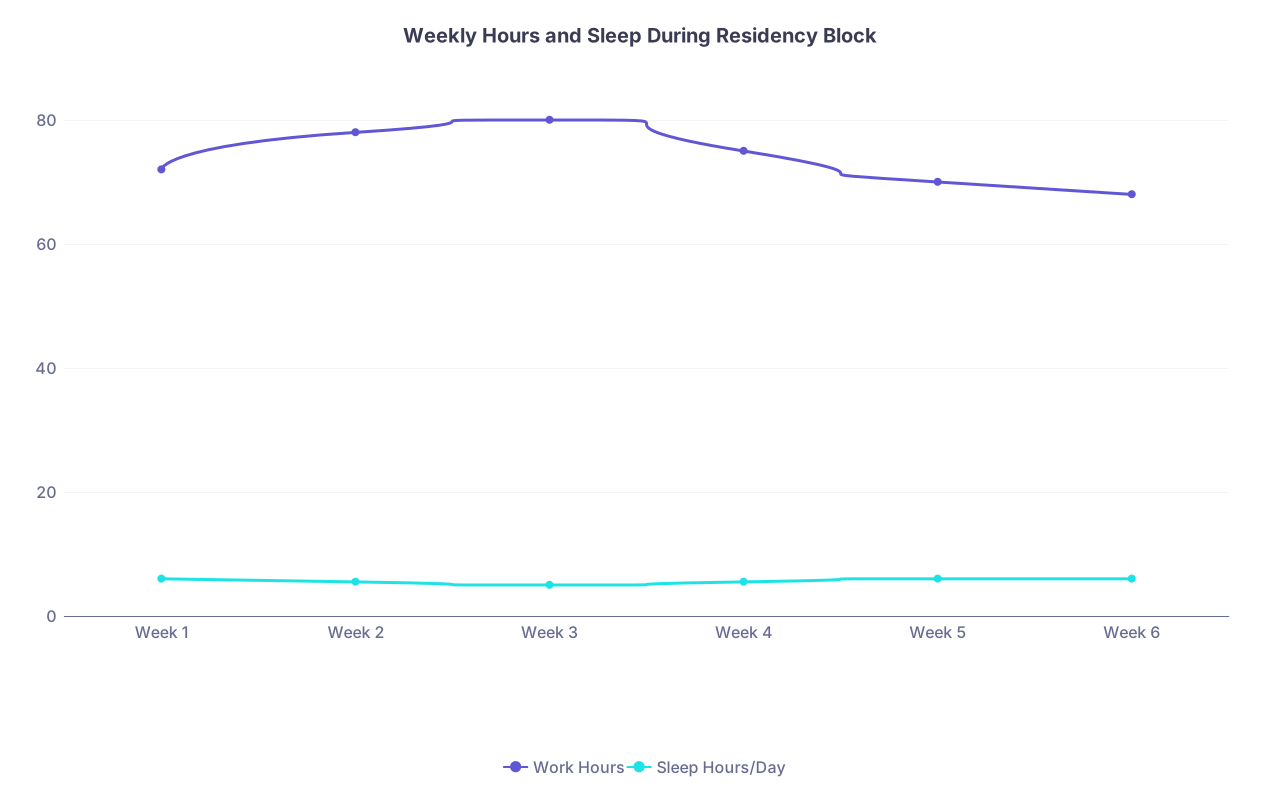
| Category | Work Hours | Sleep Hours/Day |
|---|---|---|
| Week 1 | 72 | 6 |
| Week 2 | 78 | 5.5 |
| Week 3 | 80 | 5 |
| Week 4 | 75 | 5.5 |
| Week 5 | 70 | 6 |
| Week 6 | 68 | 6 |
Track:
- Daily arrival / departure times
- Sleep hours
- Number of new admits / studies / cases
- Number of serious negative encounters (conflict, yelling, safety issues)
After 6 weeks, look at:
- Are there any improving trends with your micro-fixes?
- Or is this simply a fundamentally untenable baseline?
Numbers cut through denial. Or doom thinking. Both are common in residency.
A Simple Decision Flow: Stay, Fix, Transfer, or Pivot

| Step | Description |
|---|---|
| Step 1 | Realize lifestyle is bad |
| Step 2 | Log 4-6 weeks of data |
| Step 3 | Attempt micro and mesoscale fixes |
| Step 4 | Explore pivot specialties |
| Step 5 | Stay and optimize career path |
| Step 6 | Prepare transfer applications |
| Step 7 | Move to better program |
| Step 8 | Consider pivot or structured exit |
| Step 9 | Shadow, talk to attendings, validate pivot |
| Step 10 | Plan switch or new training path |
| Step 11 | Problem mainly program or specialty? |
| Step 12 | Meaningful improvement in 3-6 months? |
| Step 13 | Transfer feasible? |
| Step 14 | Pivot still attractive? |
Final Thoughts: Your Rescue Plan in 3 Sentences
- Get specific about what is wrong—hours, culture, specialty fit—and document it with real data.
- Work the ladder: micro-fixes, structured talks with leadership, transfer attempts, then pivot or exit if needed.
- Protect your name and your health while you do it; programs come and go, but your reputation and well-being are the only long-term assets you cannot easily rebuild.