
Most people “compare lifestyle” between residency programs in the worst possible way: vibes, rumors, and whatever a tired PGY‑3 mumbled on interview day.
You can do better than that. You need a scorecard.
Lifestyle is measurable enough to compare programs side by side, and if you are going into a lifestyle‑friendly specialty (derm, ophtho, rad onc, path, psych, PM&R, etc.), you are throwing away your biggest advantage if you choose blindly.
I am going to walk you through a concrete, step‑by‑step way to build and use a lifestyle scorecard that actually differentiates programs. Not fluff. Not “gut feeling.” Numbers, weights, and a simple system you can reuse across every interview.
Step 1: Get Clear On What “Lifestyle” Actually Means
You cannot score what you have not defined. “Good lifestyle” is not just “they said they are chill.” For residency, lifestyle breaks into a few core buckets.
Here is the blunt version of what matters:
Time:
- Hours per week (average and peak)
- Call frequency and type (home vs in‑house, nights, weekends)
- Vacation and true days off
- Flexibility for appointments, life events
Work Intensity:
- Patient volume, consult volume, or reading load (for path/rads)
- Scut vs meaningful work
- Documentation burden and EMR misery level
- How often you are staying late or charting from home
Schedule Stability and Predictability:
- How far in advance schedules are released
- How often you get switched last‑minute
- How often you have true “golden weekends”
Program Culture and Support:
- How attendings treat residents
- How PD responds when things are unsafe
- Peer support vs toxic competitiveness
- How often residents actually use wellness resources
Geography and Cost of Living:
- Commute time
- Cost of rent vs salary
- Proximity to partner/family/support system
- Safety and convenience of where you will actually live
Long‑Term Sustainability:
- Night float system vs q4 “death call”
- Jeopardy/back‑up coverage (or lack of it)
- How often people burn out, go part‑time, or switch programs
- How well the lifestyle actually prepares you for your target career (academic, private, part‑time, etc.)
That is what you are trying to compare. Not “vibes.” Not the food on interview day.
For lifestyle‑friendly specialties, the differences are often subtle. The pathology program where residents consistently leave by 4 p.m. vs the one where sign‑out “often goes until 7 or 8.” The derm program with night float only during one ICU consult month vs the one with weekly home call year‑round. Those details are what the scorecard will force into the open.
Step 2: Build Your Lifestyle Scorecard Framework
You are going to build a simple tool:
- Rows = lifestyle factors
- Columns = programs
- Each factor gets:
- A score (e.g., 1–5)
- A weight (how much you personally care about it)
You can do this in Excel, Google Sheets, or Notion. I recommend Google Sheets so you can edit it from your phone between interviews.
2.1 Choose Your Core Categories
Start with 5–7 categories. Too few and you miss nuance. Too many and you will never fill it out.
For lifestyle‑friendly specialties, a good starting set:
- Clinical hours and call
- Schedule predictability
- Culture and treatment of residents
- Geographic fit and cost of living
- Personal support and flexibility
- Wellness and benefits
- Career fit (especially for people aiming for part‑time, outpatient, or academic niches)
2.2 Turn Categories Into Measurable Items
Under each category, break into 2–5 concrete items that you can actually ask about and score.
Example template:
Clinical Hours and Call
- Average hours per week on heavy rotations
- Average hours per week on light rotations
- In‑house call frequency (per month)
- Home call frequency (per month)
- Number of weeks of night float per year
Schedule Predictability
- How far in advance schedule is released (months)
- Frequency of last‑minute changes (per month)
- Number of golden weekends per block (approximate)
Culture and Treatment of Residents
- Resident‑reported attendings’ respect and approachability
- Responsiveness of PD/chief to concerns
- Examples of when program changed something for resident well‑being
- Level of hierarchy vs collegiality
Geographic Fit and Cost of Living
- Commute time (door‑to‑door, typical)
- Cost of 1‑bedroom rent vs PGY‑1 salary
- Safety and convenience of nearby neighborhoods
- Access to things you personally care about (hiking, airports, schools, etc.)
You get the idea. Specify what you will ask and what you will observe.
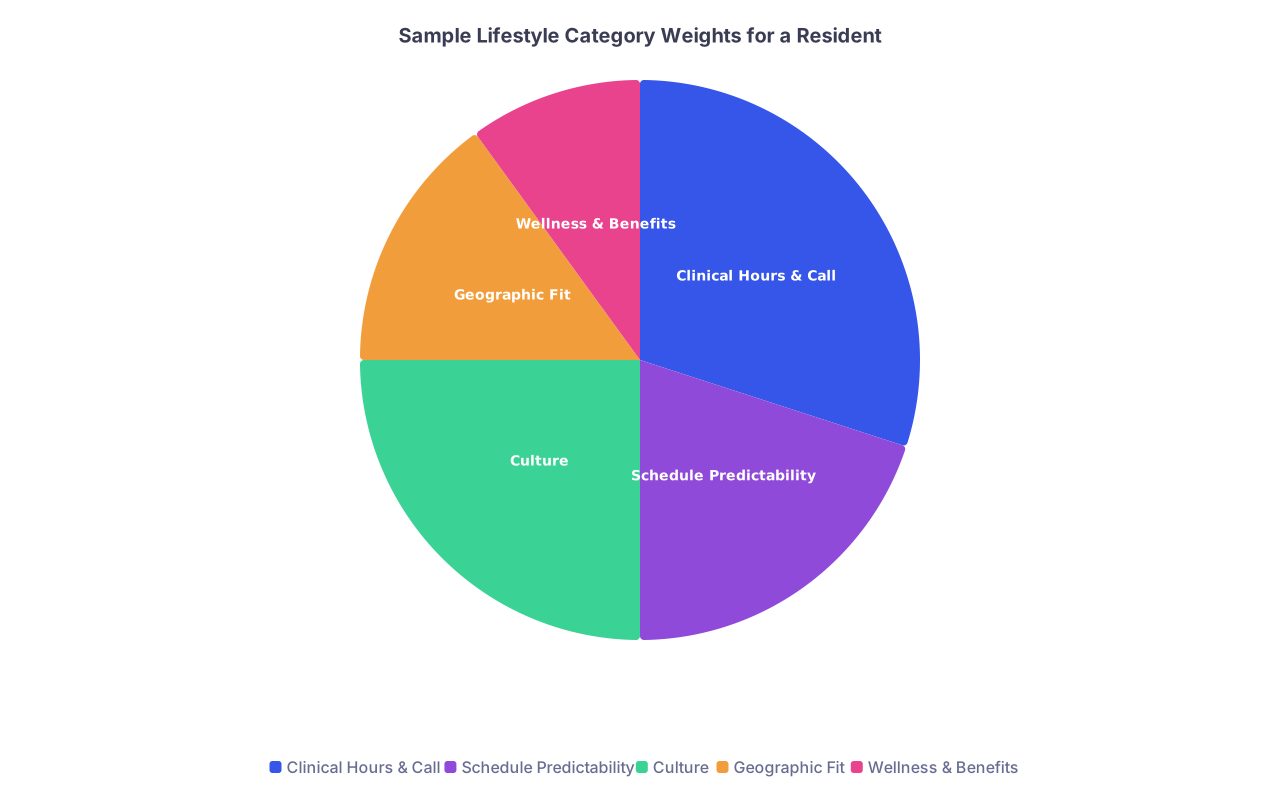
| Category | Value |
|---|---|
| Clinical Hours & Call | 30 |
| Schedule Predictability | 20 |
| Culture | 25 |
| Geographic Fit | 15 |
| Wellness & Benefits | 10 |
Step 3: Assign Weights That Reflect Your Actual Priorities
Two applicants going into the same specialty can have completely different lifestyle priorities. Someone with two kids and a working spouse cares differently than a single person in their mid‑20s willing to grind for three years then coast.
This is where most people lie to themselves.
3.1 Start With a Fixed Budget of Points
Use 100 points. Force yourself to make tradeoffs.
For example:
- Clinical hours and call – 30
- Schedule predictability – 20
- Culture and treatment – 25
- Geographic fit and cost of living – 15
- Wellness and benefits – 10
That is for one type of applicant.
If you are tied to a city because of a partner, you might invert that:
- Clinical hours and call – 20
- Schedule predictability – 15
- Culture and treatment – 20
- Geographic fit and cost of living – 35
- Wellness and benefits – 10
There is no correct distribution. There is only honest vs dishonest. Be honest.
3.2 Translate Category Weights to Item Weights
Within each category, distribute the category weight across the specific items.
Example: You gave “Clinical hours and call” 30 points. You have 5 items under it:
- Average hours heavy – 8
- Average hours light – 4
- In‑house call – 8
- Home call – 6
- Night float weeks – 4
Those are your weights. You will multiply each item’s score (1–5) by its weight.
| Category | Item | Weight (points) |
|---|---|---|
| Clinical hours & call | Avg hours heavy rotation | 8 |
| Clinical hours & call | Avg hours light rotation | 4 |
| Clinical hours & call | In-house call frequency | 8 |
| Clinical hours & call | Home call frequency | 6 |
| Clinical hours & call | Night float weeks per year | 4 |
| Schedule predictability | Schedule released (months) | 10 |
| Schedule predictability | Last-minute changes frequency | 10 |
| Culture & treatment | Attendings respectful | 10 |
| Culture & treatment | PD responsiveness | 10 |
| Culture & treatment | Peer support | 5 |
Step 4: Design a Clean, Repeatable Scoring System
Keep it simple: 1–5 scale for each item.
- 1 = terrible
- 2 = below average
- 3 = acceptable
- 4 = good
- 5 = excellent
You are not writing a research paper. You need numbers that:
- You can assign quickly after an interview
- You can compare across programs months later
- You can adjust if you later learn you were wrong about one item
4.1 Anchor Your Scale With Concrete Benchmarks
Do not just “feel” the numbers. Decide what a 1 vs 5 looks like for each item.
Example: Average hours on heavy rotations
- 1 = >80 hours consistently
- 2 = 70–80
- 3 = 60–70
- 4 = 50–60
- 5 = <50
Example: In‑house call frequency
- 1 = q3 or worse
- 2 = q4
- 3 = q5–6
- 4 = 2–3 per month
- 5 = none or extremely rare cross‑cover
You will not hit perfect precision. That is fine. The point is relative comparison.
4.2 Decide How You Will Handle Non‑Numeric Items
Some lifestyle items are softer: “culture,” “supportive PD,” “resident happiness.”
You still score them. Use descriptive anchors, not hours.
Example: Attendings respectful and supportive
- 1 = multiple residents warn you about toxic, belittling attendings
- 2 = clear hierarchy, some negative stories, residents caution you
- 3 = mixed; some attendings great, some rough, residents shrug
- 4 = residents consistently describe attendings as supportive, but a few “old school” exceptions
- 5 = every resident you ask lights up when describing attendings; concrete examples of advocacy
You get the pattern.
Step 5: Extract Real Lifestyle Data From Each Program
Here is where most applicants fall apart. They ask weak questions, take marketing answers at face value, and then wonder why the reality does not match the brochure.
You need to systematically collect data that fills your scorecard.
5.1 Before Interview Season: Research Baseline Numbers
Some things you can find before you set foot on campus:
- Program websites: look for:
- Rotation structure
- Call schedules (even if outdated, gives ballpark)
- Vacation policies
- Salary and benefits
- FREIDA / program databases: for average hours, call, etc.
- Doximity, Reddit, SDN: grain of salt, but patterns matter. If multiple people over years say “this derm program is malignant,” pay attention.
Fill in what you can in pencil. These are just priors you will confirm or correct.
5.2 On Interview Day: Ask Targeted, Non‑Leading Questions
You need to talk to multiple residents at different PGY levels. The trick is to ask the same core questions at each program so you can compare answers directly.
Examples that map to your scorecard:
- “On your busiest month, about how many hours a week are you working, door to door?”
- “When you are on lighter rotations, what does a typical weekday look like?”
- “How often do schedules change last minute?”
- “How far in advance do you usually know your schedule?”
- “Can you give me an example of a time the program leadership changed something in response to resident feedback?”
- “If someone is struggling (wellness, family issue, illness), what actually happens here?”
- “What percent of residents live within a 20‑minute commute? Why?”
- “How many vacations do you actually take each year? Any trouble getting the weeks you want?”
Then shut up and listen. Do not ask, “This seems like a very supportive program, right?” That just invites a scripted answer.
5.3 Between Interviews: Capture Impressions Immediately
Same day if possible, you:
- Fill in your scorecard while details are fresh.
- Write 3–5 bullet “impressions” per program:
- Best lifestyle feature
- Worst lifestyle feature
- Any red flags
- One concrete story you heard
Those notes will matter more than your memory three months later.

Step 6: Turn Raw Scores Into a Comparable Lifestyle Index
You now have:
- A list of programs
- Scores (1–5) for each item
- Weights for each item
Time to make it useful.
6.1 Basic Formula
For each program:
- For each item: Weighted score = (item score) × (item weight)
- Sum all weighted scores across all items
- This gives you a Total Lifestyle Score for that program
If you want to normalize, you can divide by the maximum possible score and convert to a 0–100 scale. Example:
- Max possible = 5 (max score) × 100 (total weight) = 500
- Program A total = 420
- Lifestyle index = 420 / 500 × 100 = 84
Now you can say, “Program A has an 84, Program B a 73, Program C a 91,” and that is a real, structured comparison.
6.2 Example Mini‑Comparison
Let’s say you are comparing three PM&R programs. You heavily weight hours and call.
You score the “Clinical hours and call” items (total weight 30) like this:
Program X (urban, big name):
- Avg heavy hours – score 2
- Avg light hours – score 3
- In‑house call – score 3
- Home call – score 2
- Night float weeks – score 2
Program Y (mid‑size city, less famous):
- Avg heavy hours – score 4
- Avg light hours – score 4
- In‑house call – score 4
- Home call – score 3
- Night float weeks – score 4
Program Z (suburban, small but solid):
- Avg heavy hours – score 3
- Avg light hours – score 5
- In‑house call – score 5 (almost none)
- Home call – score 4
- Night float weeks – score 5
Multiply each by your chosen weights. The “big name” may end up with the worst lifestyle score by a mile. Now that is visible.
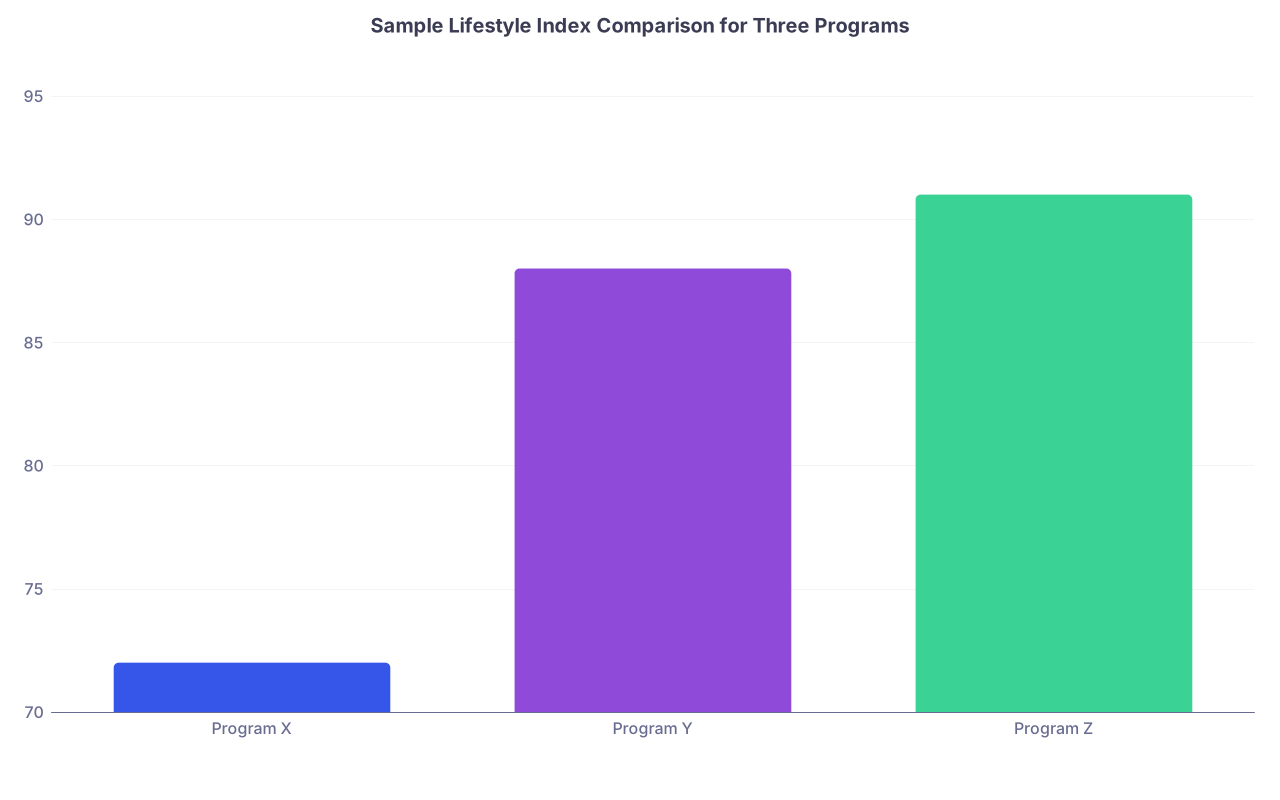
| Category | Value |
|---|---|
| Program X | 72 |
| Program Y | 88 |
| Program Z | 91 |
Step 7: Use the Scorecard During Ranking Without Letting It Dictate Blindly
Here is where people either become robots or throw the system away. Both are mistakes.
You use the lifestyle scorecard to:
- Break ties between programs that feel similar
- Surface contradictions between prestige and daily life
- Check your own bias after a particularly charming interview day
You do not use it to:
- Automatically rank #1 the program with the highest lifestyle score if it completely fails your career goals
- Ignore gut‑level “this felt wrong” red flags that your scoring missed
7.1 Create Two Parallel Rankings
- Lifestyle rank list – sorted by your lifestyle index
- Global rank list – which also considers:
- Training quality
- Fellowship prospects (where relevant)
- Fit with your specific interests (procedures vs clinic, academic vs community)
Then compare them side by side line by line.
If your #1 lifestyle program is #7 on global fit, ask why. Maybe it is still worth putting high. Maybe not. But now you are thinking consciously, not drifting.
7.2 Identify “No‑Go” Thresholds
Some lifestyle aspects are hard lines, not tradeable:
- You are a single parent and cannot do >2 in‑house overnights/month.
- You have a chronic illness and must have reliable outpatient follow‑up time.
- You are geographically locked to a partner’s job.
For those, set rules before you start:
- “Any program averaging >70 hours on multiple rotations is off my list.”
- “Any program with schedule changes less than 4 weeks in advance drops at least 5 ranks.”
If a program fails a hard line, the lifestyle score becomes irrelevant. It is out.
Step 8: Adapt the Scorecard to Your Specialty’s Reality
You said “most lifestyle friendly specialties.” Good. This is your leverage point. But “lifestyle friendly” is not identical across fields.
Here is what to emphasize for a few common lifestyle specialties.
8.1 Dermatology
Key lifestyle factors:
- Clinic schedule structure (start/end times, template density)
- Inpatient consult service expectations (if any)
- Home call coverage (how often you are bothered after hours)
- Cosmetic vs medical mix (often affects pace and flexibility)
For derm, add items such as:
- “Average number of patients per clinic session as senior”
- “Frequency of double‑ or triple‑booking”
- “Volume of unpaid admin time (prior auths, messages)”
8.2 Ophthalmology
Focus on:
- OR days vs clinic days balance
- Call structure (especially trauma coverage at big centers)
- Expectations for post‑call clinic
- Volume pressure (how many patients per half‑day)
8.3 Psychiatry
Key differences:
- Inpatient vs outpatient heavy programs
- Night call expectations and psychiatric emergency coverage
- Violence/safety protocols
- Intensity of documentation and prior auth battles
Add items like:
- “% of PGY‑3/4 time in outpatient with stable schedule”
- “Post‑call day truly off vs ‘light clinic’ ”
8.4 PM&R
Watch for:
- Inpatient rehab vs consult vs outpatient mix
- Weekend coverage norms on inpatient
- Call structure at your main rehab hospital
- Opportunities for sports/spine clinics with more control over schedule
8.5 Pathology / Radiology / Rad Onc
Lifestyle‑friendly but with traps:
- Number of evenings reading cases/studies at home
- Realistic daily case volume
- Expectations around staying until sign‑out is done, not clock time
- Home call for emergent reads (particularly radiology)
Your scorecard should mirror the actual pain points of your chosen field. Copy‑pasting internal medicine criteria onto derm is lazy and useless.
Step 9: Avoid the Common Failures With Scorecards
I have watched students build beautiful spreadsheets, then torpedo the whole system with a few predictable mistakes.
Here is how not to mess it up:
- Do not change your weights mid‑season just to justify falling in love with one place. If your priorities truly change, document why, then adjust thoughtfully across all programs.
- Do not overtrust early impressions. Your first interview will seem amazing because it is your first. Score it, but revisit once you have more data points.
- Do not let prestige sneak into “lifestyle.” If you are tempted to give the big‑name coastal program a higher “culture” score because it is fancy, catch yourself. Score based on what residents actually said and what the schedule actually shows.
- Do not skip filling it out the same day. Your brain will overwrite details in 48 hours. If you are tired, just do the key items: hours, call, culture, geography. Refine later.
- Do not treat it as a binding contract. It is a decision tool, not a judge. You are allowed to override it if you can clearly articulate why.
Step 10: Turn Your Scorecard Into Actual Questions and Habits
You now have the framework. Last step: make this practical during the chaos of interview season.
10.1 Pre‑build a One‑Page “Interview Day Reference”
Before interviews start, create a one‑page sheet (physical or digital) with:
- Your categories and items
- The exact questions you want to ask residents
- Space to jot down key numbers (hours, call, commute, rent, etc.)
Use the same sheet for every program. That repetition is what makes your comparisons solid.
10.2 Create a Post‑Interview Routine
After every interview, force a 30‑minute ritual:
- Fill in the scorecard (scores 1–5 for each item you can).
- Add a “short narrative”:
- “Best thing about lifestyle here:”
- “Worst thing about lifestyle here:”
- “Would I be happy here day to day? Why or why not?”
- Update your provisional lifestyle ranking list.
Make this just as non‑negotiable as writing thank‑you emails.
10.3 Reassess Once Mid‑Season
Around halfway through interviews:
- Re‑read your notes for the first 3–4 programs you saw.
- Ask: “Do these still sound right compared to what I now know?”
- Adjust scores if early inexperience clearly skewed things.
Do not obsess. Just ensure your first few impressions are not permanently overweighted.
The Bottom Line
You are going into a lifestyle‑friendly specialty. Use that advantage intelligently.
A lifestyle scorecard is not about being “extra.” It is about refusing to make one of the biggest choices of your life based on cafeteria food, scenery, and a 10‑minute chat with the PD.
If you remember nothing else:
- Define lifestyle in concrete, measurable terms (hours, call, culture, predictability, location) and turn those into a weighted scorecard before interview season starts.
- Collect consistent, specific data from every program using the same questions and fill in your scorecard the same day, then convert it into a lifestyle index you can actually compare.
- Use the scorecard as a disciplined decision tool, not a dictator—let it expose tradeoffs and contradictions, but integrate it with your overall career goals and hard personal constraints.
Do that, and your “lifestyle‑friendly specialty” will actually feel lifestyle‑friendly when you are three years in, not just on match day.