
The way most specialists “slide” into outpatient life is broken. You do not slide into it. You engineer it.
If your specialty is technically lifestyle-friendly but your actual life feels like a chronic call shift, you are not alone. I have watched hospitalist-heavy cardiologists, GI docs, neurologists, and OBs move into clinic-focused roles and reclaim nights, weekends, and sanity. It is absolutely doable. But it is not passive, and it is not magic. It is a strategy problem.
Below is a stepwise playbook for transitioning from inpatient-heavy to outpatient-focused practice within your specialty, without blowing up your reputation, your income, or your team relationships.
1. Get Clinically Clear: What “Outpatient-Focused” Actually Means For Your Field
Hand-waving about “more clinic” is useless. You need a concrete target model that fits your specialty.
Think in explicit buckets:
- Percentage of effort:
- Inpatient vs outpatient (clinic, telehealth, procedures)
- Daytime vs nights/weekends
- Call intensity and flavor:
- Home call vs in-house
- “Back-up only” vs primary admitting
- Procedure location:
- Hospital-based vs ASC/office-based
| Specialty | Current Mix (In/Out %) | Reasonable Target | Call Goal |
|---|---|---|---|
| Cardiology | 70 / 30 | 20 / 80 | Home only, q6–8 |
| GI | 60 / 40 | 30 / 70 | Endo call only |
| Neurology | 80 / 20 | 30 / 70 | Stroke backup only |
| Pulm/CC | 90 / 10 | 40 / 60 | ICU weeks limited |
| OB/GYN | 60 / 40 | 10 / 90 (GYN) | GYN call only |
Now translate this into a 1-page “future state” for yourself:
- Number of clinic days per week
- Number of hospital days per week (or per month, if block-based)
- Call expectations (type, qX, in-house vs home)
- Procedure volume and where you do them
- Types of patients you want to see (and do not want to see)
If you cannot write this out clearly, you cannot negotiate for it.
Quick sanity check: Is this realistic in your specialty?
Some fields have well-established outpatient-heavy tracks:
- Cardiology: noninvasive clinic cardiology, imaging-heavy roles
- GI: clinic + ASC-based scopes, limited inpatient
- Neurology: headache, movement disorders, epilepsy clinic, EMG
- Pulm/CC: pure pulmonary clinic, sleep, procedures in bronchoscopy lab
- OB/GYN: GYN-only, MIGS, menopause, fertility
- Hem/Onc: mainly infusion center & clinic, less inpatient
- Rheumatology, Endocrinology, Allergy, PM&R: typically already clinic-dominant, just need fine-tuning
If no one in your region does what you want, that is not proof it is impossible. It just means you will be building a new template, which requires more groundwork and proof of value.
2. Audit Your Current Role: Hard Data, No Denial
You cannot fix what you have not measured. This is where most people quit mentally because it forces them to admit how bad their current setup is.
Do a 4–6 week objective audit:
Track:
- Number of inpatient days vs clinic days
- New consults vs follow-ups (both settings)
- Average census on service
- Call nights per month and call burden (pages, admissions)
- RVUs or encounters by site (clinic vs hospital)
- No-show rates and overbooking patterns in clinic
- Tasks you are doing that could be shifted (documentation, refills, simple follow-ups, routine counseling)
Throw the data into a simple spreadsheet. Color-code inpatient vs outpatient.
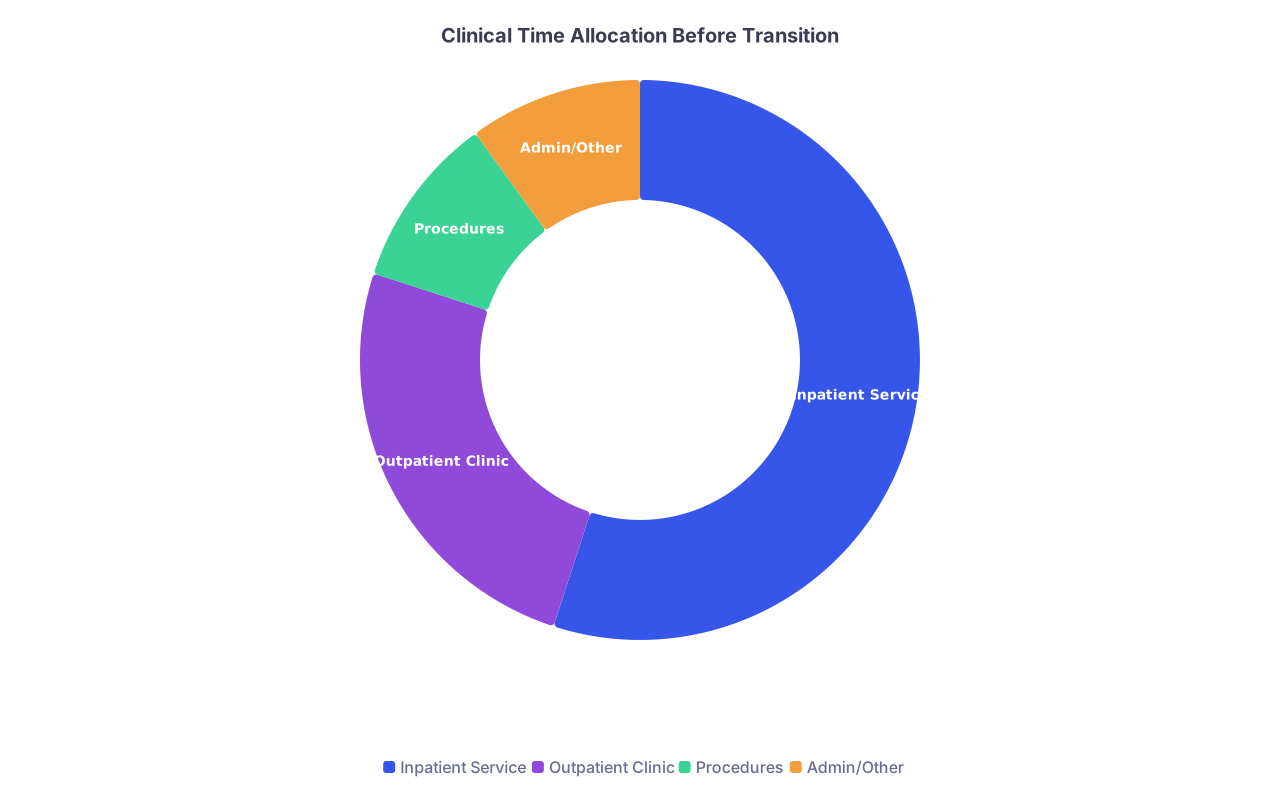
| Category | Value |
|---|---|
| Inpatient Service | 55 |
| Outpatient Clinic | 25 |
| Procedures | 10 |
| Admin/Other | 10 |
Patterns you are looking for:
- Inpatient days disproportionately generating your RVUs, but also your burnout.
- Outpatient slots that are always double-booked because your “admin” time is fake.
- Call that is “only q4” on paper but wrecks 3 days every week in reality.
- Tasks you could safely move to:
- NPs/PAs
- Nurses
- Protocolized orders
- Patient education handouts / videos
This audit becomes your evidence file when negotiating with your group or shopping for a new job.
3. Pick Your Path: Redesign vs Escape
There are really only two honest options:
- Redesign your current job
- Deliberately find a new, outpatient-heavy job
Hoping your current job “evolves” into something lifestyle-friendly is fantasy. You push it there, or you leave.
Path A: Redesign Where You Are
Choose this if:
- You like your colleagues.
- The payor mix is decent.
- The system is at least semi-functional.
- You have any leverage (volume, subspecialty skills, leadership roles).
Your goal is to move from “default workhorse” to defined niche outpatient asset.
Core levers:
- Narrow your inpatient scope.
- Expand and systematize your outpatient niche.
- Trade undesirable service weeks for high-value ambulatory work.
Path B: Plan a Structured Exit
Choose this if:
- You are in a toxic culture (constant guilt-tripping, martyrdom, zero boundaries).
- Leadership has a long track record of “promising” and never delivering.
- Your previous attempts at change have been ignored or punished.
Then your job is not to argue harder. Your job is to quietly prepare to leave while maintaining professional performance.
We will walk through both routes, but do not pretend they are the same. Redesigning a semi-reasonable environment is surgery. Leaving a dysfunctional one is amputation. Both can save your life.
4. Redesigning From Within: Stepwise Tactical Plan
Assume you are trying to stay and shift your balance. Here is the sequence that actually works.
Step 1: Build a visible outpatient niche
You must be more than “another general XYZ doc” if you want leverage.
Examples:
- Cardiology: cardio-oncology, women’s heart health, imaging, preventive cardiology
- GI: IBD clinic, motility, hepatology, obesity medicine
- Neurology: headache clinic, MS, epilepsy, neuromuscular/EMG
- Pulm: sleep medicine, pulmonary hypertension, pulmonary rehab programs
- OB/GYN: MIGS, pelvic pain, menopause, infertility, high-risk contraception
Actions:
- Start one focused half-day clinic per week for your niche.
- Tell referring PCPs: “I am building X clinic. Here are the referral criteria.”
- Create one simple referral guideline handout; ask your system to distribute it.
- Track your new outpatient consults. Volume is your leverage.
You are building the argument: “My outpatient time is uniquely valuable to the system.”
Step 2: Re-architect your schedule
Stop being the default garbage disposal for every open slot and random service need.
Negotiate toward a template like:
- 3–4 full clinic days / week
- 1–2 inpatient days per week, or 1 week of inpatient out of every 4–6 weeks
- Real, protected admin time (minimum 0.5 day weekly)
Practical levers:
- Tie your request directly to patient access:
“If I have consistent clinic days Monday, Tuesday, Thursday, I can guarantee new patients seen within 2 weeks.” - Show your numbers:
“My outpatient visits generate X RVUs per day at lower cost than inpatient care and help decompress ER and inpatient census long term.” - Offer trade-offs:
“I am willing to take one additional weekend of backup call per quarter in exchange for a 1:4 instead of 1:3 inpatient week rotation.”
Do not ask for “better balance.” Present a concrete schedule proposal with obvious system benefits.
Step 3: Offload low-value work
If you try to do this while still carting every refill, portal message, and routine follow-up on your back, you will fail.
Systematically:
- Refills & protocol-based care
- Create standing orders and refill protocols (e.g., for stable HF, IBD maintenance, seizure-free epilepsy).
- Train nurses / MAs on specific algorithms: when to refill, when to escalate.
- Portal messages
- Introduce templated replies for common issues.
- Route administrative questions (work notes, forms, scheduling) away from MD inbox.
- Routine stable follow-ups
- Shift stable patients to:
- APP-run follow-up clinics with your oversight.
- Longer-interval MD visits (e.g., annually), with interim virtual check-ins.
- Shift stable patients to:
You are not “abandoning” patients. You are creating a sustainable care model where your time is used for complex decision-making.
Step 4: Redefine your inpatient role
You are not trying to eliminate your inpatient footprint overnight. You are trying to narrow and control it.
Common strategies:
- Become a consultant, not the primary service, for most inpatients.
- Restrict primary inpatient service weeks to a predictable block schedule.
- Define which types of admissions you will manage vs consult only.
- Push for:
- Hospitalist co-management where appropriate.
- Clear admission criteria aligned with your outpatient clinics (e.g., “my IBD patients go first to my IBD service or I am at least consult on day 1”).
Script with leadership:
“My goal is to maximize continuity and value. I am proposing to spend 75–80% of my time in outpatient settings, while continuing to provide focused consultative care inpatient, especially for [your niche]. Here is how that looks operationally…”
Then show them the calendar.
5. Planning an Exit: How to Target Truly Outpatient-Focused Positions
If internal redesign hits a wall, stop burning energy fighting the same brick. Start methodically searching for roles that already match your desired ratio.
You are hunting for job descriptions and structures, not logos.
Step 1: Know what to screen for
Red flags in postings:
- “Flexible schedule” with no specifics.
- “Shared call” with no numbers.
- “Strong inpatient and outpatient mix” when you want the opposite.
Green flags:
- Explicit clinic days (e.g., “4 days clinic, 1 admin”)
- Clear inpatient expectation (e.g., “consult-only weeks, 1:8” or “no primary admitting”)
- ASC / office-based procedure focus
- Multiple partners already in outpatient-dominant tracks
Step 2: Ask the right questions on first contact
Do not waste months only to discover it is another 70% inpatient “because that is how we all did it.”
Mandatory questions to recruiters or chiefs:
- What percentage of my time, realistically, would be:
- Inpatient service
- Outpatient clinic
- Procedures
- Admin
- How many inpatient weeks per year, and how many hours per day on service?
- What is the exact call schedule for this role, not the department?
- Do any current physicians practice in a primarily outpatient model? Can I speak to them?
If they cannot answer or seem evasive, that is your answer.
Step 3: Use interviews to validate the reality
Onsite, do informal “hallway interviews.” Ask junior faculty, not just the chair.
Questions that expose truth:
- “How many days per week are you physically in the hospital vs clinic?”
- “On your last inpatient week, how long were your days?”
- “What proportion of your RVUs is inpatient vs outpatient?”
- “If someone here wants to switch to more clinic and less hospital, has that ever worked? For who?”
You are not being difficult. You are refusing to be lied to by omission.

| Step | Description |
|---|---|
| Step 1 | Job Posting |
| Step 2 | Reject Early |
| Step 3 | Screen by Call Burden |
| Step 4 | Interview |
| Step 5 | Request written FTE breakdown |
| Step 6 | Accept or Negotiate Offer |
| Step 7 | Outpatient % >= 60 |
| Step 8 | Call q6 or lighter |
| Step 9 | Current docs with outpatient-heavy roles |
6. Money, RVUs, and The Lifestyle Trade-Offs
You can absolutely have a good income and outpatient-heavy life. But you have to understand the levers.
Key realities:
- In many specialties, inpatient work is paid better per hour but is more chaotic.
- Outpatient work can match or exceed income if:
- Clinic is efficiently run.
- No-show rate is controlled.
- Ancillary services (testing, procedures) are aligned.
The trap: saying yes to “just a bit” of extra inpatient work for cash, and quietly rebuilding the same nightmare you are escaping.
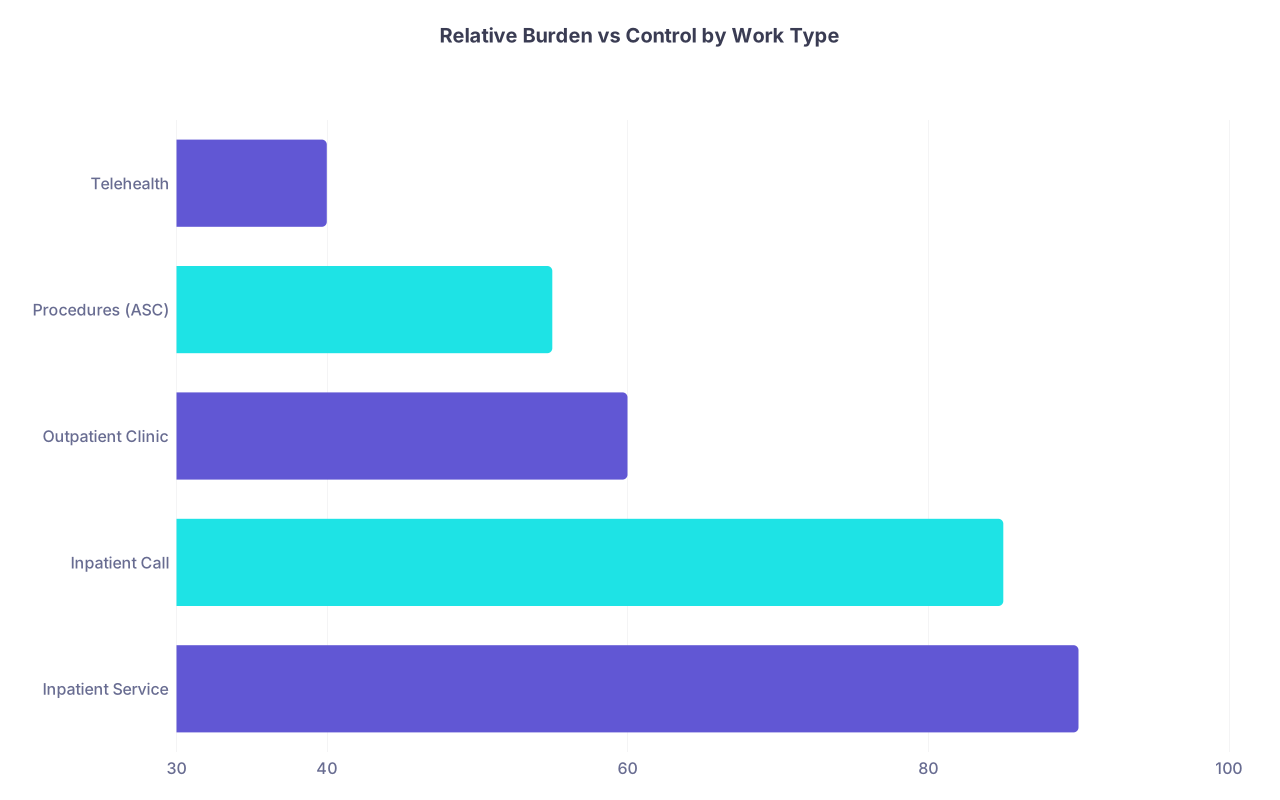
| Category | Value |
|---|---|
| Inpatient Service | 90 |
| Inpatient Call | 85 |
| Outpatient Clinic | 60 |
| Procedures (ASC) | 55 |
| Telehealth | 40 |
(Scale is subjective burden: higher is worse.)
Rules that protect you:
Never accept a vague RVU target.
Demand:- Historic data: what did the last 3 people in this role actually produce?
- Payer mix: commercial vs Medicare/Medicaid vs self-pay.
- Support staffing ratios.
If compensation is RVU-heavy, clinic efficiency is life-or-death.
You will need:- Scribes or strong MA support.
- Pre-visit planning.
- Protocols to keep low-value work out of visit slots.
Do the math on extra inpatient shifts.
Ask yourself:- What is my effective hourly rate for that weekend of call, including post-call recovery and cognitive wear?
- Is it actually worth it compared to a half-day of extra outpatient work or a day off?
Say yes to extra inpatient work only as a deliberate, time-limited financial tactic (e.g., loans, down payment), with a hard end date.
7. Negotiation Scripts That Actually Work
You need specific language, not vague requests. Here are frameworks you can adapt.
When you are early in attending life (1–3 years)
You are not powerless. You bring volume and longevity.
“I like this group and want to build my career here long term. I am at the point where I know I work best and add the most value on the outpatient side, especially in [your niche]. I would like to move toward a schedule where 70–80 percent of my time is clinic and procedures, with focused consult weeks instead of continuous heavy inpatient.
Here is the template I am proposing [hand them schedule]. I am confident we can maintain inpatient coverage because [proposed coverage plan], while improving outpatient access and physician retention. What would it take to pilot this model for 6–12 months?”
When you are mid-career and burning out
Be blunt without being emotional.
“This current model is not sustainable for me long term. I can either redesign my role here or I will eventually need to find a different practice structure. My strong preference is to stay.
I am asking for a concrete change to my FTE allocation: [X] weeks of inpatient per year, [Y] days per week of clinic, and [Z] call schedule. I am willing to [specific concessions] to make this work operationally. Can we commit to this in writing for the coming contract cycle?”
If they waffle, you already have your answer.
8. The Emotional and Identity Shift: You Are Not “Less Of A Specialist”
Some of you are stuck because you equate suffering on the inpatient service with being a “real” cardiologist / GI doc / neurologist / OB.
That is nonsense.
Things I have heard in workrooms:
- “Clinic-only cardiologists are just primary care with an echo machine.”
- “If you do not take acute stroke call, are you even a neurologist?”
- “The real money is in the ICU weeks; clinic is for lightweights.”
This is culture, not truth.
Outpatient-focused specialists:
- Keep patients out of the hospital.
- Manage complex, longitudinal care.
- Build programs that save systems money and improve quality metrics.
- Have the bandwidth to teach, lead QI, and innovate.
You are not abandoning acuity. You are choosing where you want to spend your finite cognitive and emotional energy.
If a colleague sneers at your outpatient-heavy role, ask yourself why your boundary threatens them. Then go back to your structured, sane clinic day and your unbroken night of sleep.
9. Execution Timeline: A Realistic 12–18 Month Plan
You cannot flip this switch in 4 weeks without chaos. Here is a pragmatic arc.
Months 0–3
- Complete your clinical audit.
- Define your desired future-state schedule and role.
- Start one outpatient niche clinic half-day.
- Quietly explore the market and talk to peers in other groups.
Months 3–6
- Present data and proposal to your leadership.
- Negotiate for:
- Trial schedule changes.
- Small reduction in inpatient weeks or call.
- More structured clinic support.
If you hit hard resistance with zero movement, start leaning into the external job search.
Months 6–12
- Implement:
- Niche growth.
- Offloading low-value work.
- Tighter boundaries on extra inpatient shifts.
- If pursuing external positions, interview and compare offers using hard numbers and your 1-page role spec.
Months 12–18
- Either:
- Lock in a redesigned, outpatient-heavy contract in your current group, or
- Transition to a new role that already matches your target structure.
During all of this, protect your reputation: show up, do good work, do not burn bridges. Your future self may need those letters and references.
FAQs
1. Will moving to an outpatient-focused role permanently hurt my career options if I ever want to go back to more inpatient work or academia?
Not if you are intentional. Maintain:
- Some inpatient footprint (consult weeks, selective call) for the first couple of years.
- Continuing education and board maintenance relevant to inpatient care.
- Involvement in at least one hospital committee or QI project.
If you later decide you miss the inpatient side, you can ramp that back up. Systems care less about whether you did 6 or 16 weeks of service three years ago and more about whether you are competent, reliable, and credentialed today.
2. How do I handle partners who resent my shift to more outpatient work while they cover more inpatient?
You confront the resentment directly and practically:
- Be transparent: share your clinical audit and future-state model.
- Offer concrete offsets: extra clinic to improve access, taking on administrative or program-building projects, or covering certain weekend clinics in exchange for lighter inpatient.
- Emphasize choice: they are free to pursue a similar path if they want.
If someone simply wants you to stay miserable so they feel better about their own choices, that is their problem. You are responsible for designing a sustainable practice, not upholding a martyr culture.
Key points, boiled down:
- You do not drift into an outpatient-focused lifestyle. You design it with hard numbers, niche-building, and explicit schedule structures.
- If your current system will not support that design after a good-faith effort, you stop fighting it and deliberately move to one that already does.
- Outpatient-heavy does not mean less “real” or less valuable as a specialist; it means you have decided how you want to spend your one career and you are backing that decision with strategy, not wishful thinking.