
Most new physicians in “lifestyle” specialties leave real money and real freedom on the table in their first contract. That is a mistake you do not need to repeat.
You are not negotiating a piece of paper. You are negotiating your sleep, your marriage, your ability to have kids on your timeline, your burnout risk, and your exit options if things go sideways.
Especially in lifestyle‑friendly fields—dermatology, ophthalmology, radiology, anesthesia, PM&R, outpatient psych, allergy/immunology, EM (in the right groups)—you actually have leverage. The market wants you. If you walk into negotiations acting like a powerless PGY‑2 asking for a day off, you will get steamrolled.
I am going to give you a concrete, field‑tested checklist you can literally put next to you while you read and edit contracts. Not vague “know your worth” nonsense. Line‑item, fix‑this clauses.
Use this as your default unless a health-care attorney gives you a better local tweak.
1. Start with Strategy, Not Red Ink
Before you pick up a pen or call the recruiter, you need clarity on three things: leverage, priorities, and deal breakers.

| Step | Description |
|---|---|
| Step 1 | Clarify Priorities |
| Step 2 | Research Market Data |
| Step 3 | Identify Leverage |
| Step 4 | Review Draft Contract |
| Step 5 | Consult Health Lawyer |
| Step 6 | Targeted Negotiation |
| Step 7 | Final Review |
| Step 8 | Sign or Walk |
| Step 9 | Major Red Flags |
A. Know your market (especially for lifestyle fields)
You cannot negotiate intelligently if you have no idea what normal looks like.
Minimum homework:
- MGMA / AMGA / AAMC / specialty society data
- Find: median and 75th percentile compensation, wRVUs, hours, call.
- Local intel
- Co‑fellows’ offers.
- Senior residents who just signed.
- Attendings in town: “What would be a fair starting package here?”
For lifestyle specialties, typical patterns:
- Derm, ophtho, radiology, anesthesia, allergy, outpatient psych
- Higher pay per RVU
- More predictable hours
- Higher partnership track potential in private groups
- Hospital employed “lifestyle” gigs (radiology, anesthesia, PM&R, hospital psych)
- Better benefits
- Less upside but more stability
You want to know: For my field, in this region, what is a reasonable range for: base salary, bonus structure, call burden, and partnership track?
2. The Core Checklist: What To Review, Line by Line
Print this section. Keep it next to you. Every contract, every time.
2.1 Compensation Structure
Compensation is not just “base salary.” It is the interplay of base, bonus, RVUs, collections, and partnership terms.
| Model Type | Often Seen In | Risk Level | Upside Potential |
|---|---|---|---|
| Straight Salary | Hospital EM, PM&R | Low | Low–Medium |
| Salary + RVU | Radiology, Anesthesia | Medium | Medium–High |
| Collections % | Derm, Ophtho, Psych | High | High |
| Hybrid (Base + Collections) | Derm, Allergy | Medium | High |
Checklist: Compensation
Base salary
- Compare to median for your specialty and region.
- Ask: “Is this guaranteed, and for how long (1–3 years)?”
- Fix: Add language that base is not retroactively reduced if targets not met.
Bonus structure
- Is it tied to: RVUs, collections, quality metrics, or opaque “discretionary” bonuses?
- You want:
- Clear formula: “Above 6,000 wRVUs/year, physician receives $X per additional RVU.”
- Transparent timing: “Bonus paid within 60 days of year‑end reconciliation.”
Productivity metrics
- Ask for:
- The exact RVU conversion factor or collections percentage.
- Historical data: average RVUs or collections for comparable physicians at 1, 3, 5 years.
- If they refuse to share, treat that as a yellow flag.
- Ask for:
Partnership path (private groups)
- Is there a written path to partnership?
- Must include:
- Timeline: “Eligible after 2 full fiscal years.”
- Criteria: “No ongoing professionalism issues, meets RVU target of X per year.”
- Buy‑in formula: specify methodology (e.g., fixed amount; percent of collections).
- Avoid: “Partnership at the discretion of the partners” with no criteria.
Call pay (lifestyle’s silent killer)
- If call is heavy, is there separate compensation?
- For EM, anesthesia, radiology, and OB‑light fields (e.g., gyn only, outpatient psych) this matters less.
- You want:
- Rate per shift or per night.
- Increased pay for holidays and extra shifts beyond baseline expectation.
3. Time: The Real Lifestyle Currency
Money can be adjusted later. Time and schedule structure are much harder to change once you’re in the system.
3.1 Schedule and Hours
Lifestyle specialties often sell “better hours” then bury the exceptions in the contract.
Checklist: Schedule / Hours
Clinic / reading / OR hours
- Get specific:
- “Clinic hours are 8 a.m. to 5 p.m. Monday–Friday, with 1 hour for lunch.”
- “Expected radiology reading hours are 8 a.m. to 5 p.m., no routine evenings.”
- Add: Protection against unilateral schedule changes:
- “Material changes in schedule require mutual written consent.”
- Get specific:
Patient volume expectations
- Ask for:
- Target patients per day (derm, ophtho, PM&R, allergy, psych).
- Target scans per day or wRVUs (radiology, anesthesia).
- Ensure volume is reasonable for safe practice and lifestyle.
- Ask for:
-
- Radiology, psych, allergy, and some PM&R: remote work is negotiable gold.
- You want:
- “Physician may perform up to X days per month via telehealth or remote reading, subject to operational needs.”
3.2 Call, Nights, and Weekends
Call is where “lifestyle” can quietly die.
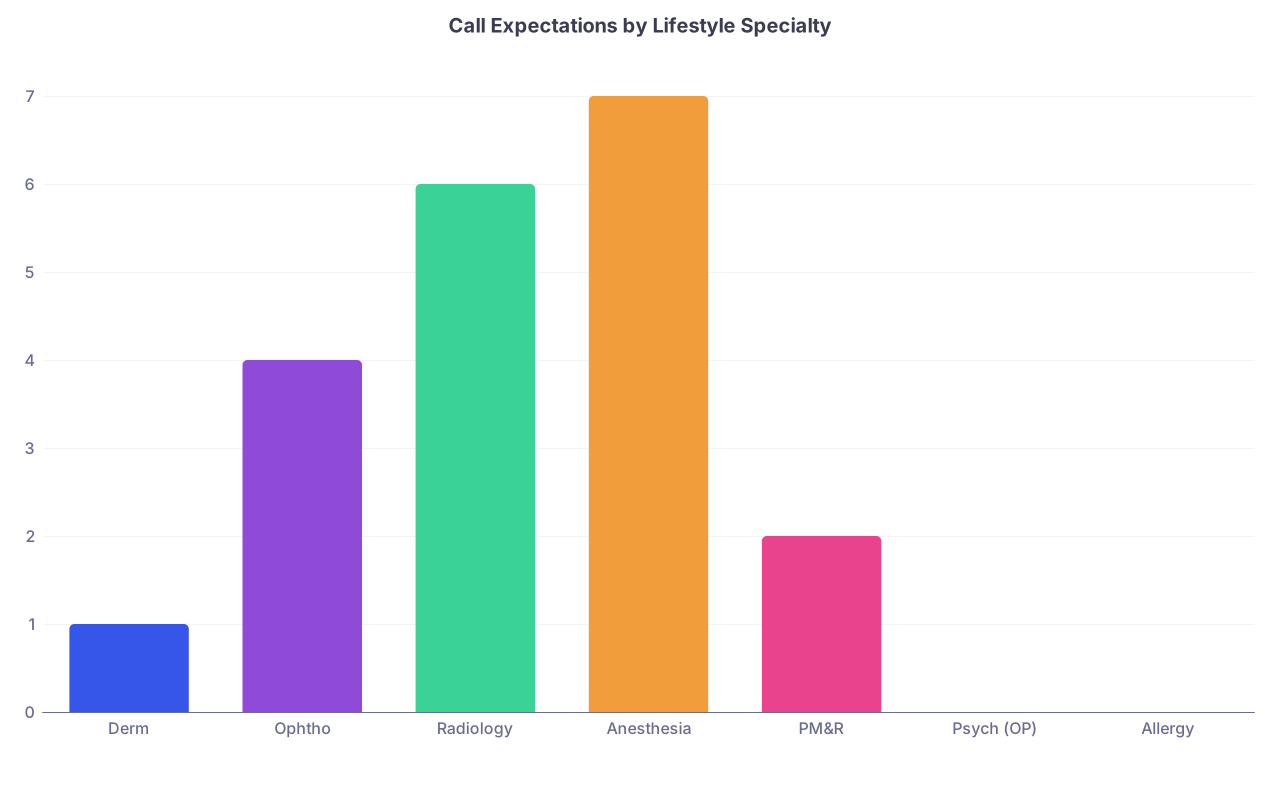
| Category | Value |
|---|---|
| Derm | 1 |
| Ophtho | 4 |
| Radiology | 6 |
| Anesthesia | 7 |
| PM&R | 2 |
| Psych (OP) | 0 |
| Allergy | 0 |
(Values ~ number of call nights/month in many markets. Local reality varies, but this pattern holds.)
Checklist: Call / Nights / Weekends
Call frequency and type
- “1:5 home call” vs “in‑house call” vs “backup call” need explicit definitions.
- Write: “Home call defined as phone availability with rare emergent returns (<1 per week on average).”
Weekend duty
- Spell out:
- “Physician will cover no more than X weekend days per month.”
- Extra weekends beyond that paid at $Y per day.
- Spell out:
Holiday rotation
- Require:
- Written rotation.
- Seniority‑based preferences over time.
- Require:
Call coverage when partners leave
- Add:
- “If call burden increases by more than 20% due to departures or staffing changes, compensation and/or staffing will be renegotiated in good faith within 60 days.”
- Add:
4. Non‑Compete, Geographic Limits, and Exit Routes
This is where naïve residents sign away their future. I have seen people forced to commute 90 minutes one way because of a sloppy non‑compete.
4.1 Non‑Compete Clause (Restrictive Covenant)
You are in a lifestyle field. The main asset is your ability to work in a desirable city on a normal schedule. Do not give up geography without a fight.
Checklist: Non‑Compete
Scope: What is restricted?
- Ideally: limited to your specialty and your clinical practice.
- Fix: “This restriction applies only to the practice of dermatology in an outpatient clinical setting.”
Radius: How far?
- Target:
- 5–10 miles from primary work site in urban areas.
- Larger radii may be reasonable in rural areas, but push back on anything absurd.
- Avoid: multi‑county or “any location where employer does business.”
- Target:
Sites: From which locations?
- Limit to:
- Primary practice site, or at most, named sites.
- Fix: “Non‑compete radius applies only to 123 Main Street Clinic and 456 Suburb Office.”
- Limit to:
Duration: How long?
- Normal: 12 months.
- Anything beyond 24 months is excessive; push for 12–18.
Trigger: When does it apply?
- Ideally:
- No non‑compete if they terminate you without cause or if you decline to renew after the full initial term.
- Add: “Non‑compete is void if employer terminates physician without cause.”
- Ideally:
Carve‑outs for lifestyle back‑up plans
- Especially in radiology, anesthesia, EM, psych:
- Try to permit locums, teleradiology, telepsych outside defined radius.
- Write: “Telemedicine services to patients located outside the restricted area are not considered competitive activity.”
- Especially in radiology, anesthesia, EM, psych:
5. Malpractice Coverage and Tail: Do Not Gloss Over This
The single most common expensive surprise in first contracts is malpractice tail coverage. I have seen people hit with $60,000 bills when leaving a job they hated.
5.1 Claims‑Made vs Occurrence
Claims‑made policy: cheaper annually, but you need separate tail coverage when you leave.
Occurrence policy: more expensive annually, no tail needed. Rare in many systems.
Checklist: Malpractice
Type of coverage
- Confirm: claims‑made or occurrence.
- If claims‑made, you must address tail in writing.
Tail coverage responsibility
- Aim for:
- Employer pays tail if they terminate you without cause, fail to renew, or a sale/merger ends your role.
- Cost shared (50/50) if you leave voluntarily before X years.
- Example clause:
- “If physician remains employed for at least 3 years, employer shall pay 100% of tail premium upon termination for any reason.”
- Aim for:
Policy limits
- Typical: $1M/$3M or $2M/$4M.
- Check your specialty standard (e.g., OB‑adjacent PM&R may need higher).
Coverage for moonlighting / side gigs
- If you plan to locum, run a small telehealth side practice, or do aesthetic procedures:
- Clarify whether those are covered or must be separate.
- Get explicit written permission if the contract restricts outside work.
- If you plan to locum, run a small telehealth side practice, or do aesthetic procedures:
6. Duties, Autonomy, and Scope of Practice
In lifestyle fields, scope creep is a real threat. Suddenly the “outpatient psych job” wants you doing inpatient call every other week. Or the “PM&R spine focus” morphs into full‑time general rehab.
6.1 Job Description and Work Sites
Checklist: Duties and Locations
Primary duties
- Put your actual intended role in writing:
- “Physician will primarily practice outpatient allergy and immunology, with no more than one half‑day per week of general internal medicine coverage.”
- This protects you from a slow bait‑and‑switch.
- Put your actual intended role in writing:
Additional duties by mutual agreement
- Add language:
- “Any material change to physician duties or specialty focus requires mutual written consent.”
- Add language:
Work locations
- List:
- Named clinics, ASC, imaging centers, main hospital.
- Limit:
- “Employer may assign physician to additional locations within a 15‑mile radius, with at least 60 days’ notice and compensation review if commute increases by more than 20 minutes.”
- List:
7. Metrics, Reviews, and “Cause” for Termination
The key is to avoid vague, subjective grounds for firing you that would also trigger your non‑compete or make you pay tail.
7.1 What Is “Cause”?
Checklist: Termination for Cause
Define “for cause” tightly
- Acceptable reasons:
- Loss of license, DEA, hospital privileges.
- Gross misconduct, verified fraud, criminal conviction.
- Push back on fuzzy language:
- “Failure to meet productivity expectations” should not be cause unless:
- There is a clear, written metric,
- You were notified in writing,
- You were given a remediation period.
- “Failure to meet productivity expectations” should not be cause unless:
- Acceptable reasons:
Cure periods
- Add:
- “For any alleged breach that is capable of cure, employer must provide written notice and 30 days to cure before termination for cause.”
- Add:
Without cause termination
- Both sides should have the right to end without cause with notice.
- Typical: 60–90 days.
- This is your escape hatch from a toxic situation.
8. Benefits, CME, and Non‑Clinical Perks (That Actually Matter)
People obsess over a $10,000 salary difference and ignore benefits that are worth more than that in practice.
8.1 Key Benefits
Checklist: Benefits
CME and licensing
- Minimum reasonable:
- $3,000+ annually
- 5–7 paid CME days
- Employer pays licenses, DEA, hospital dues.
- Minimum reasonable:
Retirement
- 401(k)/403(b) match or contribution:
- Benchmark: 3–5% employer match or defined contribution.
- 401(k)/403(b) match or contribution:
Disability and life insurance
- You want group policies plus freedom to buy your own specialty‑specific disability coverage.
Paid time off (PTO) and holidays
- Spell out:
- Vacation days vs CME days vs sick days vs holidays.
- Clarify:
- Who controls schedule approval.
- Spell out:
Parental leave
- Especially in lifestyle specialties where people plan families:
- Push for written policy.
- Paid leave period and any impact on bonuses/partnership timeline clearly defined.
- Especially in lifestyle specialties where people plan families:
9. Specialty‑Specific Landmines and Opportunities
Let me call out a few nuances by specialty. Obviously every market is different, but patterns are consistent.
9.1 Dermatology
- Watch for:
- Unrealistic patient volume expectations (40+ patients/day from day one).
- Non‑competes tied to cosmetic and general derm across huge radii.
- Negotiate:
- Clear split on cosmetics vs medical derm revenue.
- Ownership of cosmetic equipment or med‑spa entities if you help build them.
- Clarity on who owns patient lists if you leave.
9.2 Ophthalmology
- Watch for:
- Opaque ownership structures of surgery centers (ASC).
- Partnership offers that never materialize.
- Negotiate:
- Written ASC ownership path and buy‑in formula.
- OR block time guarantees for surgical volume.
9.3 Radiology
- Watch for:
- Night float expectations buried in “schedule as assigned.”
- Unreasonably high RVU targets for full bonuses.
- Negotiate:
- Explicit night/weekend structure and extra compensation.
- Remote work days after initial onboarding.
- Cap on mandatory nights per month.
9.4 Anesthesia
- Watch for:
- Unpaid in‑house overnight call.
- “Call from home” that is effectively in‑house due to case volume.
- Negotiate:
- Minimum stipend for any overnight call.
- Additional pay for post‑call cases if they regularly keep you past 11 a.m.
9.5 PM&R
- Watch for:
- Being used as “cheap IM coverage” in rehab units.
- Excessive rounding expectations on weekends.
- Negotiate:
- Explicit separation of PM&R vs hospitalist duties.
- Weekend rounding schedule with cap and pay.
9.6 Outpatient Psychiatry
- Watch for:
- Unrealistic panel sizes and 15‑minute med checks only.
- Pressure to see primarily high‑acuity patients without support.
- Negotiate:
- Reasonable visit lengths.
- Protected time for documentation.
- Clear triage policy and access to therapy support staff.
9.7 Allergy / Immunology
- Watch for:
- Heavy primary care coverage disguised as “allergy.”
- Being the default on‑call for general medicine issues in clinic.
- Negotiate:
- Defined scope: allergies, asthma, immunology only, with narrow exceptions.
- Volume expectations that match complexity of visits.
10. How to Actually Negotiate Without Burning Bridges
Most residents know what they want and completely botch how they ask for it. You are not demanding. You are clarifying terms with a future business partner.
10.1 Sequence of Moves
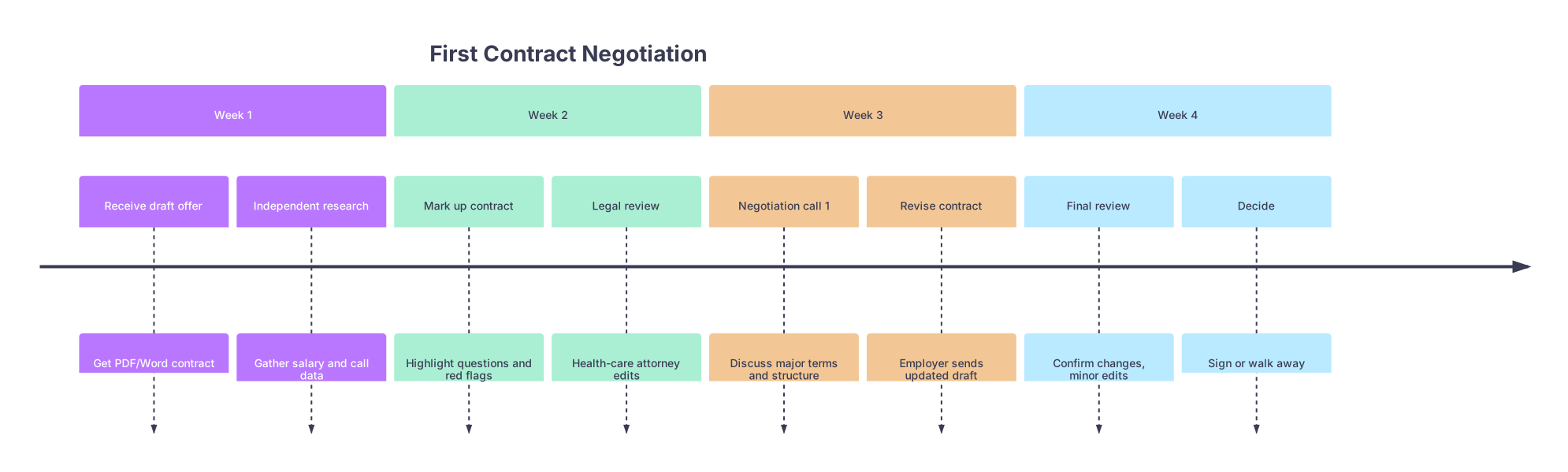
| Period | Event |
|---|---|
| Week 1 - Receive draft offer | Get PDF/Word contract |
| Week 1 - Independent research | Gather salary and call data |
| Week 2 - Mark up contract | Highlight questions and red flags |
| Week 2 - Legal review | Health-care attorney edits |
| Week 3 - Negotiation call 1 | Discuss major terms and structure |
| Week 3 - Revise contract | Employer sends updated draft |
| Week 4 - Final review | Confirm changes, minor edits |
| Week 4 - Decide | Sign or walk away |
Step‑by‑step
Get the contract in writing first.
Do not negotiate based on verbal promises.Read it once without a pen.
Just understand the shape: salary, duties, duration, non‑compete.Second pass with this checklist.
Mark anything unclear, missing, or concerning.Get a healthcare attorney.
Not your cousin who does real estate. A real physician‑contract lawyer.
Cost: usually $500–$1500. Value: often tens of thousands plus preserved options.Prepare a short, prioritized list.
- 5–8 key points max:
- Compensation structure
- Non‑compete radius/duration
- Tail coverage
- Schedule/call caps
- Partnership clarification
- PTO/CME
- 5–8 key points max:
Use the right phrases on the call or email.
Instead of:
- “This is unfair”
Use:
- “For our specialty and region, I typically see X. Can we adjust this closer to that range?”
- “I am very interested in this position. If we can resolve these few items, I will be ready to sign.”
Get every agreed change in writing.
Verbal promises are fantasy. Ask for a revised contract or written amendment, not just “we will note that.”Be willing to walk.
Your power in a lifestyle field is simple: there are other jobs. If the group refuses to budge on massive non‑competes, no tail help, and abusive call, that is not your home.
11. A One‑Page Contract Checklist You Can Use Today
Here is a condensed version you can literally copy into a note and check off:
Compensation
- Base salary at or above regional median for my field
- Bonus formula clear and written (RVU/collections/quality)
- Historical productivity data provided or approximated
- Partnership path (if any) with timeline, criteria, and buy‑in formula
- Call pay structure explicit
Time / Schedule
- Clinic/OR/reading hours specified
- Patient/volume expectations reasonable and written
- Telehealth/remote work options defined (if relevant)
- Call type, frequency, weekends, holidays clearly outlined
- Protection against major unilateral schedule changes
Non‑Compete / Exit
- Scope limited to my specialty and clinical practice
- Radius modest and tied to named sites
- Duration 12–18 months
- Non‑compete void if terminated without cause
- Carve‑outs for telemedicine or locums outside radius
Malpractice
- Type (claims‑made vs occurrence) clearly stated
- Tail coverage responsibility defined, ideally employer‑paid after X years
- Adequate policy limits
- Clarified coverage for any side work or explicitly allowed outside gigs
Duties / Sites
- Primary role/scope of practice written as intended
- Additional duties require mutual consent
- Work sites listed and geographically reasonable
Termination / Protection
- “For cause” tightly defined with cure period
- Both sides can terminate without cause with 60–90 days’ notice
Benefits / Life
- CME money and days adequate
- Licenses, DEA, and dues covered
- Retirement match or contribution spelled out
- PTO, holidays, parental leave clearly defined
You do not need a perfect contract. You need a clear, livable, and escape‑friendly one.
Your next move is simple: pull up your current or upcoming offer and run it against the checklist above. Today.
Open the contract, go section by section, and mark every line that touches: compensation, call, non‑compete, and malpractice. Those four areas decide whether this “lifestyle” job actually gives you a life.