
The way most residents “plan” their week is broken. Lifestyle specialties are not magically chill; they are just more controllable—if you structure your time like an adult and not like a panicked intern.
This is about that structure.
If you are headed into a lifestyle-friendly specialty (derm, ophtho, radiology, PM&R, anesthesia in many settings, outpatient-focused IM or peds), the upside is huge: predictable hours, fewer middle-of-the-night disasters, and very real time for life. The downside: if you do not deliberately time-block your week, the job and the inbox will quietly expand to fill every open space. You will still feel fried, and you will have nothing to show for it.
Let me give you a concrete, workable way to build your week so you:
- Protect your own time.
- Hit your productivity targets.
- Do not drown in charting, messages, or random meetings.
- Actually enjoy the “lifestyle” you signed up for.
1. The Core Idea: Fixed Blocks, Not Endless Flexibility
Flexible schedules are overrated. Controllable schedules are gold.
Lifestyle specialties give you:
- More predictable clinic or procedural hours.
- Less emergent overnight work.
- Some control over clinic templates and non-clinical time.
But that control is only real if you commit to fixed time-blocks and stop making daily decisions about everything.
Here is the rule:
Decide your week once. Execute it many times.
You should not be:
- Re-deciding when to chart every afternoon.
- Negotiating with yourself daily about workouts, studying, or family time.
- Checking email 40 times a day because “it only takes a second.”
Instead, you build a standard template week, then adjust only for call, conferences, and rare exceptions.
2. The Foundation: Three Non-Negotiable Pillars
Before we get into specialty specifics, you need three pillars blocked first. Not last.
- Sleep
- Deep work (complex cognitive tasks)
- Recovery / life (family, relationships, hobbies, exercise)
If you do not time-block these, the “lifestyle” promise will evaporate.
Step 1: Hard-Fence Your Sleep
Pick a consistent sleep window and treat it like a clinic schedule:
- Example: 10:30 pm–6:30 am, Sunday night to Thursday night.
- Weekend variation allowed, but do not swing wildly.
You are not “available” during that time unless you are on call. Period.
Step 2: Schedule Two Daily Deep-Work Blocks
Every lifestyle specialty has non-patient-care work:
- Charting
- Reviewing imaging / labs / pathology
- Reading / studying
- Projects (QI, research, teaching prep, admin)
Deep work must be scheduled while your brain still functions.
Template:
- Morning deep work: 30–60 minutes before clinic or first case.
- Early evening deep work: 45–60 minutes immediately after clinical work or after a short reset.
These are no-notification, no-pager (if possible), no-email blocks. This is where reports get read, charts closed, lectures built, and exam prep actually happens.
Step 3: Lock in Recovery and Life
Lifestyle specialties make this realistic, but only if you do it on purpose.
Examples:
- 3 fixed workout slots per week (e.g., Mon/Wed/Fri 6:30–7:15 pm).
- 2–3 fixed “off-screen” evenings (no charting, no EMR, no reading).
- One solid block for partner / family time – e.g., Friday date night, Sunday morning with kids.
Put these on the calendar before you let anyone talk you into extra clinics or meetings.
3. A Core Weekly Template for Lifestyle Specialties
Let us build a general framework, then modify by specialty.
Think of your week in 4 types of blocks:
- Clinical / procedural
- Admin / inbox / charting
- Deep work / development (learning, projects)
- Personal (sleep, exercise, relationships, hobbies)
Here is a simple resident-level template (you can loosen it as an attending, but the structure holds):
| Block Type | Typical Time |
|---|---|
| Morning deep work | 6:30–7:30 am |
| Clinic/OR 1 | 8:00–12:00 pm |
| Midday admin | 12:30–1:00 pm |
| Clinic/OR 2 | 1:00–4:30 pm |
| End-of-day admin | 4:30–5:30 pm |
| Evening deep work | 7:30–8:30 pm (2–3x/wk) |
You will not hit this perfectly every day. But you should have a default pattern that you come back to.
4. Specialty-Specific Weekly Structures
Now let us get concrete with the big lifestyle specialties and how to structure the week block-by-block.
Dermatology: Clinic-Heavy, Message-Heavy
Derm clinic is fast-paced and high volume. Your enemy is after-hours charting and MyChart wars.
Your goals:
- Finish charts same day.
- Batch messages so they do not bleed into every 15-minute gap.
- Protect reading time (derm is visual; you need study reps).
Weekly structure:
Mornings
- 6:30–7:15 am: Deep work – derm reading (e.g., 10–15 images, 2–3 pages of Bolognia).
- 7:15–8:00 am: Commute / breakfast.
- 8:00–12:00 pm: Clinic session 1.
Midday
- 12:00–12:30 pm: Lunch (off EMR).
- 12:30–1:00 pm: Admin block 1 – inbox + quick sign-offs. Timer set to 30 minutes.
Afternoons
- 1:00–4:30 pm: Clinic session 2.
- 4:30–5:15 pm: Admin block 2 – complete all charts from afternoon clinic. Hard rule: no leaving with >2 open notes.
Evenings
- 6:30–7:15 pm (2 days/week): Project / reading block (board prep, review interesting cases).
- Other evenings: Off-screen life.
Nasty reality check:
The common failure pattern in derm is “I’ll finish my notes later tonight.” You won’t. Your rule: The session is not done until the notes are done. Shrink your templates before you sacrifice that rule.
Ophthalmology: Procedure + Clinic Balance
Ophtho splits between clinic, minor procedures, and OR. Documentation is lighter than some fields, but precision matters, especially pre/post-op.
Your goals:
- Use short gaps for micro-tasks, not deep work.
- Protect one longer block for surgical review and learning.
- Keep pre- and post-op documentation tied directly to those visits.
Weekly structure:
Typical clinic days
- 7:00–7:45 am: Deep work – surgical videos, pathology images, studying optics.
- 8:00–12:00 pm: Clinic.
- 12:00–12:20 pm: Charts from morning + 1 quick inbox pass.
- 12:20–1:00 pm: Actual lunch.
- 1:00–4:30 pm: Clinic.
- 4:30–5:15 pm: Charts from afternoon, next-day prep.
OR days
- Pre-block:
- 6:00–6:30 am: Quick case review for the day (biometry, IOL calculations, imaging).
- OR:
- 7:00 am–? pm: Cases.
- Post-block:
- 3:30–4:00 pm (or when done): Dictations, orders, follow-up planning.
- 4:00–4:30 pm: One focused inbox pass, then done.
Weekly deep work
- One 60–90 minute protected block (e.g., Tuesday evening) for:
- Reviewing complicated cases.
- Attending feedback incorporation.
- Board review questions.
You do not use every post-OR afternoon for “catching up” on random admin work. OR days should be tiring but clean: cases + all related documentation closed by that afternoon.
Radiology: Classic Lifestyle Specialty—If You Control the Edges
Radiology looks “chill” to outsiders. In reality, the mental fatigue is serious, and the risk of cognitive drift is real if you read 10 hours straight like a zombie.
Your goals:
- Schedule rhythm: read – break – read – admin.
- Deliberately practice complex reads when you are sharpest.
- Keep teaching and learning integrated, not piled onto nights and weekends.
Core principles:
- Your prime brain time (first 3–4 hours of the day) goes to the most complex modality: neuro, MR, tricky CTs.
- Simpler modalities and admin (plain films, follow-ups, calls) move to later blocks.
Sample resident day on a readout rotation:
- 7:00–7:30 am: Deep work – board-style cases (no phone, no email).
- 7:30–11:00 am: High-focus read block (CT/MR, more complex cases). No email. Pager only for truly urgent consults.
- 11:00–11:30 am: Sign out with attending.
- 11:30–12:00 pm: Admin – finalize reports, calls, quick messages.
- 12:00–12:30 pm: Lunch.
- 12:30–3:30 pm: Second read block (slightly lower complexity if possible).
- 3:30–4:00 pm: Teaching/lecture.
- 4:00–4:30 pm: Wrap-up – finish reports, next-day prep.
Night float / call:
You have less control here. But you can still:
- Define a post-call rule: No extra “catch-up” reading. Sleep is the job.
- Have a minimalist “keep alive” schedule for life tasks and nothing else.
PM&R: Outpatient-Heavy, Multi-Task, Team-Based
PM&R often blends clinic, procedures (EMG, injections, blocks), consults, and rehab team meetings. The trap: your day fragments into 20 tiny pieces and nothing substantial gets done.
Your goals:
- Batch similar tasks.
- Protect longer procedure or consult blocks.
- Keep notes from dragging into the evening.
Weekly structure:
Clinic days
- 7:00–7:30 am: Deep work – reading on specific conditions (stroke rehab, SCI, MSK).
- 8:00–11:30 am: New and follow-up visits.
- 11:30–12:00 pm: Same-location documentation block – finish all morning notes.
- 12:00–12:30 pm: Lunch.
- 12:30–3:30 pm: Procedures (EMG, US-guided injections) or follow-ups.
- 3:30–4:00 pm: Charting block.
- 4:00–4:30 pm: Team calls, PT/OT collaboration, patient messages.
Inpatient rehab days
- Morning: Single consolidation block for:
- Rounds
- Orders
- Family updates
- Afternoon: One 60–90 minute admin/documentation block where you close all notes, update team plans, email consultants.
Do not try to “just write notes between things” all day. That is why people hate PM&R documentation. Concentrate your cognitive switching into 1–2 admin blocks.
Anesthesiology: Front-Loaded Focus, Back-End Creep Control
Anesthesia can be very lifestyle-friendly in some groups (predictable OR days, minimal home call). It can also quietly spill into nights if you overcommit.
Your goals:
- Protect pre-op planning and post-op learning time.
- Do not let late-running cases permanently nuke your personal blocks.
- Integrate studying into your week, not your exhaustion.
Typical OR day:
- 5:45–6:15 am: Pre-op review – cases, airway risks, comorbidities.
- 6:15–7:00 am: Set up rooms, lines, drugs.
- 7:00 am–3:00/5:00 pm: Cases and turnovers.
- 30–45 minutes post-OR: Close charts, write postop orders, debrief complex cases.
Where to insert deep work:
- 2 mornings/week, pre-hospital (e.g., 4:45–5:30 am) – yes, early, but short and focused. Board prep, high-yield reading.
- 1 evening/week: 45–60 minutes for reviewing complex recent cases, new guidelines, and exam prep.
You cannot “plan” exactly when a case finishes. But you absolutely can plan:
- Your minimum weekly deep-work study hours.
- A default post-OR buffer that stops charting and debriefs from drifting into your evening workout or family time.
Outpatient Internal Medicine or Pediatrics: Primary Care with Boundaries
Outpatient IM and peds can be hidden lifestyle gems in the right practice. Or total inbox hell.
Your goals:
- Strict boundaries between clinic, inbox, and home.
- Zero tolerance for “just a few charts” after dinner.
- Two serious admin blocks per day.
Sample template:
- 7:00–7:30 am: Deep work – guideline review, board questions, complex case follow-up.
- 8:00–11:30 am: Clinic visits.
- 11:30–12:00 pm: Admin block 1 – close morning charts, respond to priority messages.
- 12:00–12:30 pm: Lunch.
- 12:30–4:00 pm: Clinic.
- 4:00–4:45 pm: Admin block 2 – close all afternoon charts, refill requests, routine inbox.
- After 5:00 pm: Inbox off, EMR closed, life on.
The poison here is leaving multiple half-finished notes “to do later.” Your brain then carries those patients all evening. Your rule: Leave with 90–100% of notes done. Shrink clinic volume before you sacrifice that.
5. Inbox, Messages, and Charting: Hard Rules That Save Your Brain
Across all lifestyle specialties, three enemies blow up your week:
- Constant inbox checking.
- Drifting charting.
- Being “always available.”
You fix this with blunt, boring rules.
Rule 1: Inbox Windows Only
Decide:
- 1–3 inbox windows per day.
- Example: 11:30–11:50 am, 4:00–4:20 pm.
During that block:
- You process messages in batches.
- You do not open something without either:
- Resolving it fully, or
- Scheduling time to resolve it.
No inbox between patients “just to see.” That is how 20 seconds turns into 20 minutes.
Rule 2: Same-Day Chart Completion Rule
You set a personal standard:
- 100% of same-day encounters are charted the same day unless:
- True emergency.
- Unavoidable late-running procedures.
- Major personal disruption.
And if you repeatedly break this rule, the fix is not “more willpower.” The fix is:
- Reduce visit volume.
- Use more templates/smart phrases.
- Use real-time documentation (finish as much as possible in the room).
- Get scribe support if your system allows it.
Rule 3: No EMR on Personal Devices After Hours
If your institution lets you access the EMR on your phone, set limits:
- Remove the app from your home screen.
- Turn off push notifications.
- Decide that EMR access after a certain time (say 7 pm) requires a conscious choice and a specific reason.
Your nervous system should not be on call to the EMR 24/7, especially in a lifestyle specialty.
6. Building Your Standard Week Template
Time to actually structure your own week. Not theoretically. On paper (or in your calendar).
Step-by-step protocol
Map fixed commitments
- Clinic sessions
- OR/procedure blocks
- Required conferences
- Call schedules
Drop in non-negotiables
- Sleep window.
- 2–3 workouts per week.
- One weekly social/family block.
- One half-day or evening with zero clinical/academic work.
Add deep-work blocks
- 30–60 minutes most mornings.
- 1–2 evenings per week for larger projects/board prep.
Place admin/inbox blocks
- 1 midday block (20–30 minutes).
- 1 late afternoon block (20–60 minutes).
- Tie them to natural transitions (post-clinic, post-OR).
Create specialty-specific rules
- Derm: “No more than 2 open notes after clinic.”
- Radiology: “No email during first 3 hours of reading.”
- Ophtho: “All pre-op planning done day before OR by 4 pm.”
- PM&R: “No notes at home; daily 60-minute doc block.”
- Outpatient IM/Peds: “EMR closed at 5:30 pm, no exceptions.”
Audit weekly
- Once a week, 10-minute review:
- Where did work leak into personal time?
- Where did you underestimate admin?
- What block needs to be lengthened, shortened, or moved?
- Once a week, 10-minute review:
This is not about perfection. It is about having a default pattern you snap back to after chaos.
7. Common Failure Patterns (and How to Fix Them)
Let me call out the usual messes I see over and over.
Failure Pattern 1: “I’ll just catch up tonight”
Reality:
- You are cognitively empty by 8 pm.
- You half-chart, half-scroll, and hate yourself.
Fix:
- Aggressive same-day charting rule.
- Reduce visit volume or complexity until you consistently hit it.
- If you are always behind, ask for:
- Templating help.
- Scribe support.
- Coaching from a fast, accurate senior.
Failure Pattern 2: Every gap becomes inbox time
Result:
- You never get into deep focus.
- You feel “busy” all day but accomplish nothing important.
Fix:
- Lock inbox to 1–3 windows per day.
- Silence non-urgent notification noise.
- Tell your staff: for true urgency, they should page or call—not send a random EMR message.
Failure Pattern 3: No protected time for growth
You rely on “whenever I get time” to:
- Study for boards.
- Work on academic projects.
- Prepare for talks.
Fix:
- Two weekly 60–90 minute deep-work blocks on your calendar titled explicitly:
- “Board Prep – GI”
- “Manuscript revision”
- “Talk prep – resident noon conference”
Treat them like an OR block: you would not casually give away that slot; do not casually give away your growth blocks either.
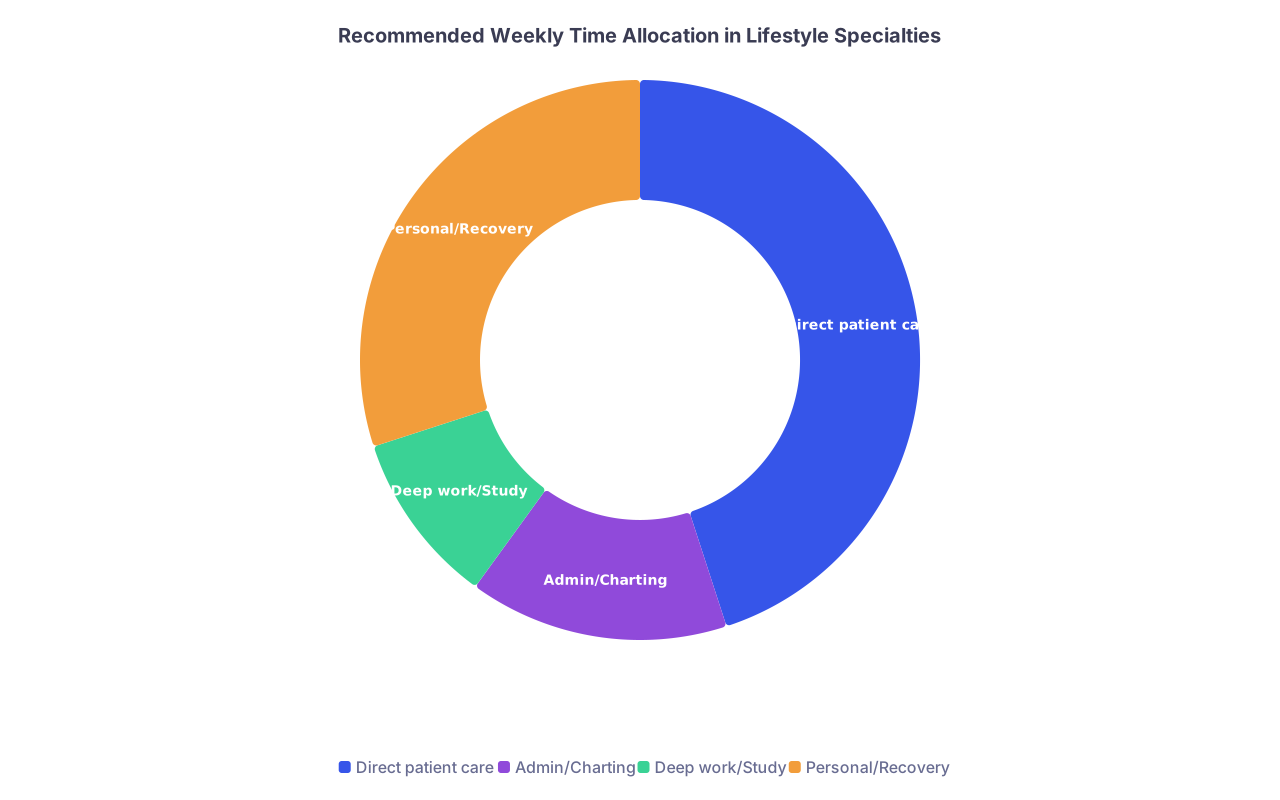
| Category | Value |
|---|---|
| Direct patient care | 45 |
| Admin/Charting | 15 |
| Deep work/Study | 10 |
| Personal/Recovery | 30 |

| Step | Description |
|---|---|
| Step 1 | List fixed duties |
| Step 2 | Block sleep and life |
| Step 3 | Add deep work blocks |
| Step 4 | Insert admin windows |
| Step 5 | Define hard rules |
| Step 6 | Run template for 2 weeks |
| Step 7 | Reduce volume or extend admin blocks |
| Step 8 | Lock template as default |
| Step 9 | Leaking work into nights? |
8. When You Have an Unpredictable Week (Call, Float, Holidays)
Even in lifestyle specialties, there will be chaotic weeks:
- Covering colleagues.
- Extra call.
- Board exam weeks.
- Family emergencies.
The structure still helps.
Here is the micro-protocol:
Shrink your goals, not your structure.
- Keep the blocks (sleep, exercise, deep work), but shorten them.
- Example: 30-minute workouts instead of 60. 20-minute board review instead of 45.
Switch to “maintenance mode.”
- Focus on:
- Patient care.
- Absolute minimum admin.
- One deep-work session per week.
- Everything else is optional or deferred.
- Focus on:
Post-chaos reset.
- The week after, return directly to your standard template.
- Do not reinvent your schedule; go back to default, then adjust.