
The prestige trap ruins more lifestyle careers than bad board scores ever will.
If you care about lifestyle and you chase reputation anyway, you are setting yourself up for the exact life you said you did not want.
Let me be blunt:
I’ve watched people who wanted “predictable hours and time with family” talk themselves into hyper-competitive, prestige-heavy paths… and then look absolutely shattered two years into residency. Not because they were weak. Because the job description they chose directly contradicted their values, and prestige blinded them to that mismatch.
This is preventable. If you’re a lifestyle‑oriented applicant thinking about the “most lifestyle friendly specialties,” there are some very specific traps that will derail you.
Let’s walk through the big ones before you lock yourself into a miserable choice.
1. The Core Lie: “I Can Have Both Prestige and Lifestyle… Easily”
You will hear this line in different outfits:
- “This derm group makes $800k and they’re home by 3.”
- “My friend does IR, it’s super chill at their hospital.”
- “Cards isn’t that bad if you pick the right practice.”
- “Anesthesia is lifestyle now – CRNAs take most of the calls.”
Here’s the problem: those are outliers, highly local situations, or straight-up misrepresented.
Lifestyle‑friendly means:
- Predictable schedule
- Limited or no overnight call
- Reasonable control over how much you work
- Emotional bandwidth left after work to be a functioning human
Prestige‑driven choices often mean:
- High acuity patients
- Unpredictable emergencies
- Culture of “always available” and “team heroics”
- Long years of training before you can control anything
Yes, there are “lifestyle versions” of almost every specialty. But if you lead with prestige, you’ll tend to choose:
- Big‑name academic centers
- Sicker patients
- Harder schedules
- Extra fellowships “because everyone else is doing one”
That trade is rarely neutral. It very often blows up your lifestyle.
2. Most Common Prestige Traps for Lifestyle Seekers
Here’s where I see lifestyle‑oriented applicants get burned.
| Trap Specialty/Path | Actual Lifestyle Risk |
|---|---|
| Interventional Cards | Heavy call, nights, high stress |
| IR-heavy Radiology | Emergent procedures, unpredictable hours |
| Surgical Subspecialties | Long cases, early mornings, late evenings |
| Big-name Academics (any field) | Research pressure, teaching, extra meetings |
| Highly competitive fellowships | More training years, delayed lifestyle control |
Trap 1: “Lifestyle-friendly” specialties… at the wrong kind of program
I’ve seen this a lot with:
- Dermatology
- Ophthalmology
- Radiology
- Anesthesiology
- PM&R
The specialty can be lifestyle‑friendly. But applicants chase:
- The most research-heavy derm program
- The top academic ophtho department that runs trauma call
- The radiology group with heavy IR expectations
- The anesthesia department doing high‑acuity hearts and transplants
Result? You match into:
- High‑pressure, perfectionist cultures
- Nights and weekends that “aren’t that bad” (they are)
- Nonstop evaluations, meetings, research deadlines
The mistake: assuming the reputation of the department matters more than the day-to-day existence you’ll live.
Trap 2: The “I’ll just do a lifestyle fellowship” fantasy
The script usually goes like this:
“I’ll match into internal medicine at a strong academic program, then do a lifestyle fellowship like allergy or rheum. I’ll grind now, chill later.”
Here’s how this goes wrong:
- IM residency at big-name program = brutal schedule
- Culture: everyone pushing for cards, GI, heme/onc
- You’re surrounded by prestige-chasers, not lifestyle-protectors
- By PGY2, you’re either:
- Burned out and just trying to survive, or
- Pulled toward more “impressive” fellowships against your original intent
And then allergy or rheum isn’t a guarantee. You might end up in hospitalist work or a fellowship you never truly wanted… because it was “too good” to turn down.
Trap 3: Overvaluing “top program” for non-competitive lifestyle fields
Family medicine, psych, peds, PM&R, even some EM programs.
Applicants talk themselves into:
“But this is the Harvard of psych programs. That’s gotta matter.”
For lifestyle‑oriented careers, outside of a few niche academic dreams, the market doesn’t care nearly as much as you think about which residency logo is on your diploma. But the schedule hit you take at those “elite” places? That’s very real:
- More rotations that destroy your sleep
- More pressure to do research/lectures/QI projects
- More committee work and “department priorities”
- More residents competing to stand out
You’re trading current lifestyle damage for minimal future benefit if you’re ultimately going to be a community psychiatrist, outpatient pediatrician, or bread-and-butter PM&R doc.
3. What Lifestyle-Oriented Actually Means (You’re Probably Underestimating This)
I don’t care what specialty we’re talking about; if you want lifestyle, you need to stop romanticizing how much discomfort you can tolerate.
Lifestyle‑oriented usually means some combination of:
- You want regular sleep
- You want evenings and weekends that are usually yours
- You care deeply about family time or hobbies
- Your mental health is not optional
- You don’t want your entire identity to be “doctor”
If that’s you, there are some non‑negotiables you cannot casually discard:
- Call burden – Nights and weekends add up. They erode relationships and your own stability.
- Length of training – Adding 3–6 extra years of training for “optional” fellowships delays the life you say you want.
- Control over schedule – Outpatient vs inpatient, procedural vs non-procedural, hospital‑based vs clinic-based. These are not small details.
- Culture of martyrdom – Some fields worship the “I stayed 30 hours past my shift” heroics. That’s poison for lifestyle.
Here’s how people get in trouble: they treat these as “soft” factors that prestige can compensate for. It cannot.
4. The Red Flags You’re Ignoring on Interview Day
You will see the danger signs. Most people just don’t want to believe what they’re seeing.
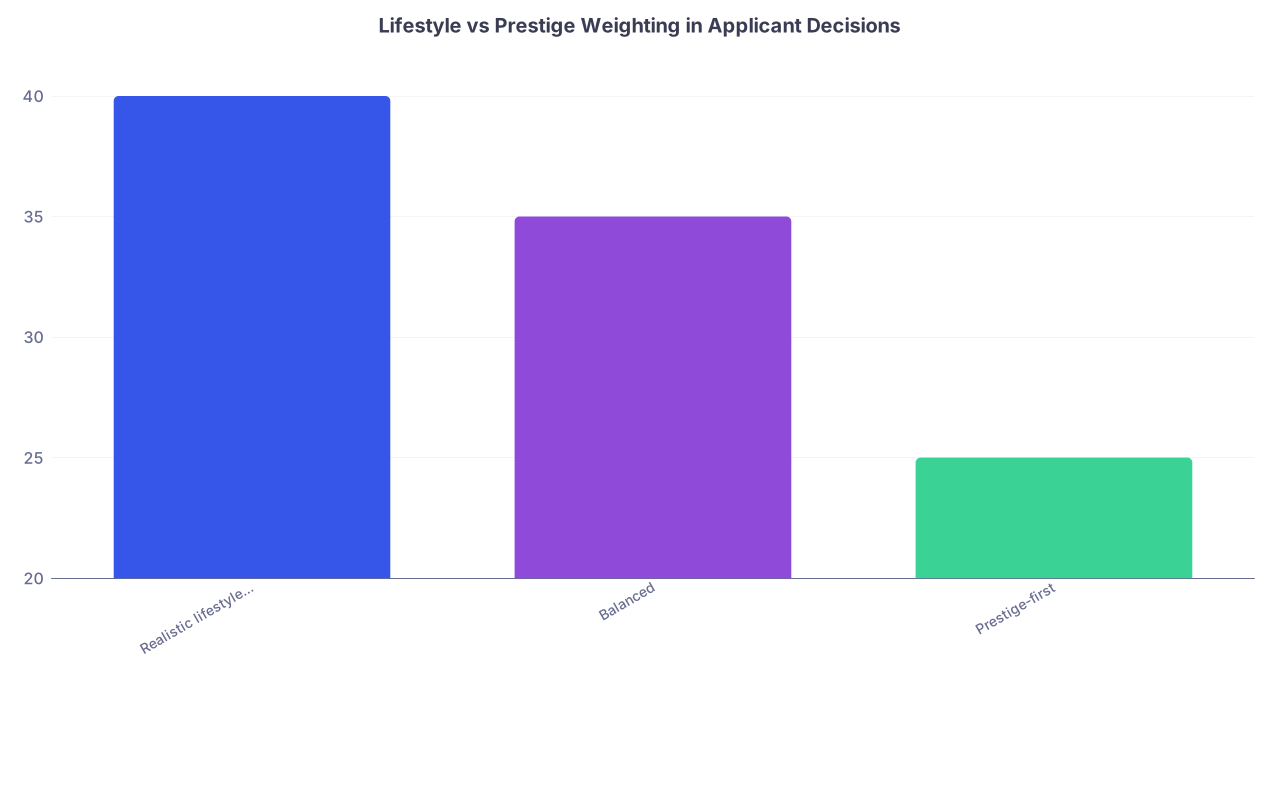
| Category | Value |
|---|---|
| Realistic lifestyle-first | 40 |
| Balanced | 35 |
| Prestige-first | 25 |
Watch for these:
- Residents joking about surviving, not thriving
- “You just get used to being tired.”
- “My spouse knows not to expect me home for dinner.”
- Faculty bragging about intensity
- “Our residents are the hardest-working in the region.”
- “We don’t produce 8–5 doctors here.”
- Smokescreen answers when you ask about hours
- “It varies a lot, but you’ll learn so much.”
- “The ACGME limits are… guidelines.” (Huge red flag)
- No one can tell you their real day-off pattern without looking nervous
- “We’re working on improving wellness” instead of concrete changes and actual examples
If they can’t quickly and confidently describe:
- Typical daily schedule
- Frequency of nights/weekends
- How often people get called in during off-hours
- How many residents have kids / stable relationships
…assume lifestyle is not a priority there.
And do not ignore your own reactions. If you leave a day thinking, “They’re impressive, but I feel tense just imagining working here,” your subconscious is doing you a favor. Listen.
5. When Prestige Actually Doesn’t Help You Much
Let’s be specific. For lifestyle-oriented applicants, prestige adds much less value in these scenarios than you think:
| Scenario | Prestige Impact | Lifestyle Cost |
|---|---|---|
| Community outpatient job | Minimal | Often high (training grind) |
| Non-academic psych/family/peds | Very low | Can be massive |
| Small/medium city practices | Low | Training burnout, delay family plans |
| Telemedicine-heavy careers | Almost none | Unnecessary extra stress |
| Non-clinical pivot later | Helpful but not essential | Years of lifestyle sacrifice |
If your likely endpoint is:
- Outpatient psychiatry
- Community pediatrics or family med
- Outpatient rheum, allergy, endo
- PM&R outpatient/MSK
- Low‑acuity radiology or telerads
- Lifestyle emergency medicine (yes, it does exist in pockets)
Then the brand name of your residency is usually drowned out by:
- Your board scores
- Your personality and interview
- Your willingness to work in less-saturated areas
- Your actual skills and references
I’ve seen mediocre residents from top places struggle in the job market because they’re unpleasant to work with. I’ve watched solid residents from “average” programs get fantastic lifestyle jobs because they knew what they wanted and didn’t burn every bridge during training.
Prestige does not erase being exhausted, bitter, or checked out.
6. Concrete Ways Lifestyle-Oriented Applicants Screw This Up
Let’s call out the patterns, so you can catch yourself.
Mistake 1: Ranking order based on name, not day-in-the-life
The classic:
“Program A is clearly stronger academically than Program B, so I should rank it higher.”
Yet:
- Program A: residents visibly wrecked, call q3–4, heavy nights, brutal ICU months, push for everyone to do fellowship
- Program B: solid clinical training, home by 5–6 most days, call reasonable, residents actually smiling, multiple grads in exactly the kind of job you want
If your end goal is a normal community outpatient life, ranking Program A higher purely for “strength” is a lifestyle self-sabotage.
Mistake 2: Overestimating your future tolerance for suffering
Right now you’re in med school mode. You’ve done 28-hour calls. Lived on coffee and adrenaline. You tell yourself:
“I can do anything for a few years.”
You’re not wrong short-term. You can. But if you stack:
- High-intensity residency
- Plus fellowship
- Possibly plus another fellowship or research years
You’re looking at 7–10+ years of “I can do anything for a few years.” You change in that time. Your priorities change. Sleep debt collects interest.
Assume your future self will be slightly less willing to tolerate misery than you are now, not more.
Mistake 3: Confusing “being capable” with “being aligned”
You might absolutely be capable of surviving a malignant surgical subspecialty program. That doesn’t make it a good idea if you:
- Hate missing holidays
- Want to be a present parent
- Get drained by constant conflict or intensity
- Need reliable time off to function
Too many strong students match the hardest specialties because they “can,” not because it fits. Then five years later they’re staring at a life where backing out feels impossible.
7. How to Actually Evaluate Lifestyle vs Prestige (Without Lying to Yourself)
You need a simple framework. Otherwise you’ll rationalize anything.
Use three buckets for each program/specialty you’re considering:
- Schedule Reality
- Average daily start/finish times
- Call frequency (and how often people actually get called in)
- Weekend/clerkship demands
- Night float structure
- Culture & Expectations
- Attitude toward work‑life boundaries
- How they talk about residents with families
- Whether people feel safe saying “no” or “I’m at capacity”
- Pressure for research, extra projects, or prestige fellowships
- Actual Career Outcomes
- What jobs grads end up in (and where)
- How many chose academic vs community vs lifestyle practice
- Whether anyone has built the exact life you want
Now the painful step: assign each category a priority score for you, not in the abstract.
If lifestyle is your real priority, “Schedule Reality” and “Culture & Expectations” should outrank prestige by a mile. If that’s not what you find yourself doing, be honest: you’re not actually lifestyle‑first.
8. Specialties Usually Compatible With Lifestyle – And How Prestige Warps Them
Let’s zoom in on some “most lifestyle friendly specialties” and where prestige tends to ruin them.
Psychiatry
Baseline: Can be extremely lifestyle-friendly in outpatient settings.
Prestige pitfalls:
- Big-name academic psych = tons of consults, high-acuity inpatients, complex cases, more nights
- Heavy on research expectations, pressure to subspecialize
- Culture sometimes leans toward overwork disguised as “patient-centered dedication”
Lifestyle-protective moves:
- Programs with strong outpatient emphasis
- Communities where grads work 4‑day clinic weeks
- Less research pressure, more focus on practical skills
Dermatology
Baseline: Clinic-heavy, predictable hours… in the right jobs.
Prestige pitfalls:
- Highly academic derm: complex rashes, inpatient consults, expectations for publications
- High demand for cosmetic cases after graduation, which can come with weekend/evening work for $$$
- Competitive culture; everyone chasing the “coolest” prestigious fellowships
Lifestyle-protective moves:
- Programs with balanced mix of medical and surgical derm, low inpatient burden
- Mentors who work in regular-hour community practices
- Realistic exposure to bread-and-butter outpatient derm, not just academic zebras
Radiology
Baseline: Can be very lifestyle-friendly, especially telerads and certain outpatient gigs.
Prestige pitfalls:
- IR-heavy or trauma-heavy programs with lots of call-ins
- Academic centers where residents do a huge amount of nights and weekends
- Subspecialty paths (neuro IR, complex interventional) with brutal call well into attending life
Lifestyle-protective moves:
- Programs with clear separation between diagnostic and IR expectations
- Strong telerads or outpatient imaging job pipelines
- Honest conversations with upper-levels about their real hours
PM&R
Baseline: Strong candidate for lifestyle if you avoid certain traps.
Prestige pitfalls:
- Programs fixated on inpatient rehab with heavy call and weekend work
- Strong push toward spine intervention jobs with big procedure days and potential call
- Academic centers where you’re on consult services nonstop
Lifestyle-protective moves:
- Programs with diversified outpatient MSK exposure
- Alumni working 4‑day outpatient weeks, predictable schedule
- Lower inpatient call at the resident level
9. A Simple Sanity Check Before You Finalize Your Rank List
Run this thought experiment honestly.

| Step | Description |
|---|---|
| Step 1 | Start - Considering Program |
| Step 2 | Ask about hours, call, culture |
| Step 3 | Prestige acceptable trade off |
| Step 4 | Program fits |
| Step 5 | Lower on list or drop |
| Step 6 | Lifestyle Priority High? |
| Step 7 | Residents thriving? |
| Step 8 | Can you accept lifestyle hit? |
Ask yourself:
If two programs got magically stamped with the same prestige tomorrow, which would you pick based purely on:
- Day-to-day feel
- Resident happiness
- Realistic hours
If you told your future partner/kids what your life would look like in each specialty, which one would they prefer for you?
If your ego couldn’t brag about the specialty or program name, would you still choose it?
If the honest answers point away from the prestige-heavy option, but you’re still leaning toward it, you’re not making a lifestyle decision. You’re making an ego decision and trying to label it “practical.”
Stop. That’s the mistake I’m trying to keep you from making.
Key Takeaways
- If you are lifestyle‑oriented, prestige is more likely to hurt you than help you unless you’re very intentional.
- The real enemies are hidden: high call burden, malignant culture, and years of extra training disguised as “opportunity.”
- Rank and choose based on day-in-the-life reality and career outcomes, not brand names or bragging rights.