
The fantasy that “outpatient = lifestyle” is quietly wrecking careers.
You can absolutely end up working 60–70 hours a week in an “easy” clinic specialty if you choose wrong, sign the wrong contract, or believe the brochure version of outpatient life.
Let me be blunt: the big mistake is assuming that just because a specialty is mostly clinic-based, it’s automatically lifestyle-friendly. That’s how people land in jobs where they’re charting until midnight, working most Saturdays, and still being told they’re “so lucky” to be outpatient.
You’re trying to avoid that. Good. Let’s make sure you actually do.
The Core Lie: “Clinic Is 8–5, Monday–Friday”
Here’s the sales pitch you’ll hear during residency:
- “Our doctors are in clinic 8–5.”
- “No call, no nights, no weekends.”
- “You can see 18–20 patients a day and be out on time.”
What they do not say out loud:
- Documentation spills into your evenings, every evening.
- In-basket messages, lab follow-ups, refill requests, and portal essays eat your early mornings and weekends.
- 18–20 patients only works if you accept shallow visits and constant shortcuts—or you stay late.
- Many outpatient jobs quietly assume 50–60 hours as “full-time” when you add up all the invisible work.
The trap is thinking “my clinic schedule is 4.5 days a week, so it must be lifestyle-friendly.” Wrong question. The question is:
How many hours a week are the attendings actually working door-to-door, including charting, messages, and admin?
Ask that. Relentlessly.
If you do not ask, you’re volunteering to be misled.
The Hidden Time Sink: Everything That Happens Outside The Visit
The single biggest misunderstanding among residents: thinking “full-time” is just the time you’re physically in the exam room.
It isn’t. The job is all the junk orbiting each patient.
What your future self will hate you for ignoring
For every 15–20 minute visit, you’re also doing:
- Charting and coding (correctly, or you get dinged)
- Reading specialist notes and hospital discharge summaries
- Ordering and then following up labs and imaging
- Calling patients who didn’t get the message
- Arguing with insurance for prior auths
- Sending letters/excuse notes/FMLA/short-term disability
- Replying to patient portal novels
And yes, a lot of clinics are now pushing hard: “Portal responses must be answered within 24 hours.”
That “no nights, no weekends” job? It quietly becomes:
- In clinic: 8–5
- Charting and messages: 6–7 am or 8–10 pm
- “Just catching up”: a few hours most weekends
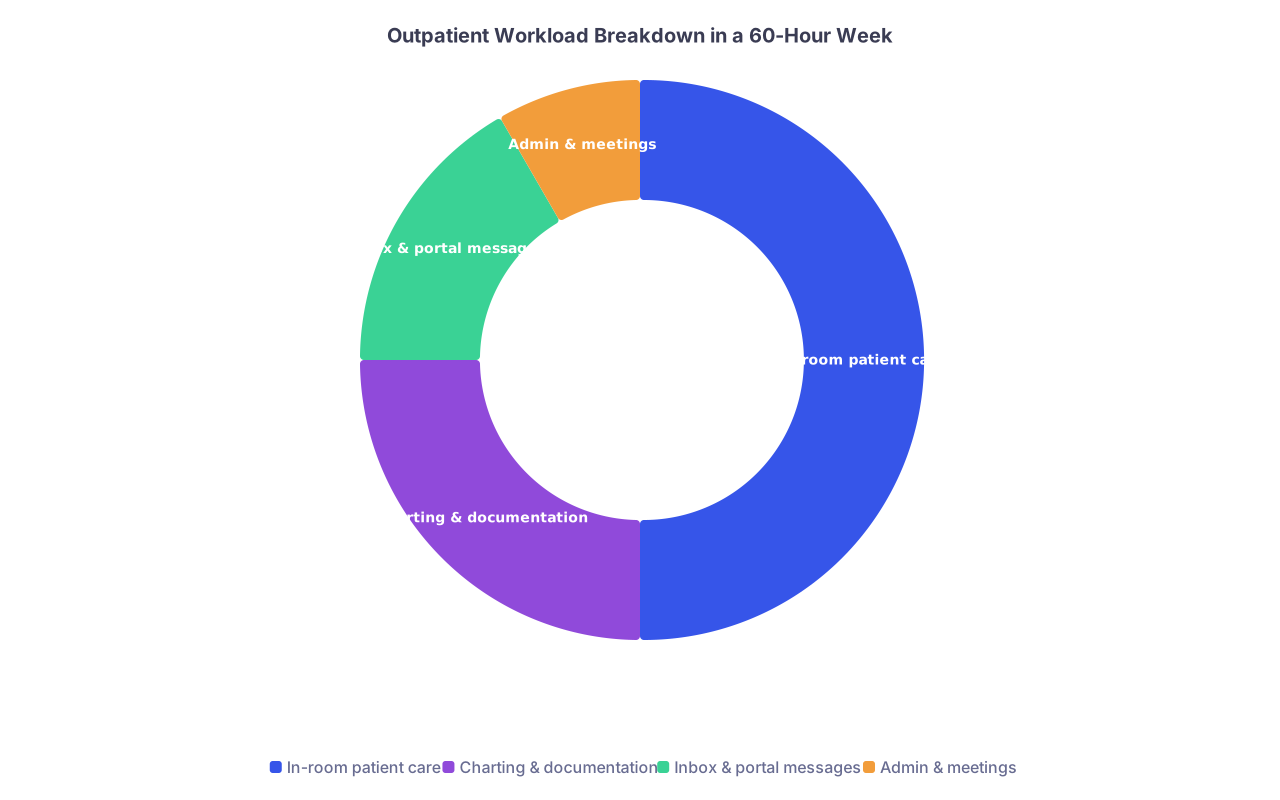
| Category | Value |
|---|---|
| In-room patient care | 30 |
| Charting & documentation | 15 |
| Inbox & portal messages | 10 |
| Admin & meetings | 5 |
The mistake is not respecting how big the “non-visit” time slice really is. If you only look at clinic hours, you will pick the wrong job and the wrong type of outpatient practice.
Outpatient Specialties That Can Quietly Turn Into 60+ Hours
Not every job in these fields is terrible. But these are the ones I see people misjudge all the time.
Primary Care (Internal Medicine / Family Medicine / Pediatrics)
The classic. Also the most common disappointment story.
The problem isn’t the field; it’s the structure:
- High-volume expectations: 20–28 patients per day is common.
- Complex patients with 3–10 active problems each.
- Unlimited asymmetry: each click you save today becomes more inbox tomorrow.
A “standard” full-time outpatient primary care job can look like this:
| Component | Official Expectation | Reality for Many |
|---|---|---|
| Clinic sessions | 8–5, 4.5 days | 8–5:30 or 6 |
| Patient volume | 20/day | 20–25/day |
| Charting completion | During visits | 1–3 hrs at home |
| In-basket/messages | Between patients | 1–2 hrs/day |
| Weekly total hours | 40–45 | 55–65 |
Where people go wrong:
- They ignore the actual current volume of the practice they’re joining. A “growing practice” can mean “we’re understaffed and drowning.”
- They don’t ask if any full-time doc consistently leaves on time with charts closed. If the answer is no, that’s your red flag.
- They assume “4-day workweek” means “lifestyle,” but it’s actually 4 packed days plus a fifth day of remote catch-up.
Primary care can be lifestyle-friendly if:
- Panel sizes are capped and actually enforced.
- You have strong support staff (RNs managing triage, MAs doing pre-visit planning, pharmacists handling meds).
- The group is disciplined about scheduling templates and same-day add-ons.
Most residents never push on those details. That is the mistake.
Outpatient Neurology, Rheumatology, Endocrinology, GI, Cards Clinics
These often look better than primary care on paper. Fewer patients per day. More “focused” complaints. But subspecialty outpatient can still be a stealth 60-hour job.
Why?
- Complex chronic disease = tons of labs, imaging, forms, med titrations.
- High reliance on prior auths, especially for biologics or advanced therapies.
- Patients call. A lot. “Side effect question,” “lab result question,” “can you refill early,” “I saw something on TikTok.”
The trap:
You see a schedule template of “12–14 patients per day” and think that’s light. But if half of those are 4- to 6-problem visits with extensive documentation and multi-specialty coordination, you’re still buried.
I’ve watched new rheum and neuro attendings get blindsided because:
- The prior attending left due to burnout, so you inherit a monster panel.
- The support structure is weak—MAs are just rooming, not doing meaningful pre-work.
- The clinic leadership quietly expects you to “grow the practice,” meaning more new patients and more complexity.
Again, none of these specialties are inherently bad. They just become 60+ hours when you assume “clinic = chill” and fail to dig into the details of how the clinic actually runs.
Outpatient Psych (Especially General Adult)
Yes, outpatient psychiatry can be a 4-day, 30–35-hour dream job. It can also be a complete grind if you fall into the wrong environment.
Danger signs that make psych secretly 60+ hours:
- 15-minute med management visits all day, every day.
- High no-show rates leading to pressure to overbook.
- Tons of refill requests, crisis calls, and collateral calls from family, therapists, and schools.
- Little to no integrated therapy support, so patients use you as therapist + prescriber + crisis line.
In a bad setup, your day looks like:
- Back-to-back 15–20 min visits, no buffer.
- Charting and refill approvals done at night.
- Emergency calls and messages bleeding into evenings and weekends.
The residents who get burned are the ones who only asked, “What’s the visit length?” and never asked:
- “How many hours a week do you all spend on calls and charting outside scheduled clinic?”
- “What’s your actual total workweek, not just time in the office?”
The Biggest Red Flag: Any Job Selling “Lifestyle” Without Data
If a recruiter or department chair leans hard into “great lifestyle,” you should immediately start looking for numbers they’re not offering.
You need real metrics, not vibes.
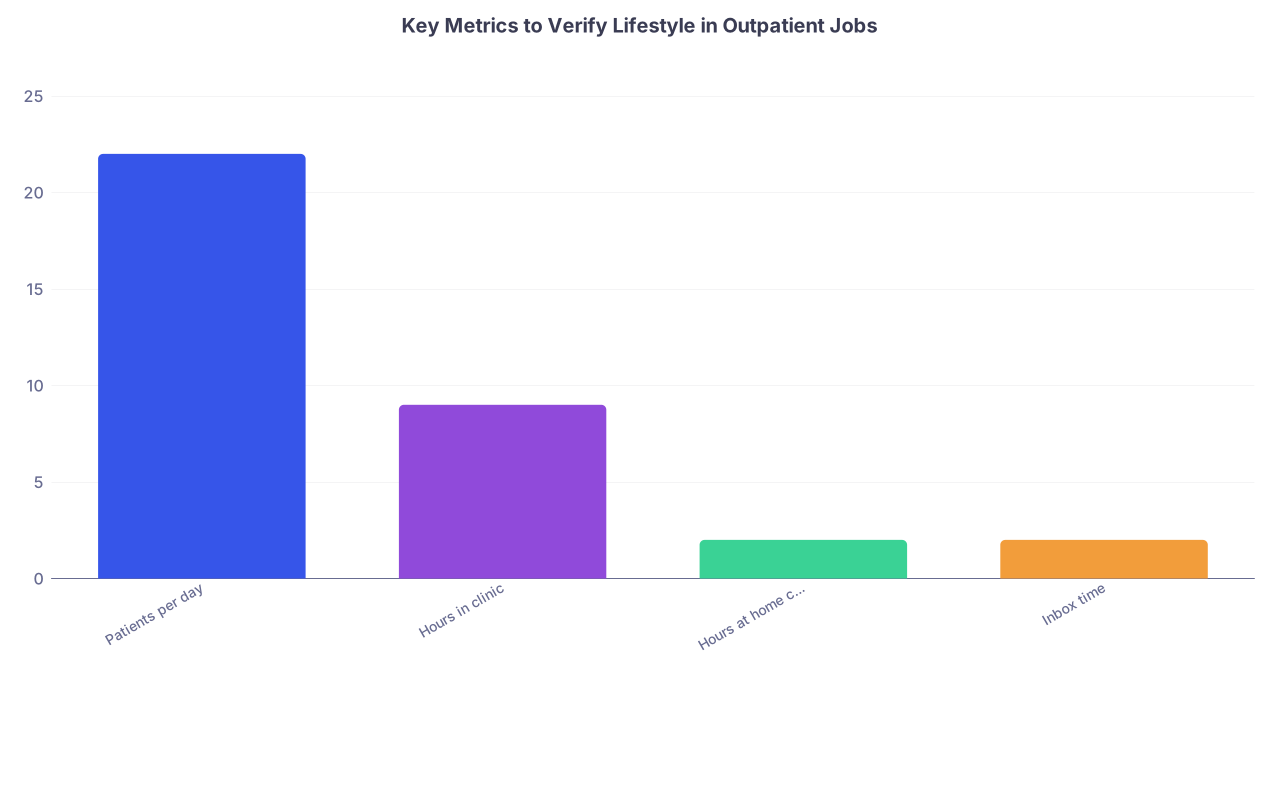
| Category | Value |
|---|---|
| Patients per day | 22 |
| Hours in clinic | 9 |
| Hours at home charting | 2 |
| Inbox time | 2 |
Here’s what you should insist on seeing or concretely asking about.
1. Actual Weekly Hours Of Current Physicians
Questions you should be asking directly:
- “How many hours a week does a typical full-time physician here work, including charting and inbox from home?”
- “What time do most attendings actually leave the building?”
- “Does anyone here regularly finish all their work in the clinic and go home with charts closed?”
If they cannot answer, or they answer with hand-waving (“oh, it varies, but people do fine”), assume it’s bad.
2. Real Patient Volume Expectations
Do not fall for “it’s reasonable.” That word means nothing.
Ask:
- “What is the expected number of patients per half day for a new attending? For a fully ramped panel?”
- “How many visits per day do your highest-volume physicians see? Your lowest-volume?”
- “Are there productivity bonuses tied to RVUs, and what RVUs per year do people actually hit?”
Then translate that into your own speed. You know if a 24-patient day is realistic for you or not. Be honest with yourself.
3. In-Basket and Portal Management
This is where a “40-hour” job becomes 60+.
Force clarity:
- “Who handles refill protocols? Do MAs or nurses triage messages, or do they all go straight to the physician?”
- “What is your expected response time for portal messages?”
- “Do patients get charged for complex portal interactions, or is it all uncompensated time?”
- “Do physicians get protected inbox time in their schedule, or is it expected to be done before/after clinic?”
If the answer is “we squeeze it in between patients,” that’s a lie. The real answer is “you will take it home.”
Structures That Almost Guarantee 60+ Hours
Some systems are structurally hostile to lifestyle, no matter the specialty label.
RVU-Heavy, Volume-Driven Systems
You’ll see:
- “Competitive compensation based on productivity.”
- “Opportunity to significantly increase your income.”
Translation: you will be pushed—subtly or explicitly—to see more patients, shorten visits, and work outside your scheduled hours.
The mistake is thinking, “I’ll just aim lower volume and take home less money.” Sometimes that’s allowed. Sometimes it’s not. Ask:
- “Is there a minimum RVU threshold for full-time status or to avoid penalties?”
- “What happens if a physician chooses to see fewer patients per day?”
- “Do you have any docs here who’ve chosen lower volume—how many hours do they work and what do they earn?”
If there’s no visible example of someone working sanely, don’t imagine you’ll be the first.
Poor Support Staff / High Turnover
Lifestyle dies when you become your own MA, nurse, pharmacist, and social worker.
Pay attention to:
- MA-to-physician ratios.
- Use of RNs for triage.
- Availability of care coordinators, social work, pharmacists.
- Staff turnover—are they constantly hiring MAs and nurses?
I’ve seen clinics where the doctor:
- Rooms their own patients when staff is short.
- Handles all refill questions personally.
- Manages all disability paperwork without help.
That setup will chew through your evenings. It doesn’t matter if the specialty is supposedly “easy” or “lifestyle.”
Zero Protected Time
Any job that tells you “we don’t really do admin time; you just handle it during the day” is telling you you’re going home with unfinished work.
You want to see built-in:
- Admin half-days.
- Inbox blocks.
- Meeting time that doesn’t cannibalize clinical time.
If those don’t exist, the work doesn’t disappear. It just migrates to your nights.
Structures That Are Genuinely Lifestyle-Friendly
There are outpatient specialties and jobs that really are 40 hours or less. You just need to recognize how they’re built.

| Step | Description |
|---|---|
| Step 1 | Outpatient job offer |
| Step 2 | High burnout risk |
| Step 3 | More lifestyle friendly |
| Step 4 | Is volume capped? |
| Step 5 | Strong support staff? |
| Step 6 | Protected admin time? |
Here’s what usually separates the truly sane jobs from the disguised 60-hour ones.
1. Capped Panel Sizes And Realistic Templates
Lifestyle-friendly practices:
- Cap panel sizes and stop accepting new patients when full.
- Keep patient volume in a range where notes can be done same day.
- Avoid chronic double-booking and “squeeze-ins” except for rare true emergencies.
Outpatient fields where this is more common:
- Dermatology
- Allergy/Immunology
- Some concierge or direct primary care (DPC) practices
- Certain private-practice psych setups with 60-min intakes and 30–45 min follow-ups
But even in these, you still need to ask about after-hours messages, refill processes, and admin expectations. A 25-patient derm day with no MA support is still brutal.
2. Strong Use Of Support Staff
Lifestyle jobs delegate well.
They have:
- Nurses handling triage, refills under protocol, and basic education.
- MAs doing pre-visit planning, med reconciliation, and quality metric checklists.
- Pharmacists managing complex med titrations in chronic disease.
- Social workers helping with access issues, disability forms, and community resources.
If a practice uses the physician as the solution to every task, your job is already bloated before you see the first patient.
3. Transparent, Realistic Schedules
Healthy clinics aren’t afraid of data. They’ll show you:
- How many patients each doc sees.
- How many hours they actually work.
- How many work part-time by choice and are happy.
Ask to see:
- The clinic schedule template for a full week for 2–3 different physicians.
- Their “inbox” or portal message volumes (on average per day).
- How many hours they block for admin.
If they won’t share that, assume they’re hiding something you won’t like.
How To Evaluate A “Lifestyle-Friendly” Outpatient Offer Without Getting Burned
Here’s a simple sanity check system to avoid the big 60+ hour mistake.
| Factor | Green Flag | Yellow/Red Flag |
|---|---|---|
| Patient volume/day | 12–18 (complex), 18–22 (simple) | 22–28+ routinely |
| Panel size policy | Capped and enforced | “We’re growing” / no cap |
| Inbox management | RN/MA triage, protected time | All to MD, no set time |
| Admin/meeting time | Scheduled blocks | “Just fit it in” |
| Docs leaving on time | Common, normal | Rare, mostly late |
If you see more red than green, this “lifestyle” job is probably closer to 55–65 hours in disguise.
Specific questions you should ask during interviews:
- “Can you walk me through a typical full-time physician’s day here, hour by hour, including when they do inbox and documentation?”
- “On average, how many hours a week do most attendings work, door-to-door?”
- “What percentage of physicians here are part-time or have reduced FTE, and why did they choose that?”
- “If I wanted to prioritize leaving on time over maximizing RVUs, is that culturally accepted here or frowned upon?”
- “Has anyone left in the last 2–3 years due to workload or burnout?”
Watch their faces when you ask. The hesitation will tell you more than the words.
The Safe Path: Match Specialty To Structure, Not Fantasy
You want a “most lifestyle friendly” specialty? Then stop thinking only in terms of labels like “outpatient” or “no call.”
Lifestyle comes from:
- Reasonable volume
- Real support
- Protected time
- Culture that values boundaries
You can find or destroy that in almost any outpatient specialty.
Someone in outpatient family medicine with a capped panel, strong team, and 0.8 FTE can be living a far saner life than a burned-out outpatient cardiologist churning RVUs until 7 pm every night.
Your job is to not get seduced by the title.
Match your expectations to:
- The actual workflows
- The true hours
- The visible lives of the attendings you’re joining
Talk to the ones who look like the future you want. Not just the superstar who “loves to stay busy” and “takes a few notes home—no big deal.”
Because it is a big deal when you’re the one doing it, year after year.
FAQ (Exactly 5 Questions)
1. Which outpatient specialties are most likely to be truly lifestyle-friendly?
Dermatology, allergy/immunology, some outpatient psychiatry setups, and well-structured concierge/DPC primary care are often closer to true 40-hour weeks—when they have capped panels, strong support staff, and sane scheduling. But the specialty alone doesn’t guarantee this; you still have to interrogate the specific job.
2. Is it safer to just work part-time if I want lifestyle?
Part-time can help, but it’s not a magic fix. In a dysfunctional system, 0.8 FTE can feel like 1.0 FTE of work plus a pay cut. If inbox and admin expectations don’t scale with FTE, you’ll still be working more than you’re paid for. You should explicitly ask how FTE affects patient volume, inbox load, and committee/admin duties.
3. How many patients per day is “too many” for outpatient clinic?
For complex medicine (IM/FM, rheum, neuro, endocrine), more than ~18–20 per full day usually pushes people into evenings for charting, unless support is outstanding. For quicker visits (derm, simple follow-ups, procedure-heavy clinics), higher volumes can be fine. What matters is whether most attendings finish notes same-day and leave on time. If they don’t, the volume is too high—regardless of the number.
4. Are academic outpatient jobs safer for lifestyle than private practice?
Not automatically. Academic jobs can have lower pure clinic volume, but they also stack on teaching, research expectations, meetings, and committee work. Private practice can be more volume-driven but also more flexible if you control your own schedule. You have to ask, in both settings: “What is a typical workweek in hours, and how many nights/weekends are people working from home?”
5. How early should I start thinking about these lifestyle details in residency?
Earlier than you think. By PGY-2 (and definitely by PGY-3), you should be paying attention to how your attendings in different clinics actually live: who is constantly behind, who looks calm, who has time for family. Start asking them privately about their patient volume, inbox load, and regrets. The worst mistake is waking up during your first attending job and realizing you optimized for “outpatient” instead of for a sustainable life.