
The worst mistake you can make planning a family in residency is pretending specialty choice “doesn’t really matter” for lifestyle. It does. Massively.
You’re not just choosing interesting pathology. You’re choosing how many bedtimes you’ll miss. How often your partner feels like a single parent. Whether you’ll actually see your kid awake on weekdays.
If you’re planning a family in residency, you need to treat “lifestyle” as a core clinical parameter, not a side consideration. And some fields are simply more compatible with diapers, daycare runs, and daycare call-backs than others.
This isn’t about “easy” vs “hard” specialties. It’s about predictability and control. I’ll walk you through which fields tend to be most lifestyle-friendly, who they actually fit, and exactly what questions to ask before you sign yourself and your future kid up for 3–7 years of chaos.
Step 1: Be Honest About Your Non-Negotiables
Before we even touch specialties, you have to get brutally clear on what you actually need for your future family.
Do not skip this. This is the part people hand-wave with “we’ll figure it out,” and then three months into intern year someone is crying in a parked car outside the hospital.
Ask yourself and your partner, in specific terms:
- Do you want to be present for bedtime most nights?
- Are you okay with one partner being gone some evenings but home post-call?
- How much support do you have? (Local grandparents vs no one within 500 miles is a huge difference.)
- Are you okay with irregular schedules if you can cluster days off?
- What’s your financial reality? (Some “lifestyle” fields pay less in residency and early attending years.)
Be concrete. Example hard lines I’ve heard from residents:
- “I need at least 3 nights a week where I’m home by 7 pm.”
- “We can handle weekends, but not 24-hour in-house calls more than once a week.”
- “My spouse works 7–7; we must have at least one predictable adult home for daycare pickup.”
Write your version. Then hold it up against each specialty.
Step 2: The Big Picture – Which Fields Tend To Be Lifestyle-Friendly?
Let’s stop pretending all specialties are the same. They aren’t.
Here’s how the usual “lifestyle-friendly” suspects stack up, from a family-in-residency standpoint, not just post-attending fantasy land.
| Specialty | Typical Residency Length | Schedule Predictability | Nights/Weekends | Family-Friendliness (Residency) |
|---|---|---|---|---|
| Dermatology | 4 years | Very high | Minimal | Excellent |
| PM&R | 4 years | High | Moderate | Very good |
| Psychiatry | 4 years | High | Moderate | Very good |
| Radiology (DR) | 5 years | High after PGY-2 | Some nights | Good–Very good |
| Pathology | 4 years | High | Limited | Very good |
| Outpt Pediatrics | 3 years (then choose job) | Variable by program | Some call | Good (program-dependent) |
Are there exceptions? Sure. There’s always that one malignant psych program or that dreamy surgery program. But these are patterns, and you’d be foolish to ignore them.
Now let’s get practical and specific.
Dermatology: The Gold Standard for Predictability
Derm is the cliché “lifestyle specialty” because… it actually is. During residency, not just as an attending.
What it usually looks like:
- Hours: Typically clinic-based, roughly 8–5 on average.
- Nights: Often home call. Many programs have minimal or no in-house nights.
- Weekends: Some consult coverage, but usually not frequent or brutal.
- Emergencies: Very few true middle-of-the-night emergencies.
Why it’s great for young families:
- You can actually predict your days. You know when you’ll be home.
- Childcare logistics are much simpler: dropping off at 7:30, picking up by 5:30 is realistic.
- Less emotional trauma than some acute-care fields; you’re not coming home wrecked every day.
The catch:
- It’s brutally competitive. If you want a family-friendly future and your heart isn’t set on derm, do not waste years chasing a derm spot that may never come.
- Some derm programs still have consult rotations or hospital-based months that will temporarily blow up your schedule. Ask about this on interview day.
Concrete action if you’re considering derm with a family in mind:
- Decide by early MS3 and align your entire CV accordingly.
- If you’re a borderline applicant, have a backup specialty that still works with family plans (e.g., psychiatry, PM&R) and apply to both.
Psychiatry: Quietly One of the Best for Parents
Psych is underrated for people planning a family in residency.
Typical reality:
- Hours: Often 8–5 or 9–5:30 for outpatient and many inpatient services.
- Call: Variable, but usually manageable—night float or home call setups are common.
- Intensity: Emotionally heavy sometimes, but physically lighter. You’re usually sitting, not sprinting between crashing patients.
Why it works well for families:
- Predictable days during most rotations.
- Post-call days are often true post-call days (not 3 pm “go home” that becomes 6 pm).
- A lot of psych departments are used to residents with families and can be flexible about appointments, maternity/paternity leave, and pumping breaks.
The thorny parts:
- Acute psych units can have long days. Some places run you hard on consult-liaison.
- If you’re easily emotionally drained, coming home to small kids may feel like too much after days full of severe depression, psychosis, or trauma.
Questions to ask programs:
- “How is call structured across the four years?”
- “What’s the typical end time on inpatient days?”
- “How do you handle family leave—any recent residents take 6–8 weeks off? How was coverage?”
If the leadership dodges those, that’s your answer.
PM&R (Physiatry): The Quiet Lifestyle Gem
Physical Medicine & Rehabilitation is one of the best-kept secrets for family planning.
Reality in residency:
- Hours: Often similar to medicine or psych, but with more consistent daytime schedules.
- Call: Depends on the program, but usually lighter and often home call.
- Workload: Fewer overnight emergencies. Lots of team-based care, rehab units, consults.
Why it’s family-friendly:
- Acute catastrophes are less frequent. That alone stabilizes your life.
- Many programs have a strong rehab-hospital base with defined hours.
- The patient population is chronically complex, but not constantly crashing.
People who do well here often like:
- Long-term relationships with patients.
- Team-based care (PT, OT, speech, nursing, social work).
- Procedural options (injections, EMGs, spasticity treatments) without pure surgical lifestyle.
If you’re thinking “I like neuro/ortho but do not want their lifestyle,” you should absolutely be looking at PM&R.
Radiology: Good Lifestyle, With a Warning Label
Radiology is often brought up as lifestyle-friendly. Yes, but with nuance.
Typical reality:
- Early years (PGY-2/3): You’re learning a new language and drowning in scans. Hours may be like 8–5:30 or 7–5 with some late shifts.
- Call: Nights and weekends happen, but usually in shifts. Night float is common.
- Later years: You gain more control but still rotate through evenings and some nights.
Why it’s good for families:
- No pre-rounding, no rounding, no chasing labs.
- When you’re off, you’re off. You’re not carrying a patient list at home.
- Many programs schedule in defined blocks (days, evenings, nights) which can help in arranging childcare.
But:
- Evening shifts (e.g., 3–11 pm) destroy bedtime presence. If that’s non-negotiable, it’ll hurt.
- Night float blocks with kids at home are tough. Not impossible, but you’ll barely see them for a while.
You and your partner need to explicitly talk through:
- “What happens when I’m on a week of nights and you’re solo?”
- “Can we afford extra help during those weeks?” (Night nanny, grandparents, etc.)
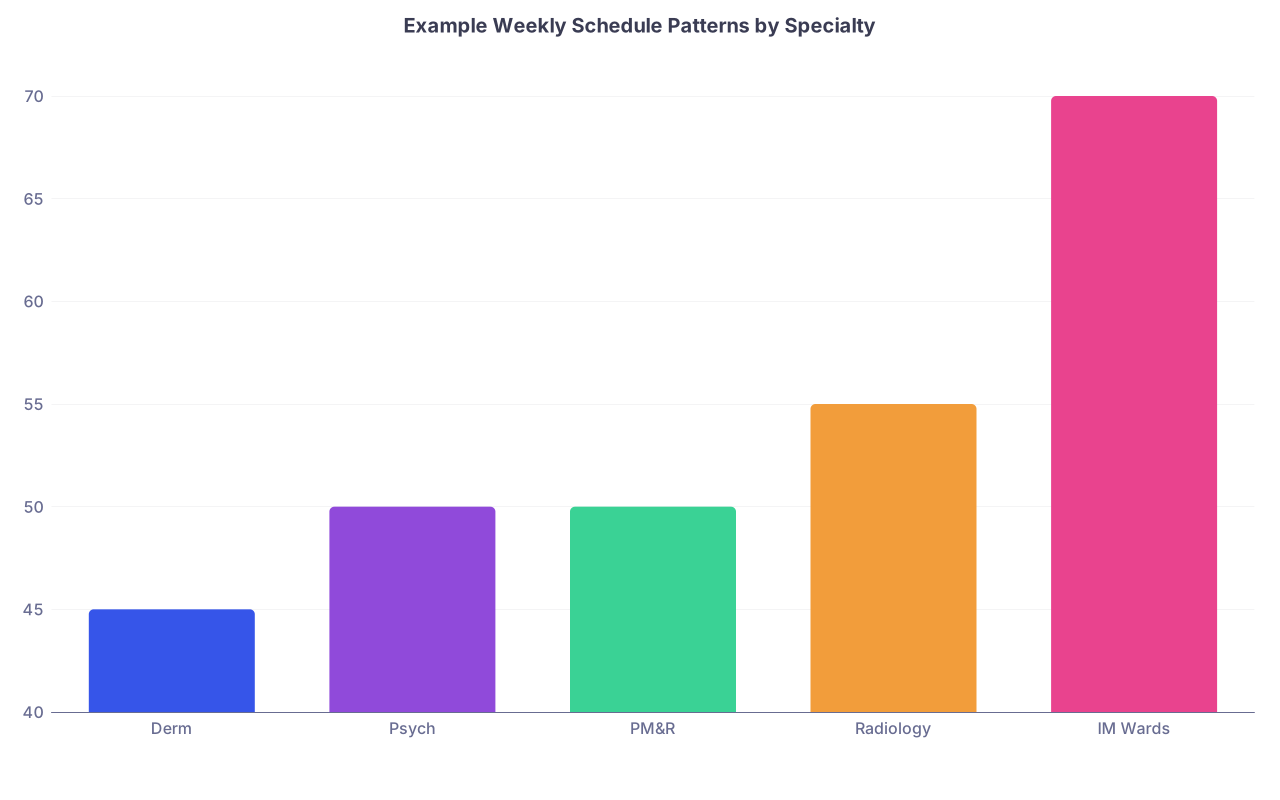
| Category | Value |
|---|---|
| Derm | 45 |
| Psych | 50 |
| PM&R | 50 |
| Radiology | 55 |
| IM Wards | 70 |
That chart is the point: it’s not just about total hours. It’s when those hours fall.
Pathology: Stable, Predictable, and Overlooked
Pathology is one of the most schedule-stable specialties you’ll find.
Residency reality:
- Hours: Often something like 7:30/8 am to 5 pm.
- Nights: Very limited. Mostly home call for frozen sections or lab issues.
- Weekends: Some coverage, but rarely anything like ICU call.
Why it’s strong for families:
- Ridiculously predictable daily life compared to most clinical specialties.
- Very little risk of 3 am disasters.
- Mental load is real, but you’re not also physically exhausted from running around the hospital.
Who it actually fits:
- People who like puzzles and pattern recognition.
- Folks who do not need constant patient interaction.
- Those okay with being “behind the scenes” clinically.
If you love anatomy, micro, and diagnostics, and you know you want to be home for dinner regularly, you should not let prestige-chasing pull you away from considering path.
Outpatient-Oriented Pediatrics and IM: Proceed Carefully
“Outpatient” is not a magic word. But outpatient-focused after residency can be lifestyle-friendly.
During residency? Still rough, but some programs are significantly better than others.
What you’re actually up against in peds/IM residency:
- Wards, ICU, nights, codes, admissions. All the usual.
- Rotations that run 6 am to 6 pm (or worse).
- Realistic average: 60–80 hours/week during heavy rotations.
So why do I include them at all?
Because:
- They’re shorter (3 years), so you get to the more controllable attending life sooner.
- Once you’re out, you can pick an outpatient or hospitalist job with defined shifts and say no to the chaos.
If you’re planning to have kids during residency and you’re dead-set on IM or peds, then you need to be very selective about the program:
- Look for places that cap admissions reasonably and don’t abuse “pre-rounding.”
- Ask residents flat-out: “Do you have co-residents with kids? How are they doing?”
- Ask about schedule transparency: “When do you get your yearly schedule? How often does it change last minute?”
If the residents look at their shoes, that’s your answer.
Emergency Medicine & Anesthesia: Not “Lifestyle” During Residency
I’ll say it clearly. If your top priority is small-kid bedtime consistency during residency, EM and anesthesia are bad bets.
Are there exceptions? Programs that are less malignant, better schedules, etc.? Absolutely.
But the baseline:
Emergency Medicine
- Pros: Defined shifts, lots of variety, true when-you’re-off-you’re-off.
- Cons: Evenings, nights, weekends are baked into the DNA of the job. Your kids’ birthdays will land on shifts. Bedtime presence is unpredictable.
Anesthesiology
- Pros: Procedural, high-acuity, decent pay later, some attending jobs with good hours.
- Cons: Early mornings, unpredictable OR days, call, late cases. Residency especially can be brutal with call schedules.
If your ideal is “home by 6 nearly every weekday,” these are long-term mismatches. If your partner is incredibly flexible, loaded with support, and okay with more solo-parent stretches, then maybe. But be honest.
Geography and Program Culture Matter as Much as Specialty
You can pick psych and still be miserable at a malignant program. You can pick IM and survive at a humane community program with strong caps.
You are not choosing “psych.” You’re choosing “this specific psych program in this city with this culture, leadership, and call structure.”
Things that radically affect lifestyle within the same specialty:
- Academic vs community
- Region (big coastal academic vs midwestern community can feel like different planets)
- Program size (bigger programs often spread call more evenly)
- Presence of fellows (they can either help or siphon good cases away)
- Culture around schedule changes and coverage
You want to identify family-friendly programs inside lifestyle-friendly specialties. That’s the sweet spot.
How to Evaluate Programs When You’re Planning a Family
You can’t just trust marketing. Everyone says they’re “supportive” and “like family.” Some of them lie.
Here’s how you actually check.
1. Ask Residents Targeted Questions
Not “How’s the lifestyle?” That’s useless. Ask specifics:
- “On a typical inpatient day, what time do you arrive, and what time do you actually leave?”
- “What’s the call schedule like in PGY-2 specifically?”
- “How many residents here have kids, and at what stages (pregnancy, newborn, toddlers)?”
- “When someone takes maternity/paternity leave, how is coverage handled? Do people get punished with heavier call later?”
You’re looking not just at the answers, but the body language. Long pause + “it’s… manageable” = red flag.
2. Ask Faculty the Policy-Level Questions
- “What’s your standard parental leave setup for residents?”
- “Have any residents taken 6–12 weeks off recently? How did that work structurally?”
- “If a resident has an unexpected family emergency, how does the program typically respond?”
If leadership looks confused that you’re even asking, walk away.
3. Check for Structural Evidence
Do they have:
- Written policies about parental leave?
- Lactation rooms that actually exist and are accessible?
- Schedules given months in advance, or do they rearrange things every 2 weeks?
- Remote-work possibilities for certain tasks (e.g., charting, teleradiology during certain rotations)?
You want systems that don’t rely on “hoping people are nice.”
Planning the Timing of Kids During Residency
There is no “perfect” year. Every year has trade-offs.
That said, here’s how it tends to play out:
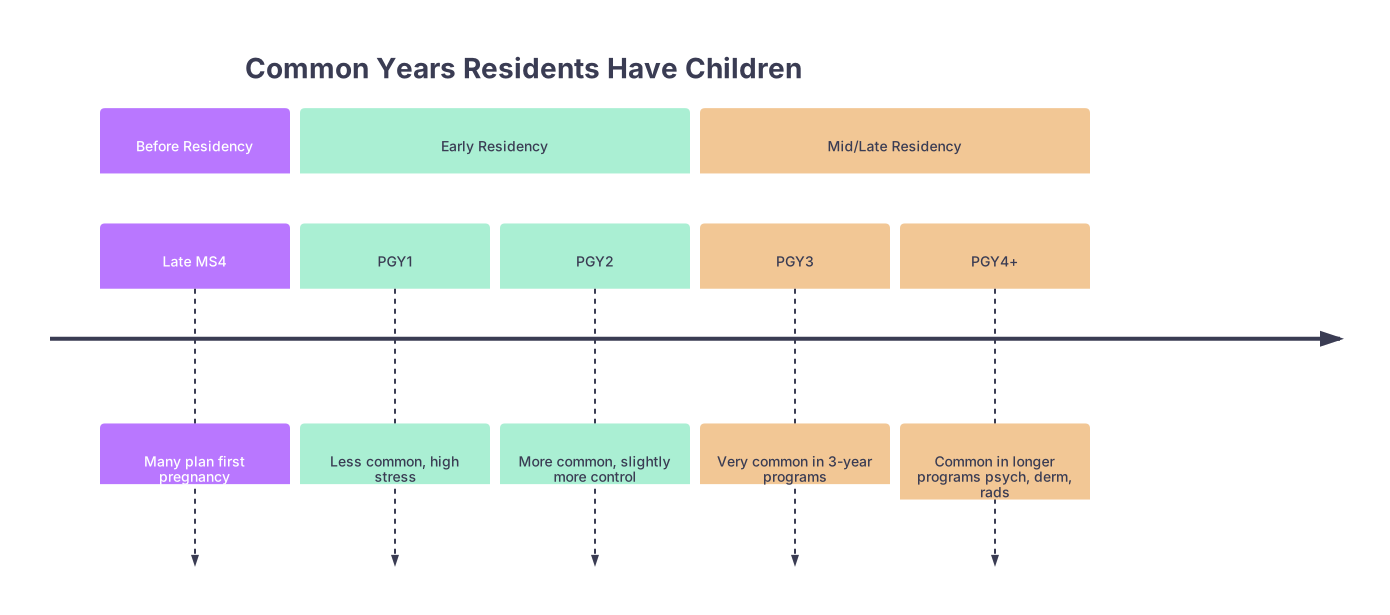
| Period | Event |
|---|---|
| Before Residency - Late MS4 | Many plan first pregnancy |
| Early Residency - PGY1 | Less common, high stress |
| Early Residency - PGY2 | More common, slightly more control |
| Mid/Late Residency - PGY3 | Very common in 3-year programs |
| Mid/Late Residency - PGY4+ | Common in longer programs psych, derm, rads |
Very rough guidance:
- PGY-1: Hard unless you have strong support. You’re learning everything, you have the least control, you’re watched most closely.
- PGY-2: Still hard, but you understand the system and your own capacity better.
- PGY-3 and later: Often a better sweet spot—more seniority, more electives, more negotiation power.
When in doubt, talk privately with residents who actually did pregnancies or newborns in that program. Ask them what they would do differently.
The Partner and Support Question You Can’t Ignore
I’ve watched residents with kids thrive in “harder” fields because their partner had a 9–5, local grandparents, and could flex everything.
I’ve also watched residents burn out in “easy” fields because they were in a new city, no support network, partner also in residency, and daycare costing more than their rent.
Before you commit to a specialty and program with a baby on the horizon, sit down with your partner and map these:
- Who can flex more—your schedule or theirs?
- Are you okay hiring paid help (nanny, au pair, night help) and can you afford it?
- Is living near family an option, and is it worth prioritizing, even above a “top-tier” program name?
That last one is unpopular but real. A solid mid-tier psych program in the same city as your parents may be 10x more livable than an elite derm program three time zones away with no support.
How to Decide If You’re Stuck Between Two Fields
If you’re torn between, say, psych and EM—or derm and anesthesia—and family is a major factor, do this:
- Write down a sample “bad week” in each field as a resident with a toddler and a working partner. Specific: wake times, daycare drop-off, who cooks, who does bedtime, who’s solo-parenting when.
- Then write a “bad month” (streak of nights, back-to-back ICU rotations, etc.).
- Ask yourself honestly: which set of problems are you more willing to live with?
Do not compare “average day psych” vs “worst day EM.” Compare worst-to-worst. That’s what breaks families, not the average Tuesday.
Quick Specialty Snapshot: If You’re Planning a Family
Here’s the blunt version:
- Top tier family-friendly (residency + attending): Derm, PM&R, Pathology, Psychiatry.
- Good with careful program choice: Radiology, Allergy/Immunology (fellowship), Rheumatology (later), outpatient-focused Peds/IM.
- Manageable but demanding: Hospitalist-track IM, outpatient OB/GYN at select practices later (residency still rough), some anesthesia jobs.
- High risk for family strain in residency: General Surgery, OB/GYN (residency years), EM, neurosurgery, most surgical subspecialties.
Again, there are exceptions. But if you’re planning pregnancies and toddlers during training and you want to stack the deck in your favor, that’s the starting map.
Final Takeaways
Three things I want you to actually remember:
Lifestyle is not a dirty word. If you’re planning a family, choosing derm over gen surg or psych over EM is not “selling out.” It’s aligning your life with your priorities. That’s called being an adult, not being weak.
Specialty choice and program culture both matter. A “lifestyle” field in a toxic program can wreck you just as effectively as a brutal field in a normal program. You’re picking both the field and the specific people you’ll answer to at 2 am.
Plan like it’s real, not hypothetical. Write down your non-negotiables. Ask residents direct questions. Picture your life with an actual baby and a call schedule, not some hazy “later we’ll figure it out” fantasy.
If you treat this decision with the same seriousness you treat patient care, your future self—and your future kid—will thank you.