
It’s 3:17 a.m. You are in the workroom charting your sixth admission of the night. The senior just snapped at you for asking a question. Your program director’s last “meeting” with you was basically a threat wrapped in feedback. You are halfway through PGY-1 or PGY-2 and you’ve realized: this place is malignant, and this specialty does not match the life you want.
But you’ve already matched. You’ve moved cities. You have loans. You have a contract. Everyone keeps saying, “Just push through residency; it gets better after.” Deep down, you know that’s a lie for you. You’re not willing to do 3–5 more years in this environment and then spend the rest of your career in a high-burnout field.
You’re not trying to quit medicine. You’re trying to get to a lifestyle specialty without blowing up your career.
Here’s how to think about a lateral move when you’re already inside a malignant program.
Step 1: Be Brutally Clear About Your Situation
First thing: separate two issues in your head:
- Malignancy of the program
- Mismatch with the specialty / lifestyle
You might have:
- Good specialty fit, awful program
- Bad specialty fit, tolerable program
- The double whammy: bad specialty, malignant program
You’re reading this because you’re thinking about lifestyle specialties. So I’m going to assume at least partial mismatch with your current field and growing interest in something like:
- Dermatology
- Ophthalmology
- PM&R
- Radiology (including IR-lite roles later)
- Anesthesia (especially certain practice models)
- Outpatient-focused fields: Allergy/Immunology, Rheum, Endocrine, Pain, Sleep
Not all of those are easy to jump into. Some are extremely competitive; some require new training from scratch; some allow “side doors.”
Before we get tactical, you need to document reality. Not for catharsis. For evidence.
Tonight or on your next “day off” (quotation marks intentional), start a simple log:
- Dates of abusive incidents, unsafe workloads, or clear policy violations
- Names involved
- Specifics: “21 patients on my list as PGY-1 on cross-cover,” “threatened with non-renewal for using the fatigue policy,” “attending screamed and cursed in front of patient/family”
- Any emails or messages that support the pattern
You’re doing this for two reasons:
- To protect yourself if things escalate.
- To decide whether you’re trying to:
- Escape this program via transfer, or
- Change your entire trajectory to a more lifestyle-friendly specialty, or both.
Step 2: Decide Which Outcome You Actually Want
There are four main outcomes you could pursue. You need to pick a primary and a backup:
- Lateral transfer within same specialty, better program vibes
- Switch to a lifestyle specialty requiring a new residency from PGY-1
- Switch to a related specialty with advanced or shorter-track entry
- Finish current residency, then pivot with fellowship or job choice
Let’s be concrete.
| Current Field | Direct Lifestyle Pivot | Indirect / Realistic Pivot |
|---|---|---|
| IM | Allergy, Rheum, Endo | Sleep, Obesity, Primary care with good job |
| Gen Surg | Anesthesia, PM&R | Pain, Palliative, Wound care |
| EM | Anesthesia, IM, FM | Urgent care, Occupational med |
| OB/GYN | FM (with OB), IM | Hospitalist-focused OB jobs |
| Psych | Lifestyle already decent | Niche telepsych, part-time models |
If your current field is already moderately lifestyle friendly (psych, PM&R, sometimes pathology), then the issue is more likely the program and not the specialty. In that case, a straight transfer might be smarter than blowing everything up.
If you’re in something like general surgery, OB/GYN, malignant IM, or malignant EM and you hate the work itself, then a specialty pivot toward a lifestyle field is on the table.
But you cannot aim at everything at once. Pick:
- Primary goal: “Switch to anesthesia” or “Switch to radiology” or “Transfer to a sane IM program.”
- Secondary goal: “If that fails, at least transfer to a non-malignant program in my same field.”
Write those two sentences down. Literally. Clarity here matters.
Step 3: Quietly Map Out Your Realistic Targets
You are not a med student anymore. You can’t just “apply widely” to 80 programs. You have a living, an income, a contract, sometimes a visa. Your moves need to be strategic.
Here’s how I’d break it down.
A. Know which lifestyle specialties are even feasible from where you are
Some are borderline fantasy if you’re already a non-competitive resident with mediocre board scores and no prior interest. Others are absolutely reachable.
Rough, honest tiers from your current position:
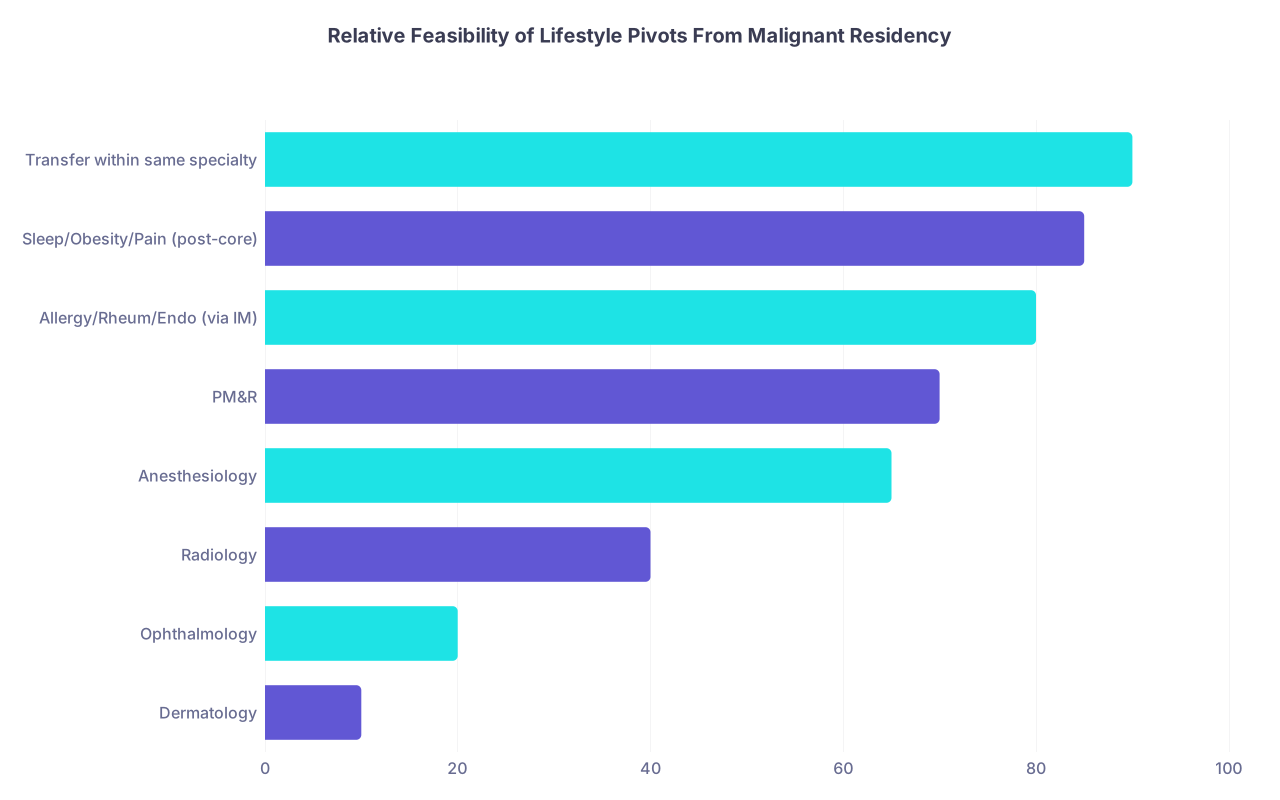
| Category | Value |
|---|---|
| Dermatology | 10 |
| Ophthalmology | 20 |
| Radiology | 40 |
| Anesthesiology | 65 |
| PM&R | 70 |
| Allergy/Rheum/Endo (via IM) | 80 |
| Sleep/Obesity/Pain (post-core) | 85 |
| Transfer within same specialty | 90 |
Scores aren’t percentages; think of them as relative ease. A 10 means: possible, but you’d better be exceptional or have prior work to point to.
Notice:
- Dermatology and ophtho are near the top for lifestyle, near the bottom for feasibility from scratch as a mid-residency pivot.
- PM&R, anesthesia, and radiology are your more realistic “hospital-based but lifestyle-better” moves.
- Allergy, rheum, endo, sleep, obesity, pain are mostly fellowship-dependent after internal medicine or family medicine.
B. Audit your background in 20 minutes
You need to look at your application the way a PD would:
- Board scores: Step 1 (if numerical), Step 2.
- Red flags: failures, probation, gaps.
- Past evidence: any rotations, research, letters tied to your target field?
- Visa status: are you on a J-1 or H-1B? That narrows options fast.
- PGY year: PGY-1 vs PGY-2+ matters for what PGY year you can enter somewhere else.
Do this without self-pity. Just data. You’re trying to see: “Could someone plausibly believe I really want PM&R / anesthesia / rads, or would it look like random flailing?”
Step 4: Start the Quiet Recon – No One Needs to Know Yet
You don’t start with your PD. You start with information and allies.
1. Find people who actually made the jump you want
You are looking for:
- Surgery → Anesthesia / PM&R
- IM → Anesthesia / Rads / PM&R
- EM → Anesthesia / Rads / IM / FM
- Anything → Allergy/Rheum/Endo via IM
- Any miserable program → sane non-malignant program (same field)
Where to look:
- Alumni lists from your med school: there is always someone who switched
- Specialty Facebook groups / Reddit (filter for signal, ignore noise)
- Institutional email lists: “Residents who matched into PM&R from [Your Med School]”
Message them something short:
“Hi Dr. X, I’m a PGY-1 in [specialty] at [program]. I’m seriously considering moving into [target specialty] for long-term lifestyle and fit reasons. I’d be grateful for 10–15 minutes of your perspective on how you approached your switch—especially what you’d do differently now.”
You don’t need dozens. Two to four real conversations beat 100 anonymous online posts.
2. Quietly talk to faculty you trust – often outside your program
At your hospital there’s usually:
- The “normal human” attending in another department
- The old-school IM doc who’s seen 50 residents burn out
- The anesthesiologist who remembers being miserable in surgery
Set up a “career advice” meeting:
“I’d love your advice on long-term specialty fit and career planning. I’m rethinking where I want to end up.”
You do NOT lead with, “My program is malignant and I want out.” You’re testing:
- Who is safe to be honest with?
- Who might later write a letter for you or make a call behind the scenes?
Step 5: Understand the Mechanics of Leaving or Transferring
Everyone thinks this part is impossible. It’s not. It’s just messy and bureaucratic.
A. Transfers within the same specialty
If you can tolerate your field but need a non-malignant environment, this is the most realistic path.
How it usually works:
- Programs randomly have a PGY-2 or PGY-3 spot open due to someone leaving, firing, visa issues, etc.
- They don’t always advertise widely. Emails go out via listservs, NRMP, or personal PD networks.
- You send:
- Updated CV
- Personal statement (short, focused)
- Letters (current PD letter is often requested, sometimes mandatory)
- Milestones/rotation evaluations
The catch:
You often need your current PD’s knowledge or at least their blessing. In a malignant program, that’s risky—some PDs punish residents who try to leave.
So you need to assess:
- Is your PD vindictive or pragmatic?
- Do they have a history of blocking transfers?
- Does your institution have a GME office that can “middle-man” this?
If you’re unsure, talk to a GME office ombudsman or a trusted APD-level faculty before going to the PD.
B. Switching specialties – with or without credit
Every specialty has its own rules about credit for prior residency. Some will give you:
- Zero credit – start over as PGY-1
- Partial credit – enter as PGY-2 with some PGY-1 completed
- Rarely, more
You need to look up:
- ACGME program requirements for your target specialty – there is usually a section about “credit for prior training”
- Ask people already in that specialty who switched: “How much credit did they give you?”
Examples:
- IM → Allergy/Rheum/Endo: You need IM done (3 years). You can’t shortcut.
- Surgery → Anesthesia: Many anesthesia programs credit 1 surgical prelim year, so you might enter as CA-1 after PGY-1 or PGY-2 surgery.
- EM → Anesthesia: Variable, but some credit.
- Transition to PM&R: Some PM&R programs accept prior year(s) as prelim; others want categorical.
Bottom line: sometimes “start over in a better field” is not actually “six more years.” It may be “one more year than you were already going to do, but in a specialty that won’t ruin your life.”
Step 6: Build a Narrative That Doesn’t Torch You
No one wants to hear: “My program is malignant and I hate this specialty.” Even if it’s true.
You need a story that:
- Is honest but controlled
- Emphasizes pull factors (what you’re moving toward) over push factors (what you’re running from)
- Doesn’t make PDs think, “This person will badmouth us and bail in a year”
Your core elements:
Discovery of better fit
- “Through exposure to [target specialty] patients, I realized I’m more drawn to X type of thinking/procedures/patient relationships.”
- “I find myself most fulfilled when doing [skill common in target specialty].”
Concrete experiences
- An elective you did as a student or resident
- Research or QI you did in that area
- Shadowing experiences you can still arrange (even now) to show effort
Professional, not emotional description of your current situation
- “My current training environment has strongly underscored for me how important consistent mentorship, psychological safety, and sustainable workloads are.”
- “While I’m committed to finishing this year well, I’ve concluded that my long-term career goals align more closely with [target specialty].”
If they push you about your current program being malignant:
- You do not vent.
- You stick to safety and outcomes.
“There have been challenges with workload and support that I have escalated through appropriate channels. I’ve learned a lot about resilience and advocating for patient safety, but I also know I need a training environment that models the kind of career longevity I’m aiming for.”
That’s it. Do not go into war stories unless they specifically ask—and even then, be measured.
Step 7: Get Your Documents in Order Without Setting Off Alarms
You need to quietly prep your application materials.
Update your CV
- Put your current residency on it, with dates and any scholarly stuff.
- Highlight anything remotely relevant to your target field.
Draft a short, specific personal statement
- 1 page max.
- First paragraph: “Here is why I am drawn to [target specialty].”
- Middle: concrete experiences and what you’ve learned from your current training.
- Last: what kind of resident you’ll be for them.
Identify 2–3 potential letter writers Priorities:
- At least one in the target specialty if at all possible (even if from med school; better if new)
- One from someone where you are now who likes your work and is stable
- PD letter only when absolutely necessary (and time it carefully)
Figure out the PD letter trap Many programs will want:
- “Letter from current PD stating you are in good standing and indicating whether they support your transfer.”
If your PD is malignant and controlling:
- First, talk to GME office confidentially. Ask about institutional policy for transfers and PD letters.
- Second, have at least one outside advocate (e.g., anesthesia chair, IM chair) who can call on your behalf if the PD is obstructive.
Do not trigger the PD letter request until you have:
- At least one or two programs interested enough to interview or consider you.
- A GME ally aware of your situation.
Step 8: Watch the Timing and Logistics
You can’t casually “apply next week.” There are windows and realities.
A. Match vs off-cycle openings
There are two main ways out:
Off-cycle spot
- A program suddenly needs a PGY-2/3 in July (or even mid-year).
- These get posted informally: email lists, specialty society boards, word of mouth.
- You apply directly to program. Faster but messier.
- Great for lateral transfer or switch when you already have some PGY credit.
Re-entering the Match
- You apply through ERAS for a new PGY-1 or categorical spot.
- Cleaner, but you might have to:
- Finish your current year
- Possibly have a gap or prelim year
- For highly competitive lifestyle specialties (derm, ophtho, rads at top-tier), you probably need to Match, not just off-cycle.
B. Contracts and GME rules
Read your contract. Then read the GME handbook. Yes, seriously.
Look for:
- Notice requirements if you resign
- Penalties (rare but possible)
- Whether they can withhold your “good standing” letter or completion of PGY-1
- Any clauses about “moonlighting” or other jobs (if you’re planning a gap year)
And start a quiet, factual email trail when you’re considering leaving:
“To clarify my understanding of policy, if a resident were to transfer to another ACGME-accredited program, what is the process for release of training verifications and credit?”
Keep it generic at first.
Step 9: Protect Your Sanity While You Work the Long Game
This whole process can take 6–18 months. You’re doing it while still in a malignant environment.
So you need a short-term survival plan.
I’ve watched people burn their career by letting resentment turn into underperformance. Do not give your program ammunition.
Minimum viable approach:
- Show up on time.
- Document well.
- Don’t pick fights.
- Protect your sleep aggressively on days off. Yes, that means saying no to some social stuff.
- Find one or two co-residents you actually trust and lean on each other—carefully, not in group rants that can be screenshotted or quoted.
If your mental health is tanking:
- Get an outside therapist, ideally one who has worked with residents or high-stress professionals.
- If necessary, use leave policies (FMLA, medical leave). Just don’t do it impulsively; coordinate with someone who understands downstream effects on credentialing.
Step 10: Realistic Paths Into “Most Lifestyle-Friendly” Fields
Let’s talk actual on-ramps, not Instagram fantasies.
A. Path into anesthesia from a malignant program
Good if you’re coming from: surgery, EM, IM.
What you do:
- Line up 1–2 anesthesia electives or shadow blocks ASAP.
- Do tangible work: a small QI project in periop, a case report with an attending.
- Get at least one anesthesiologist letter.
- Apply both through:
- Off-cycle CA-1/PGY-2 spots
- Next Match for categorical / advanced anesthesia spots
Pitch:
- You like acute care, procedures, physiology—but want more control over schedule and less chaos than EM/surgery.
- You can handle nights/calls; you’re not naïve. You just want a field with better long-term sustainability.
B. Path into radiology
Best if you like diagnostics, pattern recognition, and can stomach a few more brutal call years for long-term flexibility.
What you do:
- Leverage any imaging-heavy work from current field.
- Get a month with radiology if possible, even if informal.
- Expect to re-enter the Match as an R1 unless you find a random off-cycle spot.
Reality: Some rads jobs are lifestyle heaven. Some call-heavy. But your odds of a sane attending job are significantly higher than in malignant core fields.
C. Path into PM&R
Strong option from surgery, IM, neurology, FM, EM.
What you do:
- Spend time on PM&R consults or inpatient rehab if available.
- Focus on pain, MSK, neuro rehab, disability counseling—things you can point to as “this is what I enjoy.”
- PM&R is more open to people who found it later, especially with logical narratives (burned out on surgery lifestyle, want longitudinal function-focused care).
Long-term, you can steer toward:
- Outpatient MSK
- Sports
- Pain
- Neurorehab
with fairly reasonable life.
D. Internal medicine as a gateway to outpatient lifestyle
If you’re already in IM at a malignant place, honestly, you may not need a new specialty. You may just need:
- To transfer programs or
- To mentally commit to: “I will finish this, then do a lifestyle fellowship or outpatient job.”
Lifestyle-ish post-IM routes:
- Allergy/Immunology
- Rheum
- Endocrine
- Sleep medicine
- Obesity medicine
- Outpatient primary care at a well-run, non-RVU grinder clinic
If your main problem is your program, not the field, focus energy on a transfer, not radical reinvention.
One Hard Truth: You Might Need to Swallow Some Extra Years
Sometimes the math is ugly:
- 2 years done in malignant surgery
- To get into anesthesia or PM&R, you might need 3–4 more
That’s a big hit. But scroll forward.
Would you rather:
- Grind 3 more years in a field you hate and then practice 25 years in a lifestyle you hate, or
- Spend 4–5 more years training in something you can tolerate or maybe even like, and then practice 25 years with control?
Residents underestimate how long their careers are. Five years vs ten years is a big deal; five vs thirty is not.
What you do not do:
Stay in a malignant, misaligned path just to avoid the discomfort of an extra year or two. That’s how attending-level burnout is born.
Your Next Move Today
Do one concrete thing within the next 24 hours:
Make a short, ruthless document called “Exit Plan – Draft 1” with these headings:
- My primary goal specialty / outcome
- My backup outcome
- My honest CV strengths / weaknesses (bullets)
- 3 lifestyle-friendly specialties that are actually feasible for me
- Names of 3 people I will contact this week for advice (alumni, attendings, residents who switched)
Then send one email:
Subject: Quick career advice?
Hi Dr. [Name],
I’m a PGY-[year] in [current specialty] at [institution]. I’ve been reassessing my long-term specialty fit and I’m strongly considering a move toward [target specialty or “a more outpatient/lifestyle-focused field”].
You’ve had a career path I respect, and I’d really value 10–15 minutes of your perspective on how you would think through this decision if you were in my shoes.
Would you be open to a brief call or meeting sometime in the next couple of weeks?
Best,
[Your Name]
Start there. Quiet, strategic, forward-looking. You are not trapped yet. But you do need to start acting like you’re steering the ship, not just taking the waves.