
You’re an IMG. You need a visa. Your Step scores are decent but not “Harvard or bust.” Everyone keeps telling you “just pick a lifestyle specialty,” but then you look at the data and realize: the most lifestyle-friendly specialties are exactly the ones that hate visas and love US grads.
Derm? Mostly no visa.
Optho? Forget it.
Radiation oncology? Shrinking.
PM&R? Half the programs say “no visa.”
You’re sitting there wondering: “Do I chase lifestyle and risk never matching, or do I pick something brutal just because they sponsor visas?” That’s the exact tension we’re going to untangle.
Let’s walk through what’s actually realistic for a visa-restricted IMG who wants a life outside the hospital. Not a fantasy list. The real, sometimes gritty version.
1. The Harsh Reality Snapshot: Lifestyle vs Visa vs IMG
Before we get to solutions, you need a clear view of the playing field.
Here’s the unspoken rule I’ve watched play out for years:
Lifestyle-friendly + competitive + low call =
US MD heavy + few visas + research-heavy CVs
Visa-dependent + IMG-friendly + large programs =
Internal medicine, family med, peds, psych, neurology
(Some ask for Step 3, many want strong scores, but they exist.)
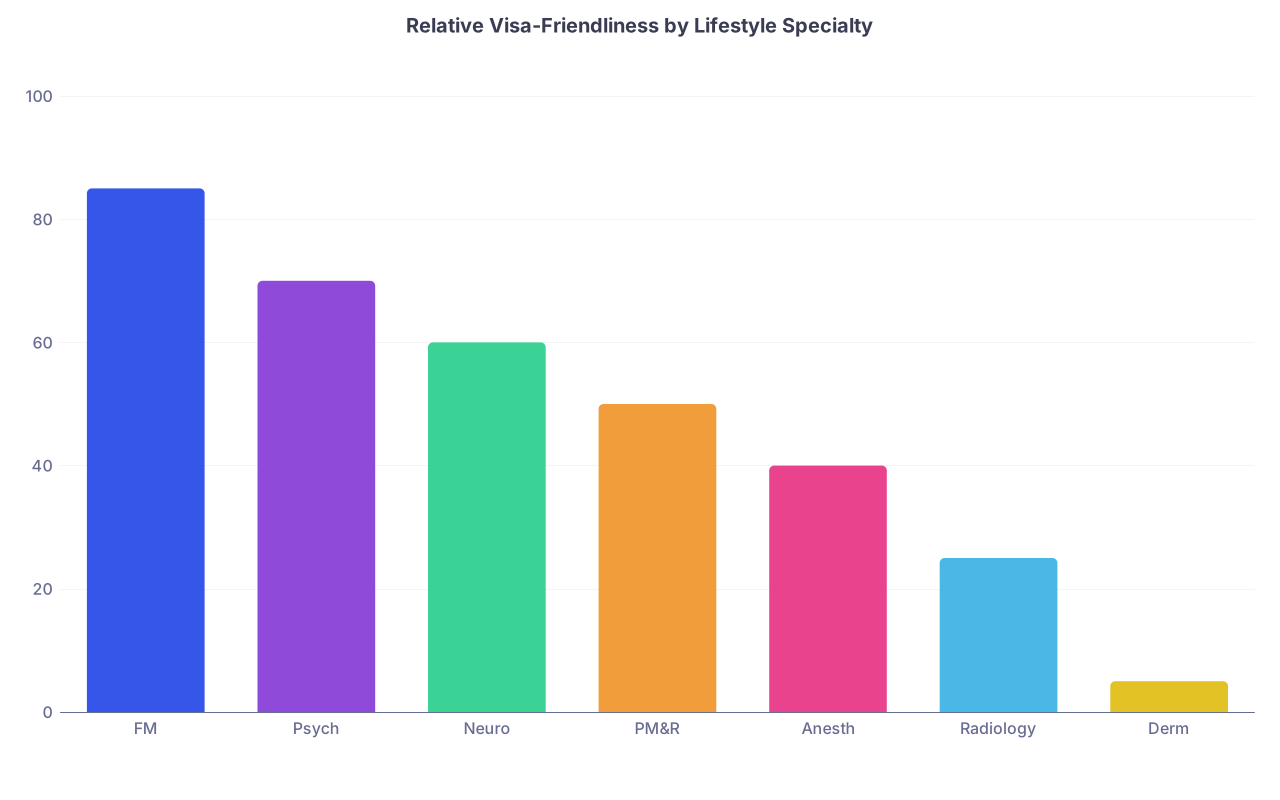
| Category | Value |
|---|---|
| FM | 85 |
| Psych | 70 |
| Neuro | 60 |
| PM&R | 50 |
| Anesth | 40 |
| Radiology | 25 |
| Derm | 5 |
Rough interpretation (these are directional, not official NRMP stats):
- Family medicine: High visa sponsorship, lots of IMGs, many community programs.
- Psychiatry: Strong growth, relatively IMG-friendly, more H-1B than you’d expect.
- Neurology: Mid-size field, decent number of programs open to visas.
- PM&R: Mixed. Some excellent IMG-friendly places, many that are US-grad only.
- Anesthesiology: More competitive, but a subset of community programs sponsor.
- Radiology: Tough for visa-restricted IMGs, but not impossible with a strong profile.
- Dermatology: Essentially unrealistic for a visa-dependent IMG unless you’re a unicorn with US PhD-level research and massive connections.
You’re not just choosing a specialty. You’re choosing:
- How hard it is to find any visa-sponsoring program.
- How much risk you’re willing to take.
- What your Plan B will be if you miss.
You can want “lifestyle” all you want. The system still has rules. So you work with the rules strategically.
2. Tiered Strategy: Lifestyle Within What’s Actually Accessible
Let me be blunt: for a visa-restricted IMG, the question is almost never
“Derm vs ophtho vs anesthesia vs radiology?”
It’s usually:
- “Which of the relatively accessible fields gives me the best lifestyle down the road?”
- “How much short-term pain am I willing to accept for long-term gain?”
- “How do I keep doors open while I play this game?”
Tier 1: Most Realistic Lifestyle-Friendly Options for Visa-Restricted IMGs
These are the core fields where I’ve repeatedly seen visa-dependent IMGs match and later build very lifestyle-friendly careers:
- Psychiatry
- Family Medicine
- Neurology
- PM&R (for some countries / profiles)
Let’s walk each one as if I were advising you in a hallway between clinic sessions.
3. Psychiatry: Quietly the Best Lifestyle Bet (For Many IMGs)
If you told me: “I need a visa, I want a life, and I’m not obsessed with procedures,” I’d put psychiatry at the top of your list.
Why psych works:
- Large and growing need. Mental health demand is exploding.
- Many programs already full of IMGs. They understand visas.
- Less physically demanding. Your back and your sleep will thank you.
- Outpatient-heavy career paths with very controllable hours.
Lifestyle reality:
- Many psychiatrists end up working 4–4.5 days/week.
- Inpatient psych can be intense, but call is often home call, not Q3 trauma.
- Outpatient clinics can be 8–4, no weekends, minimal emergencies.
Visa angle:
- A decent chunk of programs sponsor H-1B.
- Many accept J-1 without drama.
- They’re used to waivers and don’t freak out when you ask about visa stuff.
Who should seriously consider psych:
- You actually like talking to people and hearing hard stories.
- You’re not allergic to chronic, messy problems.
- You can handle vague cases without a CT or lab to “fix it.”
Who probably should not:
- You want your hands on procedures all the time.
- You hate ambiguity and long conversations.
- You’re chasing psych solely because it “sounds lifestyle.” That backfires; programs smell it.
4. Family Medicine: The Unsexy Workhorse with Big Lifestyle Upside
You might be rolling your eyes at family medicine because someone on Reddit told you it’s “low status.” Ignore that. You’re not applying to impress random strangers online.
Family medicine is:
- One of the most visa-friendly specialties.
- Packed with community programs that live on IMGs.
- Ridiculously flexible after residency.
Your residency lifestyle? Depends. Some FM residencies are brutal — heavy inpatient, lots of nights, OB, clinic overload. Others are chill, especially community programs in less desirable locations.
Your attending lifestyle? That’s where FM shines.
You can craft:
- 100% outpatient primary care, 8–5, M–F.
- Urgent care with set shifts, no pager.
- Telemedicine-only roles once you’re licensed.
- Niche: obesity medicine, lifestyle medicine, geriatrics, palliative, etc.

Visa advantage:
- Tons of J-1 spots; state waiver jobs after residency are everywhere in rural areas.
- H-1B is more limited, but still present in a subset of programs and jobs.
- If your priority is “I need a job in the US as a doctor” — FM gives you the most safety.
Downside:
- Pay is lower compared with procedures and radiology.
- You’ll deal with everything: rashes, chronic pain, anxiety, diabetes, social issues.
- Burnout risk is real if you land in a poorly run clinic.
Who should seriously consider FM:
- You’re okay being a generalist.
- You like continuity — following patients over years.
- Your priority is: match probability + visa security + eventual control over hours.
5. Neurology: Moderate Competitiveness, Decent Lifestyle If You Choose Right
Neurology sits in the middle:
- More competitive than FM/psych in some regions.
- Still has a fair number of IMGs and visa sponsorship.
- Lifestyle is variable depending on subspecialty.
Residency lifestyle:
- Often front-loaded with stroke services, night calls, consults.
- PGY-2 year can be tough — lots of codes, pages, ICU consults.
- But not surgery-tough, and not IM night float level.
Attending lifestyle:
- Outpatient neuro (headache, epilepsy clinic, movement disorders) can be very lifestyle-friendly.
- Stroke and neuro ICU are more intense — shift-like, more nights, but also structured.
- Academic neuro tends to have manageable, predictable schedules.
Visa angle:
- Many academic neurology departments sponsor visas because they rely on fellows and residents as workforce.
- Some even prefer IMGs with neuro research experience.
- J-1 waivers in neurology are not as ubiquitous as FM but still available.
Who should consider neurology:
- You actually find the brain interesting. If neuroanatomy made you want to vomit, skip this.
- You can handle complicated patients and families.
- You’re okay with some night work early in your career.
6. PM&R: Great Lifestyle, But Watch the Visa Trap
Physiatry looks amazing on paper: procedures, rehab focus, outpatient-heavy, good lifestyle.
Reality for visa-restricted IMGs:
- Many PM&R programs are small and university-based.
- Quite a few say “no visas” or “no H-1B.”
- The ones that do sponsor visas are often competitive and expect strong US clinical experience and good scores.
When PM&R works for you, it really works:
- Sports medicine, spine, pain-focused rehab clinics — all lifestyle-friendly.
- Inpatient rehab hospitals often have structured day shifts and home call.
- Less chaos than ED, less grind than hospitalist medicine.
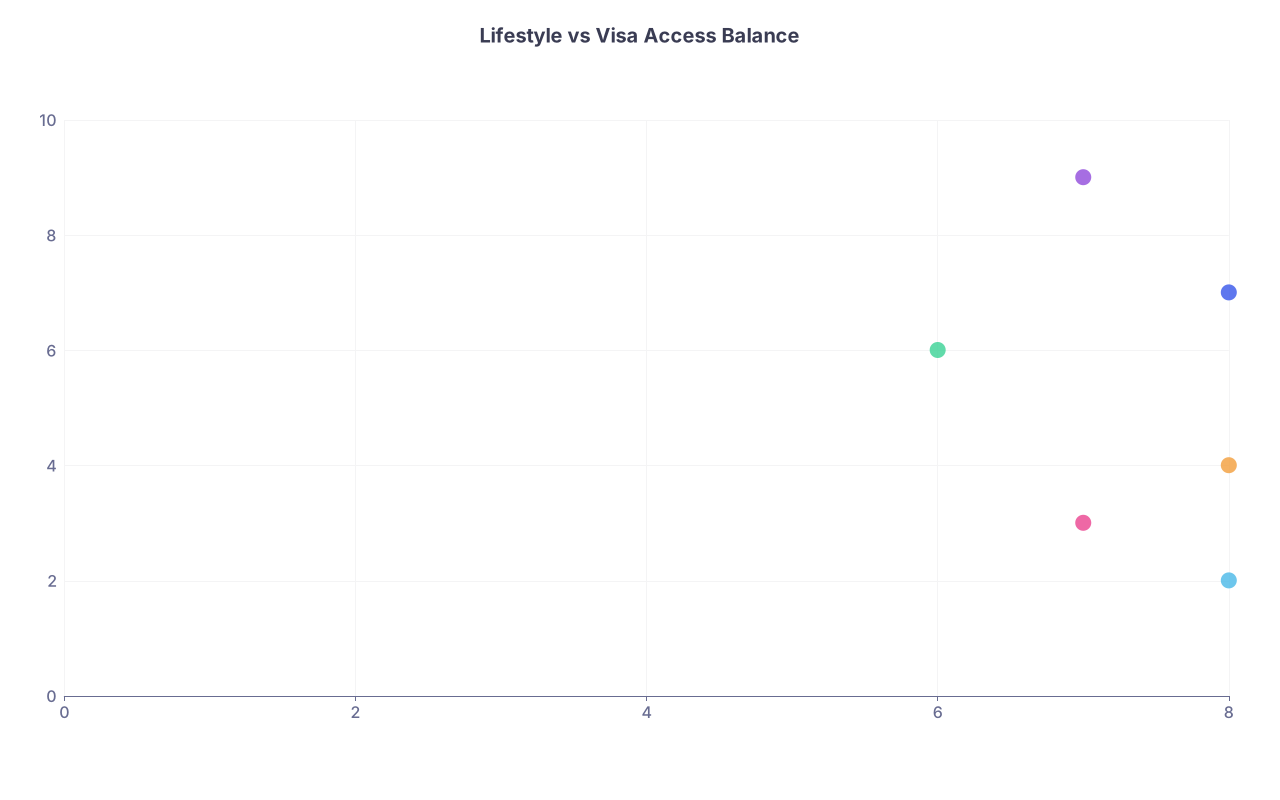
| Category | Value |
|---|---|
| Psych | 8,7 |
| FM | 7,9 |
| Neuro | 6,6 |
| PM&R | 8,4 |
| Anesth | 7,3 |
| Rads | 8,2 |
(Above: x-axis = lifestyle potential (1–10), y-axis = visa accessibility (1–10), rough comparative thinking.)
Who should take PM&R seriously:
- You already have some US PM&R exposure or research.
- You’re okay applying broadly and maybe doing a prelim year in IM or surgery first.
- You accept that this is riskier for a visa-dependent IMG than FM/psych.
If you’re reading this thinking, “I’ve never even rotated in PM&R,” then do not anchor your entire plan on it. Treat it as a parallel option, not your only path.
7. “Lifestyle” Fields That Are Technically Possible But High-Risk
Here’s where people get seduced and then crushed.
Anesthesiology
- Good lifestyle in certain practice settings: group practice, ASC work, no trauma call.
- For visa-restricted IMGs: mid-to-high risk.
- You need:
- Strong scores (think high 230s/240s on Step 2 if Step 1 is pass).
- Good US letters, ideally anesthesia-specific.
- Willingness to apply to a huge list and accept less glamorous locations.
Some IMGs match anes with visas every year. But you’d better be honest about whether you’re in their league or not. If you are, fine — pursue it, but with a backup.
Radiology
- Very lifestyle-friendly after residency in many private practice groups.
- But:
- Many programs avoid visas.
- IMG proportion is lower than IM/FM/psych.
- They often want research or US rotations and strong academics.
If you’re dead set on rads and you’re visa dependent, you need a plan like:
- Transitional or prelim year in IM at a visa-sponsoring program.
- Research years (if visa allows) with radiology departments.
- Extremely broad application strategy.
If that sounds exhausting — that’s because it is.
8. Choosing Based on Who You Are: Profiles and Paths
Let’s get concrete. Here are some archetypes I see all the time.
| Profile | Key Features | Higher-Yield Specialty Targets |
|---|---|---|
| Strong Academic | Step 2 ≥ 245, research, good English | Psych, Neuro, Anes (with backup), PM&R |
| Solid but Not Stellar | Step 2 225–240, some USCE | FM, Psych, Neuro (broad list) |
| Lower Scores / Attempts | Step 2 < 220 or attempts | FM (broad), Psych (safety-heavy) |
| Research Heavy | Publications, US research years | Neuro, Psych, PM&R, Rads (high-risk) |
If your main priority is: “I must match and get a visa”
Your high-probability pair is:
- Family medicine + psychiatry
You can still rank your true preference higher, but FM/psych gives you a realistic floor.
If your main priority is: “I want decent lifestyle plus some intellectual niche”
- Psychiatry with subspecialty (addiction, CL psych, child & adolescent)
- Neurology with outpatient subspecialty
- PM&R if you can line up solid exposure and IMG-friendly programs
If your main priority is: “I want max lifestyle, I’m willing to risk more, and my CV is strong”
- Consider:
- Anesthesiology with a backup in IM or neuro.
- Radiology only if you’re extremely competitive + willing to do research.
9. How to Actually Research Visa-Friendly, “Lifestyle-Tolerant” Programs
Stop guessing which programs sponsor visas. You can’t afford to waste 40% of your ERAS list on “unknowns.”
Here’s the process I give to IMG advisees:
Use FREIDA + program websites
Filter by specialties you’re considering. On each program:- Look at current residents: are there IMGs? Are there obvious visa graduates?
- Check if they explicitly say “J-1 only,” “H-1B considered,” or “no visas.”
Cross-check with current or recent residents
Message people on LinkedIn or find alumni from your med school:- “Hi Dr. X, I’m an IMG from [school] considering applying to [program]. I’m visa-dependent. Does your program currently sponsor H-1B or J-1 for residents?” Short, polite, direct. Some won’t respond, but enough will.
Build a personal list of “green light” programs
For each specialty, you want:- “Definite visa sponsors”
- “Probable sponsors based on current residents”
- Avoid “Unknown / no info” except as a small minority.
Pay attention to location
Rural / less popular states:- More likely to need IMGs.
- More likely to do J-1 waivers later.

| Step | Description |
|---|---|
| Step 1 | Start - Need Visa and Want Lifestyle |
| Step 2 | Consider Psych Neuro PM&R Anes |
| Step 3 | Focus on FM and Psych |
| Step 4 | Apply Broadly to Lifestyle Options |
| Step 5 | Add More FM Psych Programs |
| Step 6 | Rank by Fit and Visa Support |
| Step 7 | Strong Scores and Research? |
| Step 8 | Visa Friendly Programs? |
10. Tactics to Improve Lifestyle Within a Given Specialty
You might end up matching in a field that’s not your dream lifestyle on paper. Or you might pick FM/psych/neuro and still worry about burnout. So you shape your path inside that specialty.
Levers you can pull:
Outpatient vs Inpatient Bias
During residency, angle for:
- Outpatient-heavy electives.
- Continuity clinics that mirror the kind of practice you want.
After residency:
- Say no to hospitalist-style roles if you hate nights.
- Look for clinic jobs with clear hours in writing.
Subspecialty Choice
Examples:
- Neuro: avoid pure stroke-only jobs if you want fewer nights; lean into movement disorders, general outpatient, epilepsy if call is shared.
- Psych: outpatient, partial hospitalization programs, telepsychiatry, specialty clinics (ADHD, mood disorders).
- FM: direct primary care, concierge, or niche clinics (weight management, women’s health).
-
The less picky you are about city, the more power you have to choose your lifestyle:
- Small cities / rural areas: often easier visas, sometimes easier schedules.
- Big coastal cities: more competition, sometimes worse hours for same pay.
Boundary Setting Early
Even in residency:
- Don’t volunteer for every extra shift “just to look good.” Programs will let you burn out quietly.
- Take your vacations. Seriously.
11. If You’re Already Locked into One Path and Regretting It
This happens all the time. You’re PGY-1 internal medicine on a J-1, and you’re thinking: “I wanted lifestyle, what did I do?”
You still have options:
After IM:
- Sleep medicine, outpatient cardiology (if you can land it), endocrinology, rheumatology — all more lifestyle-friendly than pure hospitalist grind.
- Outpatient-only primary care roles.
If you’re early in your path and still in med school:
- Stop letting status anxiety pick for you.
- A “less glamorous” but visa-friendly lifestyle field is 100x better than sitting unmatched with a “glamorous” specialty on your ERAS.

12. Step-by-Step: What You Should Do This Month
If you’re serious about lifestyle and you’re visa-dependent, do this in the next 30 days:
Write down your top 3 specialties from this list:
FM, psych, neuro, PM&R, anes, rads.For each one, answer honestly:
- Am I actually competitive here as a visa-restricted IMG?
- Do I have or can I quickly get meaningful USCE or research in this field?
- Would I be okay doing this specialty every day for 20+ years?
From that reflection, pick:
- One “primary” lifestyle specialty you’re truly aiming for.
- One “safety net” specialty that is more visa-friendly (often FM or psych).
Build a spreadsheet:
- Columns: Program name, state, specialty, visa type, IMG presence, competitiveness, notes.
- Start with at least 40–60 programs per specialty (depending on how competitive you are).
Reach out to 5–10 current residents this week.
- Ask them specifically about visas and work-life culture.
Adjust your study, research, and USCE plans to support your primary and safety specialties — not random padded experiences that don’t help either.
FAQ (Exactly 4 Questions)
1. Is it a mistake for a visa-restricted IMG to aim for anesthesiology or radiology if I really want them?
Not automatically a mistake, but it is a gamble. If your scores, English, and US experience are clearly top-tier, you can absolutely aim for anes or rads. The problem is when people with weak or average profiles ignore FM/psych/neuro, apply only to ultra-competitive “lifestyle” fields, and end up unmatched. If you aim high, you still need a realistic backup list that can actually sponsor your visa.
2. Between family medicine and psychiatry, which generally has the better lifestyle long-term?
Managed well, psychiatry usually wins on predictability and emotional bandwidth. Outpatient psych tends to have fewer “true emergencies,” and the work is less paperwork-heavy in many setups. Family medicine can be excellent too, but it depends heavily on the clinic structure. If you land in a high-volume, poorly staffed clinic, your lifestyle will suffer. If both are equally open to you visa-wise and you like both, psych usually edges ahead for pure lifestyle.
3. Does choosing a more IMG-heavy specialty hurt my future job prospects or reputation?
No. That’s insecurity talking. Employers care about: your competence, your visa status, and your fit with their practice. Patients do not care if your specialty was “competitive” or not; they care if you listen and help them. Picking an “IMG-heavy” specialty like FM or psych that fits your life is far smarter than chasing something for prestige and ending up burned out or unmatched.
4. If I’m still in my home country with no USCE yet, what’s the single best move I can make now?
Decide on your top 2 realistic specialties (one primary, one backup) and start aligning everything toward them: research in those fields, observerships targeting those programs, conference abstracts if possible. Do not collect random experiences in five different specialties “just to show variety.” Depth in one or two IMG- and visa-friendly lifestyle specialties beats scattered noise every time.
Open your notes app or a blank document right now. Write two headings: “Primary Specialty Target” and “Backup Lifestyle Specialty.” Put one realistic choice under each, using what you just read. If you can’t pick, that’s your job for this week: narrow it down until you can.