
You’ve landed. New badge, new system, new country.
Your phone still has your home country’s SIM in slot 2, and you’re Googling “best lifestyle specialties” between orientation modules that make no sense.
People keep throwing advice at you:
“Derm or ophtho if you want lifestyle.”
“EM is dying.”
“Primary care is overworked.”
“You’re an IMG, just be happy with any spot.”
Useless. Because none of that answers your real question:
Given that I’m an international graduate in a new country, what are actually realistic lifestyle-friendly specialties for me – not some fantasy list for homegrown grads with perfect scores?
Let’s go straight at that.
Step 1: Get Brutally Honest About Your Starting Position

| Step | Description |
|---|---|
| Step 1 | IMG in new country |
| Step 2 | Prioritize visa friendly fields |
| Step 3 | More options |
| Step 4 | Consider moderately competitive lifestyle fields |
| Step 5 | Focus on less competitive lifestyle friendly fields |
| Step 6 | Visa needed |
| Step 7 | Scores and recs strong |
Here’s what actually shapes your realistic options more than “I like skin” or “I like eyes”:
- Visa status
- Exam scores & recency
- Local experience (observerships, research, electives)
- Communication and accent (yes, this matters in real life)
- Your tolerance for a few hard years to get to a long-term good lifestyle
Let’s be clear:
- If you need visa sponsorship, you’re automatically in a narrower lane.
- If your scores are mediocre and old, some doors that look “lifestyle” online are, in reality, bolted shut.
- If your communication is just “good enough” but patients constantly say “sorry, can you repeat?”, some specialties will drain you.
The goal isn’t to chase the perfect lifestyle specialty.
The goal is to find a field you can realistically match into that gives you a livable schedule and long-term control over your time and income.
Step 2: Forget Internet “Top Lifestyle Specialties” Lists
Most lifestyle lists are written for:
- Domestic grads
- Top 10–20% scores
- People with built-in network and letters
You’re not playing that game. You’re playing this one:
“What can I match into as an IMG that won’t destroy my health, marriage, or immigration status?”
So we’re going to use a more honest framework:
- Low/Moderate Competitiveness + Reasonable Hours + Job Flexibility
- And specifically: Fields where IMGs actually get in.
Step 3: Know Your Realistic “Lifestyle Tier” Options as an IMG
| Specialty | Competitiveness (for IMG) | Typical Schedule Control | Procedural vs Cognitive |
|---|---|---|---|
| Internal Medicine | Low–Moderate | Improves post-residency | Mainly cognitive |
| Psychiatry | Low–Moderate | High after residency | Cognitive |
| Family Medicine | Low | High in outpatient jobs | Cognitive |
| Pathology | Moderate | Good daytime hours | Non-patient facing |
| PM&R (Physiatry) | Moderate–High | Good but regional | Mixed |
We’ll go deeper on each. But these are the realistic starting points that can lead to true lifestyle. Then we’ll talk about “stretch” options.
Step 4: Internal Medicine – The “Gateway” to Lifestyle
Internal Medicine (IM) is not itself a cushy lifestyle in residency. You’ll work. Nights, weekends, admissions until 2 a.m. But for an IMG, IM is one of the most powerful doors into long-term lifestyle.
Why IM is realistic and smart for an IMG
- Many programs are IMG-friendly, including visa sponsorship.
- Once you’re in, you can pivot: outpatient primary care, hospitalist with block schedules, non-academic jobs, or subspecialties.
- After residency, lifestyle can be very good depending on your choices.
But you have to be strategic.
How IM turns into lifestyle in real life
Here’s what an IM path can look like:
Residency (3 years)
- Hard, but survivable.
- You build your reputation (and local references) in this new country.
Early career choice:
- Outpatient clinic (8–5, minimal nights)
- Hospitalist 7-on/7-off
- Mix of telemedicine + part-time clinic
Refine to lifestyle:
- Drop inpatient call.
- Move to a multispecialty group with team-based care.
- Negotiate fewer evenings, more NP/PA support.
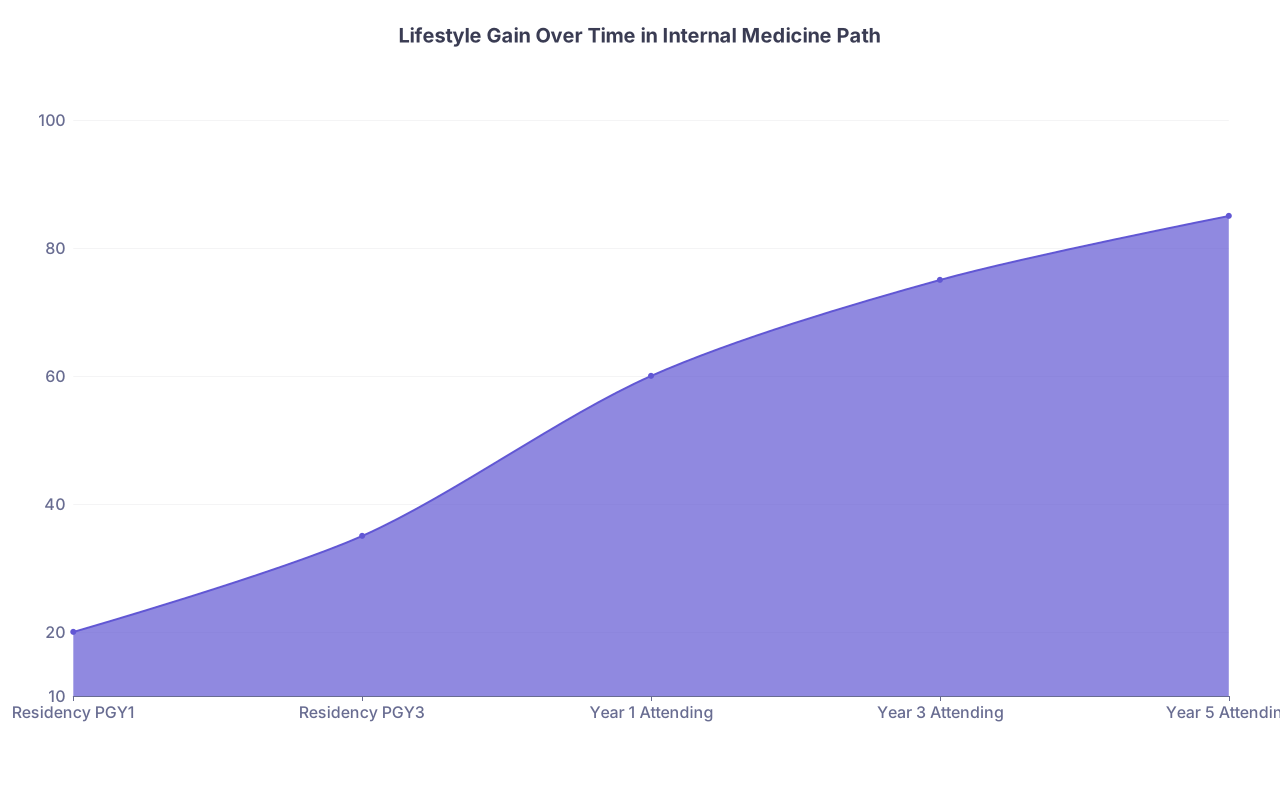
| Category | Value |
|---|---|
| Residency PGY1 | 20 |
| Residency PGY3 | 35 |
| Year 1 Attending | 60 |
| Year 3 Attending | 75 |
| Year 5 Attending | 85 |
(Think of that area curve as “lifestyle quality score” out of 100. Rough, but you get the idea.)
Where IM goes wrong for lifestyle
I’ve watched this happen again and again:
- IMG matches IM, breathes sigh of relief.
- Takes the first job offered: high-volume clinic, or brutal academic hospitalist with teaching + Q3 weekends.
- Gets stuck, burns out, thinks “this country is toxic.”
The problem wasn’t the specialty. It was lack of strategy.
IM gives you options, but you must actively chase and negotiate the lifestyle version.
If you’re in a new country and need stability + visa + eventual control → IM is your safest “long game” lifestyle play.
Step 5: Psychiatry – Quietly One of the Best Lifestyle Fields for IMGs
Psych is a strange beast. It used to be bottom of the barrel; now it’s popular. But for IMGs, it’s still fairly reachable in many regions.
Why psychiatry is lifestyle-friendly
- Predictable hours in outpatient settings.
- Emergencies are fewer and mostly handled by on-call systems.
- Telepsychiatry is exploding: remote work, flexible location.
- High demand almost everywhere.
When psych is a good fit for an IMG
- Your communication is strong and clear.
- You’re comfortable with long conversations and nuance.
- You’re okay with heavy emotional content but not so keen on procedures.
If your accent is thick and you struggle with idioms or subtle cultural cues? This can be harder, not impossible, but more exhausting. You’ll be “on” linguistically all day.
Visa and job reality
Many psych programs sponsor visas. And post-residency, underserved or rural regions will practically beg you to come.
Here’s the lifestyle version:
- 4-day clinic week, 8–5, no OB, no procedures.
- About 10–14 patients per day if you choose a sane practice.
- Optional telehealth days from home.
Once established, psych is one of the highest control/lifestyle fields you can realistically reach as an IMG in many systems.
Step 6: Family Medicine – Lifestyle Depends Entirely on How You Use It
Family Medicine (FM) is often dismissed by IMGs as “too low prestige” or “too broad.” That’s a mistake if lifestyle is your main goal.
The honest FM picture
- Easiest gateway specialty in many countries for IMGs.
- Massive range of practice models: from overworked urgent care mills to sweet 8–4 suburban clinics.
- You can niche down: women’s health, geriatrics, sports, ADHD, addiction, procedures, etc.
The catch: FM can be either:
- The most lifestyle-friendly field
- Or a treadmill of 25–30 patients per day and constant charting at night
It depends heavily on:
- Practice type (FQHC vs private vs large system)
- How much you’re willing to say “no” to crazy productivity metrics
- Your willingness to move to smaller cities or less saturated regions at first
FM as an IMG in a new country
Here’s where FM quietly wins:
- Shorter path to independent practice (3 years).
- More outpatient-focused, less brutal night coverage than IM.
- Easier job search in many regions.
- Often more open to IMGs and visas than highly competitive fields.
You can purposely craft a lifestyle practice:
3–4 clinic days/week, part-time telemedicine, maybe one urgent care shift if you want extra money.
The downside: yes, you’ll fight productivity pressure. But that’s true almost everywhere.
Step 7: Pathology – Great Lifestyle, Very Specific Trade-Offs
Pathology is routinely ignored in IMG circles, but if you hate the constant emotional grind of patient-facing work, you should at least consider it.
Why pathology often has good lifestyle
- Mostly daytime work.
- Limited nights and weekends in many settings.
- No direct patient complaints, no “my wait time was too long” nonsense.
- Deep, focused work.
But. You're trading:
- Lower visibility and glamor.
- Direct patient interaction (if you like that, this will feel empty).
- Reliance on hospital systems or academic centers for your job.
Reality as an IMG
Path isn’t overrun with IMGs, but many departments are open if:
- You have strong academic records and attention to detail.
- You’re ready to commit to a relatively narrow field early.
Lifestyle can be solid: 8–5, some call, but not like surgery or OB. If you want quiet, stable, and intellectually heavy, this is a very reasonable choice.
Step 8: PM&R (Physiatry) – Attractive but Not Always Realistic
Physiatry looks sexy on paper: rehab, musculoskeletal, procedures but not surgery, reasonable hours, lots of outpatient.
The problem? It’s increasingly competitive. And heavily regional.
PM&R lifestyle pros
- Outpatient MSK/rehab clinics with 8–5 hours.
- Procedures (injections, EMG, sometimes interventional pain).
- Low night call in many private settings.
But for an IMG in a new country
Barriers:
- Fewer spots than IM/FM, so every seat is contested.
- Some programs heavily prefer domestic grads.
- You almost always need local US/Canada/UK/Aus experience + letters in PM&R specifically.
I’ve seen IMGs get in. But they had:
- US rotations in PM&R
- Good exam scores
- Mentors who picked up the phone
If you’re early in the process and can still arrange electives/observerships in PM&R, it’s worth a shot. But don’t build your entire plan around this being your only acceptable lifestyle option.
Step 9: The “Dream Lifestyle” Fields and How They Actually Look for IMGs
Dermatology, radiology, ophthalmology, anesthesiology, EM. Let’s be blunt.
Dermatology
- Ultra-competitive in most developed countries.
- As an IMG with no derm research, no home country derm training, and average scores? Essentially fantasy.
- If you already did derm residency abroad with serious research and can get into fellowships, story changes, but that’s rare.
Ophthalmology
Beautiful lifestyle once established. But:
- Highly competitive.
- Often ring-fenced for domestic grads.
- Heavy procedural skill expectations early.
If you didn’t already have ophtho training or research, don’t bank on this.
Radiology
Now we’re closer to “possible but requires a plan.”
- Moderately to highly competitive depending on country.
- Some programs take IMGs, especially if you have good exam scores and technical aptitude.
Lifestyle as an attending can be excellent (especially telerads). But this is a stretch field for many IMGs, not a default safety option.
Anesthesiology
Call. Nights. OR delays. Lifestyle heavily depends on your group and hospital.
Also: competitiveness has gone up and down, but for many IMGs, anesthesia is far from guaranteed unless you have strong metrics and US connections.
Emergency Medicine
Used to be lifestyle. Now? Tough.
- Nights, weekends, violent patients, burnout, contract instability.
- Many EM docs are actively warning students away.
- As an IMG, matching EM in some countries is already challenging.
If you’re after stability and predictable daytime hours, EM is not your friend.
Step 10: Match the Specialty to Your Real Life, Not Just Your Fantasy
Here’s the real exercise you need to do:
Sit down with a blank page and write three columns:
- What I absolutely can’t tolerate (night call frequency, bloody trauma, endless rounding, etc.)
- Non-negotiables in my actual life (visa, need to support family quickly, location constraints)
- Strengths I already have (communication, language skills, research, prior specialty, procedural interest)
Then map those to the realistic fields we just walked through.
- If you need visa + like talking + want predictable days → Psych or FM, possibly IM outpatient later.
- If you need visa + like general medicine + can grind a few tough years → IM, then shape your practice.
- If you hate direct patient interaction + tolerate meticulous, quiet work → Pathology.
- If you love musculoskeletal medicine + can hustle for exposure → PM&R as a stretch.
Do not pick based only on what online forums romanticize this year. Those fads change. Your immigration status and debt do not.
Step 11: Tactical Moves You Should Make This Year
You’re in a new country. You don’t have time or money to waste. Here’s how to act like a grown-up about this.
Identify 2 primary and 1 stretch specialty.
Example: Primary – IM and Psych. Stretch – PM&R.Get local clinical exposure in at least your primary fields.
Observerships, externships, research with patient contact. Whatever you can realistically get.Target IMG-friendly programs from day one.
Don’t apply blind. Look up programs with a track record of IMGs, especially visa sponsorship if needed.Fix your communication.
If patients frequently struggle to understand you, invest serious time now in accent reduction, idioms, and casual conversation skills. This will massively influence your day-to-day happiness, especially in FM/IM/Psych.Keep an eye on long-term practice models.
During rotations, note:- Who looks burnt out and why
- Who looks actually content and what their schedule is
- What practice types (academic vs private vs community) seem livable
This is the fieldwork that actually leads to a decent lifestyle five years from now.
FAQs
1. I’m an IMG with mediocre scores and need a visa. Is lifestyle even realistic for me or am I doomed to grind forever?
You’re not doomed. You just don’t get to be picky early. Your path will probably look like: match into an IMG-friendly field (IM or FM most likely), take a job that’s not perfect but stable, then upgrade once you have local experience and a better CV. Many IMGs start in tougher locations (rural, underserved) then move into better hours, lower volume clinics or hospitalist roles after 2–3 years. You won’t get perfect lifestyle straight out of residency, but you can absolutely build toward it.
2. Should I chase a “dream” lifestyle field like derm or ophtho if that’s my passion, even if chances are low?
As a side option, fine. As your only plan, no. Apply broadly to realistic IMG-friendly fields first. If you truly have derm/ophtho-level credentials (research, prior training, top scores, strong mentors), you already know that. If you don’t, be honest: your first obligation is to secure a residency that gets you into the system. Passion doesn’t pay for exam fees or visas.
3. What if I choose a general field (IM/FM) and later regret not going for a more specialized lifestyle specialty?
You’ll have more options than you think. IM/FM can pivot into niches that dramatically improve lifestyle: sleep medicine, obesity medicine, sports medicine, outpatient-only, concierge practices, telemedicine-heavy roles. I’ve seen plenty of IMGs recalibrate after residency, carve out a niche, and end up with a far better lifestyle than they expected. The key isn’t chasing prestige; it’s designing a practice that fits your actual life and limits.
Key takeaways:
- As an international graduate in a new country, your best realistic lifestyle bets are usually IM, FM, Psych, Path, and sometimes PM&R – not the classic internet “top 5 lifestyle specialties.”
- The specialty is only half the story; how and where you practice within that specialty determines whether your life feels sane.
- Pick 2 realistic fields and 1 stretch option, get local experience, and build toward long-term control, not instant perfection.