
It’s 8:30 p.m. You’re post-call, half-scrolling through residency websites and Instagram pages. Every program claims “protected didactics,” “respect for wellness,” and “collegial culture.” The photos are all residents at breweries, hiking, laughing around a fire pit. Meanwhile, your intern friend at one of these “lifestyle” places just texted you from hour 29 in the hospital.
You’re not crazy to wonder: who’s actually lifestyle-friendly, and who’s just running a PR campaign?
Let me walk you through how people who’ve done this a few times sort programs into “actually livable” vs “this will eat your life and then send you a wellness newsletter.”
Step 1: Understand What “Lifestyle-Friendly” Really Means
Before you judge programs, get clear on what you’re trying to protect.
Lifestyle-friendly does NOT just mean:
- “We’re chill”
- “We’re a fun group”
- “We have a resident wellness committee”
Lifestyle-friendly usually means a combination of:
Predictable, sane hours
You’re not regularly living at 80 hours, even if the cap is 80. Most weeks fall in the 55–65 range with some spikes. Call is structured, not chaos.Respect for days off and vacation
- You actually get your 4 days off per month.
- You don’t get guilted for taking your 3–4 weeks of vacation.
- Coverage is planned instead of dumped on co-residents last minute.
Real backup systems
When someone is out sick, there’s a plan. Not just “the intern picks it up.” This matters more than any wellness talk.Non-punitive culture
You’re not terrified of asking for help, calling out fatigue, or saying you’re overwhelmed. That’s culture, not policy.Location + cost of living that actually works
A “great lifestyle” program in a city where rent eats 60% of your paycheck is not lifestyle-friendly for most people.Specialty baseline
Some specialties are inherently more lifestyle-friendly: dermatology, pathology, radiology, PM&R, outpatient psych. Others (gen surg, OB, EM in certain places) have to fight their own nature.
The trick: you’re looking for structure + culture. Both. If either is bad, your lifestyle is bad.
Step 2: Use Hard Data Before You Ever Talk to Anyone
Do some pre-filtering. Programs love adjectives; you need numbers and structure.
A. Check actual schedules, not marketing language
If a program posts block schedules online, read them like a contract.
Watch for:
- How many months of ICU?
- How many inpatient months per year?
- How many nights / night float blocks per year?
- How much elective time and when does it start (PGY-1 vs PGY-3)?
If it’s a “lifestyle-friendly” IM program but:
- PGY-1: 8+ months heavy inpatient + ICU
- PGY-2: 6+ heavy blocks
- Night float stacked repeatedly
…it’s not lifestyle-friendly. It’s just less malignant.
B. Check call structure vs vague phrases
“Home call” sounds nice. It can be a trap.
You want to know:
- Home vs in-house?
- Frequency: q3, q4, q6?
- Is post-call truly off, or do you pre-round the next day?
- How often are weekends actually free?
If none of this appears anywhere on their website or in their materials, that’s your first red flag: they’re not transparent.
C. Look at vacation + leave policies
Specifically:
- How many weeks of vacation? Is it written as a number, or vague like “generous time off”?
- Are there blocked vacation weeks vs scattered days?
- Sick days and parental leave – is there a formal policy, or just “we’re supportive”?
Programs that are lifestyle-friendly are usually proud and specific about this. Programs that are not? They bury it.
Step 3: Decode the Red Flags Hidden in Their Own Materials
Programs accidentally tell on themselves constantly.
Here’s what to watch:
| Signal | What It Often Really Means |
|---|---|
| “We’re like a family” | Boundary issues, guilt, blurred work-life |
| “We’re very hardworking” | Long hours are normalized |
| “We’re not a lifestyle program” | Expect 70–80 hour weeks as routine |
| “We train warriors” | Toxic toughness culture |
| “Wellness half days” only | Surface-level wellness, no workload change |
Words I pay attention to:
- “We’re busy but…” = you will be crushed, but you will be told it makes you strong.
- “We’re a high-volume center” in lifestyle-specialties (derm, PM&R, rads) = borderline factory.
- “We’re like a family” repeatedly = people will get offended when you set boundaries.
Also look at photos:
- If every photo of residents is in the hospital, none outdoors, none doing normal life things, that tells you something.
- If they post tons of “workroom grind” photos as pride content, that’s the cultural vibe.
Step 4: Use the Interview Day to Get Real Answers
Interview day is structured to hide the bad parts. You have to be intentional.
Ask residents these exact questions (or very close):
“How many hours did you work last week?”
Then follow up: “Is that typical, low, or high for you?”
Do this with multiple residents.“How often do you violate duty hours?”
The answer should not be “never, we never violate.” That usually means “we don’t log honestly.”“How easy is it to get someone to cover if you’re sick?”
Good program: “Pretty easy, we have backup / jeopardy.”
Bad program: long pause, awkward laugh, or “well, we try not to get sick.”“How often do you get your full days off?”
Watch for: “Technically…” or “We’re supposed to…” or “Most of the time.”“How many people left the program in the last 5 years?”
If they dodge: that’s data.For lifestyle specialties (derm, rads, path, PM&R, psych):
“What does your worst rotation look like? Your hardest week?”
If their “worst” is still 50-ish hours and not emotionally brutal, that’s lifestyle-friendly.
Watch behaviors, not just words
Red flags during the day:
- Everyone looks wrecked and flat. Not just tired, but empty.
- Residents sugarcoat and use program-leadership phrases: “We’re very invested in education,” “we’re a high-acuity center” – that’s propaganda leaking.
- You never get residents alone without a faculty member hovering.
Green-ish flags:
- Residents comfortably joke about flaws.
- Someone says, “Honestly, X rotation sucks, but it’s just 2 months and we all cover for each other.” That’s normal.
- They talk about actual hobbies with specifics: “I play in a local soccer league,” “We go climbing every Thursday.” Not “People have hobbies.”
Step 5: Cross-Check With Anonymous Sources (Where People Tell the Truth)
You’d be dumb not to use the places where people vent:
- Reddit (r/Residency, r/medicalschool, specialty-specific subs)
- Specialty forums and Discords
- Alumni from your med school now in those programs
- People a year or two ahead of you who interviewed there
Ask them:
- “Who are the truly chill programs in this specialty?”
- “Which ones market lifestyle but are actually brutal?”
- “If you had to pick 1–2 programs where your co-residents seem genuinely happy, what would they be?”
You’ll see the same names show up repeatedly – both good and bad. Patterns matter more than one angry post.
Step 6: Specialty-Specific Reality Check
Some specialties are built for lifestyle. Others are lifestyle-possible only in specific types of programs.
More lifestyle-friendly by default (residency + career):
- Dermatology
- Pathology
- Radiology
- PM&R
- Outpatient Psychiatry
- Radiation Oncology
In these, you’re mainly separating:
- Reasonable vs insane call expectations
- Malignant vs normal culture
- Academic pressure vs balanced learning
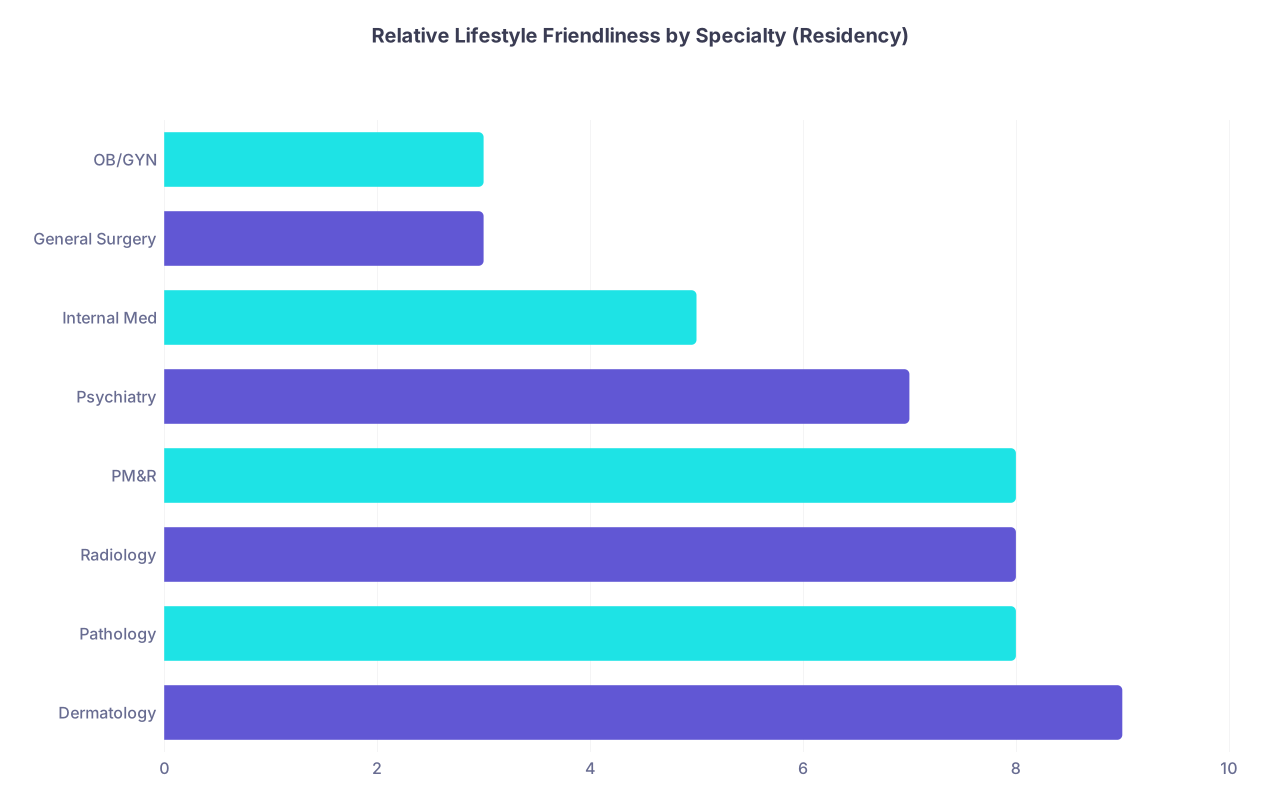
| Category | Value |
|---|---|
| Dermatology | 9 |
| Pathology | 8 |
| Radiology | 8 |
| PM&R | 8 |
| Psychiatry | 7 |
| Internal Med | 5 |
| General Surgery | 3 |
| OB/GYN | 3 |
(Scale 1–10: higher = more lifestyle-friendly in residency.)
In-between specialties (highly program-dependent):
- Internal Medicine
- Pediatrics
- Neurology
- Anesthesia
- EM (huge variation by site and schedule model)
Here, a “lifestyle” IM program at a community hospital with strong caps and night float can be far more livable than a top-10 academic powerhouse where nobody leaves before 7 p.m.
Hard mode regardless, but still variable:
- General Surgery
- Orthopedics
- OB/GYN
- Neurosurgery
- ENT
Here “lifestyle-friendly” doesn’t mean derm hours. It means:
- Fewer 80-hour weeks, more 60–70
- Genuine post-call day off
- No yelling OR culture
- Real attention to fatigue and backup
So when a general surgery or OB program advertises “great lifestyle,” interpret that as “less soul-crushing for surgery.” Not in absolute human terms.
Step 7: Ask the Questions Programs Hate (But Need to Answer)
You can do this politely and still get real data. Ask at least a few of these:
- “Can you walk me through a typical day on your busiest rotation for an intern? Start-to-finish?”
- “Roughly what time do most residents leave on wards, on average?”
- “How many patients does an intern usually carry?” (for IM/peds/psych)
- “How often does your night float resident cross-cover more than X patients?”
For lifestyle specialties:
- “How much actual home-work (reads/calls/charting) do you bring home?”
- “On average, what’s your door-to-door time?” (when you leave home vs return)
You’re looking for ballparks. Not perfection, just reality.
Step 8: Signs a Program Is Actually Lifestyle-Friendly
Put it all together. Strong signs you’re dealing with the real thing:
- Written, specific duty-hour and call policies, easily found, not hidden
- Backup / jeopardy system explained clearly by residents who say “we actually use it”
- Residents can list real hobbies and talk about them like they actually do them, not aspirationally
- They admit which rotations are bad and frame them as finite, not “you just grind through”
- You see diversity in life situations: residents with kids, residents who commute from reasonable suburbs, people who seem like they have a life outside the program
And maybe the biggest: when asked, “If you had to choose again, would you pick this program?” most residents say yes without a long pause.
Quick Decision Framework
If you want a simple “gut check” framework when ranking:
- Did you get clear, specific answers about hours and call from residents?
- Did at least one resident look like the kind of human you want to be in 3 years?
- Are there real backup systems? (not “we all pitch in”)
- Would you be okay living in that city on that salary for 3–5 years?
- Do anonymous sources basically agree with what you saw?
If you’re three or more “no’s” on that list, I’d be very careful calling that program lifestyle-friendly, no matter how many yoga photos they upload.
FAQ (Exactly 6 Questions)
1. Are community programs always more lifestyle-friendly than academic ones?
No, but they skew that way. Community programs often have:
- Lower patient volumes
- Less research pressure
- Fewer “conference after conference” obligations
That said, I’ve seen community sites that grind residents into dust and academic programs that are surprisingly humane. You still have to look at schedules, culture, and call. Don’t assume.
2. How much weight should I give to duty-hour violations when evaluating lifestyle?
A lot – but context matters. If residents say, “We technically violate sometimes on X rotation, but we report it and it’s getting better,” that’s reality. If they say, “We basically never report, it’s easier,” that’s a problem. Real lifestyle-friendly programs encourage honest logging and adjust rotations instead of punishing complainers.
3. Can a surgical or OB/GYN program ever be truly lifestyle-friendly?
In absolute terms, not like derm or rads. In relative terms, yes. A “good lifestyle” surgical program means: rare 80+ hour weeks, strong post-call protection, non-toxic attendings, and a culture that doesn’t glorify suffering. You’ll still work hard. But you won’t be destroyed.
4. What if residents give completely different answers about hours and lifestyle?
That actually happens a lot. Pay attention to:
- PGY level (interns usually suffer more)
- Rotations they’re on when you ask
- Whether the more senior people look burnt out or content
If one person says 40 hours and another says 80, believe the higher number as the safe baseline.
5. How do I factor in city and cost of living into “lifestyle-friendly”?
Heavily. A “chill” program in Manhattan where you’re broke and in a 300 sq ft apartment may feel worse than a busier program in a mid-size city where you can afford a yard and a 10-minute commute. Lifestyle is not just hours; it’s what your non-working hours actually look like.
6. Is it okay to directly ask, “Are you really lifestyle-friendly or just marketing?”
You can, but phrase it smarter. Try: “Some programs advertise lifestyle but residents feel differently. What do you think your program gets right about supporting resident life outside the hospital, and what still needs work?” You’ll get a more honest, nuanced answer—and you won’t sound confrontational.
Key takeaways:
- Ignore the buzzwords and Instagram. Focus on schedules, call, backup systems, and what residents actually say when they’re slightly off-script.
- Lifestyle-friendly is relative to the specialty and the city. Compare programs against realistic baselines, not fantasies.
- When in doubt, trust consistent patterns from residents and anonymous sources more than any single polished presentation.