
What does a “four‑day workweek” actually look like when you’re a physician who’s supposedly full-time? Is it real, or just recruiter fiction?
Here’s the honest answer: Yes, you can work four days a week in a full-time physician role in many specialties. But it almost never means a chilled 32-hour week with full salary and no tradeoffs. Someone pays for that day off—either you, your paycheck, or your partners.
Let’s break down when a 4-day schedule is actually realistic, which specialties make it easiest, what “4 days” really means in clinic hours and RVUs, and how to negotiate it without blowing up your income or your group.
Step 1: What “Four Days a Week” Really Means for Physicians
Before you even think about specialty, you need to translate vague recruiter talk into actual numbers.
Most “4-day” physician jobs fall into a few buckets:
| Model | Clinical Days | Daily Clinic Hours | Typical Weekly Hours |
|---|---|---|---|
| Compressed Full-Time | 4 | 9–10 | 40–50 |
| 0.8–0.9 FTE | 4 | 7–8 | 32–38 |
| 4 Days + Call/OR | 4 | 8–10 | 45–60+ |
| Hospitalist 7-on/7-off | 3–4 | 12+ | 40+ (averaged) |
When someone says “four days” you need to immediately ask:
- How many clinic hours per day?
- How many patients per day?
- Is call included? Paid? Home call or in-house?
- What FTE is this actually (0.8, 0.9, 1.0)?
- How is compensation tied to wRVUs or hours?
Because here’s the trap: A lot of “four-day” gigs are just five days of work jammed into four long ones. I’ve seen outpatient docs with “four days” of clinic, 8:00–5:30 scheduled, plus charting at night and “just a few calls” on the off day. That’s basically full-time-plus, compressed.
You’re probably really asking:
Can I work four days, protect my day off, and still have a career that feels sustainable?
That’s a different question. And yes, in many specialties, that’s absolutely possible.
Step 2: Specialties Where a 4-Day Week Is Actually Lifestyle-Friendly
Let’s go through the most lifestyle-friendly options for a realistic four‑day setup, not fantasy.
1. Outpatient Primary Care (FM, IM, Pediatrics)
This is the classic “four‑day clinic” situation.
Why it works:
- Clinic schedules are predictable.
- You can block a weekday and just not see patients that day.
- Coverage can be shared across a multi-physician group or advanced practice provider (APPs).
Typical real-world setup:
- 4 clinic days/week (e.g., Mon–Thu), 8–9 scheduled hours.
- 18–24 patients/day depending on system.
- 0.8–1.0 FTE depending on panel size and RVUs.
- Light call: phone call pool, maybe 1:6 or 1:8 weekends.
The catch:
- If you go 0.8 or 0.9 FTE, your salary and benefits may prorate.
- In RVU models, dropping a day may hurt income unless you keep your productivity high on the four days.
- Charting will still leak into your off day if you don’t guard it.
Is a true four-day lifestyle realistic here? Yes, if:
- You’re okay with slightly less income or higher intensity.
- You aggressively protect your day off (no casual “can you just see one patient?” nonsense).
2. Outpatient Subspecialties (Endo, Rheum, Allergy, Derm, Psych, etc.)
A lot of the “most lifestyle-friendly” specialties are clinic-heavy and non-procedural.
Best bets for a 4-day week:
- Dermatology
- Psychiatry (especially outpatient)
- Allergy/Immunology
- Endocrinology
- Rheumatology
- Outpatient-only GI or Cards in rare setups
Why it’s feasible:
- Generally elective, non-emergent care.
- You control clinic templates.
- Less night coverage compared to procedural or hospital-based fields.
Example:
- Outpatient psychiatrist: 4 days clinic, mix of 45-min intakes and 20–30-min follow-ups.
- Derm: 4 days of clinic, procedures scheduled into clinic time, minimal call.
The trade-off:
- High-paying outpatient subspecialties may expect correspondingly high productivity. If you slash a day but want top 10% income, you’ll feel that pressure.
- In competitive fields (derm, some GI/Cards), partnership tracks may assume “full-time” means 4.5–5 days at high volume.
Yes, you can be the 4-day derm or psych doc. But you probably won’t also be the top earner in the group unless your four days are intense.
3. Anesthesiology, Radiology, and Pathology
These are often held up as “lifestyle” fields. Reality is more nuanced.
Anesthesiology
Four-day options:
- 4x10s in the OR (common in larger groups).
- Structured shifts (e.g., 3 longer days + 1 shorter).
- Daytime-only anesthesiologist positions with a set weekly schedule.
Pros:
- Shift-based work makes 4-day scheduling very natural.
- Some groups explicitly offer 0.8–0.9 FTE for reduced days.
Cons:
- Call nights/weekends can blow up the “4 days” fantasy quickly.
- In some private groups, partners working less than “full blast” get side-eyed.
A realistic lifestyle-friendly version:
- Large hospital group.
- 4 days/week, mostly day shifts.
- Limited or optional call with corresponding pay cut.
Radiology
Radiology has quietly become one of the best four-day-lifestyle specialties in the right setting.
You’ll see:
- 4 days of teleradiology, often 10-hour shifts.
- Hybrid 3–4 day/week models.
- Evening shifts that compress total days.
Why it works:
- Purely shift-based.
- Workload is measured in RVUs/reads not “days.”
Watch for:
- Overnight or evening shifts: lifestyle hit but sometimes huge flexibility.
- Some groups expect FTE radiologists to take their share of nights/weekends.
Pathology
Path can be very stable 4-days in the right private group, but:
- Smaller groups may need you 5 days physically present.
- Case volume spikes can bleed into your off day mentally and digitally.
Overall: Among procedural-ish and diagnostic fields, anesthesia and radiology give some of the most structurally friendly paths to 4-day work.
4. EM and Hospitalist: “Four Days” by Average, Not Calendar
These are different beasts. You don’t think “days per week,” you think shifts or blocks.
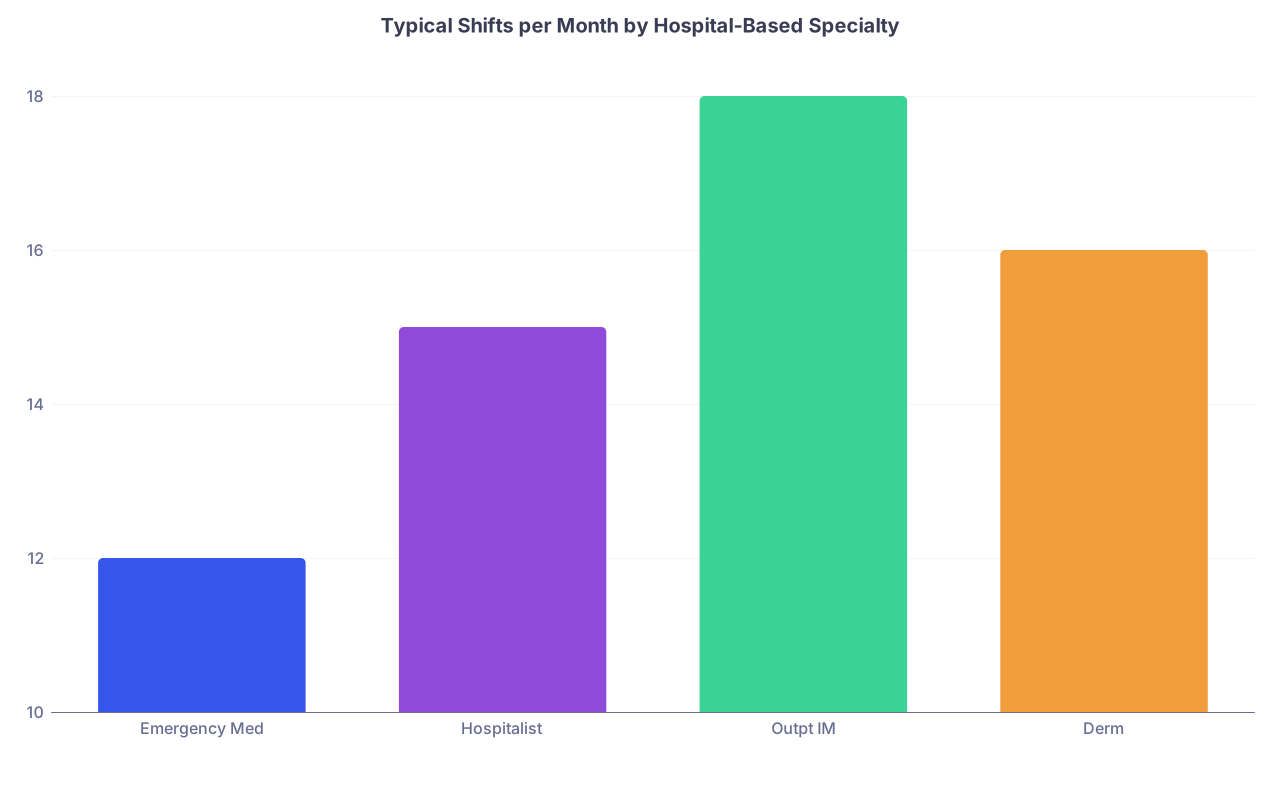
| Category | Value |
|---|---|
| Emergency Med | 12 |
| Hospitalist | 15 |
| Outpt IM | 18 |
| Derm | 16 |
Emergency Medicine
EM is basically built around nontraditional schedules.
A common setup:
- 12 shifts/month of 8–12 hours each.
- That averages to 3–4 days/week, but some weeks are heavy, some weeks light.
Lifestyle advantage:
- Tons of control over clustering shifts.
- You can effectively work “full-time” hours with more days off if you stack.
But:
- Nights, weekends, holidays.
- Shifts are intense; “off days” are often recovery days.
So can you say “I work 4 days a week”? Sort of, yes. But the emotional and circadian wear is not the same as 4 office days in derm.
Hospitalist Medicine
Common 7-on/7-off model also averages out to about 3.5 days/week over a year. But those 7 days? They’re full blast.
For 4-day lifestyle:
- You can often negotiate 0.7–0.8 FTE: fewer shifts per month, 4–5-day blocks instead of 7.
- Or join a larger team that offers part-time with pro-rated salary.
It can be lifestyle-friendly if:
- You like intensity-burst then full disconnect.
- You protect your off weeks as sacred.
But if you’re picturing four gentle 8-hour days and long weekends—this is not that.
Step 3: Specialties Where a True 4-Day Lifestyle Is Tough
This is where people try to force a 4-day structure into a 5–6-day culture and it goes badly.
1. Surgical Specialties (Gen Surg, Ortho, ENT, Uro, etc.)
Let me be blunt: if you want to be a busy operating surgeon, consistently working only four days a week long-term is tough.
Why:
- OR block time plus clinic plus postop care plus call.
- Emergencies don’t read your schedule.
- Culture in many surgical groups equates time in hospital with “commitment.”
You can:
- Do 4 clinic days and reduce OR time (at the cost of income and maybe credibility).
- Move into more elective, low-urgency niches (e.g., bread-and-butter outpatient ortho, plastics) and set up a more lifestyle-focused private practice.
- Go academic with more research/admin time, though that’s not necessarily lighter.
But if your top priority is a protected weekly day off and predictable evenings, you’re choosing the wrong neighborhood.
2. OB/GYN
OB/GYN is famously rough on lifestyle because:
- Clinic + OR + L&D coverage + unpredictable nights.
- Even “call share” still interrupts sleep and off days.
Yes, there are laborist models or GYN-only jobs where 4 days are realistic, but these are specific niche roles you’d have to actively target.
If you demand a four-day lifestyle with minimal disruption, OB/GYN makes you fight the current constantly.
3. Highly Inpatient-Dependent Subspecialties
Think:
- Cardiology (invasive, interventional especially)
- Pulm/crit (with ICU blocks)
- GI (with heavy procedures and call)
- Heme/Onc with lots of complex rounding
The more your specialty leans on hospital, procedures, and emergencies, the harder it is to reliably protect a day off. You can piece together a 4-day on paper, but in reality, your fifth day gets eaten by add-ons, call, and “just a quick consult.”
Step 4: How to Actually Get a 4-Day Schedule Without Wrecking Your Career
Here’s the part almost nobody teaches you: you don’t ask, “Can I work four days?” You ask, “What FTE and RVU target can I accept, and which jobs support that structurally?”

| Step | Description |
|---|---|
| Step 1 | Start - Want 4 day week |
| Step 2 | Target high RVU outpatient or shift based |
| Step 3 | Accept 0.8 to 0.9 FTE |
| Step 4 | Look at psych, derm, radiology, anesthesia |
| Step 5 | Consider EM, hospitalist, busy subspecialty |
| Step 6 | Negotiate 4 day contract with pro rated pay |
| Step 7 | Ask for explicit schedule in contract |
| Step 8 | Review call, admin time, RVU expectations |
| Step 9 | Need full 1.0 salary? |
| Step 10 | Lifestyle priority high? |
Here’s the playbook:
Decide what you’re optimizing for.
- Maximum income? Your four days will be busy, and you’ll probably pick a high-output specialty (EM, anesthesia, radiology, high-volume outpatient).
- Maximum lifestyle? You’ll accept slightly less income and avoid hospital-heavy specialties.
Filter specialties early.
If a predictable four-day week is non-negotiable for you, don’t torture yourself trying to make trauma surgery or interventional cardiology fit that mold.During residency, watch how attendings actually live.
Not what they say. Who:- Leaves on time?
- Has protected nonclinical days?
- Actually takes vacations without chaos?
When job hunting, force specificity.
Don’t accept “Yeah, we can probably do four days” from a recruiter. Ask:- How many hours of clinic per day?
- What is the written FTE definition?
- What did the last doc in this role actually do?
- Show me a sample weekly schedule.
Get the schedule structure in writing.
Your contract doesn’t need every detail, but it should say things like:- “Four days of scheduled clinic per week.”
- “0.8 FTE with proportional base salary and benefits.”
- Clear expectations for call and weekends.
Use FTE intentionally.
A lot of people fight the idea of being anything less than 1.0 FTE. But:- 0.8–0.9 FTE with a sane life is often better than 1.0 FTE and miserable.
- In many systems, 0.8 still gets full benefits.
Expect to trade some income for sanity.
That’s not failure. That’s an adult decision. You can always ramp up later if you want.
Step 5: Where the Four-Day Week Fits by Specialty – Big Picture
If you want a quick mental map, here it is:
| Specialty Type | 4-Day Realism | Lifestyle Comment |
|---|---|---|
| Outpatient Primary Care | High | Most common and straightforward |
| Outpatient Subspecialties | High | Best combo of pay + predictability |
| Radiology/Anesthesia/Path | High–Moderate | Great if shift-based and group is flexible |
| EM/Hospitalist | Moderate | 4-day *feel* via shifts, but high intensity |
| Surgical Fields | Low–Moderate | Possible in niche or low-volume roles |
| OB/GYN | Low | Need very specific job structure |
If you told me:
- “I want to work four days, predictable hours, minimal nights, and still feel like a real doctor,” I’d steer you toward:
- Outpatient FM/IM/Peds in a good system
- Derm, psych, allergy, rheum, endo
- Radiology in a reasonable-volume group
- Anesthesia with stable days and limited call
If you said:
- “I don’t mind intensity or weird hours, but I want clustering and lots of days off,” I’d say:
- EM
- Hospitalist
- Certain anesthesia or radiology shift models
And if you said:
- “I want to be a high-volume surgeon and always have Fridays off,” I’d tell you that’s probably a fantasy unless you’re willing to:
- Take a serious pay cut, or
- Build an outpatient-heavy, elective practice over years and intentionally design for it.
Bottom Line: Can You Realistically Work Four Days a Week?
Yes, you can. But be specific about what that means.
Key points to remember:
“Four days a week” isn’t magic. Translate it into hours, RVUs, and call. Then decide if that’s truly a lifestyle improvement or just repackaged full-time work.
The most lifestyle-friendly four-day options cluster around outpatient-focused and shift-based specialties: primary care, outpatient subspecialties, psych, derm, radiology, anesthesia, and certain EM/hospitalist setups.
You will trade something—usually income, sometimes prestige, occasionally certain career paths—to protect that extra day. That’s not weakness. That’s designing a career that doesn’t burn you out by 40.