
The biggest mistake applicants make about lifestyle questions is not what they ask, but when they ask it.
You cannot grill a program director about moonlighting and call buy-downs in your first email. You also should not wait until rank list week to find out whether “q4 call” really means you leave post-call at noon or you routinely stay till 5.
Here’s your interview season calendar for when to ask what about work-life expectations, especially if you’re targeting the most lifestyle-friendly specialties (think: dermatology, radiology, PM&R, pathology, anesthesia, even some IM and psych programs with genuinely humane cultures).
Use this like a playbook: month-by-month, then week-by-week, then down to the exact moment during the interview day to ask specific questions.
August–September: Pre-ERAS – Quiet Recon Phase
At this point you should not be asking programs direct lifestyle questions. You do not exist to them yet. Use this window to build context.
What you focus on now
Build a baseline expectation for lifestyle by specialty.
Get real about the “lifestyle friendly” reputation. Some are still brutal at certain places.Lifestyle Expectations by Specialty (Typical, Not Universal) Specialty Typical Hours/Week Call Burden Lifestyle Reputation Dermatology 45–55 Minimal Very lifestyle friendly Radiology 50–60 Variable nights, home call common Lifestyle friendly at many programs Pathology 45–55 Rare in-house call Lifestyle friendly PM&R 50–60 Light call, some weekends Moderately lifestyle friendly Psychiatry 50–60 Some nights/weekends, usually manageable Moderately lifestyle friendly Stalk websites with purpose.
You’re hunting for implicit signals of work-life culture:- Do they show residents at social events or only at microscopes/OR tables?
- Are there explicit statements about wellness, protected didactics, or mental health support?
- Do they brag about “high volume, high acuity, high expectations” with zero mention of support? Red flag.
Ask older residents and alumni — not programs.
This is when you text the radiology PGY-3 from your med school:- “How often are you actually staying past your scheduled end?”
- “What’s the real call schedule, not the advertised one?”
- “How many residents burn out or transfer out?”
At this stage, your questions should be off the record, peer-to-peer. You’re building your internal benchmark for what “reasonable” looks like in each specialty.
October: Application Submission – Light Probing, No Direct Demands
You’ve submitted ERAS. Radio silence from programs. Tempting to email coordinators to show “interest” and slip in lifestyle questions. Don’t.
At this point you should:
- Refine your deal-breakers before any interviews appear:
- Max acceptable average weekly hours.
- Max number of in-house overnights per month.
- Geographic or commute constraints.
- Mandatory research time vs more clinic time (for lifestyle, research months can be a hidden break or a hidden trap).
Write these down. Seriously. When you’re staring at rank lists in February, you’ll forget what seemed reasonable in October.
- Draft your question bank by audience (you’ll use this later):
- PD-only questions (high-level philosophy).
- Resident-only questions (what actually happens).
- Coordinator/admin questions (logistics, benefits, schedules).
You are not asking them yet. You’re preparing.
November: Early Invites – Email & Social Event Boundaries
First invites trickle in. This is where people start oversharing in pre-interview emails and blow their own image.
When you get an invite
At this point you should confirm attendance and gather structure, but not grill them.
Safe to ask the coordinator:
- “Will there be a resident-only session?”
- “Is there a separate time to discuss things like benefits and schedules, or should we save those for email later?”
- “Is there a typical interview day agenda you can share?”
Not safe to ask in November pre-interview emails:
- “How many hours per week do residents work on average?”
- “How strict are you about duty hour violations?”
- “Can residents usually leave by 3 pm on Fridays?”
Those questions belong, but later — in the right room, with the right person, when you’re more than a name on a spreadsheet.
December–January: Peak Interviews – Week-by-Week Strategy
This is the core of it. You’re now in the rooms where it happens.
Let’s break this down:
- Week before the interview
- Interview day – morning
- Interview day – PD/faculty interviews
- Interview day – resident-only time
- Evening social / post-interview follow-up
Week Before Each Interview: Prep the Right Questions for That Program
At this point you should tailor, not improvise.
Re-scan the website for lifestyle clues.
If a PM&R program talks endlessly about competitive fellowships and barely about wellness, your questions change.Slot questions into categories you’ll aim for:
For Program Director / Chair:
- “How do you think about balancing high-volume training with resident wellness?”
- “What changes have you made in the last few years in response to resident feedback about workload?”
- “If a resident is struggling with burnout, what formally exists to support them?”
These are philosophy and systems questions, not “Will I be home by 5 pm?”
For Residents (especially PGY-2/3):
- “On a typical inpatient month, what time do you actually get out?”
- “How often do you feel like duty hours are ‘technically met’ but practically stretched?”
- “Do people have time for family/partners/hobbies? Who actually does that here?”
For Coordinator / Admin:
- “Can I see examples of the rotation schedule across the three years?”
- “How many weeks of vacation per year and how is it usually taken?”
- “Is there flexibility for scheduling around major life events (weddings, kids, etc.)?”
You’re building a script. Not to read verbatim, but to prevent going blank when someone says, “What questions do you have for us?”
Interview Day: Hour-by-Hour – What to Ask and When
Now the real timeline.
Morning Welcome / Program Overview
At this point you should listen more than you ask. You’re watching for contradictions.
Things to listen for:
- Phrases like “We’re a work-hard-play-hard program” → usually means “We work you hard, hope you cope.”
- “We don’t really watch the clock” → duty hour problems.
- “We’re like a family” but zero specifics about coverage when someone is sick → burnout risk.
If there’s a Q&A with leadership here, your questions should be soft but pointed:
- “You mentioned strong clinical volume. How do you make sure that doesn’t come at the expense of resident wellness?”
- “Are there protected times when residents can’t be pulled for service, like didactics or clinic?”
That’s as aggressive as you go in a big group.
One-on-One with Program Director / APD
This is where people either go too timid (“No questions, thanks”) or too blunt (“How early can I leave on most days?”). You’re aiming for principles, not specifics with PDs.
At this point you should ask:
System-level questions about work hours and expectations:
- “How do you monitor for and respond to duty hour violations?”
- “If a resident consistently finishes late, how is that approached — is it seen as a system issue, a workload issue, or a performance issue?”
- “Have there been any recent changes to the call schedule or night float to improve sustainability?”
Questions about culture and precedent:
- “What differentiates residents who thrive here from those who struggle?”
- “In the last 3–5 years, have any residents left the program early or transferred? What drove that?”
Family / outside-life framing (without sounding disengaged):
- “Many of us are thinking about long-term sustainability — family, aging parents, or dual-career households. How does the program support residents with major life responsibilities outside the hospital?”
Avoid direct “Can I have Wednesdays off for my kid’s soccer?” types of questions at this stage. You’re not negotiating a contract. You’re gauging philosophy.
Faculty Interviews
Faculty are useful for narratives and expectations, less so for hard schedule data (they’re often surprisingly out of touch with the current call system).
At this point you should:
Ask, “How has resident workload changed since you trained?”
Their answer tells you whether they see current duty hours as cushy or still intense.Ask, “What do you see residents struggling with most here?”
If the answer is always “time management,” that can be code for “we overload them and blame them.”Ask, “What do you notice about residents who seem happiest here?”
You’re trying to see if the “happy” residents are people who never mind staying late, or people who actually have lives.
No need to grill every faculty member. One or two pointed questions per interview block is enough.
Resident-Only Session: This Is Where You Get Specific
This is your goldmine. PDs are gone. Cameras (usually) off. At this point you should stop being vague and get to the numbers.
Ask the residents:
Hours and workflow — concrete:
- “On your last inpatient month, what was a typical arrival and departure time?”
- “How many days a week are you getting out close to on-time vs more than 2 hours late?”
- “For night float, what does the average shift feel like — crushing, manageable, or slow?”
Call and coverage reality:
- “How often are you called in from home call?”
- “What happens when someone is sick — is there jeopardy, or do you just stretch thinner?”
- “On paper the call looks q4 — is that what it actually feels like?”
Life outside work:
- “What do people here realistically do outside of work — gym, kids, hobbies? Who actually manages that?”
- “Do residents take vacations in full, or are they constantly interrupted?”
- “Do you feel like you can say no to extra shifts or coverage without retaliation?”
Burnout and mental health:
- “Have you seen co-residents burn out? How does the program respond when someone is struggling?”
- “Is there a culture of staying late to appear dedicated, even when work is done?”
Here, you are allowed to be blunt. If you cannot ask residents direct questions about hours and lifestyle at this stage, you’re handicapping your own rank list.
Evening Socials (Virtual or In-Person)
These are informal, but still on the record. At this point you should be confirming your impressions, not discovering fundamentals.
Good to ask:
- “If you had to do it over again, would you choose this program for lifestyle?”
- “Compared with friends at other programs in this specialty, do you think your hours are better, worse, or about the same?”
- “What’s the one thing you wish you’d known about workload here before matching?”
This is where you hear the offhand comments:
- “We’re busy, but it’s fine” (watch their face when they say this).
- “Honestly, it’s a lot, but our seniors try to protect us.”
- “I barely saw my partner my PGY-2 year, but it’s better now.”
Those throwaway lines tell you more than the polished “official” answers.
Late January–February: Post-Interview Follow-Up – Precision Questions Only
Now you’re down to a few programs that are similar on paper and vibe, but you need more detail about lifestyle to rank them.
At this point you should only follow up with targeted, respectful questions, usually to a chief resident or PD you’ve already met.
Things that are fair to ask by email or phone now:
- “Could you share a sample call schedule or rotation schedule for a typical PGY-2 year?”
- “Is there a set policy on post-call departure time? Is it honored in practice?”
- “Are there limits on how many consecutive days we can work? How often do you hit that limit?”
If you’ve built rapport with a resident, you can go further on a call/text:
- “I’m deciding between a couple of programs and trying to understand lifestyle differences. On average, how many hours a week would you say you work on your busiest rotations? Your lightest?”
Do not:
- Email the PD asking if you can negotiate fewer calls “if I match.”
- Pitch yourself as a strong candidate who “values time outside the hospital more than anything.” That reads as “I don’t want to work.”
Be honest with yourself. Not dramatic with them.
Early March: Rank List Finalization – Compare Lifestyle Data Side by Side
Now you turn anecdote into something you can actually compare.
At this point you should sit down and translate your notes into a simple comparison grid for your top programs.
| Program | Reported Hours/Week (heavy) | Call Type | Post-Call Reality | Resident Happiness (your gut) |
|---|---|---|---|---|
| A | 65–70 | In-house q4 | Often stay past noon | Medium |
| B | 55–60 | Night float blocks | Usually leave by 9 am | High |
| C | 60–65 | Home call | Frequent call-ins | Medium-High |
You’re not pretending this is mathematically perfect. You’re just making your own pattern obvious.
Then ask yourself:
- “If I wake up 2 years from now completely exhausted, at which program would that feel most survivable?”
- “Where did residents sound genuinely content vs rehearsed?”
Lifestyle-friendly specialties can still break you at the wrong program. Conversely, a moderate-workload program with strong support and honest culture can beat a supposedly cushy one that lies.
Quick Visual: When Lifestyle Questions Belong
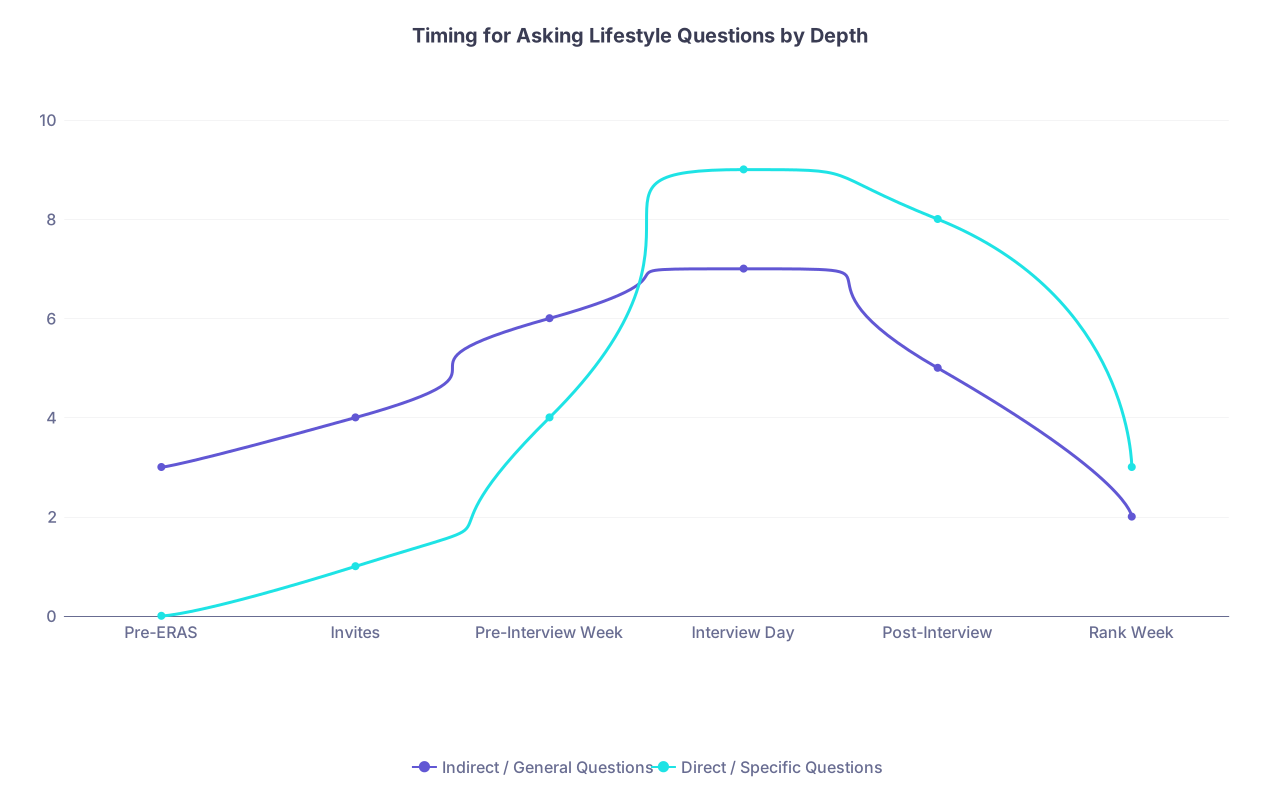
| Category | Indirect / General Questions | Direct / Specific Questions |
|---|---|---|
| Pre-ERAS | 3 | 0 |
| Invites | 4 | 1 |
| Pre-Interview Week | 6 | 4 |
| Interview Day | 7 | 9 |
| Post-Interview | 5 | 8 |
| Rank Week | 2 | 3 |
Scale 0–10: higher = more appropriate / more detailed questions.
Use this as a sanity check. If you’re asking 9/10-level specific questions in October emails, you’re early. If you still have nothing specific by February, you’re late.
Final Step: What You Should Do Today
Do this right now: open a blank document and make three short lists:
- Your non-negotiable lifestyle limits (hours, call, geography).
- Five PD-level questions about philosophy and systems.
- Ten resident-level questions about real hours, call, and life outside work.
This becomes your interview-season script.
Print it. Screenshot it. Have it open on your second monitor during virtual interviews.
Then, for your very next interview, decide exactly when you’ll ask each type of question — PD block vs resident session vs post-interview follow-up. If you know the timing in advance, you will actually get the answers you need, instead of walking away thinking, “I wish I’d asked if people here ever see their kids.”