
It is January of your third year. You just finished a call-heavy inpatient month and, in a rare quiet moment, you Google “lifestyle friendly specialties.” Up pop the usual suspects: Dermatology, Ophthalmology, PM&R, Radiology, Radiation Oncology, Pathology, Allergy/Immunology.
Now you are staring at a blank spreadsheet labeled “Away Rotations” and asking two questions:
- How many away rotations do I actually need for these fields?
- How do I avoid destroying my sanity, my Step 2 score, and my bank account trying to impress programs?
This is where you need a timeline. Not vague “start early” advice. A month‑by‑month plan that tells you, clearly: at this point you should…
Big Picture: How Many Aways Do Lifestyle Fields Actually Need?
First, anchor your expectations. Lifestyle fields are not all the same when it comes to aways.
| Specialty | Common Away Count | Why Do Them? |
|---|---|---|
| Dermatology | 1–2 | Signal interest, get a letter |
| Ophthalmology | 1–2 | Mentors, home vs. away LOR |
| PM&R | 0–2 | Exposure, letter, networking |
| Radiology | 0–1 | Often optional, get exposure |
| Radiation Onc | 1–3 | Small field, strong networking |
| Pathology | 0–1 | Usually optional |
If you are doing 4 away rotations in dermatology, radiology, or PM&R, you are almost certainly overextending unless you have a deeply unusual situation (no home program, extreme regional limitation, or major red flags).
The rest of this guide assumes:
- You are aiming for one of the more lifestyle‑friendly specialties.
- You want to maximize impact with 0–2 aways, maybe 3 in specific cases.
- You do not want your entire M4 year to feel like a traveling road show.
Now, the timeline.
12–15 Months Before Application: Reality Check and Early Positioning
You are halfway through third year, roughly January–March, the year before you apply.
At this point you should:
Clarify your likely specialty lane.
- If you are between, say, Dermatology and Internal Medicine, or Ophthalmology and Radiology, you are not ready to commit to away specifics. But you can narrow to 1–2 realistic lanes.
- Look at hard data: board scores, class rank, research output. Dermatology with no research and average scores? Possible but steep. Radiology with strong quantitative background and average scores? Very realistic.
Talk to actual humans in the specialty.
- Find one resident and one faculty member in each potential field.
- Ask blunt questions:
- “How many away rotations do you see successful applicants doing?”
- “Which away rotations actually help vs. just checking a box?”
- A derm attending at a mid‑tier program once told me: “If you do more than two aways, I assume you are scrambling or not strategic.” That kind of comment should shape your plan.
Check VSLO and program patterns from last year.
- Pull up VSLO (or your school’s equivalent). Look at:
- When applications opened.
- Which programs even take visiting students in your field.
- For lifestyle fields, a surprising number either:
- Do not take visiting students, or
- Offer very limited spots that fill fast.
- Pull up VSLO (or your school’s equivalent). Look at:
Block out your M4 year skeleton schedule.
- Talk to your dean’s office about graduation requirements:
- Required sub‑I months.
- ICU or EM requirements.
- Longitudinal clinics.
- You want a rough map:
- July–September: Prime away months.
- October–January: Interview heavy.
- At least one “home” audition month in your field before ERAS opens if at all possible.
- Talk to your dean’s office about graduation requirements:
9–12 Months Before Application: Commit to a Strategy, Not Just Dates
Now we are in April–June of your third year.
At this point you should:
Define your away rotation strategy in one sentence.
- Examples:
- “I will do 1 away in dermatology at a program in the region I want and 1 strong home rotation before ERAS.”
- “I will not do any radiology away, but I will do an advanced elective at my home institution and push for strong letters.”
- “I will do 2 PM&R aways because I have no home PM&R program and need letters plus direct exposure.”
If you cannot state your strategy in one sentence, you will overextend yourself. Guaranteed.
- Examples:
Pick a target number of away rotations. And cap it.
- Competitive lifestyle fields with small programs (Derm, Ophtho, Rad Onc):
- Reasonable target: 1–2 aways.
- Absolute cap: 3. More than 3 is almost always waste.
- Less away‑dependent lifestyle fields (Rads, PM&R, Path):
- Reasonable target: 0–1 away.
- Only go to 2 if:
- No home program, and
- You truly need letters and face time.
- Competitive lifestyle fields with small programs (Derm, Ophtho, Rad Onc):
Sequence your rotations in a way that protects Step 2 and letters. Use a simple template:
- Late M3 / Very early M4 (May–June):
- Step 2 CK study and exam OR
- Home rotation in your field if Step 2 is done early.
- July–September:
- 1–2 specialty rotations (home + away, or away + away).
- October:
- Lighter elective or research month to accommodate interviews.
The non‑negotiable: Do not stack three heavy audition rotations back‑to‑back July–September. You will burn out, and your performance will flatten by rotation #3.
- Late M3 / Very early M4 (May–June):
Shortlist specific target programs. Consider:
- Geography you actually want to live in.
- Realistic competitiveness match (stop pretending you are applying to all top‑5 programs if your metrics do not match).
- Programs known to “recruit their rotators” vs. those that do not care.
Then trim the list:
- 5–8 realistic away targets maximum.
- You only need to land 1–2 of them.
6–9 Months Before Application: Apply Smart, Not Everywhere
Now it is roughly May–July of your M3 → M4 transition. VSLO season.
At this point you should:
Finalize your M4 schedule with your school.
- Lock in:
- Required sub‑I (preferably in or adjacent to your field if that helps).
- Graduation requirements.
- Blocks you are reserving for away rotations.
- Aim for your first rotation in the field (home or away) no later than July or early August if possible, so your letters are ready early.
- Lock in:
Submit well‑targeted VSLO applications.
- For each program, you need a reason:
- Regional ties.
- Existing research collaboration.
- Specific niche interest (e.g., neuro‑ophthalmology, sports PM&R).
- Do not carpet bomb. That is how you end up doing 3 aways you kind of hate.
- For each program, you need a reason:
Rank your desired months by priority. Lifestyle fields usually like you there early:
- Ideal away months:
- July, August, September.
- If you are forced into October:
- Make sure it will still generate a letter in time.
- Ask directly: “Will an October rotation letter be ready for programs before rank lists?”
- Ideal away months:
Protect your Step 2 timeline.
- If you have not taken Step 2, you need to nail the sequence:
- Option A:
- Step 2 in June → first specialty rotation in July.
- Option B:
- Light elective or research in June/July + Step 2 → start aways in August.
- Option A:
- What you should not do:
- Take Step 2 in the middle of a hardcore audition month in a competitive lifestyle field. Your score and your evals both suffer.
- If you have not taken Step 2, you need to nail the sequence:
Reality‑check the cost.
- Away rotations are expensive:
- Application fees.
- Housing.
- Travel, food, scrubs, etc.
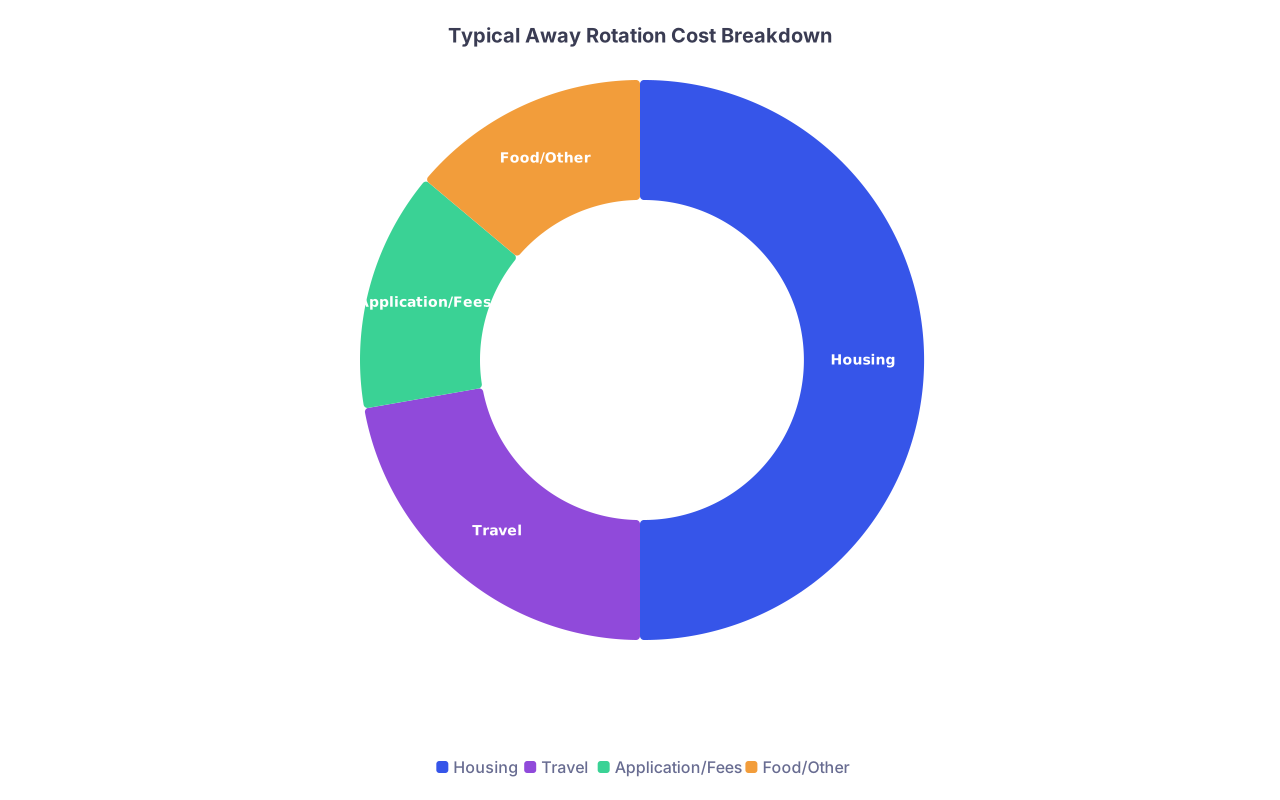
Typical Away Rotation Cost Breakdown Category Value Housing 900 Travel 400 Application/Fees 250 Food/Other 250 If doing a third away means credit card debt and chronic stress, do not do it. That third away almost never moves the needle for lifestyle specialties the way people think.
- Away rotations are expensive:
3–6 Months Before Application: Prepare to Perform, Not Just Show Up
It is June–August of your M4 year. ERAS is looming. Your first away (or your home audition) is coming up.
At this point you should:
Clarify your goals for each specific rotation.
- Not just “get a letter.”
- Better:
- Rotation A (Home Derm): Be the strongest student on the team, secure 1 faculty letter and 1 PD or APD letter.
- Rotation B (Away Ophtho at regional program): Show that you are serious about the region, get a letter if performance justifies it, and gauge whether you would realistically rank the program.
Contact the site coordinator early.
- Ask:
- Typical schedule (clinic vs OR vs consults).
- Expectations for students.
- Housing suggestions.
- You are not a tourist. You are testing a potential workplace for 3+ years.
- Ask:
Study in a focused way for the field.
- Two weeks before each rotation:
- Spend 30–45 minutes a day on:
- Core reading (Bolognia essentials for Derm, Basic Radiology for Rads, PM&R pocket book, etc.).
- Common consult questions and bread‑and‑butter cases.
- Spend 30–45 minutes a day on:
- You are not cramming a textbook. You are preventing yourself from looking lost on basic cases.
- Two weeks before each rotation:
Plan your energy, not just your calendar. Do not schedule:
- A brutal ICU sub‑I immediately before your first big away.
- Back‑to‑back out‑of‑state aways with 48 hours between them.
- Three consecutive call‑heavy blocks.
Build at least one lighter month in the 3‑month block that includes your aways. Even lifestyle fields can have demanding inpatient or consult services.
During the Away: How Not to Burn Out While Impressing People
You are on your away now. Day 1, new hospital, different EMR, new norms.
At this point you should:
Week 1: Learn the culture and set a sustainable pace.
- See how early residents realistically arrive.
- Ask: “What does a strong student look like here?”
- Aim for:
- Punctual.
- Prepared.
- Pleasant.
Not:
- The student who stays until midnight every day in a field where everyone leaves at 5. It reads as tone‑deaf, not dedicated.
Week 2: Identify letter‑writing attendings.
- Pay attention to:
- Who sees your work.
- Who enjoys teaching.
- Who has influence (section chiefs, PDs, well‑known faculty).
- Start working more closely with 1–2 of them, without being clingy.
- Pay attention to:
Week 3: Ask for specific feedback.
- Quick, targeted questions:
- “What is one thing I could improve over the next week?”
- “Is there anything that would keep you from giving me a strong letter?”
- This gives you one last chance to fix something and telegraphs maturity.
- Quick, targeted questions:
Week 4: Close the loop on letters and fit.
- If performance has been solid:
- Ask explicitly for a strong letter.
- Clarify timeline:
- “Would you be able to upload the letter by [date] for my ERAS application?”
- Quietly ask residents:
- “Do they interview most of their rotators?”
- “How many rotators usually match here?”
- If performance has been solid:
Protect time for ERAS and mental health.
- During an away in a lifestyle field, you should still:
- Sleep. This is not trauma surgery.
- Work on your personal statement and ERAS bits in the evenings.
- If you are so crushed you cannot do that, you stacked your schedule wrong. Do not repeat that mistake for another away.
- During an away in a lifestyle field, you should still:
After Each Away: Decide What Actually Helped
You finish an away. You are tired. Tempted to immediately jump into the next thing.
At this point you should, within 3–5 days:
Write down clear impressions.
- Pros:
- Culture, schedule realism, resident morale.
- Cons:
- Call expectations relative to “lifestyle” reputation.
- Any red flags (toxic behavior, lack of support, chaos).
- Be honest: would you be happy here if it were your only match?
- Pros:
Confirm letters in writing.
- Short email:
- Thank them for teaching.
- Confirm that you are applying to X field.
- Include:
- ERAS letter instructions.
- Your CV.
- Draft personal statement (even if not final).
- Short email:
Update your application strategy.
- If the away went great:
- Bump that program up your app list and interview priority.
- If it went poorly or you did not click with the field:
- Do not reflexively add another away to “fix it.”
That is how you overextend.
- Do not reflexively add another away to “fix it.”
- If the away went great:
Check your burnout level before committing to more.
- Ask yourself, concretely:
- Am I sleeping?
- Am I behind on ERAS, Step 2, or graduation requirements?
- If the answers worry you, the correct move is to drop or downgrade later away plans, not pile on more.
- Ask yourself, concretely:
Timing Around ERAS and Interviews: Do Not Overcrowd the Peak Months
Now it is August–October of your M4 year. Applications are opening. Interviews are about to start.
At this point you should:
Make sure you have enough, but not too many, specialty experiences. By ERAS submission, you want:
- At least one excellent evaluation in your chosen field (home or away).
- Ideally 1–2 strong letters from that field.
- Some evidence of alignment with the specialty (electives, research, etc.).
You do not need:
- Four separate aways in the same field to “prove” your interest. That proves you cannot prioritize.
Guard October–January as interview territory.
- For most lifestyle fields, interviews spread out but will cluster in:
- November–January.
- Do not schedule an away rotation in another state during peak interview months unless it is absolutely essential.
If you must:
- Pick a program that is flexible about days off for interviews.
- Tell them ahead of time: “I am in the middle of interview season; is that workable here?”
- For most lifestyle fields, interviews spread out but will cluster in:
Align your final months with your future.
- After interviews:
- Use later M4 months for:
- Lighter electives.
- Research clean‑up.
- Skill building that matters for intern year (e.g., a brief IM or EM refresh).
- Use later M4 months for:
Do not keep auditioning in November–January like you are still trying to prove you exist. Most programs have decided by then.
- After interviews:
A Visual Snapshot: Year‑Before to Match
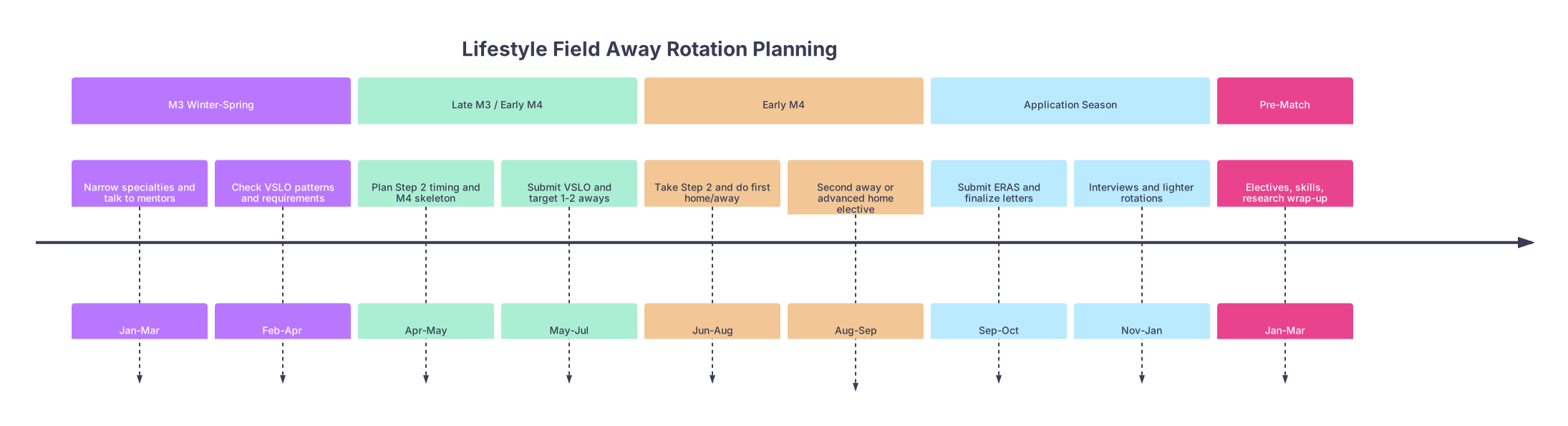
| Period | Event |
|---|---|
| M3 Winter-Spring - Narrow specialties and talk to mentors | Jan-Mar |
| M3 Winter-Spring - Check VSLO patterns and requirements | Feb-Apr |
| Late M3 / Early M4 - Plan Step 2 timing and M4 skeleton | Apr-May |
| Late M3 / Early M4 - Submit VSLO and target 1-2 aways | May-Jul |
| Early M4 - Take Step 2 and do first home/away | Jun-Aug |
| Early M4 - Second away or advanced home elective | Aug-Sep |
| Application Season - Submit ERAS and finalize letters | Sep-Oct |
| Application Season - Interviews and lighter rotations | Nov-Jan |
| Pre-Match - Electives, skills, research wrap-up | Jan-Mar |
Final Check: Signs You Are Overextending Yourself
Before you lock anything in, ask yourself:
- Are you planning more than 2 away rotations in a lifestyle field without a very specific, defensible reason?
- Are you sacrificing Step 2 timing, sleep, or basic financial sanity to squeeze in “just one more” away?
- Do you have a clear one‑sentence away strategy, or are you just saying yes to everything?
If you are failing those checks, scale back. Strong performance on 1–2 well‑chosen rotations beats mediocrity on 4.
Key Takeaways
- For most lifestyle specialties, 1–2 targeted away rotations are plenty. More than that usually adds stress and cost, not match probability.
- Sequence your year to protect Step 2, letters, and your energy: early specialty exposure, capped aways July–September, lighter months around interviews.
- Every rotation must have a clear purpose—letter, regional signal, or true exposure. If you cannot state that purpose in one sentence, you probably do not need that away.