
It is 6:45 p.m. on a Tuesday. You are a PGY-3 in a “lifestyle-friendly” specialty, still in the hospital finishing notes while your non-med friends are on their second drink. Your attending, who swears this field is perfect for work–life balance, just mentioned he “only” works four days now—after 20 years in practice and two near-divorces.
You want that four-day week. But not “someday.” You want to know how to design it deliberately, starting in residency, instead of hoping lifestyle magically appears later.
This is the manual for that.
I am going to be blunt: a four-day week in medicine does not happen by accident. Not even in the so-called lifestyle specialties. You do not drift into it; you engineer it. Specialty choice helps, but structure, negotiation, and strategy are what actually cut your workweek down.
Let’s walk through it step by step.
1. Pick the Right Battlefield: Specialties Where a Four-Day Week Actually Works
Some specialties will fight you every inch of the way. Others will quietly let you rearrange the puzzle pieces.
You are in the “most lifestyle friendly specialties” bucket already or headed there. Good. But there is a big spread within that label.
Here is where a four-day full-time-equivalent (FTE) week is structurally easiest:
| Specialty | 4-Day Week Feasibility | Typical Route That Works Best |
|---|---|---|
| Dermatology | Excellent | Outpatient group or private |
| Radiology | Excellent | Group practice, telerad |
| PM&R | Very good | Outpatient/MSK-focused |
| Psychiatry | Very good | Outpatient, tele-psych |
| Anesthesiology | Good | Group practice, no OB call |
Why these work:
- Predictable, modular work units.
Clinic sessions, reading lists, OR days. Easy to redistribute. - Less emergency/time-critical work.
You can safely not be there one weekday without the system breaking. - High demand for part-time / flexible coverage.
Especially in psych, derm, and radiology. Coverage models already exist.
Harder (not impossible, but you will sweat for it):
- Surgical subspecialties with heavy elective + urgent caseloads
- Hospitalist roles with rigid block schedules
- Traditional academic roles with “other duties as assigned” bloat
If you are still in medical school or early residency and you care deeply about a four-day week, choose a specialty with:
- Mostly outpatient or shift-based work
- Lots of private practice or multi-physician group opportunities
- Proof that current attendings actually work 0.8–0.9 FTE
Ask residents and attendings specifically:
“Who in this department works four days per week or less, and how did they pull it off?”
If they cannot name anyone, consider that a warning.
2. Define Your Version of “Four-Day Week” (Before Someone Else Does)
“Four-day week” sounds simple. It is not. Employers will happily twist it.
You must define it precisely. Otherwise you end up working 4 long clinic days plus “just a little admin from home” that eats your fifth day anyway.
You need to decide:
Is it truly 0.8 FTE (80% pay) or 1.0 FTE compressed into 4 days?
- 0.8 FTE: Less work, less pay. Real time off.
- 1.0 compressed: Same work, but longer days. Better for 3-day weekends, worse for fatigue.
What is your non-work day for?
- Recovery/rest
- Childcare/family obligations
- Side business / research / academic projects
- Commute day for multi-site practices
Non-negotiables:
- No regular clinic/OR/procedure sessions on that day
- No recurring meetings
- Only true emergencies can pull you in (and even that needs clear boundaries)
Write this down. Literally. One page. Because later you will be negotiating, and vague intentions get steamrolled.
Your goal phrasing should sound like:
“My target schedule is 4 days per week on-site, 0.8–0.9 FTE, with one predictable weekday protected from scheduled clinical duties. I am willing to flex which weekday if needed, but the structure should hold long term.”
Without this clarity, you will accept something like “you can leave early some Fridays” and wonder why you feel cheated.
3. Start During Residency: Build the Leverage You Will Need Later
You do not negotiate a four-day week from a position of weakness. You negotiate it with leverage: competence, reliability, and proof you can move volume efficiently.
Use residency to build exactly that.
A. Build a reputation for efficiency and independence
By PGY-3+ you want attendings saying:
“She runs a full clinic and still leaves on time.”
“He can handle the list without drama.”
Practical moves:
- Learn the EHR faster than your peers. Create templates. Smart phrases. Macros.
- Pre-chart when possible. Keep clinic/OR days tight.
- Volunteer to help streamline small workflow issues (intake process, order panels, standardized consents). Not to be nice. To become the person known for fixing bottlenecks.
People give scheduling flexibility to physicians who do not create chaos when they are gone.
B. Get exposure to multiple practice models
During residency, deliberately seek:
- Private groups vs. academic vs. corporate (Optum, Kaiser, etc.)
- High-volume vs. boutique / concierge
- Telemedicine-heavy vs. in-person only
You are collecting data: Where do four-day weeks actually exist? Who has them and how are they structured?
Ask pointed questions on rotations and electives:
- “How many days per week do each of the partners work?”
- “If someone wanted a four-day week, how hard would that be to arrange here?”
- “Do part-time or 0.8 FTE docs have equal say in group decisions and scheduling?”
Log answers. Patterns will emerge.
C. Use electives to prototype lifestyle
If your residency allows elective schedule flexibility:
- Arrange one or two blocks where you mimic a four-day pattern—stack procedures / clinics into four intense days, one “light/admin” day.
- Track:
- How tired you are
- How much admin piles up
- How your call schedule interacts with a “day off”
This gives you realistic parameters before you negotiate your first job.
4. Target the Right First Job: Filtering for Four-Day Potential
Most residents screw this up. They choose employer first (city, big name hospital, salary) and hope flexibility follows.
You are aiming for the opposite: choose structure first, details second.
When you evaluate jobs, look for:
A. Existing part-time / flexible clinicians
Non-negotiable:
You want proof that at least one physician in the group currently has:
- 4-day week, or
- 0.6–0.8 FTE schedule, or
- Some other clearly protected flexible arrangement
Red flag:
“We could definitely work something out” with zero examples. Translation: no one has done it, and you will be fighting uphill.
B. Group size and coverage model
Simpler to get a four-day week when:
- Group size is ≥5–6 physicians
- Panel/call are easily redistributed
- There are advanced practice providers (NP/PA) to buffer volume
In a 2–3 physician group, every day off hits someone else directly. That can work, but only if built into the compensation / FTE structure.
C. Payment model
You want a model that decouples your time presence from group resentment.
| Payment Model | Four-Day Friendly? | Why |
|---|---|---|
| Pure RVU | Good | Work less, earn less; simple tradeoff |
| Base + RVU bonus | Good | Predictable base, optional extra work |
| Straight salary | Mixed | Must tightly define FTE expectations |
| Equal-share pool | Risky | Partners may resent lower time input |
In lifestyle specialties, base + RVU or RVU-heavy is usually cleaner for four-day setups. You produce 80–90% of your peers’ volume, you get 80–90% of pay, and no one feels cheated.
5. Negotiate the Four-Day Week Up Front (Not “Someday”)
Here is the mistake I see constantly: residents accept a full 5-day, 1.0 FTE job with vague “chance to cut back later” language.
That “later” rarely materializes without a fight.
You want the structure in the offer letter or contract. Even if you start at 0.9–1.0 FTE, you embed the pathway to four days.
A. What to ask for explicitly
In your job discussions, bring it up early, in simple terms:
“My ideal long-term schedule is four clinical days per week. I am willing to structure this as 0.8–0.9 FTE with commensurate pay. How have you handled that with prior hires?”
Look for a concrete answer like:
- “We have 0.8 and 0.9 FTE options with proportional base salary and RVU targets.”
- “Dr. X works four days; here is how her FTE is calculated.”
If you get mushy promises, push:
“I appreciate the flexibility. For planning purposes, I need to understand how a four-day week would be defined in my contract. Can we outline: – Expected clinical sessions per week
– Proportionate salary
– Call expectations at 0.8–0.9 FTE?”
B. Sample language to bake into the contract
You are not a lawyer, but you can recognize the correct building blocks. Things you want:
- FTE definition
“0.8 FTE is defined as 8 half-day clinical sessions per week, plus proportionate non-clinical duties, with one weekday free of scheduled clinical responsibilities.”
- Protected day
“The physician will not have regularly scheduled clinics, procedures, or standing meetings on [Day]. Occasional schedule changes require mutual agreement.”
- Proportional expectations
“Productivity targets, administrative duties, and call obligations will be scaled proportionally to FTE (e.g., 0.8 FTE equals 80% of the standard call load).”
You want math, not vibes.
C. If they resist
Common pushbacks and how to respond:
“Everyone starts full-time; you can cut back later.”
Response: “What is the typical timeframe and process for that? Can we include the right to move to 0.8 FTE after year one, with defined salary and schedule parameters?”“We cannot guarantee a specific weekday.”
Response: “I can be flexible on which weekday, but I do need one consistently unscheduled day per week. Can we codify that, even if the specific day varies by quarter?”“We do not have part-time partners.”
Translation: They do not value non-full-time physicians. Believe what they are telling you.
If every answer is vague or defensive, walk. There are other jobs.
6. Design the Actual Week: Tetris, Not Wishful Thinking
Once you land a job that is open to a four-day setup, you have to design something that works not only for you, but also for the practice.
Here is a simple four-day template for common lifestyle specialties.
A. Outpatient-heavy specialties (Derm, Psych, PM&R, many subspecialty clinics)
Aim for:
- 8 half-day clinical sessions per week (0.8 FTE)
- One non-clinical/admin block somewhere to mop up the mess
Example schedule:
- Monday: AM clinic; PM clinic
- Tuesday: AM procedures; PM clinic
- Wednesday: OFF (true off)
- Thursday: AM clinic; PM admin (charts, calls, telehealth follow-ups)
- Friday: AM clinic; PM clinic
Principles:
- Front-load your heaviest work on days adjacent to your off day or weekend.
- Use one predictable admin block to stop charting from invading your “off” weekday.
- Keep the day off free of recurring meetings. Be ruthless about this.
B. Radiology / Anesthesiology / Shift-based roles
For shift-based lifestyle specialties, think in shifts per month, not days.
Say the group considers 16–18 shifts per month as full-time. A four-day equivalent might be:
- 12–14 shifts per month instead of 16–18
- Same shift length, proportionate pay, fewer nights/weekends
You could structure:
- Week 1: Mon/Tue/Thu/Fri
- Week 2: Mon/Tue/Wed
- Week 3: Mon/Tue/Thu/Fri
- Week 4: Mon/Tue/Wed
Average: ~3–4 shifts per week, one extra day off per week on average.
Your contract should define:
- Full-time shifts per month
- Your FTE and expected shifts
- Call/night differential at lower FTE
7. Protect the “Off” Day Ruthlessly (Or You Will Lose It)
Getting a four-day week on paper is step one. Keeping it in reality is step two.
Here is how your “off” day dies:
“Hey, can you just jump on this quick Zoom?”
“We had to put one urgent add-on patient at 11:00.”
“Everyone is here for the quality committee except you…”
Fix that early.
A. Hard rules for yourself
- No scheduled clinic, OR, procedures. None.
- No recurring internal meetings. If a must-attend meeting always falls on that day, your schedule is broken.
- Set your EHR and email away messages: “I am out of office on Wednesdays and will respond on Thursday.”
You train people how to treat your availability.
B. Soft availability for true emergencies
Decide what actually counts as “worth breaking the rule.” For example:
- A truly urgent patient issue no one else can handle
- A once-per-year critical meeting that will materially affect your job
And then track how often that happens. If you are “making exceptions” weekly, your structure is failing.
C. Use your admin block properly
If you do not have an admin block, create one by shortening one clinic session and converting the extra slot to admin.
Use it for:
- Inbox
- Refills
- Patient messages
- Chart completion
The goal:
By 5 p.m. on your last clinical day before your “off” day, your inbox and charts are reasonably current. So your off day is truly off, not secret charting day.
8. Handle Call, Coverage, and Group Politics Without Becoming the Villain
This is where four-day arrangements blow up if you are not careful.
Your colleagues will accept your four-day week if at least one of these is true:
- Your pay is clearly proportionally reduced.
- Your call is clearly proportionally reduced.
- Your total RVU / revenue contribution is fairly aligned with your FTE.
What they will not tolerate long-term:
- You working less, making almost the same money, and taking the same call.
A. Scale your call
If 1.0 FTE = 1 in 6 call, then:
- 0.8 FTE should be ~80% of that: maybe 1 in 7–8
- 0.9 FTE might match 1 in 6, but with more post-call protection
Get this in writing:
“At 0.8 FTE, physician call obligations will be 80% of standard for full-time physicians, rounded to nearest feasible distribution.”
B. Offer flexibility where it costs you little
If you want goodwill, pay in the currency that is cheap for you, expensive for others.
Examples:
- Take slightly more “undesirable” time on your clinical days (early clinic, late clinic) in exchange for your day off.
- Volunteer for specific non-clinical tasks you can do from home (protocol writing, QI project) instead of being on one more committee that meets on your off day.
You are signaling: “I am not dumping work on you; I am structuring it differently.”
9. Course-Correct: When Your 4-Day Week Starts Expanding Again
I have seen this dozens of times. Two years in, the “four-day” week is effectively 4.5–5 days. Death by a thousand cuts.
You need an early-warning system.
A. Quarterly self-audit
Every 3 months, look at:
- How many hours you actually worked per week (even rough estimates)
- How many times something was scheduled on your “off” day
- How many charts you are carrying over
If you are consistently:
- Working >45–48 hours on four days
- Doing >4–5 hours of work on your “off” day most weeks
Then your FTE or schedule needs recalibration.
B. Talk to leadership with data, not vibes
Instead of “I feel burned out,” bring:
- RVUs/month compared to target
- Actual hours worked
- Specific examples of recurrent “off day” encroachments
Then propose clear fixes:
- “Either we recognize my current schedule as 0.9–1.0 FTE and adjust pay/call accordingly, or we reduce clinic sessions by one per week to align with 0.8 FTE.”
You are not asking for charity. You are asking for a coherent structure.
10. Specialty-Specific Notes and Tricks
Dermatology
- High flexibility, but high expectations for productivity in some practices.
- Key lever: designing template with fewer but high-yield procedures and efficient MAs / scribes.
- Watch out for: “Just squeeze in a few cosmetics on your day off.”
Psychiatry
- Tele-psych gives huge control over days and hours.
- Key lever: 45- vs 60-minute follow-ups. Shorten once clinically appropriate.
- Watch out for: patient crises spilling into your off day—set up coverage rules with partners clearly.
PM&R
- Mix of outpatient/MSK, inpatient rehab, procedures.
- Key lever: cluster procedure days and inpatient rounds to free a weekday reliably.
- Watch out for: being the “everything” doctor who covers gaps for ortho, neuro, etc., eroding your off day.
Radiology
- Group telerad and large practices already use flexible shifts.
- Key lever: negotiate nights/weekends separately from base FTE.
- Watch out for: “flex-time” that drifts into 6 shorter days instead of 4 solid ones.
Anesthesiology
- OR schedule control is variable. Some groups are rigid, others very flexible.
- Key lever: set days where you are simply not in the call or OR pool.
- Watch out for: constant “just cover this one extra day” in return for small bonuses that ultimately kill your lifestyle.
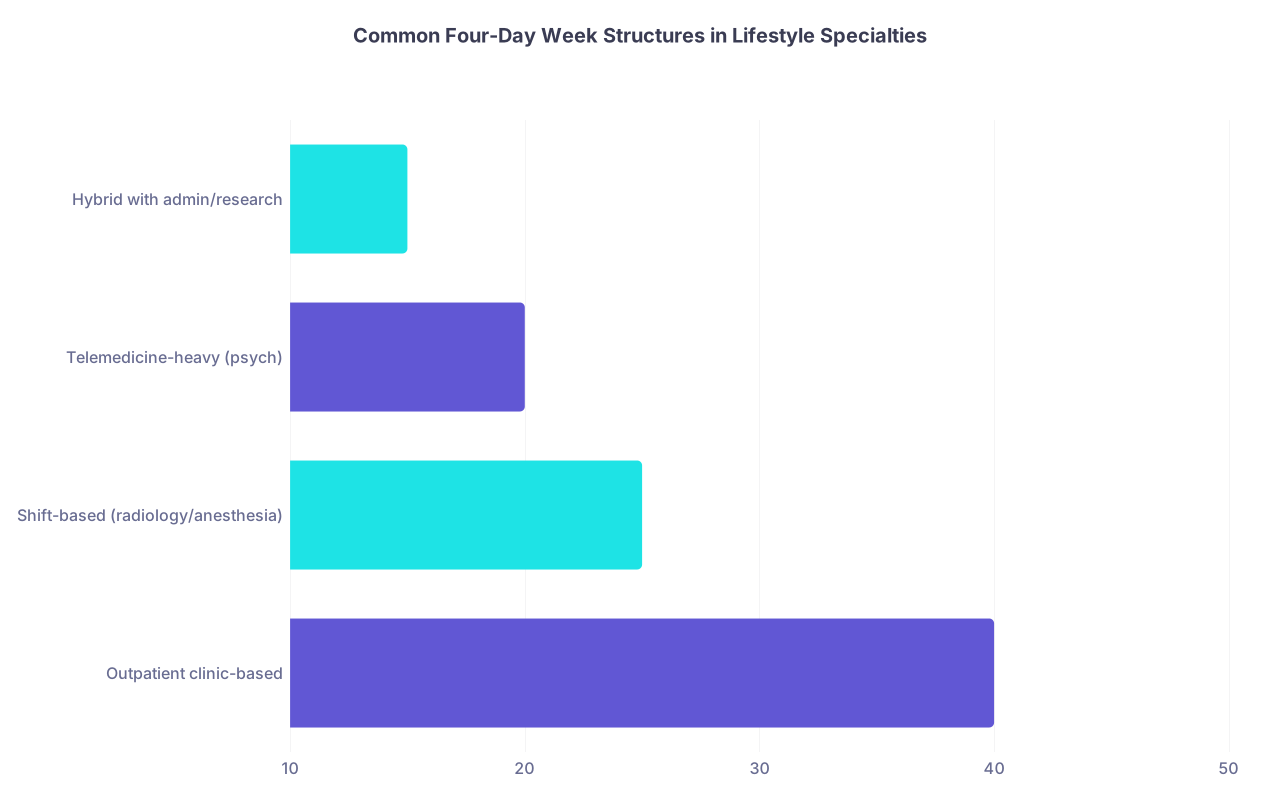
| Category | Value |
|---|---|
| Outpatient clinic-based | 40 |
| Shift-based (radiology/anesthesia) | 25 |
| Telemedicine-heavy (psych) | 20 |
| Hybrid with admin/research | 15 |

| Step | Description |
|---|---|
| Step 1 | Residency |
| Step 2 | Identify lifestyle specialties |
| Step 3 | Target practices with flexible FTE |
| Step 4 | Negotiate 0.8-0.9 FTE in contract |
| Step 5 | Design weekly schedule |
| Step 6 | Protect off day and admin time |
| Step 7 | Quarterly schedule audit |
| Step 8 | Adjust FTE or workload |