
It’s 10:47 p.m. You’re on call. Your feet hurt, your pager’s finally quiet, and you’re sitting in a dark workroom googling “lifestyle friendly specialties” while half-hoping nobody walks in and sees your search history.
Because here’s the fear that’s chewing at you:
“If I say I care about lifestyle… are attendings going to think I’m lazy? Weak? Not cut out for medicine?”
And especially if you’re leaning toward the “most lifestyle friendly” fields—derm, ophtho, rads, anesthesia, PM&R, maybe path—you’re probably running the same mental loop:
- “Are people going to think I’m just chasing money and easy hours?”
- “If an attending asks why I chose this specialty, what am I allowed to say without getting silently blacklisted?”
- “Do they all secretly judge lifestyle people and only respect the ‘hardcore’ ones—surg, EM, ICU, trauma?”
Let me just say the quiet part out loud: you are not the only one thinking this. I’ve watched people literally change their answer mid-sentence on rounds because an attending walked in.
You: “I’m interested in dermatology because I want a controllable lifestyle and—”
Attending walks in.
You, panicked re-route: “—uh, because I love complex inflammatory diseases and… longitudinal care…and…uh…biopsies.”
Yeah. I’ve seen that exact car crash.
Let’s pick this apart properly.
What Attendings Really Think When You Say “Lifestyle”
Here’s the part you’re scared to hear:
Some attendings absolutely do judge.
But it’s not as simple as “they hate lifestyle.” They judge how you talk about it.
Most attendings fall into one of a few categories:
| Type of Attending | How They React to Lifestyle Talk |
|---|---|
| Burned-Out Martyr | Sees it as weakness or selfishness |
| Quietly Regretful | Low-key jealous, mixed feelings |
| Healthy Boundary-Setter | Respectful if you’re thoughtful |
| Lifestyle-Friendly Specialist | Gets it, usually supportive |
The key pattern I’ve seen: they don’t hate that you care about lifestyle. They hate when:
- It sounds like you don’t care about patients.
- It sounds like you want maximum money for minimum effort.
- It sounds like you haven’t thought deeply—like you picked your field off Reddit rankings.
But when you frame it as:
“I want to be able to do this work well for 30+ years without burning out or resenting my patients,”
most sane people nod, even if they fake a little grumpiness on top.
Because here’s the uncomfortable truth: a lot of the loudest “lifestyle is for the weak” people are the most burned out, divorced, or chronically miserable. You won’t hear that in grand rounds, but you see it in how they talk to nurses at 2 a.m.
The Double Standard: Everyone Cares About Lifestyle, They Just Won’t Admit It
Attendings absolutely care about lifestyle. They just dress it up in different language:
- Surgeons: “I prefer this subspecialty because the call isn’t as brutal.”
- Hospitalists: “Seven-on/seven-off works better for my family.”
- Anesthesiologists: “I like that I’m done when the list is done, usually.”
- Dermatologists: “I like the outpatient continuity… and yeah, I actually get to see my kids.”
No one is out here saying, “I chose this because I wanted to be crushed into dust by my job until I forget what hobbies are.”
Even the “martyr” attendings? They still complain constantly about:
- Weekend calls
- Post-call fatigue
- Missed birthdays and anniversaries
- Late-running ORs
- Endless EMR messages
Lifestyle is not some dirty word. It’s just that in medical culture, you’re supposed to pretend it’s a side quest, not a primary driver.
So if you’re leaning toward a lifestyle-friendly specialty, you’re not some unique moral failure. You’re just being honest earlier than most.
How to Talk About Lifestyle Without Sounding Like You Don’t Care
Let’s address the nightmare scenario in your head:
You’re on rounds. An attending asks, “So what are you thinking of going into?” And your brain screams:
“If I say derm/rads/anesthesia/ophtho, they’ll immediately file me under ‘soft, lazy, money-obsessed.’”
Here’s how to thread that needle.
1. Pair Lifestyle With Patient-Centered Reasons
Wrong version (how you’re scared it’ll sound):
“I want derm because the hours are good and the money’s solid.”
Better version:
“I’m drawn to dermatology because I like visual diagnosis, procedures, and mostly outpatient longitudinal care. And honestly, the more I’ve been in medicine, the more I know I want a field where I can be present for my patients and still have the bandwidth to be present for my family and not burn out in 10 years.”
You’re saying the same core thing—you care about lifestyle.
But you’re framing it as sustainability and long-term patient care, not “I want to clock out at 4:59 p.m. sharp.”
2. Own That You’ve Thought Hard About It
Attendings hate flaky thinking more than they hate “lifestyle.”
If you say:
“I just heard derm is chill and pays well,”
you’re done. That confirms every stereotype.
Instead, show work you’ve actually done:
- “I did an elective in PM&R and really liked working with patients on function and quality of life.”
- “I’ve talked to several attendings and residents in anesthesia and I like the blend of physiology, procedures, and relatively defined work hours.”
- “I know no field is truly 9–5, but compared to [insert other field you considered], I think this is a more sustainable fit for me.”
You don’t have to overperform some fake passion monologue. You just need to prove you didn’t pick your specialty by filtering for “highest income, lowest hours.”
3. Don’t Apologize for Wanting a Life
This is the trap:
You feel guilty for caring about lifestyle, so you overcompensate by pretending it doesn’t matter.
You say stuff like:
- “I mean, lifestyle isn’t THAT important, I’ll do whatever I have to.”
- “I know it sounds bad to say, but I do care a little about having time outside of work.”
Stop shrinking. Say it like you mean it:
“I care a lot about being able to show up as a good physician and have a sustainable personal life. I know myself, and if I’m chronically sleep deprived and never home, I won’t be my best for patients or myself.”
That actually sounds mature, not selfish.
What Lifestyle-Friendly Attendings Actually Say Behind Closed Doors
I’ve sat in workrooms and heard the hushed real talk. The same attendings who roast “lifestyle specialties” on rounds will turn around and say to each other:
- “If I could do it over, I’d do anesthesia.”
- “I tell my kids not to go into surgery unless they’re absolutely obsessed.”
- “Honestly, the derm folks figured it out.”
- “My friend in radiology is way less burned out than any of us.”
The dissonance is insane. Publicly: “Follow your passion, don’t chase lifestyle.”
Privately: “Yeah if you can get derm or rads, do it.”
You’re not crazy for picking up on that.
Here’s the pattern:
- People who are miserable in their own lifestyle choices project judgment onto you.
- People who are at peace with their choice are usually chill about yours.
So when you meet an attending who’s defensive or mocking: that’s about them, not you.
The Specific Fear: Will This Hurt Me in Letters or Interviews?
You’re probably worried about the practical fallout:
- “If I tell my medicine attending I want rads, will they write a weaker letter?”
- “If I tell a hard-core trauma surgeon I want derm, will they just…decide I’m soft and useless?”
- “If in an interview I mention lifestyle at all, am I done?”
Let’s be honest. Can it hurt you if you say it clumsily? Yes.
But there are ways to handle each scenario.
With Attendings Who Might Write Your Letters
Strategy:
Lead with the parts of the specialty that overlap with what they value.
- To an internist: “I like the diagnostic reasoning and systemic thinking in radiology.”
- To a surgeon: “I like that anesthesia is procedure-heavy and you’re there for big cases in real time.”
Then layer in sustainability:
“And the more I’ve seen clinically, the more I know a field with relatively defined hours will let me do this work well long term.”Show that right now you’re still fully engaged:
Be present. Work hard on their service. Don’t act like you’ve checked out because you’re “going derm.”
What freaks attendings out isn’t your future lifestyle; it’s when your current effort drops because you feel “above” the rotation or specialty.
In Residency Interviews
You don’t need to lie. You also don’t need to lead with “I want a chill life.”
Better interview framing:
- “I thought seriously about long-term sustainability. I want to practice for decades without burning out, and I think [specialty] offers the right mix of intellectual challenge, patient care, and a schedule where I can maintain my own health and relationships.”
- “Balance matters to me, not because I want to do less, but because I want to be able to do this well over the long haul.”
No program director is offended by “I don’t want to be destroyed by my job.” They see their burned-out seniors.
Reality Check: Lifestyle Fields Are Not Actually “Easy”
There’s another judgment you’re probably worried about:
“That specialty is less intense, so they’ll assume I’m not as smart or driven.”
The counterpoint: the competitive lifestyle fields are brutal to get into:
- Derm: insane Step scores, lots of research, strong letters.
- Ophtho: early match, heavy optics/neuro, research.
- Rads: high scores, strong clinical performance, solid letters.
- Anesthesia: getting more competitive, especially at good programs.
- PM&R: increasingly popular, more applicants per spot at solid programs.
- Path: fewer spots in some places, quietly competitive at strong academic centers.
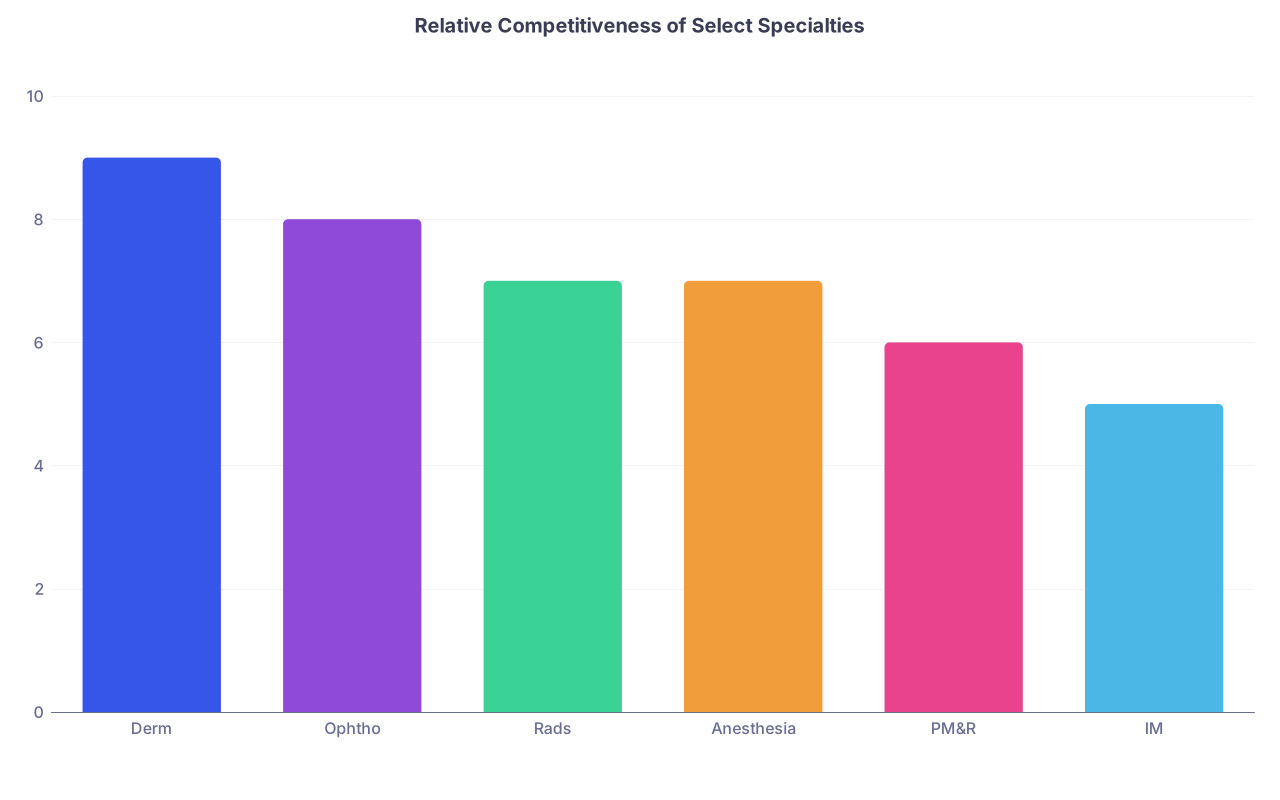
| Category | Value |
|---|---|
| Derm | 9 |
| Ophtho | 8 |
| Rads | 7 |
| Anesthesia | 7 |
| PM&R | 6 |
| IM | 5 |
(Think of 10 as “most competitive,” 1 as “easiest.” These numbers are conceptual, but you get the idea.)
If an attending tries to imply you’re taking an “easy way out,” they’re ignoring reality—or they just don’t know the match data.
You’re not dodging difficulty. You’re trading one kind of hard (chronic lifestyle chaos) for another (front-loaded competitiveness, research, networking, planning).
How to Quiet the “They’re All Judging Me” Voice (Enough to Function)
The anxious part of your brain will always find a worst-case scenario. Let it scream in the background, but don’t let it steer the car.
A few grounding thoughts:
There is no specialty choice that will universally earn respect.
- Go into surgery? Some internists will think you’re a cutter with no bedside manner.
- Go into psych? Some old-school people still think it’s “soft.”
- Go into derm? “Lifestyle chaser.”
Someone will always roll their eyes. That’s not something you can optimize away.
The people whose opinions actually matter most for your happiness are:
- Your future co-residents
- Your future attendings in your field
- Your family / partners / close friends
And guess what? Most people in lifestyle fields are actively pro-lifestyle. That’s kind of the point.
A lot of the “judgment” you’re scared of is just your own internalized guilt.
You’ve been trained in a system that equates suffering with virtue.
So when you choose something less punishing, your brain screams “cheater.”That’s not truth. That’s conditioning.
Quick Scripts You Can Actually Use
Because sometimes you just need the words.
On rounds, general:
“I’m leaning toward [specialty]. I like the combination of [two specific things you genuinely like], and I think it offers a sustainable way for me to practice long term.”With a known hard-core attending:
“I really respect the intensity of what you do, and if I were wired like that, I’d probably end up in [their field]. But I’ve realized I do best in [outpatient/OR/reading room/procedure-based] environments and want something I can sustain for decades.”With a friendly attending who seems burned out:
“Seeing how demanding this is has really made me think about sustainability. I want to stay in medicine without burning out, so I’m looking at fields where the hours are a bit more defined.”
You’re not required to throw yourself on the altar of “brutal but noble” to earn the right to be a physician.

| Step | Description |
|---|---|
| Step 1 | You mention lifestyle |
| Step 2 | Acts judgmental |
| Step 3 | Half-joking envy |
| Step 4 | Respectful and curious |
| Step 5 | Supportive and honest |
| Step 6 | Attending type |
FAQ (6 Questions)
1. Is it ever safe to directly say “lifestyle” in an interview or to an attending?
Yes, but be smart. Pair it with words like “sustainability,” “longevity,” and “being effective for patients.” For example: “Lifestyle matters to me in the sense that I want a sustainable career where I can consistently show up well for my patients and my family.” Don’t make it sound like you’re trying to minimize effort; make it sound like you’re trying to maximize durable effort.
2. Will saying I care about lifestyle make my letters of recommendation worse?
It can if you present it as “I don’t want to work hard.” But most attendings know the system is brutal and many quietly respect students who are thoughtful. If you’re engaged, prepared, kind, and hard-working on their service, most won’t tank your letter just because you picked a different path. They care way more about how you worked with them than what field you’re choosing.
3. Do programs in lifestyle specialties secretly judge applicants who mention lifestyle?
Good programs understand that their appeal is partly lifestyle. They’re not dumb. What they don’t want is someone whose only reason is “easy money, chill hours.” If you have authentic specialty-specific reasons (procedures, patient population, type of thinking) and then acknowledge lifestyle as one of several factors, that usually lands well. Pure “I just want easy” energy? That gets you quietly ranked lower.
4. How do I handle it if an attending openly mocks lifestyle specialties?
You don’t have to debate them. You can say something neutral like, “I really respect what you do; I’ve just realized I’m better suited to a different pace and environment.” Then drop it. Let them project whatever they need to. Their opinion is not the final word on your career, and arguing usually just confirms their bias that lifestyle people are defensive.
5. Am I being selfish for wanting a field where I can have a family, hobbies, or sleep?
No. Wanting to not be chronically exhausted and resentful doesn’t make you selfish; it makes you realistic. Burned-out doctors are not better doctors. Patients don’t benefit from you being wrecked. Protecting your bandwidth so you can care well—for them and for you—is not indulgent. It’s basic survival.
6. What if I’m wrong and I end up regretting choosing a lifestyle-friendly field?
You’ll probably regret the version of the life you build more than the field itself. Even in lifestyle specialties, you can overwork, chase prestige, and ignore your boundaries. Or you can choose reasonable jobs, say no to constant extra shifts, and protect your time. Yes, switching fields later is harder. But picking a “hardcore” specialty you already know you don’t want, just to avoid being judged, is almost guaranteed regret.
Key points:
- Attendings don’t automatically hate that you care about lifestyle—they hate when it sounds like you don’t care about patients or haven’t thought deeply.
- You can talk about lifestyle honestly if you frame it as sustainability, longevity, and being your best for patients, not as “I want to do the least work.”
- Choosing a lifestyle-friendly specialty isn’t weak; it’s a tradeoff. You’re allowed to protect your future self, even if some burned-out people don’t like that mirror.