
Last month, a fourth‑year sat in an empty call room and told me, “I picked derm so my life wouldn’t fall apart… but my derm residents look more burned out than the surgery people.” She laughed when she said it, but it wasn’t really a joke.
You probably know that feeling: everyone keeps saying “Just choose a lifestyle specialty,” but your brain goes, “Okay… and what if even the ‘easy’ options break me?”
Let’s talk about that. Honestly.
The ugly truth: “Lifestyle specialty” doesn’t mean “safe from burnout”
People throw around “lifestyle” like it’s a magic word: derm, ophtho, rads, gas, path, psych, PM&R, maybe outpatient IM/FM if you squint hard enough. Supposedly: good hours, good pay, low drama.
But here’s the part no one says out loud on interview day: you can absolutely still burn out in a lifestyle specialty. You can be miserable in derm. You can hate life in radiology. You can feel emotionally shredded in psych.
There are three separate issues that get blended together and confuse the hell out of us:
- How demanding the training is (residency/fellowship)
- How controllable the practice is once you’re out
- How well the work style fits your actual brain and nervous system
Everyone talks about #2. Programs market #1. Almost nobody helps you figure out #3.
Your anxiety is probably circling around this question:
“What if I choose a so‑called lifestyle field and still can’t handle it?”
That’s not you being dramatic. That’s you being the only reasonable adult in the room.
What actually makes a “too intense” lifestyle specialty… for you
The trick is that “too intense” is insanely individual. I’ve watched:
- A super introverted, sensory‑sensitive student thrive in pathology but completely fall apart on a neurology sub‑I, not because neuro is objectively “harder,” but because of constant pages, social interaction, and chaos.
- A high‑energy, talkative student love outpatient psych and then get crushed by inpatient psych nights with violent or acutely suicidal patients.
- Someone go into anesthesiology for “predictable hours” and spend residency in a malignant program doing 70–80 hour weeks getting annihilated by OR culture.
So you can’t just Google “Is radiology chill?” and call it a day. You need to ask: “Is this specialty’s flavor of intensity the kind that breaks me?”
There are four main kinds of intensity that ruin people, even in lifestyle fields:
- Time intensity – long hours, early starts, late finishes, frequent call
- Cognitive intensity – sustained attention, constant decisions, zero room for error
- Emotional intensity – deaths, trauma, psych crises, conflict with families
- Culture intensity – toxic colleagues, malignant leadership, constant pressure to produce RVUs or research
Burnout usually isn’t just hours. It’s being mismatched on two or more of those dimensions, long‑term, with no recovery.
Quick reality check: lifestyle specialties vs burnout risk
Here’s the part your anxious brain wants: some kind of map. Not perfect, but at least directional.
| Specialty | Common Burnout Triggers |
|---|---|
| Dermatology | Productivity pressure, cosmetics business side, clinic volume |
| Radiology | Isolation, constant focus, high stakes reads, call |
| Anesthesiology | OR culture, early starts, vigilance fatigue, call |
| Ophthalmology | Clinic volume, surgical precision stress, business pressures |
| Psychiatry | Emotional load, safety issues, documentation burden |
| PM&R | System constraints, fighting for resources, unclear identity |
Does this mean derm is “high burnout” and PM&R is “low burnout” or vice versa? No. It means: every single one of these has ways to quietly crush you if you’re not aligned with the work.
What you’re actually trying to ask is:
“How do I tell if this specialty is secretly intense in ways that specifically break me?”
So let’s attack this like a clinical problem, not a vibe check.
Step 1: Diagnose your own “burnout triggers” (before picking a field)
You already know more about what fries your nervous system than you think. You just haven’t labeled it.
Think back through med school:
- Which rotations left you totally drained even when the hours weren’t bad?
- When did your anxiety spike so hard you dreaded going in?
- What kind of days made you say, “I cannot do this for 30 years”?
Common patterns I keep seeing:
- “Too many people talking to me all day” – clinic‑heavy fields can be brutal
- “Never knowing when I can eat or pee” – OR‑heavy and hospitalist‑style work can feel like jail
- “Hyper‑emotional family meetings, dying patients” – IM, ICU, EM, peds oncology, inpatient psych can wreck you
- “Staring at a screen for 10 hours” – rads, path, EMR‑heavy outpatient work can feel soul‑sucking
If I forced you to pick the top 3 things that most predict you going home wrecked, what would they be? Not abstractly. Specifically: “Being yelled at in front of a team,” “unpredictable nights,” “sitting still,” “sensory overload,” “constant multitasking,” “documentation backlog,” etc.
Write those three down somewhere. Because the whole point of this article is to check each “lifestyle” specialty against those—not against Reddit’s opinion of what’s chill.
Step 2: Look under the hood of each “lifestyle” specialty
Here’s where people get fooled: they see an attending schedule (“4 days a week clinic, no weekends!”) and forget you don’t teleport to that job. You go through years of residency (and sometimes fellowship) first. That part may not be lifestyle at all.
Let me be blunt about a few of these.
Dermatology
- Residency: Often intense. Clinic is fast. Tons of patients. Attendings want efficiency. Notes, biopsies, procedures, cosmetics pressures. Expect to feel slow and incompetent for a long time.
- Practice: Can be excellent lifestyle if you land in a decent private practice or outpatient group. But production pressure (see 30–40+ patients a day) can melt people who are already anxious or perfectionistic.
Beyond the memes: derm is not soft. It’s just a different kind of intense—volume, perfectionism, business.
Radiology
- Residency: Long stretches of silent, high‑focus work. Call can be brutal depending on program (night float, ED reads, cross‑sectional imaging at 2am). You’re “the eyes” for everyone—constant fear of missing something.
- Practice: Very partitionable—telerads, part‑time, shifts. But image volume, productivity metrics, and isolation can be rough if you need social interaction or time to think deeply.
If your burnout trigger is social chaos, rads might feel safe. If your trigger is “sit still, stare at screens, be perfect,” rads can be hell.
Anesthesiology
- Residency: Early mornings. OR culture. Surgeons with zero patience. You’re constantly on: airways, hemodynamics, watching monitors, codes, OB, trauma. Night call can be absolutely crushing at some places.
- Practice: Can be lifestyle in the right group with fair call and post‑call days truly off. But you’ll always live in the land of “10 seconds of boredom, 10 seconds of sheer panic” and a lot of standing, vigilance, and pressure.
If unpredictability and acute crises are your nightmare, gas may be too intense no matter what people say about “no clinic notes.”
Ophthalmology
- Residency: Combo of clinic and OR. Fine motor surgery, precision, dealing with anxious patients terrified about vision loss. Usually more controlled hours than many fields, but not universally.
- Practice: Can be very lifestyle‑friendly (lots of outpatient, elective surgeries) but high clinic volumes and business pressures are real.
If perfectionism and tiny margin of error stress you out, ophthalmology’s surgical side can keep your nervous system on red alert.
Psychiatry
- Residency: Emotional heaviness. Some programs have rough inpatient call—suicidal patients, restraints, agitation, tragedies. Documentation is intense. Systems are broken. You can feel powerless.
- Practice: Outpatient psych, especially if you can choose your patient population and schedule, can be truly sustainable. But boundary issues, vicarious trauma, and constant emotional exposure can quietly drain you.
If your burnout trigger is emotional load and feeling responsible for people’s lives in a long‑term way… psych may still be too much, even without codes and surgeries.
PM&R (Physiatry)
- Residency: Often underrated. Mix of inpatient rehab, outpatient clinics, procedures (EMG, injections). Not usually 80‑hour weeks, but you’re constantly fighting systems: placement, insurance, rehab resources.
- Practice: Has real lifestyle potential (MSK clinics, sports, pain, EMG‑heavy practices). But can be extremely frustrating if you hate bureaucracy and slow progress.
If anger at the system is your trigger, PM&R’s eternal battle with insurance and placement can slowly grind you down.
Step 3: Match your nervous system to their worst days
Your question isn’t “Is this specialty lifestyle?” It’s:
“On this specialty’s worst day, could I survive this… over and over… for years?”
Not thrive. Just not break.
Here’s a mental exercise I make people do:
- Ask a resident or attending in that specialty, “What are your three worst kinds of days?”
- For each one, imagine doing that day once a week, every week, for a full year.
- Does that thought make you mildly anxious (“hard but manageable”) or nauseated (“I would rather quit medicine”)?
If it’s the second, that’s a red flag. You don’t build a “lifestyle career” out of best‑case days. You build it out of worst‑case days you can tolerate without losing who you are.
Burnout isn’t just hours: it’s mismatch + no control
Time for more harsh honesty: you can do 55 hours a week and be fried, or 65 hours and feel okay. I watched a psych resident working 50 hours be more burned out than a surgery resident doing 70—because the psych resident hated every hour.
Your risk of burnout explodes when three things line up:
- You’re doing work that hits your personal triggers over and over
- You have little control over your schedule, patients, or environment
- You feel trapped (“I already chose this, I can’t leave, I’ll disappoint everyone”)
Lifestyle specialties help mostly with #2 long‑term (more control) and somewhat with hours. They do nothing for #1 or #3 unless you choose carefully and stay honest with yourself.
Red‑flag signs a “lifestyle” specialty is still too intense for you
If you’re trying to evaluate a field and your anxiety is screaming, watch for these:
- You leave every day of that rotation with a headache, even on “easy” days
- You find yourself fantasizing about getting sick so you can call out
- You feel emotionally numb or detached with those patients, even early
- You dread even imagining being a senior in that specialty
- You’re mainly attracted to the field because you’re running away from something else, not toward the work itself
If the only thing you like about a specialty is “hours and pay,” that’s not a match. That’s a bribe. And bribes don’t prevent burnout for long.
How to test a specialty before you commit
Your brain wants certainty. You’re not going to get 100%, but you can get closer than “well, Reddit said derm is chill.”
Here’s what actually helps:
- Do a real elective/sub‑I in that field and treat it like a stress test. Pay attention less to “Am I good at this?” and more to “How does my body feel at 4pm?”
- Ask residents privately, “Be straight with me—what part of this job messes you up the most mentally?” and then shut up and let them talk.
- Ask attendings, “What kind of resident does badly in this field?” and see if you recognize yourself in the description.
- Notice how you recover: after a week in that specialty, do you feel okay after a weekend off? Or does it take days to feel like a human again?
And yeah, track your physical signs: insomnia before certain rotations, stomach issues, dread on Sunday nights. That’s data.
One more uncomfortable point: you’re allowed to be “fragile”
There’s this unspoken rule in medicine: you’re not supposed to admit you’re sensitive, anxious, easily overwhelmed, or someone who needs more sleep than average. You’re supposed to “push through.”
That’s how people end up suicidal during intern year.
If you already know you’re at higher risk of burnout—history of depression/anxiety, trauma, chronic health issues, or you just don’t tolerate chaos well—you’re not weak. You’re informed.
Pick the specialty that fits the actual you, not the fantasy version of you that thrives on 4‑hour nights and adrenaline. Lifestyle specialties can absolutely be safer—but only if you get brutally honest about what “safe” means for your specific brain and body.
A tiny bit of reassurance you probably need
No field is burnout‑proof. But you don’t need perfect safety. You need “good enough odds that, with therapy, boundaries, and some luck, I can build a life I don’t hate.”
There are radiologists working 7‑on/14‑off living quiet, content lives.
There are psych attendings doing 4‑day weeks in outpatient clinics who still enjoy their patients.
There are derm docs seeing reasonable volumes, home for dinner, who aren’t secretly dead inside.
Are there also burned‑out, miserable people in every single one of those specialties? Of course. But the range of lifestyles and the ability to change jobs, shift your practice, say no—that range is bigger in some fields than others. And that gives you more levers to pull when you feel yourself sliding toward burnout.
You are not one bad decision away from being doomed forever. You’re picking a direction. And even in that direction, you’ll have forks in the road later.
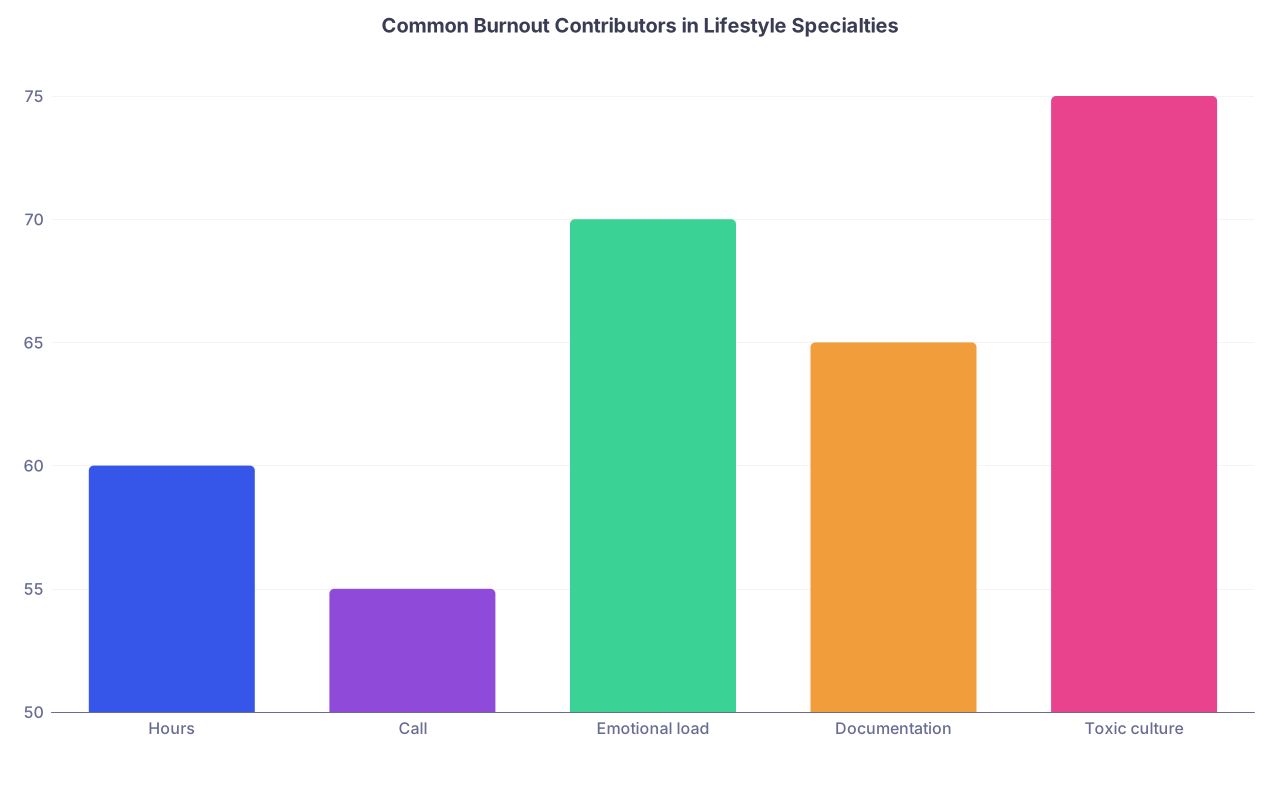
| Category | Value |
|---|---|
| Hours | 60 |
| Call | 55 |
| Emotional load | 70 |
| Documentation | 65 |
| Toxic culture | 75 |

| Step | Description |
|---|---|
| Step 1 | Consider Lifestyle Specialty |
| Step 2 | Identify top 3 burnout triggers |
| Step 3 | Do rotation or elective |
| Step 4 | Talk to residents honestly |
| Step 5 | Reconsider field |
| Step 6 | Reasonable fit |
| Step 7 | Worst days tolerable? |
| Step 8 | See yourself as senior? |

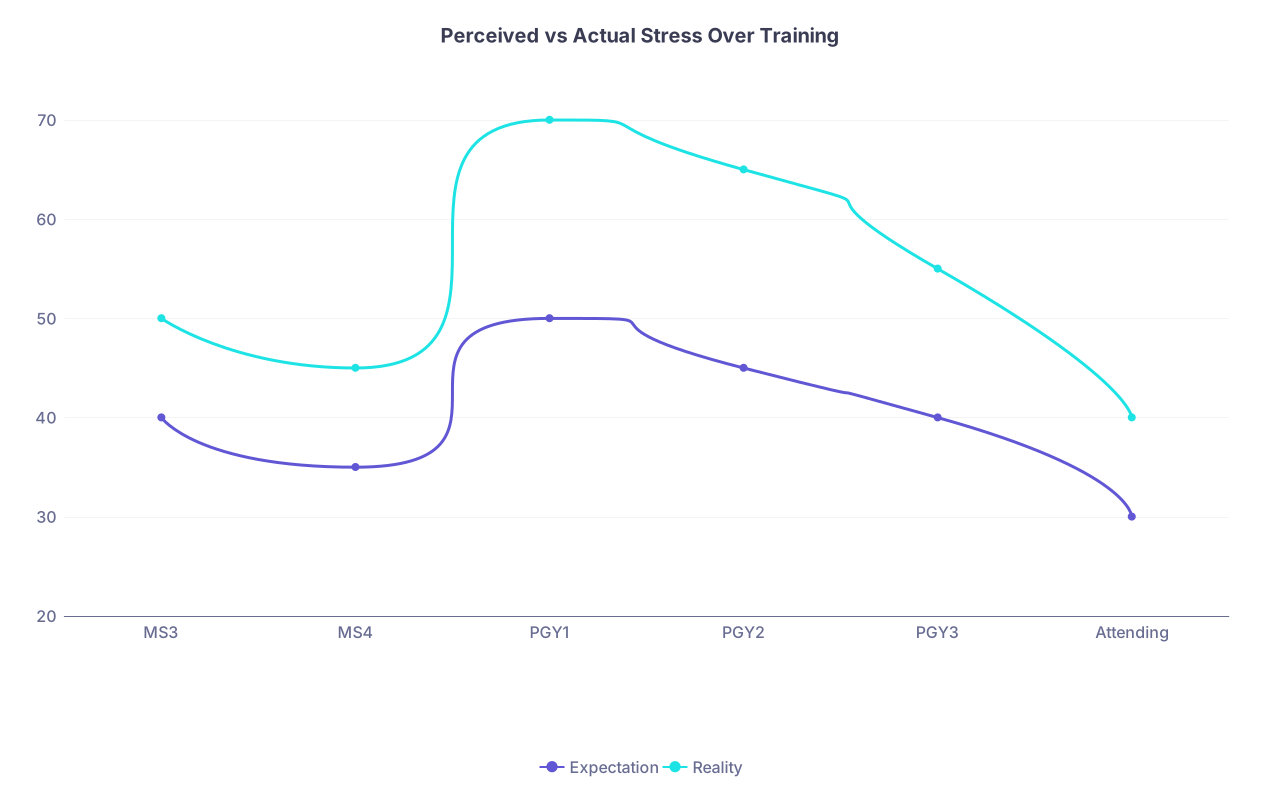
| Category | Expectation | Reality |
|---|---|---|
| MS3 | 40 | 50 |
| MS4 | 35 | 45 |
| PGY1 | 50 | 70 |
| PGY2 | 45 | 65 |
| PGY3 | 40 | 55 |
| Attending | 30 | 40 |
FAQ (exactly what your brain is spiraling about)
1. What if I pick a specialty and realize in residency that it’s too intense—am I trapped?
No, but it will feel like you are. People switch all the time, quietly. It’s messy and uncomfortable and sometimes expensive, but it’s not impossible. Programs usually know someone will leave every few years. If you hit a wall, the path isn’t “suffer for 30 years or quit medicine.” The path can be: talk to a trusted attending, program leadership, or a mentor outside your program; get mental health support; and explore transferring fields or changing settings. The earlier you admit “this is not sustainable,” the more options you have.
2. Is it bad to choose a specialty mainly for lifestyle if I’m not deeply ‘passionate’ about it?
No. The “passion” narrative is wildly overrated. A lot of content, stable physicians are “mildly interested” in their field and very committed to their life outside of work. That’s fine. What is dangerous is choosing a field you actively dislike just for the hours/pay. You don’t need fireworks; you need “I can see myself doing this most days without hating my life.” Respect is enough. Curiosity is enough. Obsession is optional.
3. I’m scared that every specialty feels too intense. Does that mean I shouldn’t be a doctor?
Not automatically. It might mean you’re burnt out from training already, or your nervous system is in constant fight‑or‑flight, so everything feels unbearable. When you’re exhausted, even a 50‑hour “chill” week sounds impossible. Before you conclude “I can’t do this profession,” get yourself evaluated for depression/anxiety, talk to someone outside your school (therapist, career coach, trusted attending), and, if you can, experience rotations when you’re not at your absolute lowest. If, at baseline, every single form of doctoring feels intolerable… then yeah, it might be time to consider alternate paths. But lots of people feel that way temporarily and later find a niche that’s tolerable.
4. How do I ask residents honest questions about burnout without tanking my chances?
You don’t ask it in front of the program director at a formal lunch. You pull aside a resident on a tour, or message a recent grad, and say something like, “Off the record, I’m really worried about burnout. For you and your co‑residents, what makes this job hardest mentally?” You’re not asking “Is your program malignant?” You’re asking “What does hard look like here?” Most residents will be surprisingly honest when they don’t feel watched. And notice their faces when they answer. That usually tells you more than the words.
Open a notes app right now and write two lists: “Things that reliably burn me out” and “Things that I can tolerate even when tired.” Then, for each specialty you’re considering, force yourself to write one brutally honest paragraph: “On this field’s worst day, would I break?” Don’t overthink it. Just write what your gut says. That’s your starting point.