What if you finally get the lifestyle you’ve been chasing… and then you wake up at 40, bored out of your mind, stuck in a “chill” specialty you kind of hate?
Yeah. That thought.
I hear versions of this constantly:
“I like derm but I’m scared I’ll be miserable doing rashes forever.”
“Outpatient IM seems sane but what if it’s just diabetes and hypertension on repeat until I die?”
“Anesthesia lifestyle looks good… but is it just pressing propofol and scrolling EMR for 30 years?”
Underneath all of that is the same fear:
What if I sell out my future self for lifestyle now?
Let’s unpack this in a real way. No fluffy “follow your passion” nonsense. You’re worried for actual reasons.
The Real Fear: Lifestyle vs. Feeling Alive
Here’s the tension you’re feeling:
- You want a life. Sleep. Relationships. Maybe kids. Hobbies that exist outside of UWorld.
- You also want to feel engaged. Challenged. Not counting minutes until lunch for the rest of your career.
Medicine loves to polarize this into two caricatures:
- The “martyr” surgeon who never sees sunlight but is “saving lives”
- The “chill” derm/anesthesia/rads doc who “just makes money and goes home”
Both are fake. Or at least wildly oversimplified.
The question you’re actually asking is more subtle:
Can I pick a lifestyle-friendly specialty and still have:
- Intellectual challenge
- Emotional meaning
- Variety in my day
- Room to change and grow over decades
Or am I trading all of that for 9–5 and no weekends?
You’re not crazy to worry. I’ve watched residents end up in fields they chose purely for lifestyle and then panic PGY-3 when they realize: “Oh. This is… all there is.”
But that outcome is avoidable if you look at specialties clearly and stop treating “chill” as a personality trait instead of a structural reality you can shape.
What “Chill” Actually Looks Like in Different Fields
Let me be blunt: no specialty is chill all the time.
But some are more controllable than others.
Here’s a quick snapshot of how “lifestyle-friendly” fields can still offer (or fail to offer) variety and meaning:
| Specialty | Baseline Lifestyle | Built-in Variety | Easy to Add Variety Later |
|---|---|---|---|
| Dermatology | Very good | Moderate | High (procedures, complex med) |
| Anesthesiology | Good to very good | High | High (ICU, pain, cards) |
| Radiology | Good (varies) | High | High (IR, subspecialty) |
| Outpatient IM | Variable | Moderate | High (specialty clinics) |
| PM&R | Good | High | High (sports, pain, neuro) |
Is this oversimplified? Of course. But notice the pattern: “chill” doesn’t mean “static.” Unless you let it.
You’re Not Actually Afraid of Boredom. You’re Afraid of Being Trapped.
Boredom is fixable. Trapped is not. That’s what your brain is screaming about.
The questions under the surface usually sound like:
- “If I choose derm and hate clinic, can I pivot to mostly procedural work?”
- “If I pick rads and miss patient contact, am I just… stuck with monitors forever?”
- “If anesthesia doesn’t feel meaningful, is there any way to move toward more continuity or complexity?”
You’re afraid of picking wrong with no exit.
So the real thing to evaluate for any lifestyle-friendly specialty isn’t just:
“Is this fun right now?”
It’s:
“Does this field give me escape hatches and knobs I can turn if I get bored?”
Let’s go field by field for a second.
How Different “Chill” Fields Build in Variety (If You Use Them)
Dermatology: More Than Acne and Rashes… If You Want It To Be
Worst-case fear: “I’ll do acne, eczema, psoriasis forever and slowly die inside.”
Reality:
Yes, general clinic can feel repetitive. But derm has a ton of levers:
- Procedures: excisions, Mohs, cosmetics, lasers, injectables
- Complex medical derm: inpatient consults, autoimmune disease, oncoderm
- Subspecialties: peds derm, dermpath, contact allergy, hair, cosmetics
If you build your career as: 5 days/week of bread-and-butter clinic, 8–5, nothing more? Yeah, that can get dull. But you also can deliberately shape your mix.
Example I’ve seen:
One derm I know does:
- 2 days: general clinic
- 1 day: complex derm / hospital consults
- 2 days: mostly procedures and some cosmetics
She’s busy. She’s not bored. Her life is still objectively good: no nights, minimal weekends, real vacations.
The trap in derm isn’t the field — it’s passively taking whatever job offers you without thinking about your mix, then waking up hating 90% of your day.
Anesthesiology: “Just Pressing Propofol” or Continuous Puzzles?
Anesthesia gets memed as the “iPad, propofol, chill” specialty.
But here’s what it can actually look like:
- Day running bread-and-butter ortho cases = can be very routine
- Cardiac anesthesia = constant hemodynamic puzzles
- Neuro = high stakes, super focused
- ICU = different pace, more continuity, heavy decision-making
- Chronic pain = clinic, procedures, longitudinal patients
I’ve seen anesthesiologists who:
- Choose mostly short outpatient cases → lots of turnover, fast pace
- Choose big tertiary centers → complex, sick patients all day
- Build half their time in ICU → acute care, longer arcs of care
- Move partially or fully into pain → highly procedural and outpatient
The boredom risk in anesthesia usually comes from:
- Same OR, same bread-and-butter cases, nothing new, year after year
- No teaching, no academics, no committees, no new skills
Can that happen? Oh yeah. But it’s not compulsory.
Radiology: Screens vs. Subspecialty Identity
The fear here is obvious: “I’ll sit in a dark room, stare at images, never see sunlight or humans, and forget what day it is.”
Here’s the more complete picture:
- Diagnostic rads can be extremely varied: trauma, neuro, chest, MSK, abdominal, etc.
- Subspecialization lets you become the person for one type of case (which can be insanely satisfying for certain brains)
- IR (interventional radiology) is procedure-heavy, hands-on, with real-time impact
- Academic rads = teaching, tumor boards, multidisciplinary planning
I’ve watched:
- General outpatient telerads docs get bored and then pivot into more hospital-based work or subspecialty focus
- IR folks shift their mix as they age (less heavy call, more clinic/procedures they like)
- Diagnostic radiologists build niches (e.g., breast imaging with procedures + patient interaction)
The danger isn’t “radiology is boring.”
It’s picking a job that treats you like a human algorithm and never pushing back.
Outpatient Internal Medicine: Routine vs. Longitudinal Meaning
Everyone’s nightmare: “If I do primary care, my life will be 15-minute visits, refills, and arguing about statins forever.”
And yes, it can be that. Clinic mills exist.
But outpatient IM can also morph into:
- Niche clinics: obesity, HIV, post-COVID, complex care, transplant follow-up
- Procedures: point-of-care ultrasound, joint injections, skin stuff
- Leadership: QI, population health, admin roles, teaching
The upside of primary care that most med students totally miss:
The longitudinal relationships sometimes are the point.
You see your patients:
- Through diagnoses
- Through family changes
- Through aging and loss
If you’re someone who needs “I am important to this person” to feel meaning, primary care can quietly be one of the most fulfilling fields.
The boredom risk: high-volume, low-control jobs that slam you with 25–30+ patients/day and no time to think. You’ve got to be ruthless about avoiding those.
PM&R: Quietly One of the Most Varied Fields
PM&R looks super “chill” from the outside, so people assume it’s low-intensity, low-engagement.
In reality, it can be wildly varied:
- Inpatient rehab: strokes, spinal cord injuries, TBI
- Outpatient: MSK, EMG, spasticity, prosthetics/orthotics
- Sports: athletes, procedures, sideline coverage
- Pain: procedures, blocks, multidisciplinary programs
I’ve seen PM&R attendings who:
- Run full-on interdisciplinary rehab units
- Do mostly sports and injections and love it
- Split time between outpatient and inpatient to avoid boredom
Lifestyle tends to be good. Nights and weekends are limited. But intellectually? It doesn’t have to be soft.
How to Test for “Am I Going to Be Bored?” Before You Commit
You cannot fully predict your 45-year-old self. But you can ask smarter questions now.
Here’s how to pressure-test a “chill” specialty:
Ask seniors and attendings:
“Who do you know in this field who is genuinely bored and burned out? What does their job look like?”
and
“Who seems energized after 15+ years? What does their job look like?”During rotations or electives, pay attention to:
- How often they say, “It’s the same thing over and over.”
- Whether attendings still debate cases with each other
- Whether they’re learning new things or if everything is by autopilot
Ask explicitly:
- “If you wanted more variety in your week, how would you get it?”
- “If someone in your field gets bored, what paths do they usually take?”
If they stare at you and say, “There’s really not much you can change”…
That’s a yellow flag.
Build Yourself Some Future Escape Hatches
You want concrete reassurance? Here it is:
Your risk of being bored drops drastically if you build options.
Things that reliably give you levers later:
- Procedures. If your field has them, learn them. They’re currency.
- Teaching. Residents, med students, APPs. Education adds meaning.
- Niche knowledge. Become “the [X] person.” It makes the work feel less generic.
- Leadership / QI. Not for everyone, but some people really come alive here.
- Research / innovation. Not “pad the CV” research. Stuff you actually care about.
You don’t have to do all of this. But doing something beyond pure clinical throughput keeps you from feeling like a cog.
Hard Truth: Some of This Anxiety Is Just… You
I need to say this out loud:
If you’re the kind of person who:
- Gets bored easily
- Always wonders “what else is out there”
- Feels like the grass is greener everywhere else
You can create that misery in literally any specialty. Even the “exciting” ones.
I’ve seen EM docs bored. Surgeons bored. Cards people bored.
Excitement from acuity wears off. Novelty always decays.
Meaning doesn’t come from constant adrenaline. It comes from:
- Mastery
- Relationships
- Autonomy
- Feeling like your work matters to someone, even if it’s “just” their eczema
So yes, be smart about variety. But don’t treat boredom as something you can cure once and for all with the correct specialty. It’s partially an internal muscle you have to build: learning how to go deeper instead of always sideways.
A Small, Practical Framework: Can This Field Grow With Me?
Here’s a way to sanity-check a lifestyle specialty that’s scaring you:
Ask yourself four questions for each field you’re considering:
Can I see a version of this that’s more intense and a version that’s more relaxed?
(So you can move along that spectrum as your life changes.)Can I shift my focus after 5–10 years without retraining completely?
(Subspecialize, do more procedures, move to academics, etc.)Is there a path in this field for me to add meaning if my baseline day starts to feel flat?
(Teaching, niche clinics, complex patients, advocacy.)If I woke up hating my current job, would I still be glad I have these core skills?
(Derm, rads, anesthesia, PM&R, outpatient IM — all pretty portable.)
If you can mostly answer “yes,” you’re not choosing a prison.
You’re choosing a field with adjustable settings.
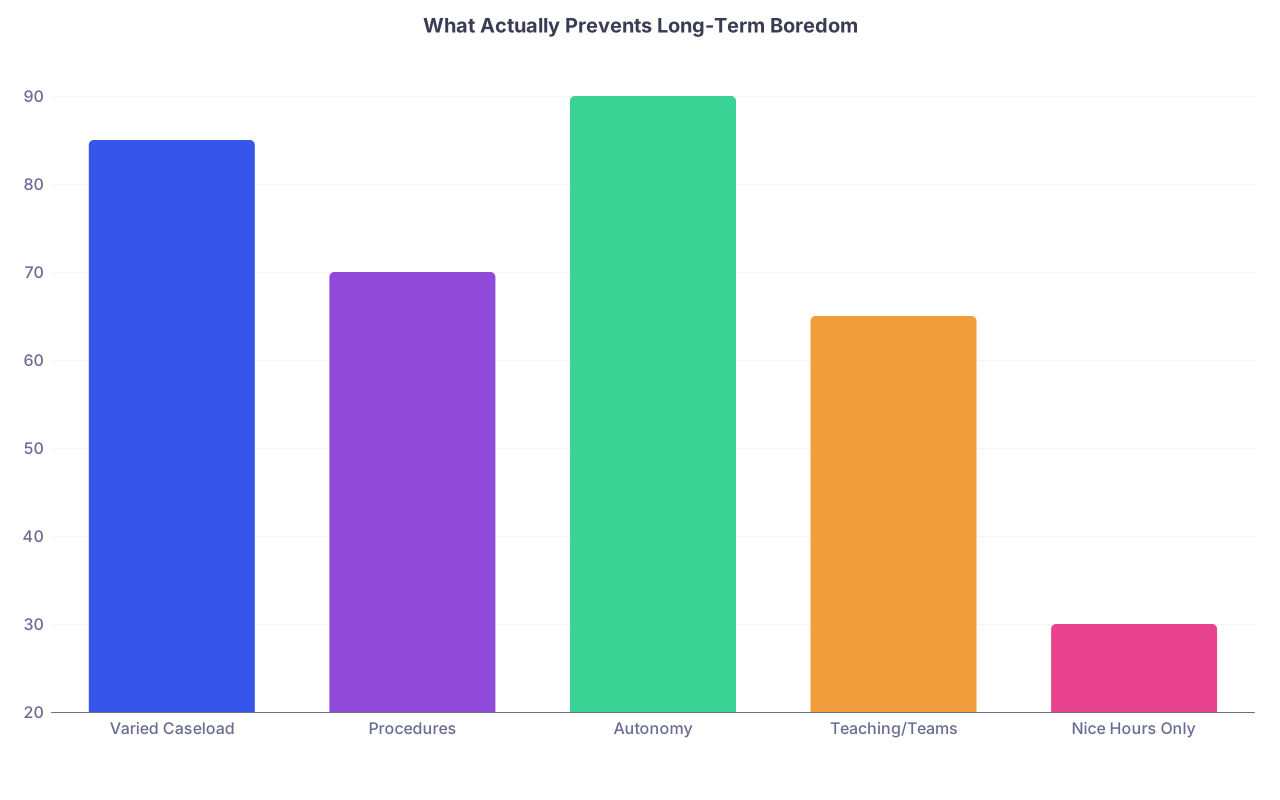
| Category | Value |
|---|---|
| Varied Caseload | 85 |
| Procedures | 70 |
| Autonomy | 90 |
| Teaching/Teams | 65 |
| Nice Hours Only | 30 |
(Values are conceptual, not real data — point is: good hours alone don’t fix boredom.)
How to Calm the “What If I Regret This Forever?” Loop
That loop never fully goes away, but you can turn the volume down.
You’re making a decision with incomplete data about a future version of yourself who will have different needs and different stamina. There is no perfect choice that makes regret impossible.
But you can:
- Pick a field with range
- Train somewhere that shows you multiple career models
- Keep doors open instead of over-optimizing for the narrowest job right away
Lifestyle-friendly doesn’t mean low-impact or low-meaning. It just means you’re not paying with your health and sanity for the privilege of feeling useful.

| Step | Description |
|---|---|
| Step 1 | Interest in chill field |
| Step 2 | Ask about variety and niches |
| Step 3 | Explore fit on rotations |
| Step 4 | Consider it seriously |
| Step 5 | Reevaluate priorities |
| Step 6 | Afraid of boredom |
| Step 7 | Field has flexibility? |
FAQ (Exactly 5 Questions)
1. What if I pick a “chill” specialty and realize I actually miss the adrenaline?
This happens. But it’s usually about mix, not field. In anesthesia, you can move toward more cardiac or trauma. In EM, you can shift to lower or higher acuity sites. In derm/PM&R/rads, you can lean into more complex cases, procedures, or hospital-based work. Very few people actually do a full retrain; most adjust their niche, practice setting, or case mix and feel better.
2. Is it safer to just pick a more “exciting” field now and worry about lifestyle later?
Honestly? That’s how people end up bitter. Banking on future-you being able (or willing) to downshift from a punishing specialty is risky: golden handcuffs, kids, mortgages, ego, and identity all pile up. If you know you value time and flexibility, don’t assume you’ll magically get it later in a field structurally built around call, nights, and long cases.
3. How do I tell if I’m actually interested in a specialty or just attracted to the lifestyle and salary?
Ask yourself: if the pay were all the same and hours were similar across fields, would I still pick this? And then look at your behavior, not your story. Which rotations made time disappear? Which podcasts/YouTube channels do you watch for fun? Which cases stick with you after you leave? If the only thing pulling you to a field is “no weekends and lots of money,” that’s a warning sign to dig deeper before signing up.
4. Can a “chill” specialty still be competitive and rewarding enough for my ego?
Yes. Dermatology, radiology, anesthesia, PM&R — they’re all competitive in different ways and have serious intellectual depth. You can lead departments, run programs, do research, innovate. The idea that “real” med students go into surgery/cards and everyone else is soft is med school bravado, not reality. Your ego will have plenty to chew on if you pick a field where you actually care about the problems being solved.
5. What if I truly have no idea what will keep me engaged long-term?
Then you optimize for flexibility. Pick a specialty with wide internal variety (like IM, rads, anesthesia, PM&R) and avoid super narrow tracks that lock you into one type of work from day one. On rotations, focus less on “Do I love every second?” and more on “Can I see at least three different ways to build a satisfying career inside this field?” You don’t need certainty. You need enough options that future-you isn’t boxed in.
Key takeaways:
- “Chill” doesn’t automatically mean boring — it just forces you to be intentional about variety and meaning.
- Your safest bet isn’t an “exciting” field; it’s a specialty with real flexibility so you can change your mix as you change.
- Boredom is often a job design problem, not a specialty problem — so pay more attention to how people use their field than the stereotype attached to it.