
What if your Step score quietly killed your chances at a good-lifestyle specialty—and nobody’s told you yet?
That’s what this feels like, right? You hear “radiology and psych are lifestyle fields” in M1. Then you take Step, open the score report, and your stomach drops. Now you’re lying in bed thinking:
“Did I just get locked out of the only reasonable lifestyles in medicine?”
Let’s talk about that. Honestly. No fake positivity, but also no doom that isn’t real.
First, how “bad” is a “low” Step score… really?
You probably already memorized the averages. But it all blurs together when you’re panicking.
For context, this is roughly the vibe for Step 2 CK in recent cycles (Step 1 is pass/fail, but programs still peek if they can):
| Category | Typical Avg Matched | Safest Zone | Yellow Zone |
|---|---|---|---|
| Radiology (diagnostic) | ~245–250 | 245+ | ~235–244 |
| Psychiatry | ~235–240 | 240+ | ~225–239 |
| Internal Medicine (categorical) | ~238–242 | 240+ | ~225–239 |
| FM / Peds / Neuro / Psych-adjacent | ~230–238 | 235+ | ~220–234 |
These aren’t exact for every year or every program, but they’re close enough for risk-calculating.
Now the part you’re actually asking: if you’re sitting at, say, 220–230, did radiology and psych just vanish?
Radiology: score-sensitive, relatively competitive.
Psychiatry: much more forgiving, especially in the right tier of programs and locations.
Let me say something clearly up front:
- A low Step score absolutely hurts your chances at certain radiology programs.
- A low Step score does not automatically take psychiatry off the table.
- Neither specialty is “off the table” as in “zero chance,” unless we’re talking truly extreme circumstances (multiple failures, no backup, no geographic flexibility).
What you lost is leverage. Not existence.
Radiology with a low Step: is this fantasy-land?
This is the one that makes people wince. Because radiology has a reputation:
High scores. Researchy people. Nerdy but in a hyper-competitive way. Lifestyle at the attending level, but residency can be intense.
Let’s split radiology candidates loosely into tiers by Step 2 CK, just for your brain to have a framework.
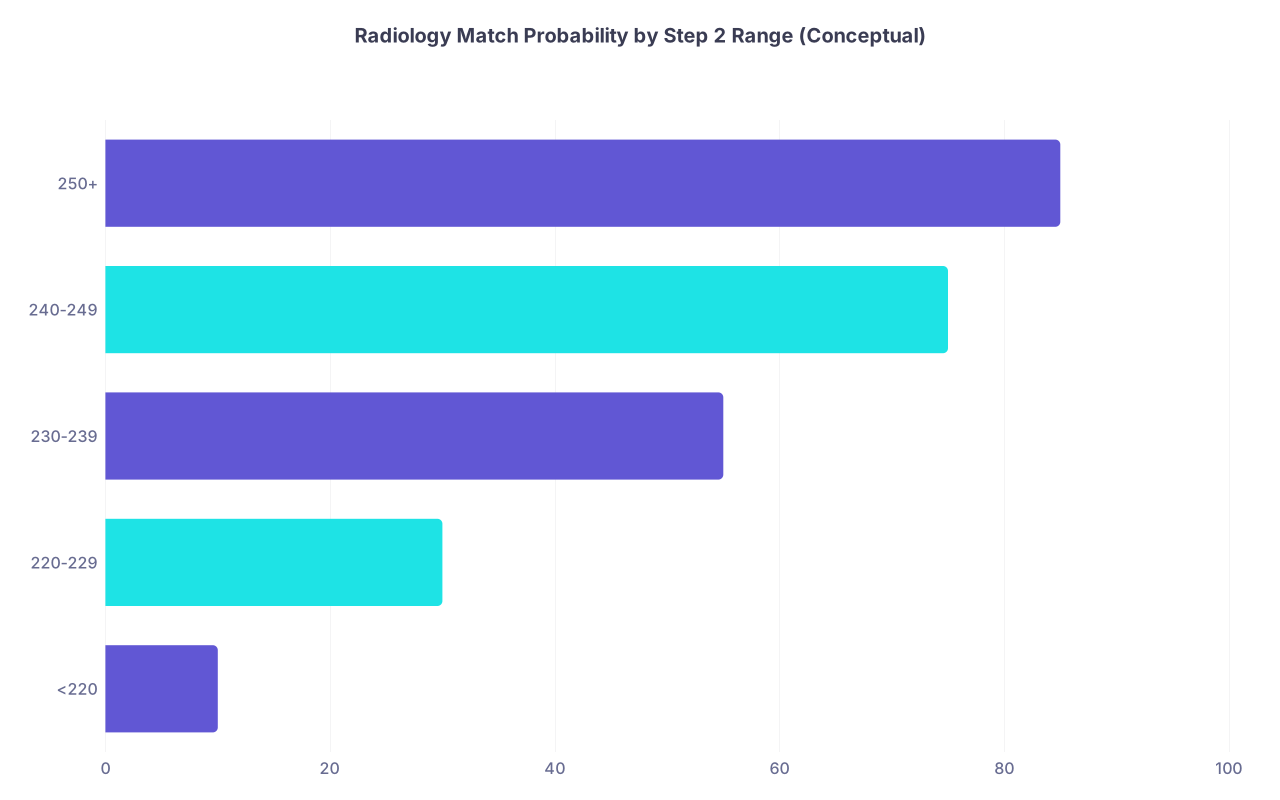
| Category | Value |
|---|---|
| <220 | 10 |
| 220-229 | 30 |
| 230-239 | 55 |
| 240-249 | 75 |
| 250+ | 85 |
This is conceptual, not official NRMP data, but it reflects what I’ve seen:
- Below ~220: you’re probably in serious trouble for rads unless there’s something unusual (PhD, huge rads research, strong home program that loves you, DO/IMG-friendly backup strategies, etc.)
- 220–229: possible, but you have to be extremely realistic and targeted. No delusions about big-name places.
- 230–239: not ideal for top-heavy rads, but absolutely workable with smart application strategy, especially if the rest of your app supports it.
- 240+: you’re more in the “normal rads candidate” zone.
Now the fears:
Fear #1: “Programs will screen me out before they even see my name.”
Some will. Actually, many will.
But not all programs screen at the same cutoff. And not every PD is obsessed with a single number.
Places more likely to keep you in the game with a lower Step:
- Mid-tier university programs in less flashy cities
- Community-based radiology residencies
- Programs in less popular regions (Midwest, South, less coastal/urban)
- Your home program, if you’ve built relationships there
What kills you is applying like a “normal” applicant: 25–30 programs, mostly coastal, big-name places, no deep thought about your actual competitiveness.
If your Step is low, and you’re serious about rads, you’re not playing that game. You’re going for volume, strategy, and signal:
- Volume = 60–80+ programs, not 25
- Strategy = aim at DO-friendly, IMG-friendly, less popular geographic areas
- Signal = rads letters, rads research, rads elective time, PDs who can call for you
If you’re thinking “But I don’t have those things yet,” that’s the next section.
Fear #2: “My Step score means they’ll assume I can’t handle the workload.”
I’ve literally heard rads faculty say, “We just don’t want someone who’ll struggle with the boards again.”
So yes, the fear is real. They worry about:
- You passing future in-training exams
- You passing the core exam on time
- Your ability to read and absorb huge volumes of image-heavy information
What helps counter this?
- Strong clerkship performance in medicine/surgery
- Honors or high passes in hard rotations
- A big upward trend from Step 1 pass (barely) → Step 2 (solid)
- Evidence you can grind: research productivity, solid letters, work experience
If your Step 2 is low but your narrative is: “I had a mess of a year but here’s the upward trend, here’s the pattern of solid performance, here’s a PD vouching for me” — that’s a different story than “barely passed everything, no one really knows me.”
Fear #3: “If I apply rads with this score, I’ll just go unmatched.”
Let me be blunt: yes, that’s a risk. Especially if you:
- Don’t have a parallel plan
- Only apply radiology prelims/ty-1-year without a categorical backup
- Aren’t geographically flexible
This is where the “lifestyle specialty” thing gets distorted. People want radiology for lifestyle but forget: the career risk is the opposite of lifestyle if you go unmatched.
If your Step score is on the low side, your safest approach if you insist on rads:
- Apply rads + a genuinely acceptable backup that you could live with
- Think hard about prelim vs categorical backup plans
- Talk with someone in advising who isn’t just telling you what you want to hear
If you can’t realistically tolerate not matching, you can’t be reckless here. Wanting a lifestyle doesn’t mean you gamble your whole future on one specialty with weak objective stats.
Psychiatry with a low Step: much more alive than you think
Psych is different. Way different.
Yes, psych is more competitive than it was 10 years ago. The averages have crept up. The coasts are ridiculous. But psych is still one of the most forgiving “lifestyle-ish” specialties for people with:
- Step scores in the low- to mid-220s
- Non-traditional backgrounds
- Imperfect transcripts
- DO/IMG backgrounds
Here’s how psych usually behaves around scores:
- 210–220: you’re not dead. You’re just not getting Harvard/BIDMC/UCSF psych.
- 220–230: still absolutely workable across a large chunk of programs, especially in middle-of-the-country and community settings.
- 230–240: you’re solid for a wide range of places.
And psych cares more than average about:
- Who you are in person
- Your commitment to the field (psych rotations, electives, interest groups, research)
- Red flags that hint at professionalism, not just exam ability
If your score is low, psych is one of the few “lifestyle-friendly” fields where you can still:
- Have a strong, genuine story
- Show you’ll be good with patients
- Build a track record of interest in mental health
- Match somewhere respectable and train well
The hidden landmine? The top 15–20 psych programs are quietly almost as neurotic as other competitive fields. They like strong scores, research, prestige. If your Step is low, stop fixating on those. That’s where people self-sabotage — they burn apps on name brand instead of places that might actually rank them.
Comparing the two: radiology vs psych when your score is low
Let me put the core reality in a snapshot for your anxious brain:
| Factor | Radiology | Psychiatry |
|---|---|---|
| Score sensitivity | High | Moderate |
| Lifestyle as attending | Excellent | Excellent (varies by practice) |
| Competitiveness trend | High and rising | Moderate and rising |
| Salvageable with low Step? | Only with strong support & plan | Often, with smart school list |
| Emphasis on personality | Lower (still matters) | High |
| Research importance | Helpful, more valued | Helpful but not mandatory |
If your number is dragging you down and you still want something lifestyle-friendly, psych is simply more forgiving than radiology. I’m not saying, “You should give up on rads.” I’m saying, “Don’t pretend the risk is the same.”
So what can you actually do to improve your odds now?
Here’s the part where people either freeze or finally feel like they have some control.
1. Decide: radiology, psych, both, or neither?
You can’t plan if you won’t admit what you actually want.
Be honest:
- If radiology is a “would be nice” but psych also genuinely interests you → you might be happier going all-in on psych and building a strong, coherent application.
- If radiology is “I’ve always loved anatomy and imaging, I’ve done electives, I shadowed, I feel alive reading scans” → okay, then you owe it to yourself to at least explore it with a backup.
- If both are just “I heard they’re lifestyle” and you have zero actual passion or exposure in either → that’s a red flag that you might just be running from burnout, not choosing a specialty.
You don’t need your final answer today, but you need to stop pretending you have “plenty of time” if apps are within a year.
2. Build field-specific evidence, not vague interest
If you’re late in med school, this hurts to hear, but it’s still true: what you do now can still tilt things.
For radiology:
- Do a dedicated radiology elective or sub-I at your home program
- Get at least one strong letter from a radiology faculty member who actually knows you
- Try to get on even a small imaging-based QI or research project (case reports count more than you think, if they’re real and rads-themed)
- Show up to rads conferences, resident teaching, journal club; be a real human in their department
For psych:
- Take a psych inpatient and/or consult elective
- Work with programs where faculty actually see you working with patients
- Ask for letters from psychiatrists who can speak to your empathy, reliability, insight
- Join a psych interest group or ongoing community mental health project
- If you have personal mental health advocacy experience or previous psych-related work, shape this into a coherent, mature narrative
Field-specific evidence tells programs, “This isn’t a random lifestyle grab. I belong here.”
The timeline reality: are you already behind?
If you’re M3 or early M4 and just got your Step 2 score, here’s a rough emotional timeline of what happens if you’re thinking lifestyle specialties with a low score:
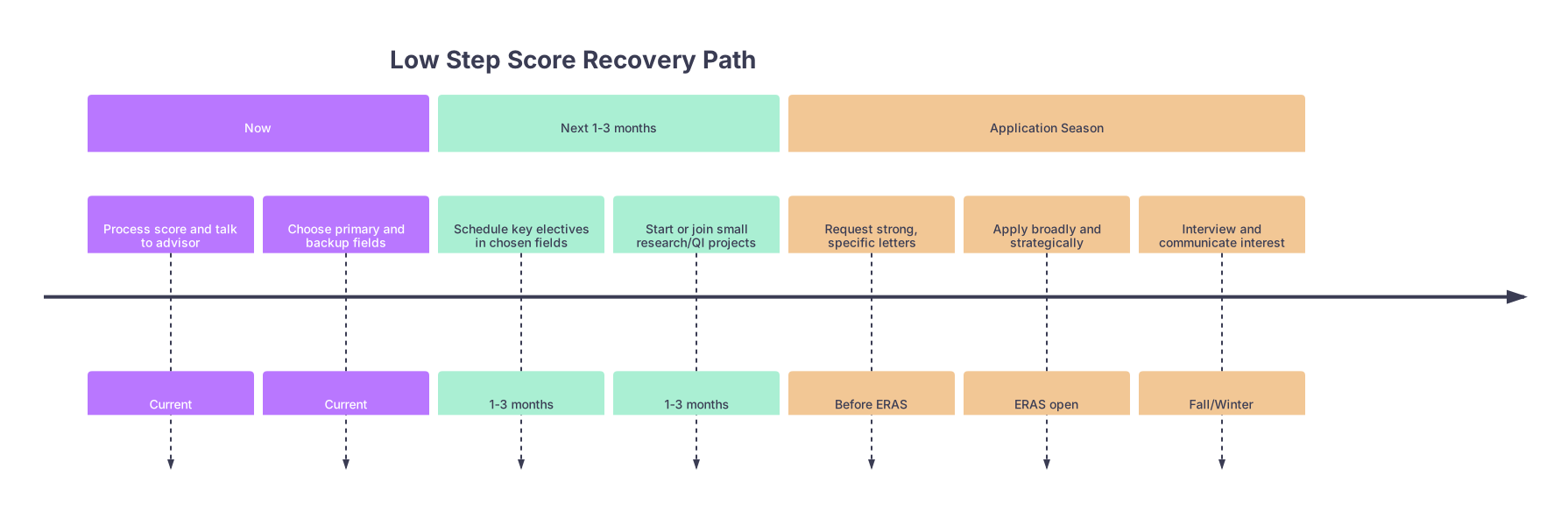
| Period | Event |
|---|---|
| Now - Process score and talk to advisor | Current |
| Now - Choose primary and backup fields | Current |
| Next 1-3 months - Schedule key electives in chosen fields | 1-3 months |
| Next 1-3 months - Start or join small research/QI projects | 1-3 months |
| Application Season - Request strong, specific letters | Before ERAS |
| Application Season - Apply broadly and strategically | ERAS open |
| Application Season - Interview and communicate interest | Fall/Winter |
You’re behind if:
- You’re in late M4 and still don’t have any elective time in your intended specialty
- You have no idea which programs are DO/IMG/low-score-friendly
- You haven’t spoken honestly with anyone (PD, advisor) about realistic targets
You are not automatically doomed if:
- You got your Step 2 late but still have 1–2 rotations you can direct toward your field
- You’re willing to apply broadly and flex on geography
- You’re willing to have a real backup and not treat it as an insult to your dreams
Don’t ignore the mental health part of this
There’s this quiet, ugly thing that happens after a disappointing Step score:
You start telling yourself you’re the “dumb one.” That everyone else is gliding into anesthesia, rads, derm, ophtho, and you’re the charity case begging for psych.
I’ve watched people self-destruct because they decided their score meant they were inherently less capable. They stopped showing up strong. They apologized for existing in away rotations. They wrote weak personal statements because they didn’t believe their own story.
That’s the part that actually kills applications.
Programs see it. They can tell when your whole message is “Sorry I’m not better.”
If you’re going into psych especially, you need to get your own narrative straight:
- “I’m more than one number.”
- “I’ve had setbacks, but I do good work with patients.”
- “I know how hard I can work when I care about something.”
- “I bring something useful that’s not captured in a multiple-choice exam.”
That doesn’t mean denying your score matters. It means not letting it define your whole identity.
The ugly risk: what if you really, actually don’t match?
You’re scared of this. Honestly? You should be, a little. That fear keeps you from magical thinking.
The people I’ve seen go unmatched with low scores and “lifestyle” dreams usually:
- Applied too few programs
- Aimed too high prestige-wise
- Had no backup or a joke backup (like 5 IM programs “just in case”)
- Didn’t fix glaring things they could have fixed (weak personal statement, generic letters, no demonstrated interest in specialty)
The people with low scores who did match into psych or rads:
- Had brutally honest advising
- Were willing to swallow pride about geography and program “prestige”
- Had concrete evidence in the specialty (letters, rotations, projects)
- Treated interviews like they mattered (because they do, massively, once you’re in the door)
You can’t remove risk. But you can stop pretending you’re a 250 applicant if you’re not.
So… are radiology and psych off the table?
Radiology:
Not “off the table,” but the table has way fewer chairs for you. You’ll need:
- Realistic target list
- Lots of applications
- Strong connections and evidence in rads
- A backup you’d actually attend
Psychiatry:
Very much still on the table in many places, even with a low-ish Step, if you:
- Show clear interest and fit
- Apply widely and intelligently
- Avoid obsessing over brand-name programs that were never going to interview you anyway
If what’s really haunting you is: “Will I ever have a decent life as a doctor now that my score is low?” — then no, that’s not over. There are still lifestyle-friendly paths. They just may not look exactly like the path you fantasized about in M1.
Open a blank doc right now and write two short paragraphs: one arguing for radiology, one arguing for psychiatry, from your own actual interests and experiences, not from fear or prestige. Then ask yourself which one sounds more like a real person talking and which one sounds like someone trying to escape burnout.