
Understanding Work-Life Balance in EM–IM Combined Residency
Emergency Medicine–Internal Medicine (EM IM combined) is a unique five-year pathway that trains residents to be fully board-eligible in both emergency medicine and internal medicine. For an international medical graduate (IMG), this track can be very appealing: broad medical exposure, strong job security, and multiple career options (ED, inpatient wards, ICU, academic medicine, administration).
At the same time, it is an intense, physically and emotionally demanding training route. To decide whether this is a lifestyle residency that fits your goals, you need a realistic work-life balance assessment—not just based on duty hours on paper, but on how your days actually feel, how much control you have over your schedule, and how sustainable the workload is over five years and beyond.
This IMG residency guide focuses on work-life balance in EM–IM for international medical graduates, with specific examples, red flags to watch for, and strategies to protect your wellness.
1. What “Work-Life Balance” Really Means in EM–IM
For EM–IM residents, work-life balance is not about working “few” hours; it’s about predictability, recoverability, and sustainability.
Key dimensions:
Workload intensity
- Acuity of patients (ED and ICU vs general medicine wards).
- Cognitive load: rapid decision-making in emergency medicine; longitudinal care and complex diagnostics in internal medicine.
- Night shifts, weekend coverage, and holiday call schedules.
Predictability of schedule
- Emergency medicine rotations: mostly shift-based with fixed start/end times.
- Internal medicine rotations: often longer days with variable end times, especially on ward and ICU months.
- How early you know your schedule (months vs weeks in advance).
Recovery and rest
- Protected time off between shifts and rotations.
- Fatigue management: rest between night shifts, post-call days.
- Ability to take vacation at meaningful times (not always chopped into small pieces).
Control and flexibility
- Can you request specific days off (religious holidays, important family events)?
- Can you swap shifts? Are co-residents usually willing to help?
- Elective time to shape your schedule and lifestyle in later years.
Personal and family considerations for IMGs
- Time zone differences when calling family abroad.
- Immigration appointments (visa renewal, USCIS visits).
- Adapting to a new culture and healthcare system while under intense workload.
In EM–IM, overall hours are heavy but not necessarily worse than categorical internal medicine or emergency medicine alone. The difference is that you are moving between two cultures and systems of work: shift-based EM vs service-based IM. That transition itself can be stressful if not managed properly.
2. Duty Hours and Typical Schedules in EM–IM
Residency work life balance starts with understanding duty hours and typical scheduling patterns. While all ACGME-accredited programs are required to follow duty hour regulations, how they operationalize these rules can vary significantly by program.
2.1 ACGME Duty Hour Framework
Most EM–IM programs follow ACGME rules for both core specialties, including:
- Maximum 80 hours/week, averaged over 4 weeks.
- Minimum one day off in seven, averaged over 4 weeks.
- No more than 24 hours of continuous in-house duty in IM (plus up to 4 hours for transitions; EM has its own shift length rules).
- Adequate time off between duty periods (usually 10 hours recommended).
- EM-specific rules on maximum shift length and number of night shifts in a row.
On paper, most programs comply. Your real question as an IMG should be: How close to the 80-hour cap do residents actually work, and how consistently?
2.2 Typical EM–IM Rotation Mix and Lifestyle Implications
Although the exact rotation schedule varies, a common pattern for EM–IM:
PGY-1 (Intern Year)
- Heavy internal medicine ward and ICU time.
- ED shifts start to appear but usually less than in later years.
- Many days: arrive ~6:30–7:00 am, leave between 5:00–7:00 pm (on IM).
- Night float blocks or 24-hour calls (depending on program).
PGY-2 and PGY-3
- Increase in ED months (shift-based) with more independence.
- Ongoing IM wards, ICU, cardiology, electives.
- Alternation between ED “blocks” and IM “blocks”.
- Lifestyle “oscillates” between EM-style and IM-style work.
PGY-4 and PGY-5
- Usually more electives and flexibility.
- Senior roles in both ED and IM services.
- Often improved control over vacations and elective scheduling.
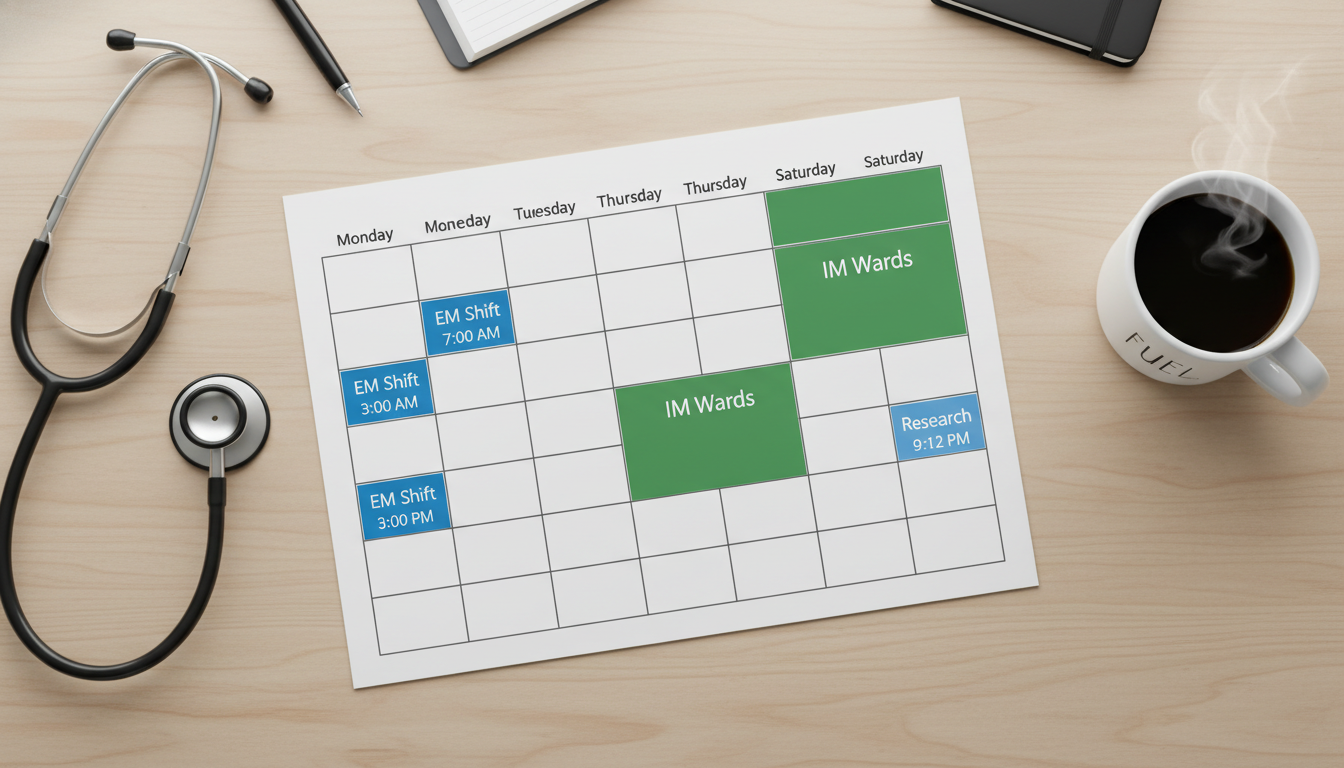
Consider two simplified sample months:
Example Month A: EM-heavy rotation
- 18–20 ED shifts in a month.
- Shift length: 8–10 hours or 12 hours, depending on program.
- Example pattern: 3–4 shifts per week, mix of days, evenings, nights.
- Pros:
- Hard stop times; once shift ends, you usually sign out and go home.
- Some weekdays completely off.
- Easier to plan specific days.
- Cons:
- Circadian disruption from rotating shifts.
- High adrenaline, emotional cases, crowding stress in ED.
Example Month B: IM wards rotation
- 6 days per week on service.
- Start ~6:30–7:00 am; finish ~5–7 pm (or later on busy days).
- 1 day off per week.
- Pros:
- More regular rhythm (always mornings, rarely sudden schedule changes).
- Longitudinal patient relationships, academic teaching rounds.
- Cons:
- Less control over leaving time.
- Harder to schedule personal appointments.
As an IMG, expect the extremes of both worlds. You will need to be comfortable with:
- Shift-based, high-urgency work (EM).
- Prolonged, often unpredictable days (IM).
Neither side is “easy,” but the combination can be very rewarding if you enjoy variety.
3. Unique Work-Life Balance Challenges for IMGs in EM–IM
While all residents face long hours and stress, international medical graduates encounter additional layers that directly affect residency work life balance.
3.1 Immigration and Visa Pressures
For many IMGs (J-1, H-1B, or other visas), your legal status is tied to your residency. Workload isn’t just tiring; failure or burnout can have immigration consequences.
Impact on work-life balance:
- Extra stress during visa renewals, DS-2019 updates, or status changes.
- Time off for immigration appointments may be hard to coordinate on intense rotations.
- Anxiety about maintaining performance while adapting to a new environment.
Actionable advice:
- Before ranking programs, ask explicitly:
- “How do you support residents during visa/immigration processes?”
- “Is there a dedicated staff member (GME office) who assists IMGs?”
- When scheduling electives or lighter months, try to align them with:
- Expected visa renewal windows.
- Important deadlines (USCIS, ECFMG, etc.).
3.2 Cultural and Communication Adaptation
Working in emergency medicine internal medicine requires rapid, precise communication:
- In the ED: quick patient interviews, team coordination, high-stakes conversations.
- In IM: detailed presentations, complex handoffs, discussions about prognosis/goals of care.
For an IMG, that means:
- Initial extra time spent reading charts, documenting, and double-checking orders.
- Higher cognitive load while simultaneously translating or adjusting to local idioms.
- Potential self-doubt that can increase stress and lengthen your perceived “workday.”
Actionable advice:
- Before residency starts:
- Practice concise English handoff phrases (SBAR, I-PASS).
- Watch US-based EM and IM clinical teaching videos to adapt to common terminology.
- Early in PGY-1:
- Ask senior residents for examples of strong presentations and notes.
- Build templates and checklists so documentation becomes faster over time.
3.3 Social Isolation and Support Systems
Many IMGs arrive in the US without local family. In an intense combined program, lack of social support can worsen burnout:
- Holidays: You may be working while your family is abroad, in a different time zone.
- Days off: Difficult to coordinate meaningful outings if your co-residents’ schedules don’t match yours.
- Emotional burden: Difficult ED resuscitations, terminal diagnoses on IM, language barriers with families.
Actionable advice:
- Seek programs with a track record of supporting IMGs:
- Ask: “What percentage of your current residents are IMGs?”
- Ask residents: “Do IMGs feel integrated socially?”
- Build intentional supports:
- Connect with local diaspora communities, religious centers, or cultural groups.
- Maintain routine calls with family abroad (set stable windows on off-days).
- Use resident wellness resources (counseling, peer support groups).
4. Comparing EM–IM to Other Residencies from a Lifestyle Lens
Many applicants ask whether EM–IM is a “lifestyle residency.” The answer is nuanced.
4.1 Comparing to Categorical Emergency Medicine
Categorical EM:
- 3–4 years total.
- Primarily shift-based work—more predictable start/stop times.
- No long inpatient ward months; less chronic management.
- Post-residency:
- Often flexible, high hourly pay, ability to adjust number of shifts.
EM–IM:
- 5 years total (longer training).
- Must fulfill both EM and IM requirements; more total months of intense rotations.
- Increases your long-term options (ED, inpatient medicine, ICU, hospitalist, academics, administrative roles).
Work-life balance comparison:
- During training: EM–IM is typically more intense overall than pure EM due to added IM workload.
- After training: EM–IM can offer more lifestyle flexibility, e.g.,
- Splitting time between ED shifts and less intense clinic work.
- Transitioning out of nights earlier in your career by moving to office-based IM or teaching roles.
4.2 Comparing to Categorical Internal Medicine
Categorical IM:
- 3 years total.
- Primarily inpatient wards/ICU early, with increasing electives later.
- Usually more consistent daytime hours but longer individual days.
- Fewer nights than ED overall, depending on call structure.
EM–IM:
- More night and weekend work on ED months.
- More variety; less monotony but more schedule disruption.
- Longer total timeframe (five years vs three).
Work-life balance comparison:
- During training: EM–IM might feel physically harder due to more nights and circadian shifts.
- After training: IM-only can lead to hospitalist roles with block schedules or clinic-only jobs that can be quite lifestyle-friendly. EM–IM offers those plus ED roles if you want them.
4.3 Is EM–IM Lifestyle-Friendly Long-Term?
Yes, EM–IM can be favorable in terms of lifestyle residency outcomes after graduation, mainly because:
- You can:
- Work part-time ED and part-time clinic/hospitalist.
- Transition gradually away from nights and weekends as you age.
- Craft a balanced schedule that suits family priorities.
- You maintain job flexibility, which is powerful if immigration status or family needs change.
The trade-off: the five years of training will be significantly more demanding than many other MOST_LIFESTYLE_FRIENDLY_SPECIALTIES, but the payoff is long-term control.

5. Practical Strategies to Protect Work-Life Balance as an IMG in EM–IM
You cannot change the length of training or the core duty hours, but you can influence your daily experience. Below are practical strategies tailored to IMGs in EM–IM.
5.1 Before You Apply or Rank Programs
During interviews and virtual open houses, ask residency programs concrete questions:
Schedule transparency
- “Can I see a sample EM–IM schedule for each PGY level?”
- “How many night shifts per month on average in EM and IM?”
- “How far in advance are schedules published?”
Wellness and support
- “What wellness resources exist specifically for residents?”
- “Are there mental health services with protected time to attend?”
- “Do residents actually use these, and is it culturally accepted?”
IMG-specific support
- “How many IMGs are in the program currently?”
- “Who handles visa and immigration paperwork—GME, outside lawyers?”
- “Any issues with J-1/H-1B support in the last 5 years?”
Culture and workload honesty
- “Are most residents close to 80 hours/week, or usually less?”
- “Do seniors and attendings encourage going home when work is done?”
- Ask current residents privately: “What is one thing you wish you had known about the workload before matching?”
Use their answers to compare programs’ true culture around lifestyle versus what is just written on brochures.
5.2 Time and Energy Management During Rotations
On EM rotations:
- Protect sleep:
- Use blackout curtains and earplugs for day-sleep after night shifts.
- Avoid scheduling important tasks right after night shifts.
- Batch life tasks:
- Groceries, banking, and long calls with family on your full off-days.
- Use online services to minimize errand time.
On IM rotations:
- Create predictable routines:
- Fixed wake-up, pre-round routine, and bedtime where possible.
- Streamline your pre-rounding template to limit overtime.
- Efficient documentation:
- Use note templates and smart phrases (where allowed).
- Dictation software if available to speed up notes.
5.3 Building Support and Resilience
- Peer support:
- Identify at least one EM–IM co-resident or senior as your mentor.
- Debrief difficult cases (codes, unexpected deaths) with peers rather than keeping them internal.
- Boundaries:
- Learn to say, “I can help with that after I finish this urgent task,” rather than taking every new task immediately.
- On your day off, limit checking work emails/messages unless absolutely necessary.
- Professional help:
- If feeling overwhelmed, use confidential counseling offered by your institution.
- Many programs have access to an employee assistance program (EAP).
5.4 Long-Term Career Planning for Better Lifestyle
As you progress to PGY-3, PGY-4, and PGY-5, think deliberately about your post-residency lifestyle:
If you want mostly daytime work:
- Explore outpatient IM roles, academic ambulatory positions, or administrative tracks.
- Consider a balance of hospitalist (block schedule) and teaching roles.
If you enjoy shift work but want fewer nights:
- Choose ED practices with flexible scheduling or more day/evening shifts.
- Some groups allow senior physicians to reduce night coverage over time.
If you value geographic or immigration flexibility:
- EM–IM training opens options in rural EDs (with higher pay), urban hospitalist roles, or telemedicine for IM.
Having this range of options is a major advantage for an international medical graduate, especially when immigration, family needs, or financial goals may evolve.
6. Red Flags and Green Flags in EM–IM Programs (From a Lifestyle Perspective)
When evaluating EM–IM combined programs for work-life balance, watch for these signals.
6.1 Green Flags: Programs That Protect Residents
- Schedules given 2–3 months in advance and rarely changed last-minute.
- Residents describe:
- “We are busy, but people go home when their work is done.”
- “Attendings encourage us to take breaks and use our days off.”
- Clear back-up systems:
- Float residents or moonlighters who can step in when volumes spike.
- EM and IM departments with good collaboration:
- No “turf wars” over admissions; smoother workflow.
- Multiple IMGs in leadership or senior resident roles, and they speak positively about support.
6.2 Red Flags: Programs That May Burn You Out
- Residents hint that 80 hours/week is the norm, not the exception.
- Frequent violations of:
- Day-off rules.
- Maximum shift length, without clear correction.
- “You’re lucky to be here” attitude toward IMGs, with little flexibility around visa-related needs.
- No mention or awareness of wellness initiatives, or they exist only on paper.
For an IMG, these red flags are especially serious, because you often have fewer external supports to buffer the stress.
FAQ: Work-Life Balance for IMGs in EM–IM
1. Is EM–IM a reasonable choice for an IMG who wants good work-life balance?
Yes, but with nuance. During the five years of training, EM–IM is intense and not among the easiest lifestyle residencies. However, after graduation, the dual training gives outstanding flexibility to construct a career with favorable work-life balance: you can choose ED shifts, clinic work, hospitalist blocks, or mixes of these, and adjust over time as your personal life changes.
2. Do EM–IM residents usually hit the 80-hour duty hours limit?
This varies widely by program and rotation. Many EM blocks are closer to 45–60 hours/week due to shift caps, while heavy IM or ICU months can cluster closer to 70–80 hours/week. Ask programs for realistic numbers and talk to current residents (especially IMGs) for candid assessments.
3. As an IMG, will visa issues significantly affect my work-life balance?
They can, primarily by adding stress and time pressure. You may need to attend immigration appointments or handle paperwork during busy rotations. Programs with strong GME support and clear experience with J-1/H-1B residents reduce this burden. When interviewing, ask how they help with visa logistics and whether time for such appointments is supported.
4. How can I tell if an EM–IM program is IMG-friendly regarding lifestyle and support?
Look for: a visible presence of IMGs among current residents, transparent responses about duty hours and scheduling, clear institutional support for wellness and visas, and a culture where residents feel comfortable discussing fatigue and mental health. If IMGs in the program say they feel respected, supported, and integrated, that is a strong positive sign.
A thoughtful work-life balance assessment is essential before committing to EM–IM as an international medical graduate. By understanding duty hours, typical schedules, the dual nature of EM and IM work, and the added challenges of immigration and cultural adaptation, you can choose programs—and strategies—that make this demanding but highly rewarding training path sustainable and fulfilling.