
As a Caribbean IMG aiming for Emergency Medicine (EM), your USMLE Step scores feel like the center of the universe—especially if they’re lower than you hoped. But they are not the whole story. EM programs, especially at the community and mid-tier academic level, routinely match strong Caribbean applicants who understand how to strategically use their Step 1 and Step 2 CK (and sometimes Step 3) to tell a compelling story.
This article lays out a practical, score-focused roadmap for Caribbean IMGs pursuing an emergency medicine residency in the U.S.—whether you’re still waiting on scores, reeling from a disappointing result, or trying to optimize a competitive score.
We’ll focus on:
- What EM programs look for in Step scores (and how this differs from other specialties)
- How Caribbean status changes the bar—and how to compensate
- Concrete strategies for different score profiles (high, mid, low, and failed attempts)
- How to integrate your scores into a complete EM match strategy as a Caribbean IMG
Understanding How EM Programs View Step Scores (as a Caribbean IMG)
Emergency Medicine has always been a holistic but numbers-aware specialty. Programs care about whether you can handle the pace, acuity, and cognitive load—but they use Step scores mostly as:
- A screening filter (pass/fail or score cutoffs, especially on Step 2 CK)
- A signal of test-taking ability for in-training exams and board passage
- A tie-breaker among otherwise similar candidates
Step 1 vs Step 2 CK in Today’s EM Landscape
With Step 1 now pass/fail, EM programs have shifted emphasis:
Step 1 (Pass/Fail)
- For a Caribbean medical school residency candidate, a first-time Pass is essential.
- A fail is a serious red flag, but not always fatal—if you show major improvement on Step 2 CK and build a strong EM-specific profile.
- Programs don’t use Step 1 numerically now, but they do note multiple attempts and long delays.
Step 2 CK (Numeric Score, Critical for EM)
- This is effectively “the new Step 1” for EM selection.
- For Caribbean IMGs, Step 2 CK is often the single most important academic metric.
- Strong Step 2 CK + strong EM letters can offset being from a Caribbean medical school, and even a modest Step 1 history.
How Caribbean Status Changes the Score Conversation
For applicants from top U.S. MD schools, a Step 2 CK near the national mean may still earn interviews. For a Caribbean IMG, programs are more cautious. They worry about:
- Variable clinical training environments
- Historical match data and board pass rates from some Caribbean schools
- Limited direct knowledge of curriculum and grading
Because of this, your Step 2 CK and your SGU residency match or similar outcomes from your school are under extra scrutiny. Programs will ask:
- “Does this candidate clearly meet or exceed our academic bar?”
- “Have we successfully trained residents from this school before?”
- “Does their EM-specific performance (SLOEs, rotations) support their scores?”
Your job is to answer all three questions with a clear “yes” using score strategy, clinical performance, and targeted application planning.
Score Benchmarks in EM: Where Do You Stand?
Every program is different, but we can outline general EM score zones relevant to Caribbean IMGs. (Exact numbers shift slightly year to year; think in ranges.)
Step 2 CK Ranges for EM (Caribbean IMG Perspective)
Use the following zones as strategic categories, not rigid labels:
Zone 1: Highly Competitive (Step 2 CK ≥ 245–250)
- Strong for EM across many programs, including some university-affiliated/community hybrids.
- Caribbean status still matters, but scores won’t block you from most filters.
- Focus: Getting top-tier SLOEs and targeted EM exposure.
Zone 2: Solid/Competitive (Step 2 CK ~235–244)
- Competitive for many community and some academic EM programs.
- Will clear many filters; focus on strengthening the rest of your application.
- Program list strategy becomes critical.
Zone 3: Borderline/At Risk (Step 2 CK ~220–234)
- Possible to match EM as a Caribbean IMG, but only with excellent EM rotations, SLOEs, and smart program selection.
- You’ll likely be excluded by some university EM programs’ filters.
- A well-researched list and strong narrative are essential.
Zone 4: Low Step Score Match (Step 2 CK < 220 or multiple attempts)
- Match into EM is still possible, but uphill.
- Requires:
- Very strong SLOEs from respected EM sites
- Strategic targeting of community, newer, and IMG-friendly EM programs
- Back-up plan (e.g., IM, FM, TY/prelim + re-apply EM)
- Your application must show growth, resilience, and clear upward trends.
Remember: Programs also weigh clinical grades, EM rotation performance, and letters—not just numbers.
Strategy by Scenario: Tailored Step Score Plans for Caribbean IMGs
This is where strategy matters. Below are practical game plans for different Step score profiles, tailored to Caribbean IMGs pursuing EM.
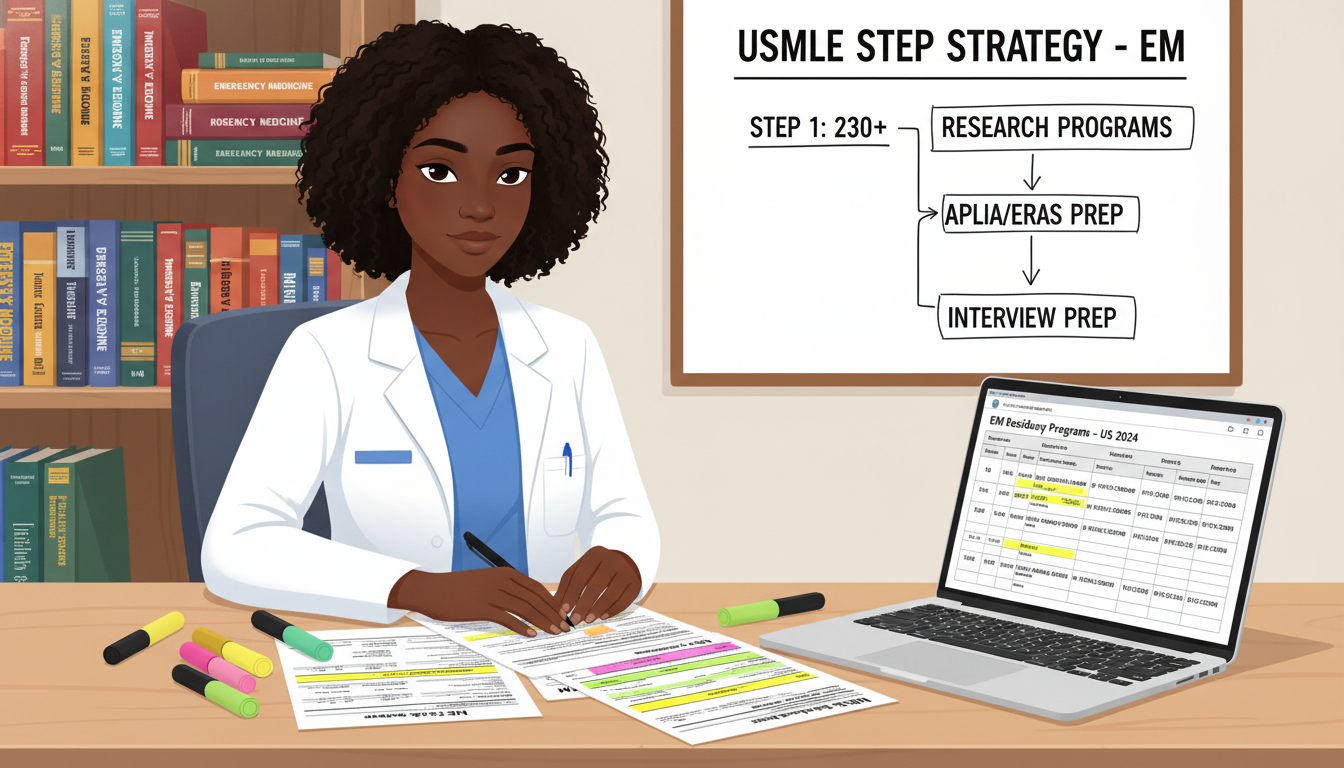
Scenario 1: Strong Step 2 CK (≥ 245–250) and Clean Record
Profile:
- Step 1: Pass, no repeats
- Step 2 CK: ≥ 245–250
- No remediation or significant academic issues
Strategic Goals:
- Capitalize on your numbers without becoming complacent.
- Maximize SLOE quality to align your clinical performance with your scores.
- Broaden program reach while still being realistic as a Caribbean IMG.
Action Plan:
EM Rotations & SLOEs
- Aim for 2–3 EM rotations at ACGME-accredited EM programs with strong SLOEs.
- Try to secure at least one rotation at a program that regularly matches Caribbean IMGs and one at a more competitive site, if possible.
- Perform at a “top 1/3 of students” level to match your score profile.
Program List Strategy
- Apply broadly (~60–80 EM programs) across:
- Community and community-academic hybrids
- Some mid-tier university-affiliated EM programs that have historically ranked IMGs
- Identify programs where previous SGU residency match or other Caribbean match data suggest they are open to your background.
- Apply broadly (~60–80 EM programs) across:
Step 3 (Optional Consideration)
- Usually not necessary before applying if Step 2 CK is this strong.
- Could be helpful if you’ll require visa sponsorship and have the time to prepare without jeopardizing rotations.
Narrative & Personal Statement
- Emphasize your clinical maturity, resilience, and why EM fits your skill set.
- Don’t over-focus on scores; let them quietly support your story.
Common Pitfall:
Assuming a strong Step 2 CK guarantees interviews at big-name university EM programs. As a Caribbean IMG, letter quality and program familiarity with your school matter just as much.
Scenario 2: Solid but Not Exceptional Step 2 CK (~235–244)
Profile:
- Step 1: Pass on first attempt (ideally)
- Step 2 CK: mid-230s to low-240s
- No major academic red flags
This is a workable and competitive range for many EM programs—especially if you optimize everything around it.
Strategic Goals:
- Use SLOEs + EM performance to “elevate” your score profile.
- Avoid programs with known high score cutoffs for IMGs.
- Demonstrate consistent performance and trajectory.
Action Plan:
Rotation Targeting
- Choose rotation sites that:
- Have a track record of taking Caribbean medical school residency applicants
- Are known for solid, fair SLOEs, not just prestige
- Your aim: “Top 1/3” SLOEs, strong comments about work ethic, team skills, and clinical judgment.
- Choose rotation sites that:
Letters & SLOEs
- Secure at least 2 strong EM SLOEs—3 if your school supports that many rotations.
- If one rotation goes only “average,” seek another EM month to generate a stronger SLOE.
Application Volume & Types of Programs
- Apply to 70–100 EM programs, heavily weighted toward:
- Community hospitals with ACGME-accredited EM programs
- Regional academic centers that list IMGs among prior residents
- Use resources like FREIDA, program websites, and alumni networks from your Caribbean school to identify IMG-friendly EM programs.
- Apply to 70–100 EM programs, heavily weighted toward:
Step 3 Strategy
- Optional but worth considering if:
- You need a visa
- You had any earlier academic issues and want to show further proof of competence
- Only take Step 3 if you can realistically score well; a low Step 3 can harm more than help.
- Optional but worth considering if:
ERAS & Personal Strategy
- Explain briefly (if relevant) any timeline irregularities (e.g., year off, delays).
- Focus on EM-relevant achievements: volunteering in acute care, EMS, leadership in emergency response, or clinical research.
Scenario 3: Borderline Step 2 CK (~220–234) or Slightly Uneven Record
Profile:
- Step 1: Pass, maybe on first attempt; possibly borderline score if numerical
- Step 2 CK: low-220s to low-230s
- OR one academic hiccup (failed shelf, extended curriculum, etc.)
This is the most common Caribbean IMG scenario: not a disaster, but not confidence-inspiring. Matching in EM is achievable with excellent strategy.
Strategic Goals:
- Prove that your EM clinical performance far exceeds your numeric metrics.
- Avoid automatic score-based rejections wherever possible.
- Show a visible upward trend and maturity.
Action Plan:
Step 2 CK Timing & Retake Decisions
- If you haven’t taken Step 2 CK yet, delay it only if you can significantly improve (e.g., NBME practice exams 10–15 points below target).
- Once you have an official Step 2 CK score, retakes are rarely an option; focus shifts to building your EM profile.
SLOE Optimization (Your Biggest Weapon)
- Treat every EM rotation like an audition:
- Show up early, stay late, volunteer for cases
- Ask for feedback midway through and adjust
- Target at least 2 high-quality SLOEs from programs that frequently work with IMGs or Caribbean students.
- Treat every EM rotation like an audition:
Program List Strategy: Volume + Targeting
- Apply very broadly: 90–120 EM programs, with emphasis on:
- Community EM programs in less competitive geographic regions
- Newer programs (still ACGME-accredited) that may be more flexible
- De-emphasize: Highly competitive university EM programs in major cities that typically have high score cutoffs for IMGs.
- Apply very broadly: 90–120 EM programs, with emphasis on:
Addressing the Scores in Your Narrative
- Do not write an essay about your Step score.
- If asked in an interview or if there’s a clear issue (e.g., Step 1 near fail, borderline Step 2 CK), frame it as:
- Early adjustment struggles
- Concrete changes in study habits
- Evidence of improvement in later clinical performance and exams
Consider Step 3 Strategically
- If time allows and you feel more prepared now, Step 3 can be a redemption opportunity—especially if your Step 2 CK is borderline.
- Aim to take Step 3 after solid, exam-heavy clinical exposure (IM, EM, ICU) and only if practice scores support a better performance.
Backup Planning (Quietly, but Seriously)
- Strongly consider dual-application:
- EM + Internal Medicine or Family Medicine
- Or EM + Transitional Year / Preliminary Medicine
- This ensures you don’t go unmatched while you build further EM credentials.
- Strongly consider dual-application:
Scenario 4: Low Scores or Failed Attempt (Low Step Score Match Strategy)
Profile:
- Step 1: Multiple attempts or fail then pass
- And/or Step 2 CK: < 220, or multiple attempts
- Caribbean school adds additional skepticism from programs
This is the toughest road—but some Caribbean IMGs do still find ways into EM through careful strategy, time, and persistence.
Strategic Goals:
- Show clear, documented academic recovery after failures.
- Demonstrate outstanding EM performance that convinces a PD to “look past” the numbers.
- Protect your overall career trajectory with a viable Plan B.
Action Plan:
Radical Honesty with Yourself First
- Ask: “Is EM still realistic for me right now?”
- Talk to:
- EM faculty who know you
- Your Caribbean school’s dean’s office or residency advisors
- Recent graduates with similar score profiles
If You Stay Committed to EM:
Maximize Step 2 CK or Step 3 as a Redemption Point
- If Step 2 CK is still pending, invest significant time to ensure a clear improvement over Step 1 history.
- If Step 2 CK is already low, consider Step 3 only if practice scores suggest you can show true improvement.
Target Programs Carefully
- Focus on:
- EM programs known to take IMGs and Caribbean grads with varied histories
- Smaller, non-coastal cities where competition is less severe
- Use alumni data (e.g., SGU residency match lists or your own Caribbean school’s match list) to find programs that have matched candidates with lower scores.
- Focus on:
Obtain Exceptional SLOEs
- Consider an away rotation at an EM program that explicitly states they consider “non-traditional” or IMG candidates.
- You must be one of the hardest-working, most reliable students they’ve seen.
Be Ready to Pivot
- Seriously plan a parallel or staged path:
- Match into IM or FM → complete residency → later apply to EM fellowships (e.g., EM from IM via certain pathways, though limited)
- Or obtain a solid TY/prelim year, gain U.S. credibility, take Step 3, and re-apply to EM if feedback is encouraging.
- Seriously plan a parallel or staged path:
Narrative Management
- If you have failures, they must be:
- Owned (“I underestimated…”)
- Explained with specific behavior changes (“I changed to spaced repetition, dedicated question banks, more frequent faculty feedback…”)
- Followed by documented improvement (better clinical evals, stronger exams, Step 3, etc.)
- If you have failures, they must be:
Integrating Scores into a Complete EM Match Strategy as a Caribbean IMG
Your Step scores are only one part of your total EM application package. To be truly competitive, you need to align them with:
- Rotations & SLOEs
- Geographic and program targeting
- Timeline planning
- Personal branding and consistent EM interest
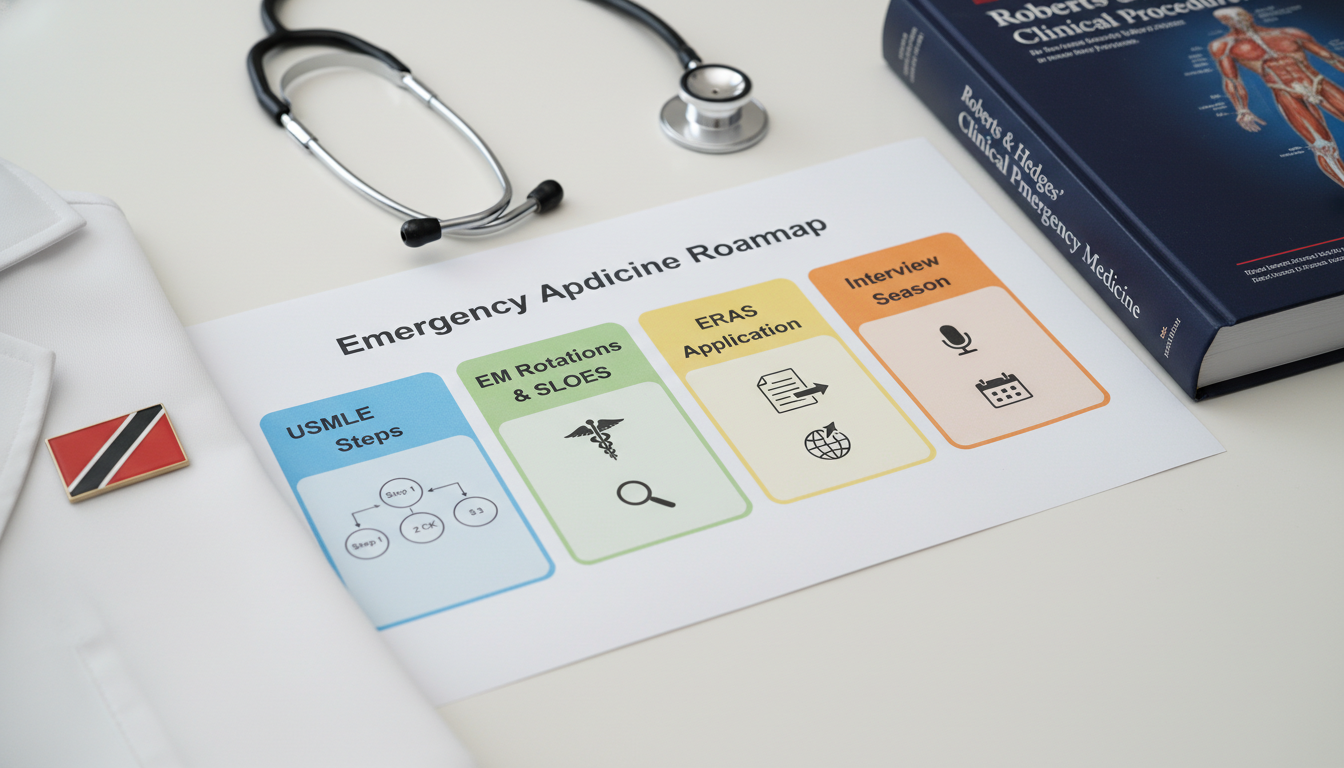
1. Timing Your Steps for EM
Ideal Timeline (Caribbean IMG, EM-focused):
- Step 1: Early in basic sciences, first-time Pass
- Step 2 CK: Completed by late spring/early summer of application year (June–July), so scores are available when ERAS opens
- Step 3: Optional; often taken during PGY-1 unless needed as a strategic tool pre-ERAS
If Step Scores Are Lower:
- Try to ensure that Step 2 CK is available before programs review. Waiting until late fall can hurt, especially if you’re hoping Step 2 CK will “rescue” a weak Step 1.
2. Using Your Caribbean Program’s Match Data
Your school’s match history is an asset:
- Study the SGU residency match data or your school’s own match list:
- Which EM programs have taken your graduates?
- What Step score ranges and profiles are common in those matches (ask advisors)?
- Are there recurring EM sites where your school sends rotations?
This helps you:
- Build a realistic, evidence-based program list
- Prioritize rotations at programs that know and trust your school
- Avoid over-investing energy in programs that have never taken Caribbean grads
3. Building Non-Score Strengths That Matter in EM
EM programs value traits that don’t show up in a three-digit score:
- Teamwork & Communication
- Demonstrate via leadership roles, teamwork-heavy experiences, EMS ride-alongs, or ED volunteering.
- Ability to Work Under Pressure
- ICU, ED, or acute care experiences, especially with strong evaluations.
- Adaptability & Cultural Competence
- As a Caribbean IMG, highlight your international training, language skills, and ability to care for diverse populations.
Use these strengths in:
- Personal statement
- Interviews (with concrete examples)
- Letters of recommendation (ask mentors to comment specifically on these)
4. Crafting Your EM Personal Narrative Around, Not About, Your Scores
The goal of your narrative is to:
- Show that EM is a deliberate, informed choice
- Emphasize growth, resilience, and readiness
- Let Step scores function as supporting evidence, not the centerpiece
General guidelines:
- Don’t mention your Step scores in your personal statement unless addressing a clear concern.
- If you do need to address a failure or low score, do it briefly, factually, and forward-looking.
- Focus most of your writing on:
- Formative EM experiences
- Key clinical moments in the ED
- The type of EM physician you aim to become
Putting It All Together: A Sample Strategy Snapshot
Imagine a Caribbean IMG with:
- Step 1: Pass on first attempt
- Step 2 CK: 231
- No major red flags, but not a standout score
A smart EM match plan might look like:
Two EM Rotations at IMG-Friendly Sites
- One at a program that has previously matched your school’s graduates
- One at a community or hybrid EM program in a less competitive region
- Aim for excellent SLOEs from both
Apply to 90–100 Programs
- Majority community/IMG-friendly
- Some university-affiliated EM programs with known Caribbean graduates
- Avoiding programs listing strict Step 2 CK cutoffs > 240 for IMGs
Strong ERAS Package
- Polished CV with any leadership, EM interest groups, or volunteer work
- Concise personal statement centered on ED experiences and patient care
- If any minor academic issues, brief and honest explanation in Additional Info
Consider Step 3 Only if:
- You have time and realistic chance to outperform Step 2 CK
- You’ll need a visa and want to reassure PDs you’re exam-ready
Backup Plan
- Parallel application to 20–30 IM or FM programs as safety net
- If matched to IM/FM, keep EM involvement through electives, moonlighting (where allowed), or research
FAQs: Step Score Strategy for Caribbean IMG in Emergency Medicine
1. What Step 2 CK score do I need as a Caribbean IMG to match Emergency Medicine?
There’s no universal cutoff, but for many community EM programs, a Step 2 CK in the mid-230s or higher positions you competitively as a Caribbean IMG, assuming strong SLOEs and no major red flags. Scores in the 220–234 range can still match EM with outstanding EM rotations, a carefully targeted program list, and a strong overall application. Below ~220, an EM match becomes difficult but not impossible—success depends heavily on SLOEs, program selection, and sometimes a longer-term plan including Step 3 or alternate training pathways.
2. I passed Step 1 on the second attempt. Is EM still realistic for me?
Yes, but you must be strategic and realistic. A repeat Step 1 raises concern, so programs will look for:
- Clear improvement on Step 2 CK (preferably above ~230)
- Consistently strong clinical evaluations and SLOEs
- A convincing explanation of what changed in your study habits and approach
You’ll likely need to apply more broadly, focus on IMG-friendly and community EM programs, and perhaps consider a backup specialty in parallel. Some programs will filter you out automatically, but others will listen if you demonstrate growth and strong clinical ability.
3. Should I take Step 3 before applying to EM as a Caribbean IMG?
It depends on your situation:
- Helpful if:
- You have borderline/low Step 1 or Step 2 CK scores and want to show academic recovery
- You need visa sponsorship, and passing Step 3 reassures programs
- Not necessary if:
- Your Step 2 CK is strong (e.g., 240+) and you have a clean record
- Risks:
- A low Step 3 can reinforce concerns and harm your application
Take Step 3 only if practice exams suggest you can outperform your earlier Step scores and you have enough time to prepare without compromising EM rotations.
- A low Step 3 can reinforce concerns and harm your application
4. How many EM programs should I apply to as a Caribbean IMG with mid-range scores?
If your Step 2 CK is in the 235–244 range with a clean history, a common target is 70–100 EM programs, focusing on community and IMG-friendly academic programs across multiple regions. With borderline scores (220–234) or any academic red flags, many advisors recommend 90–120 EM applications, plus a backup specialty. Use your Caribbean school’s match data (e.g., SGU residency match lists) and alumni contacts to prioritize programs that have successfully trained graduates from your school.
By understanding how programs interpret your Step scores—and by aligning your rotations, SLOEs, and application strategy accordingly—you can transform even less-than-perfect numbers into a coherent, credible path to an emergency medicine residency as a Caribbean IMG.