
Understanding the Challenge: Caribbean IMGs and Low Step Scores
Caribbean medical school residency outcomes can be excellent—but the path is rarely straightforward, especially if you have a low Step 1 or Step 2 CK score. As a Caribbean IMG, you already know you’re applying from a more scrutinized pathway; adding below average board scores can feel like a double disadvantage.
Yet each year, applicants from Caribbean schools with low Step scores still match—often into solid, IMG friendly residency programs—because they understand how to reposition their application and tell a stronger story than just three digits.
This article focuses specifically on low Step score strategies for Caribbean IMGs targeting IMG-friendly programs, with a special focus on:
- Applicants with a low Step 1 score (or a fail attempt)
- Applicants with below average Step 2 CK
- Those worried about matching with low scores from schools like SGU, Ross, AUC, Saba, etc.
- Those aiming to leverage SGU residency match–style strategies (high-volume, strategic targeting) even if they are not from SGU
You cannot change your score. But you can change what that score means in the context of your entire file. The rest of this guide shows you exactly how.
Step Scores in Context: What “Low” Really Means for Caribbean IMGs
Before designing a strategy, you need to understand how programs view scores—especially when you’re from a Caribbean medical school.
How Programs Interpret Scores for Caribbean IMGs
Residency programs typically separate applicants into broad tiers:
- US MD graduates
- US DO graduates
- Non-US IMGs
- Caribbean IMGs (often mentally flagged as a distinct risk category)
With Caribbean schools, programs worry about:
- Variable clinical training environments
- High attrition rates in some schools
- Inconsistent USMLE performance
Because of this, some programs set higher score filters for Caribbean graduates than for US MDs/DOs. That means a score that is “average” overall may still be considered weak when combined with a Caribbean school background.
What Is Considered a “Low” Step Score?
While specific numbers vary, for Caribbean IMG residency applicants:
Step 1 (numeric era; now more conceptual since it’s Pass/Fail)
- Below ~220 used to raise concern; <210 was often a red flag.
- A fail attempt is clearly high risk and must be addressed head-on.
Step 2 CK (still numerically crucial)
- ~250+ = standout
- 240–249 = competitive
- 230–239 = solid but not exceptional
- 220–229 = below average for Caribbean IMGs in many fields
- <220 = low Step 2 CK and often a screening cutoff for many programs
If you fall into that 220 or below range—or you have a Step 1 failure, multiple attempts, or clear score decline—you need a targeted plan.
Strategy #1: Reframe Your Profile Beyond the Score
Programs don’t match a number; they match a physician. Your job is to minimize the weight of your score by strengthening every other signal in your file.

1. Crush Step 2 CK (or Step 3) to Offset Step 1
If Step 1 is low or has a fail, then Step 2 CK must be your comeback story.
- Programs often look for:
- Upward trajectory (big jump from Step 1 to Step 2)
- Single attempt on each exam
- Example:
- Step 1: 205 (or Pass after marginal performance in coursework)
- Step 2 CK: 238
This shows clear academic recovery and reassures programs you can handle medical knowledge under pressure.
If you already have a low Step 2 CK, consider:
- Taking Step 3 early (if feasible and appropriate for your specialty and visa situation)
- Scoring well on Step 3 can reduce concern that you’ll fail in-training exams or boards.
- Particularly helpful for internal medicine, family medicine, and psychiatry applicants.
Actionable Tip:
If your Step 1 was low, delay graduation or the Match if needed to allow enough time for a strong Step 2 CK or Step 3. One extra year plus a stronger narrative is far better than going unmatched and reapplying with the same weaknesses.
2. Make Your Clinical Performance Impossible to Ignore
Residency programs trust recent, US-based clinical performance more than they trust a distant score.
Focus on:
US clinical rotations in IMG-friendly sites
- Community hospitals
- Safety-net hospitals
- Programs known to take IMGs
Outstanding letters of recommendation (LoRs)
- From US academic or teaching hospital attendings
- In your intended specialty (e.g., IM letters for IM applicants)
- With specific, behavior-based comments:
- “She efficiently managed 8–10 patients on a busy medicine service.”
- “He functioned at or above the level of an intern in terms of work ethic and reliability.”
Clinical grades and comments
- Honours or high pass in key rotations (IM, FM, Psych, etc.)
- Comments about resilience, responsiveness to feedback, and clinical reasoning help counterbalance low exam numbers.
Caribbean-Specific Tactic:
Prioritize core rotations and electives at hospitals with residency programs that are historically IMG friendly. If you shine as a student, they may see you as “known quantity” rather than “Caribbean risk.”
3. Develop a Clear, Coherent Narrative
When scores are low, your story and self-awareness matter more than ever. Your personal statement and interview answers should:
- Acknowledge (when appropriate) that standardized tests weren’t your strongest suit
- Emphasize growth and improvement rather than excuses
- Highlight:
- Clinical strengths
- Communication skills
- Work ethic
- Unique experiences (e.g., language skills, community work, leadership, prior careers)
Programs are trying to answer: “Will this person be safe, reliable, and coachable?” Your narrative should leave them with a confident “yes.”
Strategy #2: Target the Right Programs—Not Just the “Best” Ones
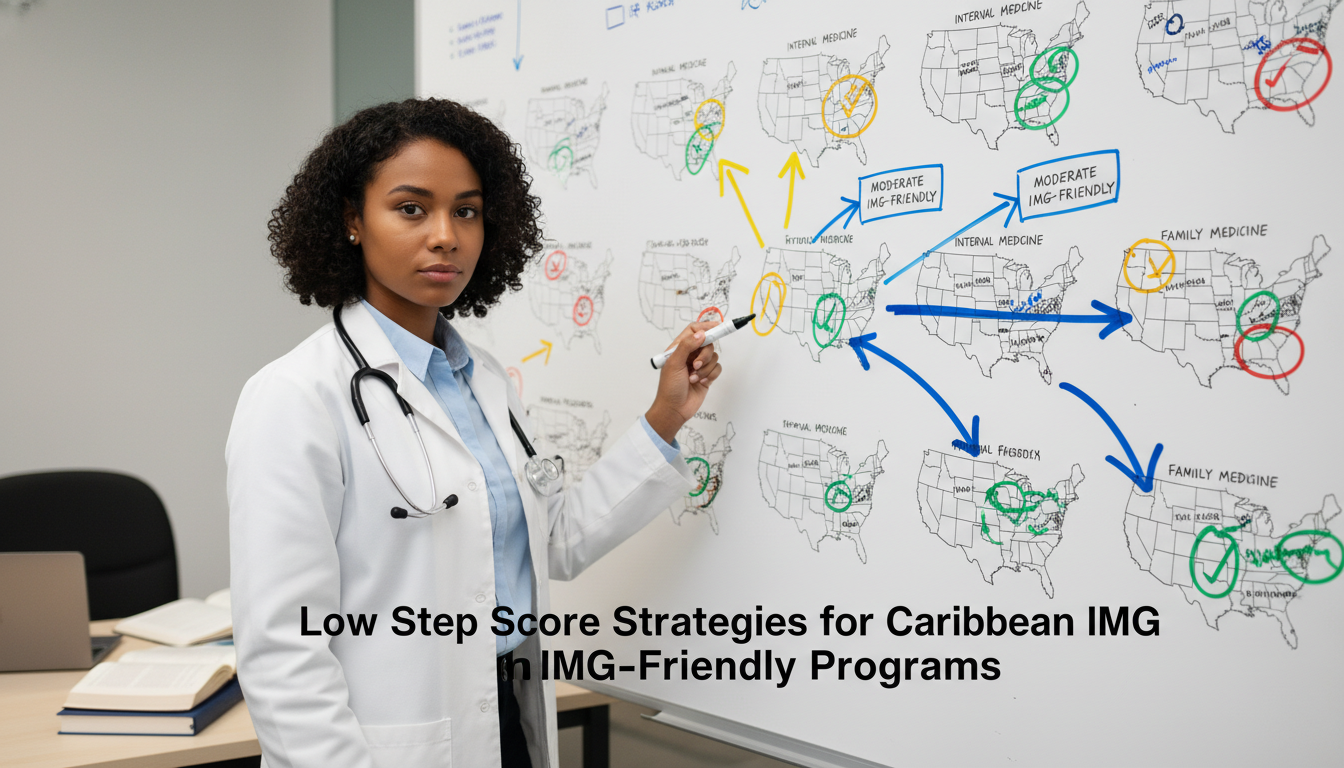
One of the biggest mistakes low-scoring Caribbean IMGs make is applying too broadly but not strategically. The SGU residency match data each year show that successful Caribbean applicants often target a high volume of carefully selected, IMG friendly residency programs, not just any open slot.
1. Understand What “IMG Friendly” Really Means
Not all “IMG friendly residency” programs are equally friendly to Caribbean graduates with low Step scores.
You should look for programs that:
- Have >30–40% of residents who are IMGs (especially non-US IMGs)
- List no Step 2 CK minimum or have cutoffs closer to 210–220
- Explicitly mention consideration of multiple attempts
- Are located in less competitive regions:
- Midwest
- South
- Smaller cities or rural settings
- Areas with higher underserved populations
You can identify these programs by:
- Reviewing residency program websites
- Studying NRMP Charting Outcomes for IMGs (when available)
- Using filters in ERAS, FREIDA, or independent IMG resources
- Talking to recent graduates from your Caribbean school who matched with similar scores
2. Align Specialty Choice with Your Score and Profile
Certain specialties are more forgiving of low scores, especially for Caribbean IMGs, particularly when you show strength in clinical performance and commitment to underserved care.
Relatively more IMG-friendly fields (for low or below average board scores) typically include:
- Internal Medicine (community programs)
- Family Medicine
- Psychiatry (some programs; still more competitive overall now)
- Pediatrics (selected programs)
- Pathology (varies by region)
- Neurology (some institutions)
More challenging with low scores and a Caribbean background:
- Emergency Medicine
- General Surgery
- OB/GYN
- Anesthesiology
- Radiology
- Dermatology, Ophthalmology, Ortho, ENT, etc.
This doesn’t mean it’s impossible—but if your Step 1 and 2 CK are low, you should:
- Strongly consider applying to a mix of more and less competitive specialties, or
- Prepare for a multi-cycle strategy (e.g., prelim year, research year, reapply).
3. Use the “Tiering” Approach to Build Your List
For Caribbean IMGs with low Step scores, a practical approach is to tier programs:
Tier 1: Safety / Strongly IMG-Friendly
- Step cutoffs ≤220 or explicitly flexible
50% IMGs in current residents
- Community-based, non-university
- Locations outside major coastal metro areas
Tier 2: Moderate Risk, Some Caribbean IMGs
- Step cutoff around 225–230
- Mixed cohort of US grads and IMGs
- Small university-affiliated programs
Tier 3: Reach Programs
- University programs with some IMGs
- Programs where your school has at least a history of matches (e.g., SGU residency match data showing recent residents there)
For matching with low scores, you should not be shy about:
- Applying to 60–120 programs in IM, 40–100 in FM, etc., depending on your specialty and budget.
- Tilting most of your list toward Tier 1 and Tier 2 while sprinkling a smaller number of Tier 3 “dream” options.
4. Leverage School-Specific Match History
If you’re from SGU, Ross, AUC, Saba, or another Caribbean program, examine your school’s:
- Recent match lists
- Locations where multiple alumni have matched
- Hospitals that consistently appear year after year
Programs that have taken several graduates from your school are more likely to be comfortable with your background—even if your scores are not stellar.
If you’re not from SGU but want to emulate SGU residency match–style success, focus on:
- Volume (enough applications)
- Precision (strongly IMG-friendly, documented history with Caribbean grads)
- Alignment (clinical rotations or observerships in those types of institutions)
Strategy #3: Strengthen the “Non-Score” Parts of Your Application
To compete in international graduate programs with low scores, every other element of your file needs to be carefully optimized.
1. Letters of Recommendation: Your Most Powerful Weapon
Letters can move the needle more than you might realize, especially when scores are weak.
Aim for:
- At least 3 specialty-specific LoRs (e.g., 3 internal medicine letters for IM applications)
- From US-based attendings who:
- Worked with you for at least 4 weeks
- Saw you on inpatient services (when possible)
- Supervisors known or respected by PDs (e.g., program leadership, core faculty)
Content that helps offset low scores:
- “Despite a lower Step score, his clinical reasoning and day-to-day performance are among the strongest I’ve seen in recent years.”
- “She demonstrated rapid growth and independently reviewed literature to manage complex patients.”
- “I fully support his application without reservation and would be happy to have him in our own program.”
2. Personal Statement: Clarifying, Not Excusing
Your personal statement should:
- Briefly and tactfully address any major academic red flags (if necessary), such as:
- A Step 1 failure or large score jump
- A leave of absence due to illness or family issues
- Emphasize:
- Concrete patient stories that show empathy and clinical insight
- Moments of learning and growth
- A clear reason for choosing this specialty and this practice setting (e.g., community-based IM in underserved areas)
Avoid:
- Lengthy explanations that sound like excuses
- Discussing anxiety, burnout, or personal disorganization without a clear demonstration of recovery and stability
3. CV, Experiences, and Research
For Caribbean IMGs with below average board scores:
- Research is helpful but not mandatory for many community IMG-friendly residency programs—however, it does help:
- Demonstrate academic curiosity
- Show perseverance and initiative
- Provide something to talk about during interviews
Other impactful experiences:
- Long-term community service or volunteer work, especially in underserved populations
- Leadership roles (tutoring, mentoring, student council, clinic leadership)
- Jobs or prior careers demonstrating resilience, maturity, or communication skills
Programs want evidence that, despite low scores, you will show up, work hard, and care about patients.
Strategy #4: Navigate Red Flags and Create a Recovery Plan
Low scores sometimes come with other red flags—failed attempts, gaps, or delays. Caribbean IMGs are scrutinized heavily on these issues, but a careful strategy and clear communication can soften their impact.
1. Failed Step 1 or Step 2 Attempts
If you have a failed Step 1 or Step 2:
Acknowledge and own it
- In interviews (and rarely, briefly, in your personal statement) explain:
- What went wrong (e.g., poor test strategy, taking exam too early, health issues)
- What you changed afterward (study methods, resources, schedule, support)
- In interviews (and rarely, briefly, in your personal statement) explain:
Show clear academic recovery
- A strong Step 2 CK (or Step 3) afterward
- No additional failures
- Strong clinical evaluations and LoRs
Target programs that explicitly accept attempts
- Some IMG friendly residency programs state on their websites or in ERAS that they will consider applicants with attempts if other aspects are strong.
2. Gaps in Training or Delayed Graduation
Program directors worry about “rustiness” when they see:
- Prolonged gaps post-graduation
- Multiple years between medical school completion and residency application
Mitigations:
- Use gaps to gain relevant US experience (observerships, research, scribe work, clinical assistant roles)
- Document activities clearly in ERAS (don’t leave unexplained time)
- Emphasize in interviews how you’ve kept clinically active and up to date.
3. Multiple Cycles of Applying
If you are a reapplicant with low scores, you need a substantive change between cycles:
- New/stronger US clinical experiences
- New letters of recommendation
- Additional exams (Step 3) or certifications
- Narrower and more strategic program list focused on the most IMG-friendly residency programs
Applying again with no meaningful changes is rarely successful.
Practical Timeline for a Low-Score Caribbean IMG Targeting the Match
Below is a sample 12–18 month strategy for a Caribbean IMG facing low Step scores and aiming at IMG friendly residency programs in internal medicine or family medicine.
12–18 Months Before Match
- Honestly assess:
- Step 1 (or pass/fail performance context)
- Step 2 CK status
- Clinical evaluations, LoRs, gaps
- Decide whether to:
- Take Step 2 CK (if not done) with maximal preparation
- Plan Step 3 (if Step 2 CK is weak and timeline allows)
- Identify IMG friendly residency targets and regions.
9–12 Months Before Match
- Complete US-based core rotations or electives in your intended specialty.
- Secure LoRs from supportive attendings while performance is fresh.
- Begin research or volunteer roles that you can sustain through the year.
6–9 Months Before Match
- Take Step 2 CK or Step 3 (if needed) early enough for scores to appear before applications.
- Draft personal statement and CV; get feedback from mentors or advisors familiar with Caribbean medical school residency outcomes.
ERAS Season (3–6 Months Before Match)
Finalize a tiered program list with strong emphasis on:
- IMG friendly residency programs
- Locations with multiple Caribbean graduates historically
- Community-focused and underserved missions
Apply broadly, especially if:
- You are from a Caribbean school
- You have a low Step 1 score, a low Step 2 CK, or any attempts
Interview Season
Prepare strong, honest responses to:
- “Can you talk about your USMLE performance?”
- “Why did you choose [specialty]?”
- “Tell me about a challenging clinical situation.”
Highlight:
- Resilience and growth after setbacks
- Consistent clinical excellence despite exam challenges
- Commitment to the program’s patient population and mission
Frequently Asked Questions (FAQ)
1. Can I still match into an internal medicine residency with a low Step 1 or Step 2 CK score as a Caribbean IMG?
Yes, it is still possible, especially in community-based, IMG friendly internal medicine programs. Your chances improve if:
- You have at least one passing score on first attempt (ideally Step 2 CK)
- You show strong clinical performance in IM rotations
- You secure excellent IM-specific letters from US faculty
- You apply to a large number of carefully selected IMG friendly programs
Many programs value reliability, work ethic, and clinical judgment at least as much as raw exam numbers—especially for primary care–oriented internal medicine.
2. Should I take Step 3 before applying if my scores are low?
If you already have:
- A low Step 2 CK, or
- A failed attempt on Step 1 or Step 2
Then a solid Step 3 score can be beneficial, particularly for:
- Internal Medicine
- Family Medicine
- Psychiatry
It reassures programs about your ability to pass future board exams. However, you should only take Step 3 if:
- You have adequate time to prepare properly
- You are confident you can pass on the first attempt
- It won’t interfere with clinical performance or application timelines
A failed Step 3 will hurt you far more than no Step 3 at all.
3. How many programs should I apply to as a Caribbean IMG with below average board scores?
Exact numbers vary, but for Caribbean medical school residency applicants with low scores, it is usually wise to apply broadly:
- Internal Medicine: often 60–120 programs, heavily weighted to IMG friendly residency sites
- Family Medicine: often 40–100 programs
- Psychiatry or Pediatrics: may require 60+ programs if scores are low
The key is quality plus quantity: apply to enough programs, but focus your list on true IMG-friendly, lower-cutoff, community or underserved-focused institutions that have a history of Caribbean or non-US IMG residents.
4. Should I address my low score in my personal statement?
It depends:
For modestly low scores (e.g., 225 instead of 240, with no failures):
- You usually do not need to mention it. Let your improved performance and clinical strengths speak for you.
For major red flags (e.g., a failed Step 1, a big gap, or severe drop in performance):
- You may address it with 1–3 concise sentences in your personal statement or be prepared to discuss it in interviews.
- Focus on:
- What happened (briefly)
- What you learned
- Concrete steps you took to improve and the successful outcomes afterward
The goal is clarification, not justification—programs should finish your application feeling confident that the problem is understood, resolved, and unlikely to recur.
Caribbean IMGs with low USMLE scores face a steeper climb, but not an impossible one. By reframing your profile beyond the numbers, targeting the right IMG-friendly residency programs, and strategically building every part of your application, you transform a low score from a dead end into just one part of a much stronger story.