
Understanding the Challenge: Low Step Scores, Caribbean Schools, and Medical Genetics
If you’re a Caribbean IMG aiming for a medical genetics residency and you’re worried about a low Step 1 score or below average board scores, you are not alone—and you are not automatically out of the running.
You are navigating three overlapping challenges:
Being a Caribbean IMG
- Some programs still prefer U.S. MD seniors.
- There can be stereotypes about Caribbean medical schools.
- PDs may not know how to contextualize your school’s grading or clinical rigor.
Having a low Step 1 score or a failed attempt
- Even with Step 1 now Pass/Fail, prior numerical scores and attempts still matter.
- Low Step 2 CK can also raise concerns about medical knowledge and test-taking ability.
Targeting a niche specialty: Medical Genetics
- Medical genetics residency positions are fewer than big specialties like Internal Medicine.
- Programs often seek applicants who truly understand and are committed to genetics.
- PDs are very sensitive to communication skills, teamwork, and attention to detail.
Yet, medical genetics is one of the more IMG-friendly subspecialties, and many PDs value maturity, persistence, and a genuine interest in genetics more than a perfect test score. Your job is to make it as easy as possible for a busy program director to say:
“Yes, this Caribbean IMG with low boards is a great fit for our medical genetics residency.”
This article will walk you through practical, stepwise strategies to overcome low scores and strengthen every other part of your application—especially as a graduate of a Caribbean medical school like SGU, AUC, Ross, Saba, etc.
We’ll cover:
- How to realistically assess your competitiveness
- Why medical genetics is still attainable with low Step scores
- Strategic use of prelim/transitional years and categorical back-up plans
- Concrete ways to build a genetics-focused CV
- How to talk about scores in your personal statement and interviews
- Residency application tactics tailored to Caribbean IMG applicants
Step 1: Realistically Assess Your Starting Point
Before choosing strategies, get a clear picture of where you stand. You can’t fix what you don’t define.
Clarify Your Exam Profile
Even with Step 1 now pass/fail, residency programs still look at:
Step 1 result:
- Pass on first attempt, Pass after a fail, or Fail with no retake yet
- If you have a numeric score from older attempts, programs may still see it.
Step 2 CK score and attempts:
- This is now the most important numerical board score.
- “Low” typically means below the national mean for matched applicants in your intended field.
- For a medical genetics trajectory (often via internal medicine or pediatrics first), being below ~230–235 for U.S. MD cohorts would be considered “low,” but for IMGs the practical threshold is often lower. Many programs will review IMGs in the low–mid 220s, occasionally lower, if the rest of the application is strong.
Step 3 (if taken):
- Not required for most PGY-1 spots but can be helpful for IMGs with low Step 1/2 if passed on the first attempt.
Label your situation honestly:
- Scenario A: Step 1 Pass, Step 2 CK ≥ ~220, no fails
- Scenario B: Step 1 Pass, Step 2 CK < ~220 or multiple attempts
- Scenario C: Step 1 fail then Pass, Step 2 CK around or below ~220
- Scenario D: Multiple exam failures across Steps
The lower and more complicated your board history, the more aggressively you will need to invest in other parts of your application.
Consider Your Caribbean Medical School Context
Programs view different Caribbean schools differently. For example:
Applicants from larger, more established schools (e.g., SGU) may benefit from:
- Existing alumni presence in U.S. residencies
- Familiarity with the SGU residency match process (e.g., many PDs know SGU graduates perform well clinically even if boards are average)
Applicants from smaller or newer schools may need:
- Stronger U.S. clinical experiences
- More targeted networking and advocacy from mentors
Take inventory:
- Did your school provide U.S.-based core and elective rotations at reputable hospitals?
- Do you have U.S. physician mentors who can vouch for you?
- Does your school offer match advising or data for medical genetics or related fields?
The more objective strengths you already have, the more leverage you can create despite a low Step 1 score or below average board scores.
Step 2: Understand the Pathways into Medical Genetics
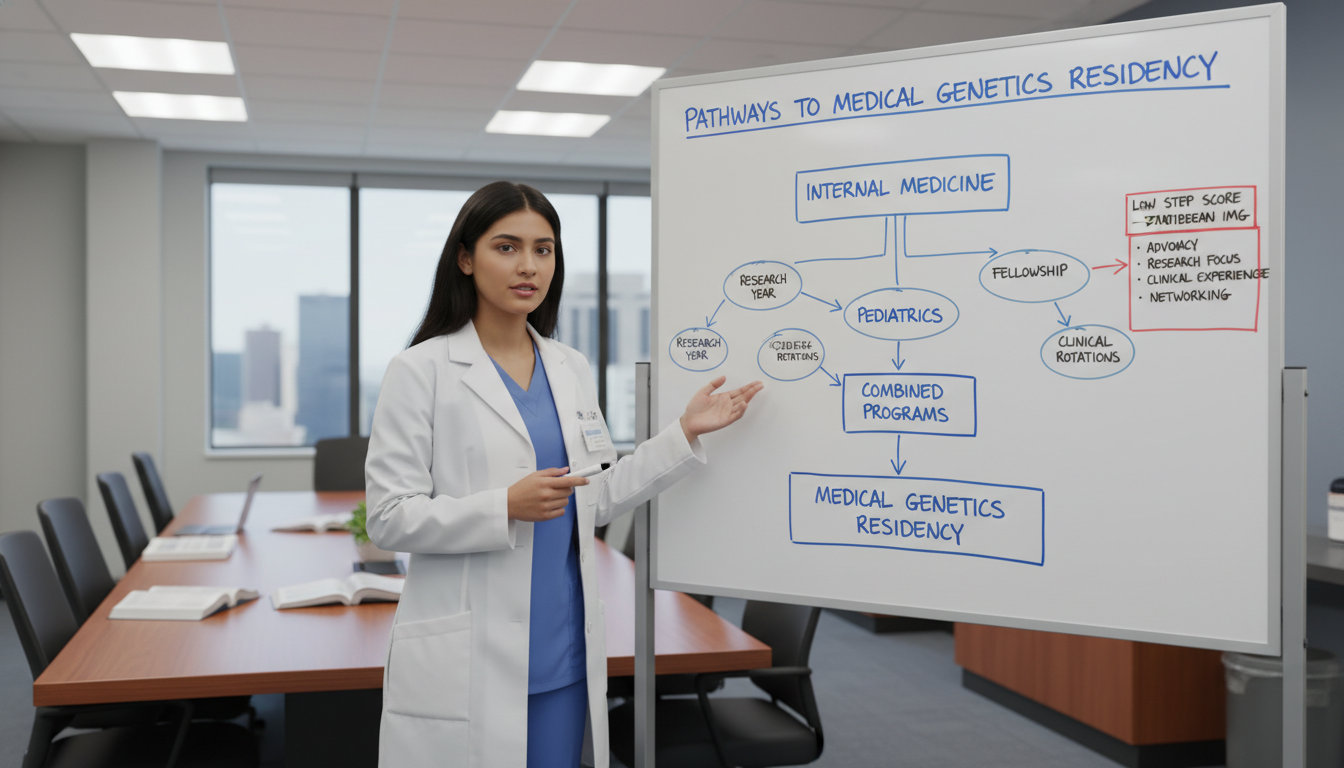
Medical genetics is somewhat unique because there are multiple training pathways that can eventually lead to a genetics match. Your low score strategy should be aligned with how you plan to get there.
Direct Categorical Medical Genetics & Genomics
These are combined programs (often 4 years) that may be structured as:
- Pediatrics–Medical Genetics
- Internal Medicine–Medical Genetics
- Other combined formats
Pros for Caribbean IMG with low scores:
- Smaller applicant pools, fewer people even consider genetics.
- PDs tend to value genuine motivation and prior genetics exposure.
- Some programs are open to IMGs and nontraditional applicants.
Challenges:
- Limited number of spots nationwide.
- Competitive at certain academic centers (they may prefer strong boards).
- May require very clear evidence of interest and aptitude for genetics.
Sequential Pathway: Categorical Primary Specialty → Medical Genetics Fellowship
The most common route is:
- Match into Internal Medicine, Pediatrics, or OB/GYN (or another core specialty).
- Complete residency (typically 3–4 years).
- Apply for a Medical Genetics and Genomics fellowship.
Pros:
- IM and Peds are more IMG-friendly, including for Caribbean grads.
- You can improve your profile as a resident (publications, letters, QI projects).
- Genetics fellowships can be more flexible about Step scores if you have strong clinical reviews and clear interest.
Challenges:
- Requires a successful first match (this is where low Step scores hurt most).
- Time to achieve “full genetics” training is longer.
- You need sustained focus on genetics during residency.
Transitional/Prelim Years as Bridges
For applicants struggling to secure a categorical spot, preliminary internal medicine, preliminary surgery, or transitional year positions can:
- Provide U.S. clinical experience with PGY-1-level responsibilities.
- Offer new U.S. letters of recommendation from residency faculty.
- Demonstrate that you can function as a safe intern despite low scores.
This path is high-effort and not guaranteed to lead to a categorical slot, but it is often a viable second chance for Caribbean IMG applicants with serious exam challenges.
Step 3: Strengthen the Rest of Your Application to Offset Low Scores
With a Caribbean medical school background and a low Step 1 score or below average board scores, your strategy is compensation: deliberately making other parts of your application strong enough that PDs look past the numbers.
1. Clinical Performance and Letters of Recommendation
For medical genetics–oriented paths (IM, Peds, OB/GYN), PDs heavily weigh:
- Rotation performance in core specialties, especially in U.S. hospitals
- Inpatient rotations: medicine wards, ICU, NICU, PICU, high-risk OB
- Electives in genetics-related areas: genetics clinic, maternal-fetal medicine, oncology, neurology
Action steps:
- Aim for honors or top decile evaluations in key rotations.
- Request detailed letters from:
- U.S.-based attendings who supervised you directly
- Faculty with academic titles (e.g., program directors, division chiefs)
- Genetics-adjacent mentors (e.g., MFM, oncology, neurology, endocrinology)
What you need in a letter to counter low scores:
- Clear statements like:
- “Despite below average test scores, Dr. X consistently demonstrated superior clinical reasoning and communication skills.”
- “I would rank Dr. X in the top 5–10% of medical students I’ve worked with over the past 5 years.”
- “I would be comfortable having Dr. X care for my own family.”
2. Build a Visible Track Record in Genetics
Programs must believe you truly want and understand medical genetics.
If your SGU residency match or Caribbean school advising system has genetics mentors, start there. Otherwise, you’ll need to be proactive.
Ways to build genetics credibility:
Elective Rotations in Genetics
- Seek out genetics clinics (adult or pediatric), dysmorphology clinics, or cancer risk clinics during clinical years.
- If genetics electives are unavailable locally, explore:
- Away or visiting student rotations (VSLO/VSAS equivalents)
- Virtual electives or tele-genetics clinics (some centers offered these post-COVID)
Genetics-Related Research
- Case reports:
- Rare genetic syndromes, metabolic disorders, hereditary cancer syndromes
- Even a well-written case report as first or second author can be powerful.
- Retrospective studies:
- Chart reviews on genetic counseling outcomes, cascade screening, or diagnostic delays.
- Quality improvement:
- Projects improving genetic testing workflows, pre-test counseling, or documentation.
- Case reports:
You do not need an R01-level research portfolio. For a Caribbean IMG, one or two focused projects in genetics are often enough to differentiate you.
- Education & Advocacy
- Present genetics topics at your school’s interest groups or local conferences.
- Create brief teaching modules for junior students on:
- Basic cytogenetics
- Interpreting genetic test reports
- Ethical considerations in genetic testing
Every activity that clearly says “I care about genetics and have invested in understanding it” moves you closer to a genetics match.
3. Addressing Low Scores Proactively
Residency programs care less about a single low score and more about what it represents:
- Knowledge gaps?
- Poor test-taking strategy?
- Burnout or personal stressors?
You want to demonstrate:
- You understand what went wrong, and
- You have taken concrete steps to fix it.
Practical steps:
Formal remediation
- Enroll in board review courses or dedicated Step 2/Step 3 prep (if finances allow).
- Use NBME practice exams to show improved performance.
Documentation of improvement
- If you failed Step 1 but:
- Passed on retake
- Performed meaningfully higher on Step 2 CK
- Possibly passed Step 3 early
- This creates an “upward trend” narrative: “I learned, adapted, and overcame.”
- If you failed Step 1 but:
Personal wellness and time management
- Seek support for mental health, learning differences, or major life stressors that were present during your low-score period.
- Programs want to know that the issue is less likely to recur under the pressure of residency.
You don’t need to share every personal detail, but you should have a coherent, concise explanation ready (personal statement and interview) for your low Step 1 score or below average board scores.
Step 4: Application Strategy for Caribbean IMG with Low Scores
With clinical performance, genetics exposure, and remediation plans underway, you need a smart application game plan.
1. Choose Target Specialties Strategically
If your ultimate goal is a medical genetics residency, you should:
Apply to:
- Categorical Internal Medicine programs
- Categorical Pediatrics programs
- Potentially combined Internal Medicine–Pediatrics (Med-Peds) if you have a strong profile
- Direct Medical Genetics & Genomics programs (where IMG-friendly)
Consider:
- Some OB/GYN and family medicine programs if there is robust genetics exposure or your interest is in reproductive genetics.
You do not need to label “genetics” as your only interest; instead, emphasize an intention to incorporate genetics into your clinical future—then pivot to fellowship later.
2. Use Filters and Data Wisely (Including Caribbean-and-IMG-Specific Info)
When targeting programs:
Leverage:
- FREIDA and program websites: Look for prior IMG residents and Caribbean grads.
- Alumni networks (e.g., SGU residency match lists): Identify programs that historically accept SGU or Caribbean IMG applicants.
Identify:
- Programs in community or university-affiliated community hospitals rather than ultra-competitive academic centers.
- States with historically higher IMG acceptance (e.g., NY, NJ, MI, IL, FL, TX).
- Programs without strict Step cutoffs listed; some state them openly.
If you know your SGU residency match patterns or your Caribbean school’s match data, align your applications with previous Caribbean IMG successes.
3. Volume and Tiering of Applications
With low Step scores and Caribbean status, you will likely need to:
- Apply to a high number of programs in IM and Peds (often 80–120+ each, depending on your risk tolerance).
- Tier your list:
- Core “realistic” programs: Community and university-affiliated programs with IMG history.
- Stretch programs: Academic/university programs with some past IMG matches.
- Safety-like programs: Smaller community programs in less popular locations that still sponsor visas if needed.
For direct medical genetics residencies:
- Apply broadly to all programs that will consider IMGs, especially those with:
- Prior IMG residents/fellows
- Emphasis on education over basic science research
Do not rely solely on genetics programs; your primary match chance often lies in IM/Peds/other core residencies.
4. Crafting a Focused Personal Statement
Your personal statement must do three key things:
Explain your interest in genetics
- Use a specific patient story:
- A child with unexplained developmental delay who was later found to have a microdeletion.
- A patient with early-onset cancer who benefited from BRCA testing.
- Connect that story to your curiosity about inheritance, risk prediction, and family counseling.
- Use a specific patient story:
Highlight strengths that compensate for low scores
- Strong clinical evaluations.
- Leadership roles or teaching experience.
- Persistence, resilience, and teamwork.
Address low scores briefly and maturely (if needed)
- One succinct paragraph:
- Acknowledge the low Step 1 score or below average board scores.
- Provide a clear, non-excuse explanation.
- Emphasize corrective actions (study strategies, wellness, Step 2 improvement).
- End with evidence of current competency (recent exam success, strong clerkship feedback).
- One succinct paragraph:
Example structure for addressing low scores:
During my early U.S. board preparation, I struggled with time management and balancing coursework with personal stressors, which contributed to a low Step 1 score. Recognizing this, I sought academic support, revised my study strategies, and focused intensively on question-based learning. These changes led to a substantial improvement on Step 2 CK and strong performance in my inpatient medicine rotations. I am confident that the habits I have developed will support my success in residency training.
Keep the tone honest, concise, and forward-looking.

Step 5: Interview and Networking Tactics for the Genetics-Minded Caribbean IMG
Once you secure interviews, scores matter much less. Your task becomes converting interviews into an actual match, despite low Step 1 or Step 2 CK scores.
1. Pre-Interview Networking
Because medical genetics is a small field, personal connections can have outsized impact.
Options:
Email genetics faculty at institutions where you rotated:
- Request brief Zoom meetings to discuss your goals.
- Ask for advice on pursuing a genetics career as a Caribbean IMG.
- If appropriate, share your ERAS AAMC ID and let them know you’ve applied to their affiliated residency program.
Attend genetics society meetings (e.g., ACMG, ASHG) as a student or early graduate:
- Participate in poster presentations or trainee events.
- Introduce yourself to faculty in programs you’re applying to.
Leverage your Caribbean school alumni network:
- Ask SGU or other Caribbean graduates now in IM/Peds/genetics to:
- Advise you on program culture.
- Forward your CV to their PD or program coordinator when appropriate.
- Ask SGU or other Caribbean graduates now in IM/Peds/genetics to:
Networking does not guarantee a genetics match, but it can move your file from the “maybe” pile to the “interview” pile.
2. Interview Performance: Key Messages
During interviews (especially for IM and Peds), be prepared to:
Show that you are first and foremost committed to being a strong intern/resident:
- “My priority is to be an excellent intern who takes outstanding care of patients and supports the team.”
- “I am drawn to your program because of its strong inpatient training and academic teaching.”
Subtly but clearly signal your interest in medical genetics:
- Mention experiences:
- “I completed an elective in pediatric genetics where I learned how early diagnosis changes long-term outcomes.”
- “My case report on hereditary cancer risk reinforced my interest in integrating genetics into general internal medicine.”
- Express long-term goals:
- “I hope to pursue additional training in medical genetics or hereditary cancer risk after residency.”
- Mention experiences:
Address low scores if asked (many interviewers won’t bring it up, but some will):
- Avoid defensiveness or lengthy stories.
- Emphasize:
- Insight: “I underestimated X, Y, Z.”
- Action: “I changed my study strategy, prioritized wellness, sought mentorship.”
- Outcome: “My later performance and clinical evaluations reflect that growth.”
3. Ranking Strategy
When creating your rank list:
- Rank programs based on realistic fit, not just prestige or genetics branding.
- For IM/Peds categorical positions, consider:
- Strong teaching culture
- Existing genetics clinics or partnerships
- Prior residents who pursued genetics fellowships
If you do receive interviews at direct medical genetics residencies:
- Rank them highly if:
- You are confident in your desire for genetics and
- The program is IMG-supportive and provides robust general pediatric/adult training depending on the pathway.
Being a Caribbean IMG with low Step scores means you must be tactically flexible while still steering toward your core goal: a genetics-oriented career.
Final Thoughts: Matching with Low Scores Is Hard, But Not Hopeless
As a Caribbean IMG pursuing a medical genetics residency, below average board scores do complicate your journey. Yet many physicians have ultimately achieved a genetics match by:
- Securing categorical IM or Peds positions despite low Step 1 and Step 2 CK.
- Building a strong foundation of clinical performance, research, and advocacy in genetics.
- Using networking and targeted applications to identify programs that value persistence, empathy, and dedication over a single test result.
Your path may be longer and require multiple cycles, transitional years, or strategic back-up plans, but it is absolutely possible to build a career in medical genetics from a Caribbean medical school starting point—especially if you commit early, plan deliberately, and seek mentorship relentlessly.
FAQ: Low Step Score Strategies for Caribbean IMG in Medical Genetics
1. Can I still get into a medical genetics residency with a low Step 1 score?
Yes, it is possible, though challenging. Your likelihood of a direct medical genetics residency is lower with significantly below average scores, but you can:
- Focus on matching into Internal Medicine or Pediatrics first.
- Build genetics experience during residency.
- Apply for a Medical Genetics and Genomics fellowship afterward.
Programs will expect to see evidence of growth (e.g., stronger Step 2 CK, good clinical evaluations) and clear, sincere interest in genetics.
2. Is SGU or another Caribbean medical school a disadvantage for the genetics match?
Being from a Caribbean medical school (including SGU) is a relative disadvantage compared to U.S. MDs, but not a disqualifier. Many Caribbean IMGs:
- Match into IMG-friendly Internal Medicine or Pediatrics programs.
- Pursue genetics fellowships later, especially at institutions where Caribbean alumni are already present.
Use your school’s match data, alumni networks, and advising resources to identify historically friendly programs.
3. Should I take Step 3 before applying to improve my chances?
For many Caribbean IMG applicants with low scores:
- Step 3 is optional but can help if:
- You have prior failures or very low scores, and
- You can realistically pass Step 3 on the first try before interview season.
A strong Step 3 can reassure programs about your test-taking ability and may be particularly helpful for community IM or Peds programs and for visa-requiring applicants. However, do not rush into Step 3 if you are not fully prepared; another low score will hurt more than help.
4. How can I show strong interest in genetics if my school didn’t offer genetics rotations?
You can still build a genetics-focused profile by:
- Writing or co-authoring case reports about patients with suspected or confirmed genetic disorders.
- Collaborating remotely with genetics faculty on small research or QI projects.
- Attending genetics conferences (ACMG, ASHG) and presenting posters.
- Teaching junior students about basic genetic concepts or ethical issues in genetic testing.
- Seeking out away or visiting electives or even short observerships in genetics clinics.
The key is a consistent pattern of activities that show you are intentionally preparing for a career that incorporates medical genetics, even if direct genetics rotations were limited during medical school.