
Understanding the Step Score Landscape for Caribbean IMGs in Urology
Urology is one of the most competitive specialties in the Match, and that competitiveness is magnified for a Caribbean IMG. Programs are inundated with applications from U.S. MD and DO students with strong test scores, research, and home-institution connections. But matching is still possible from a Caribbean medical school—just not by accident.
You need a deliberate Step score strategy that recognizes where you stand and what you can control right now. That means understanding:
- How programs interpret Step 1 and Step 2 CK in the era of pass/fail
- How being from a Caribbean medical school affects your screening
- How to use strong scores to offset “IMG friction”
- How to recover if you have a low Step score and still pursue the urology match—or pivot smartly
Throughout this article, “Caribbean IMG” refers primarily to students from larger Caribbean medical schools (e.g., SGU, AUC, Ross, Saba) applying to urology in the U.S.
We’ll anchor the discussion to key phrases programs think in: Caribbean medical school residency, Step 1 score residency filter, Step 2 CK strategy, low Step score match, and how these play out specifically in the urology match.
How Programs Actually Use Step Scores in Urology
Step 1 in the pass/fail era: still important, but differently
Even as Step 1 has moved to pass/fail, it still matters in several ways:
Binary screen
- Many urology programs will automatically filter out applications without a Step 1 pass by the time they download ERAS files.
- A First‑time pass is the minimum expectation. A fail is a serious red flag but not always fatal—especially for IMGs with later strong performance.
Timing matters
- Program directors want to see a Step 1 pass early (no later than early third year) so they can trust you’ll clear licensure exams on time.
- Late Step 1 (or late pass) feeds the concern that a Caribbean IMG may not be ready for the pace of residency, especially in a demanding surgical subspecialty like urology.
Informal use of pre-2022 numeric scores
- If you still have a numeric Step 1 score (took it before pass/fail transition), many programs will look at the number even if they don’t say so publicly.
- For urology, scores ≥240 used to be considered competitive; ≥250+ were strong, but that landscape is shifting with Step 1 pass/fail and greater Step 2 emphasis.
Step 2 CK: your new “academic centerpiece”
For a Caribbean IMG, Step 2 CK is now your flagship metric. Programs often use it to:
- Compensate for missing Step 1 numeric data
- Gauge how you compare with U.S. MD/DO applicants
- Stratify interview offers in competitive fields like urology
In practical terms:
- As a Caribbean IMG targeting urology:
- Aim: 255+
- Solidly competitive: ~250
- Borderline but possible (with strong other factors): ~240–249
- Significant barrier: <240 (not impossible, but you’ll need exceptional strengths elsewhere)
These are not hard cutoffs; they’re functional benchmarks that mirror how many program directors think about a Step 2 CK strategy.
How being a Caribbean IMG changes the score equation
Programs assess risk. When they see “Caribbean medical school residency applicant,” they often ask:
- Will this applicant handle high‑volume clinical work?
- Is their training equivalent to U.S. schools?
- Is their exam performance strong enough to offset uncertainty?
To “de‑risk” your file, programs look for:
- Higher‑than‑average scores (to compensate for school prestige)
- No exam failures (Step or school exams)
- Upward trajectory (e.g., mid Step 1 performance → high Step 2 CK)
- Strong letters from U.S. urologists confirming your clinical caliber
Think of it this way: where a U.S. MD might be competitive for urology with a Step 2 CK of 245–250, you as a Caribbean IMG may need ~5–10 points higher (with rare exceptions based on unique strengths).
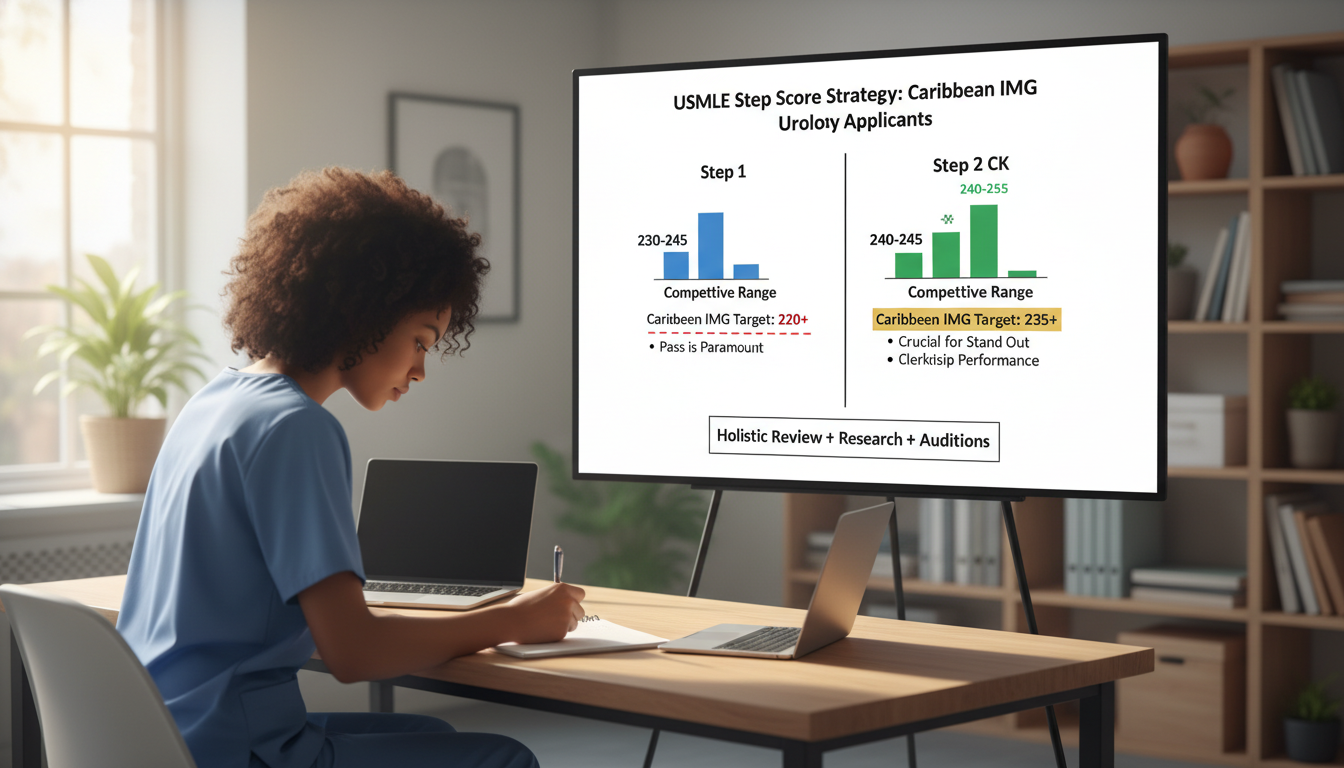
Building a Step 2 CK Strategy That Supports a Urology Application
If you’re still pre‑Step 2, this is the part that can move the needle most. Your Step 2 CK strategy should be engineered around maximizing your competitiveness for urology, not just “passing with a decent score.”
1. Set explicit score targets—don’t settle for “pass”
Write down a clear goal that fits your situation:
- If you passed Step 1 on first attempt and are early in clinicals:
- Target 255+ for a strong shot at the urology match.
- If you had a Step 1 failure but passed on second attempt:
- Target 260+ to demonstrate substantial academic recovery.
- If you already know you’re a mid‑tier test taker:
- Aiming for 245–250 may be more realistic, but then you must plan for extra strengths: research, away rotations, networking.
Why this matters: programs see an explicit objective Step 2 plan as evidence that you understand the Step 1 score residency filter has been replaced by a Step 2–centric filter.
2. Time Step 2 CK in relation to urology applications
The urology match uses its own timeline (through the AUA), often earlier than the NRMP main match. This compresses the window to take Step 2 and show your score before programs send out interview invites.
For a Caribbean IMG, the safest play is:
- Take Step 2 CK at least 2–3 months before ERAS and AUA applications are due, so your official score is in your file.
- Back‑calculate from your planned application cycle and build in:
- 1–2 months of dedicated time
- Time for NBME/UWSA self‑assessments
- A buffer in case of illness or administrative delays
If your Step 2 CK score is pending when urology programs are reviewing applications, you miss your main academic selling point—and as a Caribbean IMG, that’s especially risky.
3. Build a high‑yield, disciplined study plan
Design your plan around three pillars:
Core resources (2–3 max)
- UWorld Step 2 CK (non‑negotiable; aim for 2 passes or 1 very high‑quality pass)
- Comprehensive text or review resource (e.g., OnlineMedEd notes, Master the Boards, or a focused high‑yield text)
- NBME and UWSA practice exams to track progress
Clinical integration
- Use each rotation (especially surgery, IM, emergency medicine) to actively practice Step 2 reasoning:
- After each clinic or OR day, review 5–10 UWorld questions in that topic.
- De‑brief with residents/attendings on management decisions you missed.
- Use each rotation (especially surgery, IM, emergency medicine) to actively practice Step 2 reasoning:
Data‑driven adjustments
- Take an NBME practice test early in dedicated to establish a baseline.
- Reassess every 2–3 weeks.
- If your predicted score is:
- Within 5–7 points of your target: stay the course.
- 10+ points below target: lengthen your dedicated period or consider pushing your exam date if timeline allows.
4. Example: SGU student timeline to maximize SGU residency match odds in urology
Consider an SGU student finishing third year and targeting the SGU residency match outcomes list to see how many past grads matched into urology.
Example timeline:
- Jan–Mar (3rd year):
- Finish core rotations; integrate 10–20 UWorld questions/day.
- April 1:
- Take baseline NBME; identify weakest systems (often medicine subspecialties, psych/neuro).
- April–May:
- Study 6 days/week, 6–8 hours/day (mix of UWorld, review notes, targeted video reviews).
- Mid‑May:
- Take NBME + UWSA; if predicted score ≥250 and trending up, keep scheduled date.
- If <245, evaluate need to postpone 2–4 weeks.
- Early June:
- Take Step 2 CK.
- Late July–Aug:
- Official score released well before urology applications due.
- Use final rotations (sub‑I, away rotation in urology) to connect with attendings and get letters.
This timeline gives you a clear Step 2 CK strategy, enough time to demonstrate score strength, and avoids the risk of applying with “Step 2 CK pending” as a Caribbean IMG.
When Step Scores Are Low: Salvage, Reframe, or Pivot
Not everyone will hit a 250+ on Step 2 CK. Many Caribbean IMGs interested in urology find themselves in the “low Step score match” situation: Step 1 or Step 2 is lower than ideal. You then face three core questions:
- Is urology still realistic at all?
- What compensatory strategies can I deploy?
- Should I pivot to another specialty—and how?
1. Interpreting “low” in context
“Low” is relative, but for a Caribbean IMG targeting urology:
- Sub‑240 on Step 2 CK:
- Major obstacle. You’ll likely be filtered out by many programs, especially those with heavy IMG filters.
- 240–249:
- Borderline. Some programs may still consider you if the rest of your profile is exceptional (research, U.S. clinical performance, strong advocacy letters).
- Below passing or Step 1 failure:
- Critical red flag, but can sometimes be mitigated with:
- Large upward jump on Step 2 CK (e.g., 260+)
- Powerful letters vouching for your clinical acumen
- Evidence of remediation and consistent success afterward
- Critical red flag, but can sometimes be mitigated with:
2. Concrete strategies if you already have a low Step score
If you’re in this situation, your strategy must become extremely intentional.
A. Dominate what you still control
- Step 2 CK (if still pending)
- Treat your first attempt as “must‑crush.”
- Extend dedicated time and delay other commitments if necessary.
- Shelf exams and clinical evaluations
- Use strong clerkship performance to show that Step scores don’t reflect your real capabilities.
- Urology‑specific rotations
- Aim for sub‑internship level performance: pre‑rounding, helping with notes, clear presentations, reading ahead on OR cases.
- Build relationships with urology attendings who can write genuine, detailed letters.
B. Build a research narrative in urology
For competitive specialties, research can partially offset lower scores—especially if it shows commitment and productivity.
- Join a urology research group (even remotely) at a U.S. academic center.
- Seek:
- Case reports related to urologic oncology or endourology
- Retrospective chart reviews with clear authorship opportunities
- Conference abstracts and poster presentations (AUA, SUO, regional meetings)
The goal is not sheer volume but having urologists who know your work and can speak to your persistence, curiosity, and contribution.
C. Narrow and tailor your application list
With lower Step scores, you cannot afford a generic application strategy.
- Identify programs that:
- Have a history of interviewing or matching IMGs (look at current residents’ medical schools).
- Are community‑based or university‑affiliated rather than top‑tier academic only.
- Are in less competitive geographic regions (Midwest, some Southern states).
- Craft highly specific personal statements for your top‑priority programs, emphasizing:
- Why their training environment fits your strengths
- How your path through a Caribbean medical school has built resilience and adaptability
- Concrete ways you’ve already engaged with their department (e.g., visiting sub‑I, remote research, virtual electives)
3. When a pivot may be the smarter move
Brutal honesty is necessary: some score profiles make direct entry into urology extremely unlikely, especially for Caribbean IMGs, such as:
- Repeated Step failures (multiple exam attempts)
- Step 2 CK substantially below 235 with no realistic room for re‑take
- Limited opportunity to build meaningful urology experience or research
In these cases, you may consider strategic alternatives:
- Apply to a less‑competitive surgical field (e.g., general surgery) while planning to:
- Excel in residency
- Network with urologists at your institution
- Pursue a urology fellowship or specialized track later where possible (though formal transitions are challenging)
- Apply to categorical programs with strong surgical exposure (e.g., surgery prelim, or other fields with OR time) while keeping open lines to urology mentors.
This is not giving up; it’s protecting your long‑term ability to practice a surgical, procedure‑heavy discipline, even if your badge doesn’t say “Urologist” from day one.

Practical Application Strategies Beyond Scores
A strong Step score strategy is necessary but not sufficient for a Caribbean IMG in the urology match. You must integrate scores with clinical, networking, and application tactics.
1. Use away rotations as a “live Step score”
Away or visiting sub‑internships in urology are critical for:
- Demonstrating that you function at or above the level of U.S. MD/DO students
- Generating gold‑standard letters that explicitly state:
- You functioned at intern level
- You handled high‑volume services without complaint
- You showed strong judgment, work ethic, and teachability
For a Caribbean medical school residency aspirant in urology, think of away rotations as:
The real‑time equivalent of a high Step score: proof under pressure.
Key tactics:
- Target 2–3 away rotations at programs:
- With prior IMGs or Caribbean grads
- In regions less saturated by elite medical schools
- Before starting:
- Review urology basics (hematuria workup, BPH, prostate cancer staging, stone disease, testicular torsion, urinary retention).
- Practice concise OR presentations and pre‑op/post‑op checklists.
2. Craft a coherent narrative that connects your scores and your path
Programs will look at your file and ask: Does this story make sense?
Example narratives that work:
- High Step 2 after modest Step 1
- “I struggled early with test anxiety but systematically addressed it. My Step 2 CK reflects the clinical decision‑making skills I use on the wards and in the OR.”
- Step 1 failure, strong Step 2 CK
- “I failed Step 1 due to underestimating the exam and personal challenges. I overhauled my approach—joining a structured study group, using faculty mentorship, and focusing on NBME practice exams. That led directly to a 260+ Step 2 CK and excellent clinical evaluations. That turnaround defines how I now approach challenges as a clinician.”
Make sure letters, personal statement, and interview answers all support this narrative.
3. Use data from past matches to set expectations
If you’re at a large Caribbean school like SGU, AUC, Ross, or Saba:
- Study your school’s annual Match list:
- How many graduates matched into urology residency?
- At which programs?
- Are there repeating institutions that commonly accept Caribbean IMGs?
This tells you:
- Where SGU residency match or similar schools’ graduates have had a foothold.
- Which programs are plausibly IMG‑friendly and thus worth extra effort (emails, sub‑Is, research outreach).
4. Communicate proactively with programs (carefully)
You can sometimes mitigate score concerns with thoughtful, professional communication:
- After you have a strong Step 2 CK result, especially if your Step 1 was weak, consider a concise email to key programs:
- Reaffirm your interest in urology and in that specific program.
- Highlight Step 2 CK improvement and any recent urology rotation or research.
- Attach updated CV.
This won’t magically override strict score filters, but at IMG‑friendly programs it can pull your application out of the “maybe” pile and into “interview.”
Step Score Strategy by Scenario: Quick Guides
To put this all together, here are brief scenario‑based strategies.
Scenario 1: Strong Step 1 (numeric) and strong Step 2 CK
- Profile: Step 1 ≥245; Step 2 CK ≥255.
- Strategy:
- Apply broadly to urology, including some competitive academic programs.
- Emphasize research, away rotations, and strong letters.
- Your “Caribbean” label still matters, but your test metrics greatly reduce perceived risk.
Scenario 2: Pass‑only Step 1, strong Step 2 CK
- Profile: Step 1 pass; Step 2 CK 250–260+.
- Strategy:
- Treat Step 2 CK as your main academic currency; mention it early in personal statements and interviews (“My Step 2 CK of 258 reflects…”).
- Apply broadly, prioritize IMG‑friendly programs, but still include a few aspirational sites.
Scenario 3: Step 1 failure, strong Step 2 CK
- Profile: Step 1 fail then pass; Step 2 CK 255–265.
- Strategy:
- Directly address the failure in your personal statement (briefly, without excuses).
- Highlight the process changes that led to the Step 2 success.
- Secure urology letters that explicitly state you are clinically excellent and reliable.
- Apply to a larger number of programs than average to compensate for automatic screen‑outs.
Scenario 4: Step 2 CK 235–245 (no failures)
- Profile: Solid but not standout Step 2 CK; Caribbean IMG.
- Strategy:
- Urology match is not impossible but is an uphill battle.
- You must:
- Excel on urology sub‑Is and get standout letters.
- Build meaningful urology research.
- Apply very widely and include backup specialties early.
- Consider dual‑applying (e.g., general surgery + urology) depending on mentor guidance and your risk tolerance.
FAQs: Step Score Strategy for Caribbean IMGs in Urology
1. What Step 2 CK score should a Caribbean IMG aim for to be competitive in urology?
As a Caribbean IMG, aim for Step 2 CK ≥255 to be a strong candidate for the urology match. Scores 250–254 can still be competitive with strong supporting factors (urology research, powerful letters, excellent sub‑Is). Scores 240–249 are borderline; matching is possible but requires exceptional strengths elsewhere and a very broad application strategy.
2. Can I still match into urology with a low Step 1 score or a Step 1 failure?
It’s harder, but not automatically impossible. A Step 1 failure can sometimes be offset by:
- A substantial Step 2 CK improvement (e.g., 260+)
- Clear evidence that you changed your study process and improved consistently afterward
- Outstanding urology rotations and letters
- A compelling narrative that treats the failure as a turning point, not an excuse
You will likely be filtered out by some programs, so you must apply more broadly and prioritize IMG‑friendly institutions.
3. Is it better to delay Step 2 CK to get a higher score, or take it early for applications?
For a Caribbean IMG in urology, score quality usually matters more than a slightly earlier test date, as long as your score posts before application review. If an extra 3–4 weeks of dedicated study could realistically move you into a higher scoring bracket (e.g., from 245 to 255), delaying is usually worth it. Just ensure your exam date allows the official result to be available before urology programs begin reviewing ERAS/AUA files.
4. If my Step 2 CK score is below 240, should I abandon urology completely?
Not automatically, but you need an honest risk–benefit assessment with trusted mentors:
- If you’re just below 240 (e.g., 235–239), you might still pursue urology if:
- You can build an exceptional profile (research, away rotations, letters).
- You accept that match probability will be lower.
- You apply broadly and maintain a strong backup plan.
- If your score is substantially below 235, the odds of matching urology as a Caribbean IMG fall sharply. In that case, pivoting to a less competitive field while keeping procedural/surgical exposure may better protect your long‑term career and satisfaction.
A thoughtful Step score strategy will not guarantee a urology match, but it can maximize your chances and help you make informed, realistic decisions. As a Caribbean IMG, owning your numbers, your narrative, and your next steps is your best route to a successful—and sustainable—career in urology or a related surgical discipline.