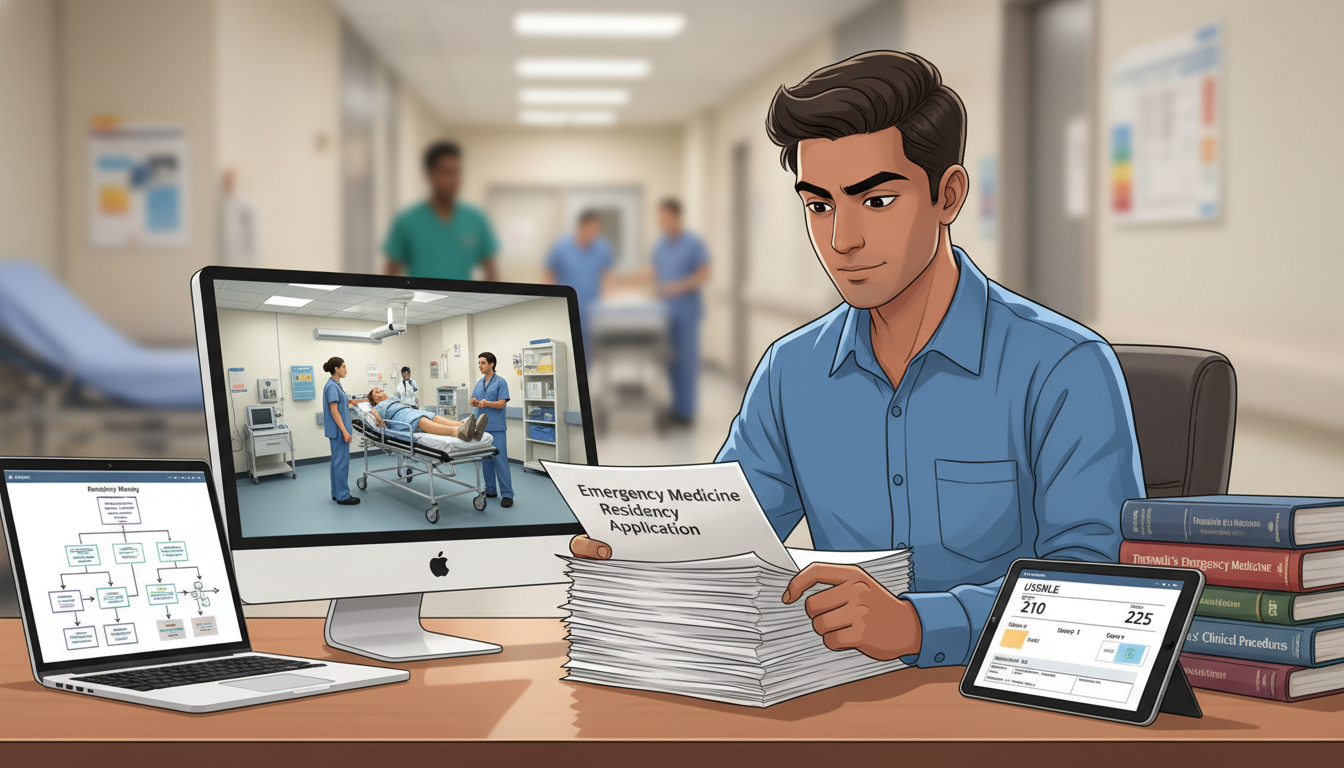
Understanding Low Step Scores in the EM Match as an IMG
Emergency Medicine (EM) is competitive for all applicants, and even more so for an international medical graduate (IMG). When you also have a low Step 1 score or below average board scores overall, it’s easy to assume your EM match chances are over.
They aren’t.
You will have fewer options, and you’ll need a very strategic plan. But many IMGs with imperfect exams successfully match into emergency medicine every year by understanding how programs think and deliberately building a compensatory application.
This IMG residency guide focuses on low Step score strategies specifically for EM, with a practical, step‑by‑step approach to:
- Interpreting your scores realistically
- Targeting programs that may be more IMG‑friendly
- Using EM rotations and letters of recommendation (SLOEs) to offset weak exams
- Crafting a compelling narrative that makes reviewers overlook numbers
- Maximizing interview and rank list strategy to convert chances into a match
Throughout, “low Step score” means below the mean of current EM applicants or anything that could trigger screening filters (for example, Step 1 < 220, Step 2 CK < 230–235, or any fail).
1. Reality Check: How Programs View Low Scores in EM
1.1 Why exam scores matter in emergency medicine
Program directors in EM rely heavily on board scores because:
- They must predict pass rates on ABEM board exams
- They often receive hundreds to thousands of applications; scores are an easy first filter
- They assume board scores correlate (imperfectly) with readiness for a fast‑paced, cognitively demanding specialty
For an international medical graduate, the bar can be higher because:
- PDs may be less familiar with your school’s rigor
- They worry about visa logistics and support needs
- They use exams and SLOEs as “standardized” comparisons with U.S. graduates
1.2 “Low score” in context for EM and IMGs
Score thresholds vary by program, but some patterns are common:
- Step 1 (even pass/fail era)
- Earlier numeric scores < 220 are often considered weak for EM
- Any fail is a red flag requiring a strong explanation
- Step 2 CK (now the main quantitative filter)
- < 230–235 is often “below average” among EM applicants
- Some academic or highly competitive EM programs use hard cutoffs (e.g., 230–240)
However, “low” is relative to your overall profile and the program’s priorities:
- A Step 2 CK of 225 may be competitive for some community‑based EM programs, especially if you have excellent SLOEs and EM‑focused experience.
- A single exam failure might be overlooked if the retake shows a strong upward trend and the rest of your application is outstanding.
Your task is not to erase a low score—it’s to build a stronger story around it and target the right programs.
1.3 When your score truly closes doors—and when it doesn’t
Realistically, low Step scores may strongly limit or nearly close off:
- Highly ranked, research‑heavy, university EM programs in top academic centers
- Programs with strict institutional score cutoffs for all specialties
- Some programs with historically very low or no IMG intake
But many doors remain open:
- Community‑based EM programs
- EM programs at mid‑size university‑affiliated hospitals
- Newly accredited or smaller EM residencies
- Programs with a track record of training IMGs and providing visas
The rest of this EM match strategy is about maximizing those doors that remain open.

2. Academic Recovery: Building a Stronger Performance Profile
2.1 Use Step 2 CK as your academic “comeback”
For many programs, Step 2 CK is now the primary objective metric. If your Step 1 is low (or pass/fail with concerns), you must treat Step 2 CK as your redemption exam.
Actionable strategies:
Delay if needed to score higher
- If your practice NBME/CCSSA scores are not within ~10–15 points of your target, postpone Step 2 rather than rushing into another below average board score.
- For an IMG aiming for EM, a score at or above ~235–240 can meaningfully offset a weaker Step 1.
Shift from memorization to clinical reasoning
- Focus on question banks that emphasize acute care and reasoning (e.g., UWorld, AMBOSS).
- Treat each question like an EM case: rapid triage of key data, prioritize life threats, then refine diagnosis.
Document improvement
- Keep a log of practice scores to demonstrate an upward trajectory if asked in interviews.
- If you have a Step failure, the combination of clear upward trend + structured remediation story is vital.
2.2 Addressing a Step failure or very low score
If you failed or scored markedly below average:
Own it in your personal statement and interviews
- Briefly explain contributing factors (e.g., illness, poorly structured preparation) without excuses.
- Focus on what you changed: new study methods, dedicated schedule, mentorship, self-reflection.
Demonstrate system and habits, not just a retake score
- Mention specific tools (e.g., Anki, question bank completion percentages, weekly self‑quizzes) to show you’ve built sustainable study skills for residency.
Add additional academic indicators
- EM‑related certifications (ACLS, PALS, ATLS, BLS)
- Strong performance in EM‑heavy electives (trauma, ICU, toxicology)
- Honors grades or top deciles in clinical years (if available from your school)
Programs are less worried about a past low score if they’re convinced you’ve become a different kind of learner.
2.3 Strategic use of additional exams (if any)
For some IMGs, additional examinations can provide more data points:
Step 3
- Taking and passing Step 3 before the match can offer reassurance about board passage, especially if your earlier Steps were weak.
- This is particularly valuable for applicants needing H‑1B visas, as many programs prefer or require Step 3 completion.
Other standardized exams
- For some countries, strong results on national board exams or postgraduate entrance exams can be mentioned, but U.S. PDs lean heavily on USMLEs. These can be supplemental but not primary reassurance.
3. Building the EM‑Specific Application: Rotations, SLOEs, and Clinical Narrative
For EM, nothing substitutes for strong clinical performance and specialty‑specific letters. When you’re matching with low scores, your SLOEs (Standardized Letters of Evaluation) and EM experiences often matter more than any other part of your IMG residency guide strategy.
3.1 Prioritize U.S. EM clinical rotations
For an international medical graduate, U.S. EM exposure is essential. Aim for:
- At least two EM rotations in the U.S.
- At least one (ideally two) SLOEs from U.S. EM faculty at established EM programs.
Types of rotations:
Audition/Sub‑internship EM rotations
- Best chance to get SLOEs that PDs trust.
- You’re evaluated alongside U.S. students, which helps normalize your performance.
Observerships
- Less powerful than hands-on rotations but still useful when hands-on is not available.
- Try to convert observerships into detailed letters highlighting your reasoning, communication, and work ethic.
Related rotations (ICU, trauma surgery, acute care)
- Can generate strong non‑SLOE letters that support your EM suitability (comfort with instability, procedures, critical thinking).
3.2 Getting SLOEs that can offset low Step scores
A great SLOE can make programs reconsider an application they might otherwise dismiss based on scores.
Aim for SLOEs that explicitly state:
- “This applicant is in the top X% of students we’ve worked with in the last year.”
- “We would rank this applicant on our own list,” or similar language.
- Evidence of key EM traits:
- Poise under pressure
- Effective multi‑tasking
- Strong team communication
- Willingness to work hard and accept feedback
How to earn these SLOEs:
Show up early; stay late
- Volunteer for tasks: procedures, notes, follow‑ups, discharge planning.
- Offer to give a short presentation on an EM topic (e.g., sepsis bundle updates, syncope approach).
Be teachable and humble
- Ask for feedback mid‑rotation and act on it.
- When you correct a mistake or knowledge gap, briefly let your evaluator know how you’ve improved.
Demonstrate EM‑style thinking
- In case presentations, start with life‑threats and disposition:
- “My main concern is X because of Y. I’d like to first rule out A/B/C before committing to discharge vs. admission.”
- In case presentations, start with life‑threats and disposition:
3.3 Curating non‑SLOE letters that still help
Not all letters will be SLOEs, and that’s okay. Choose letter writers who can:
- Comment on clinical reasoning and professionalism, not just “hard‑working and nice.”
- Provide specific examples: a complex resuscitation, managing multiple patients, translating across cultures.
- Compare you to other trainees (“among the top residents/students I’ve supervised”).
A strong ICU or internal medicine letter that describes your performance in high‑acuity situations can support an EM application, especially alongside formal SLOEs.

4. Application Strategy: Program Selection, Storytelling, and Application Components
4.1 Targeting programs realistically as an IMG with low scores
When matching with low scores, where you apply matters as much as who you are.
Key filters to consider:
IMG‑friendliness
- Use publicly available data (NRMP, program websites, forums, FREIDA) to identify:
- Programs with current or past IMG residents
- Programs that sponsor visas (J‑1, sometimes H‑1B)
- A program with 0 IMGs in recent years is unlikely to rank you highly.
- Use publicly available data (NRMP, program websites, forums, FREIDA) to identify:
Program type and competitiveness
- Community programs and some university‑affiliated community programs often have more flexible score thresholds.
- Highly research‑intensive, elite academic centers typically have higher score cutoffs and fewer IMGs.
Geography
- Some regions (certain Midwest or South areas) are more open to IMGs than hyper‑competitive coastal cities.
- Be open-minded geographically to maximize your odds.
Class size and program age
- Larger programs (e.g., 12+ residents per year) and newer programs may be more likely to consider applicants with diverse profiles and lower scores.
Application volume:
For an IMG with below average board scores applying to EM, it’s often reasonable to apply to 40–60+ EM programs, adjusting based on resources and competitiveness. If you are very low (e.g., Step 2 CK < 220 or prior failures), consider:
- A dual-application strategy (e.g., EM + internal medicine)
- Or EM + transitional year/preliminary spots as a pathway to future EM opportunities (with realism about difficulty re-entering the match)
4.2 Crafting a personal statement that reframes your scores
Your personal statement should not be an essay about your Step 1 score. But it must:
- Acknowledge major red flags briefly and professionally if relevant.
- Focus primarily on:
- Why EM? (specific, experience‑driven reasons)
- What you bring to EM (skills, perspectives, language abilities, resilience)
- How you’ve grown academically (if exams were an issue).
Example framing for a low Step 1 score:
“I struggled with the transition from preclinical memorization to the integrated style of the USMLE Step 1, and my initial score did not reflect my potential. Since then, I have fundamentally changed how I learn: I rely on spaced repetition, active question-based learning, and structured weekly self‑testing. These changes led to a significant improvement on Step 2 CK and are now embedded in how I approach every new clinical challenge.”
Avoid excessive apology. The goal is to show insight and evolution, not self‑criticism.
4.3 CV and experiences that support your EM narrative
Highlight items that specifically reinforce emergency medicine suitability:
Acute care experience
- ED volunteering, ambulance ride‑alongs, trauma/ICU rotations, disaster medicine involvement.
Procedural exposure
- Even if from surgery, anesthesia, or ICU: central lines, airways, chest tubes, ultrasound use.
Leadership under pressure
- Coordinating emergency response at your medical school, quality improvement in triage processes, pandemic response efforts.
Communication and language
- Ability to speak multiple languages is an asset in EM.
- Experiences providing care in underserved or cross‑cultural settings.
Use bullet points that describe impact and results, not just duties:
- Instead of: “Volunteered in ED.”
- Use: “Assisted triage nurses during high‑volume shifts, helping streamline intake and improving average triage-to-room time by approximately 5 minutes.”
4.4 Research and scholarly work: quality over quantity
EM is not as research‑dominated as some subspecialties, but scholarly work can still help, especially if your scores are low.
- Prioritize EM‑related topics: sepsis, trauma, ultrasound, toxicology, resuscitation.
- Case reports, quality improvement projects, and educational posters still count—particularly if you can discuss them well at interviews.
- If no EM research is available, any structured scholarly output (published paper, national presentation, QI initiatives) demonstrates analytic and writing abilities.
You don’t need dozens of publications; one or two solid, well‑understood projects are far more helpful than a long but superficial list.
5. Interview and Ranking Strategy: Converting Opportunities into a Match
Given low Step scores, your priority is to turn every interview into a strong ranking. The interview is your chance to move beyond numbers.
5.1 Preparing to discuss your scores confidently
Expect some version of:
- “Can you tell me about your Step 1 performance?”
- “How will you ensure you pass EM boards on your first attempt?”
Prepare a brief, structured response:
Acknowledge.
- “My Step 1 score was lower than I expected and below the average for EM applicants.”
Context without excuse.
- “At that time, I was still using passive learning strategies and did not have a good system for integrating material.”
Actions and changes.
- “I sought mentorship, shifted to question-based learning, used spaced repetition, and built a weekly review schedule.”
Evidence of improvement.
- “These changes led to a significant improvement on Step 2 CK and to stronger clinical evaluations during my EM rotations.”
Forward-looking confidence.
- “I now have a sustainable approach to studying that I’m confident will help me pass the EM boards on the first attempt.”
Practice this enough that it sounds natural and composed, not memorized or defensive.
5.2 Showcasing EM‑specific strengths during the interview
Program directors want to know: can you thrive in their ED despite previous low exam scores?
Demonstrate:
- Team mindset: give examples of working with nurses, techs, residents, consultants.
- Resilience: how you handled a difficult patient outcome or emotionally taxing shift.
- Self‑awareness: times you made a mistake and how you responded constructively.
- Grit and adaptability as an IMG: navigating a new healthcare system, language, or culture.
Prepare 4–5 specific stories:
- A time you led or coordinated care under pressure
- A time you received critical feedback and improved
- A challenge unique to being an international medical graduate and what you learned from it
- A meaningful EM or acute care patient experience that confirmed your choice of EM
5.3 Signal true interest: pre‑ and post‑interview behavior
With a low Step 1 score or below average board scores, your genuine interest can tip the scale.
Before interview:
- Know the program deeply: patient population, ED volume, trauma level, subspecialty tracks, ultrasound, wellness initiatives.
- Prepare program‑specific questions (not easily answered on the website).
After interview:
- Send individualized thank‑you emails that:
- Briefly express appreciation
- Reference a specific topic you discussed
- Reiterate fit and interest (without violating NRMP rules by asking for ranking commitments)
Some programs care about this; some don’t. But thoughtful communication never hurts, especially when you’re trying to distinguish yourself from others with higher scores.
5.4 Smart rank list strategy for low‑score IMGs
When ranking:
- Rank every program where you would genuinely train—even if it wasn’t your favorite. A less “prestigious” EM program is still an EM residency.
- Avoid over‑ranking ultra‑competitive academic centers if you have indications they are unlikely to rank you highly (no IMG history, strong emphasis on high scores, feedback suggesting you are not an ideal fit).
- Do not “punish” community or newer programs that gave you a chance. If they seemed supportive, they may offer a better training and board‑pass environment for someone with your background.
If you applied to a second specialty:
- Honestly assess where you would rather train: EM with some program limitations vs. another specialty you also enjoy.
- Construct rank lists that prioritize long‑term career satisfaction, not just prestige or location.
6. Long-Term Perspective: When to Reapply or Pivot
Despite your best efforts, an IMG with low scores might go unmatched. That’s painful, but it’s not the end of your EM story.
6.1 If you don’t match in EM
Immediate steps:
- Participate in the SOAP if eligible, being open to prelim/TY or categorical positions in other specialties.
- Meet with mentors (ideally EM attendings) to debrief your application:
- Were you SLOE‑weak?
- Too few or misaligned program choices?
- Interview challenges?
Strengthening a reapplication:
- Obtain additional EM or acute care U.S. clinical experience.
- Consider a prelim year in internal medicine or surgery where you can:
- Prove reliability and clinical excellence
- Garner strong letters from U.S. faculty
- Potentially rotate in the ED at that institution
Understand that re‑entering the EM match after a preliminary year can be challenging, but not impossible—especially if your Step performance is now balanced by excellent clinical work and advocacy from U.S. faculty.
6.2 Deciding whether to pivot away from EM
For some, the optimal path may be:
- Fully committing to another specialty that better fits their academic metrics and opportunities, or
- Exploring EM‑adjacent careers (hospitalist with focus on acute care, critical care pathways, urgent care, etc.).
Ask yourself:
- Am I truly committed to EM, or am I attached to an idea of EM?
- Can I be genuinely fulfilled in another specialty with more open doors as an IMG with low scores?
- Do my strengths (slow, thorough problem‑solving vs. rapid multi‑tasking) align better with a different field?
There is no shame in pivoting. But if you remain committed to EM, it’s critical to proceed with clear eyes and a structured plan, not just hope.
FAQs: Low Step Score Strategies for IMGs in Emergency Medicine
1. Can I match EM as an IMG with a low Step 1 score or below average board scores?
Yes, it is possible, but more difficult. Your chances improve if you:
- Score higher on Step 2 CK and/or Step 3
- Obtain strong EM SLOEs from U.S. rotations
- Apply broadly, with a focus on IMG‑friendly, community‑oriented programs
- Present a clear, consistent EM narrative throughout your application and interviews
The combination of improved later performance, strong clinical evaluations, and a realistic program list is crucial.
2. Is it worth taking Step 3 before applying if my earlier scores are low?
Often yes, especially for IMGs:
- A pass on Step 3 can reassure PDs about your ability to pass boards, partly offsetting a low Step 1 or Step 2 CK.
- It improves your attractiveness for H‑1B‑sponsoring programs, which sometimes prefer or require Step 3.
However, do it only if you have enough time to study and are confident you can pass. A Step 3 failure adds another major red flag.
3. How many EM programs should I apply to as an IMG with low scores?
Exact numbers vary, but many in your situation apply to 40–60+ EM programs, focusing on:
- Programs with a history of training IMGs
- Community or community‑affiliated university programs
- Regions with traditionally more IMG presence
If your scores are very low or you have multiple red flags, strongly consider a dual-application strategy to a second specialty to maximize your overall match probability.
4. What is the single most important thing I can do to offset my low scores for the EM match?
For most IMGs in EM, the most impactful step is to secure excellent SLOEs from U.S. EM rotations that explicitly endorse you as a strong EM candidate and ranking-worthy applicant. Strong SLOEs, combined with a solid Step 2 CK, can persuade programs to look beyond your early exam performance and focus on your real-world ability to function as an emergency physician.