Understanding the Landscape: Low Step Scores and Clinical Informatics
For an international medical graduate with a low Step 1 score or below average board scores, the residency and fellowship path can feel daunting. Yet clinical informatics is one of the few specialties where your long‑term value is not defined by exam numbers alone.
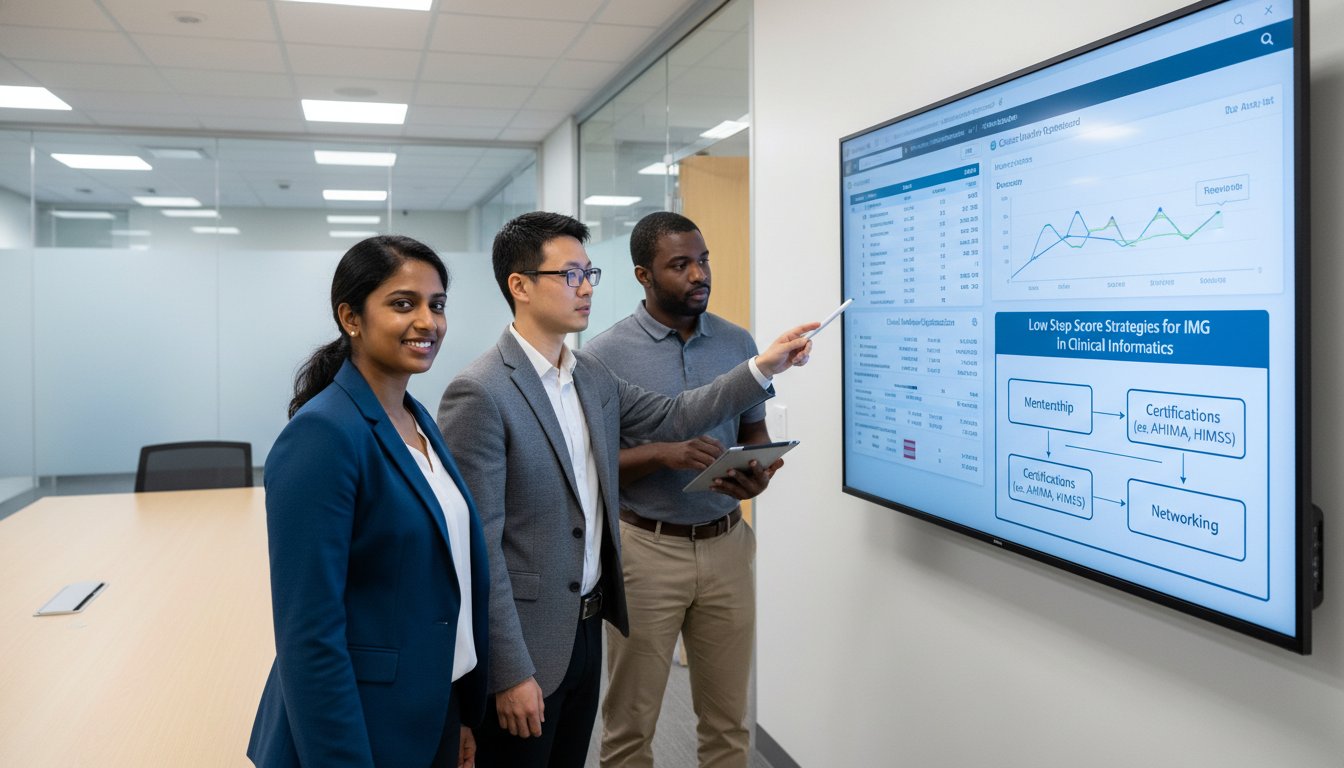
This IMG residency guide focuses on low Step score strategies specifically for those interested in clinical informatics fellowship paths and health IT training. The goal is to help you understand:
- How your exams still matter (even in a subspecialty like informatics)
- What unique strengths IMGs often bring to informatics
- Concrete, step‑by‑step strategies to offset a low Step score
- How to position yourself for both residency and, later, clinical informatics training
Why Scores Still Matter—but Less Than You Think
Even though Step 1 is now pass/fail, program directors still look at:
- Step 2 CK (now often the “sorting” score)
- Step 3 (for fellowship applicants or those seeking H‑1B visas)
- Other standardized exams (e.g., OET, USMLE attempts)
If you have a low Step 1 score (for older cohorts), low Step 2 CK, or multiple attempts, you are not automatically excluded from a career in clinical informatics. However, you must:
- Be realistic about residency competitiveness.
- Compensate deliberately in all other domains: experience, informatics credentials, communication skills, and networking.
Clinical informatics fellowship applications evaluate:
- Clinical base specialty (usually Internal Medicine, Family Medicine, Pediatrics, EM, Pathology, etc.)
- Evidence of strong analytical and systems thinking
- Demonstrated interest and skill in informatics, data, and health IT
- Ability to work on multidisciplinary teams with IT, operations, and clinicians
That means you have multiple levers besides test scores.
Step 1: Choosing the Right Clinical Pathway to Informatics
Most clinical informatics fellowships require completion of an ACGME‑accredited residency in any primary clinical specialty. If your Step scores are low, your choice of specialty and programs becomes strategically important.
A. Target More Attainable Base Specialties
With a low Step score, it’s usually unrealistic to aim for the most competitive specialties (e.g., Dermatology, Ophthalmology, Radiology, some Surgical fields) as your path to informatics.
Instead, consider specialties where:
- Informatics roles are robust
- Programs may be more IMG‑friendly
- Objective score thresholds are often more flexible
Common base specialties that feed into informatics:
- Internal Medicine (IM)
- Family Medicine (FM)
- Pediatrics
- Emergency Medicine (in some institutions)
- Pathology (highly informatics‑oriented, but can be competitive at informatics‑heavy programs)
For an IMG with below average board scores, Internal Medicine and Family Medicine are often the most practical routes, particularly at community‑based or mid‑tier university‑affiliated programs.
Action step:
Create a shortlist of 30–40 IM/FM programs that:
- Are known IMG‑friendly (look at current residents’ profiles)
- Have a hospital EHR system listed (Epic, Cerner, etc.)
- Are affiliated with a university or health system that has an informatics department or health IT initiatives
Even if they don’t have a formal clinical informatics fellowship, they may have informatics projects you can join.
B. Understanding Program Tiers and Risk Strategy
With low Step scores, a broad but focused application strategy is essential:
- Apply to a wide range of programs, including:
- Community programs
- Smaller university‑affiliated programs
- Programs in less popular geographic regions (Midwest, some Southern states, smaller cities)
- Mix “safer” programs (IMG‑heavy, lower average Step scores) with “reach” programs that have strong informatics infrastructure.
Balancing your desire for informatics exposure with your need to simply match is critical. You cannot reach clinical informatics fellowship without a base residency.
Step 2: Building a Distinct Informatics Profile to Overcome Low Scores
When your Step scores are weak, your application must send a different, stronger message:
“I am already functioning like a junior clinical informatician.”
A. Core Components of an Informatics‑Focused CV
Your CV should reflect health IT training, data literacy, and systems thinking. Aim to build tangible evidence in these areas:
Formal Education or Certificates
- Online courses (Coursera, edX, Udacity, etc.) in:
- Health informatics
- Data science in healthcare
- EHR systems
- Clinical decision support
- Sample credentials:
- “Graduate Certificate in Health Informatics” (if time and funds allow)
- Coursera Specializations:
- “Healthcare Data Analytics”
- “AI for Medicine”
- Even a structured MOOC series can be a differentiator if listed clearly with completion dates.
- Online courses (Coursera, edX, Udacity, etc.) in:
Technical Skills (Even Beginner Level) Program directors do not expect IMGs to be full‑stack developers, but evidence of technical comfort is powerful:
- Basic Python or R (for data analysis)
- SQL for querying databases
- Familiarity with Excel, Power BI, Tableau
- Understanding of clinical terminologies (ICD, CPT, SNOMED, LOINC) at a conceptual level
On your CV, use specific bullets:
- “Performed basic data cleaning and visualization in Python (pandas, matplotlib).”
- “Created dashboards of clinic quality metrics using Excel/Power BI.”
Project Work and Practical Examples Create or join small but real informatics projects. Examples:
Clinical Workflow Improvement Project
- Shadow a clinic workflow (even in your home country or volunteer site).
- Identify bottlenecks (e.g., documentation delays).
- Design an improved process using EHR templates, order sets, or checklists.
- Document before/after metrics.
Data Analysis Project
- Obtain de‑identified or synthetic datasets (from open resources).
- Analyze patterns (e.g., diabetes control outcomes, appointment no‑show rates).
- Visualize trends and propose interventions.
- Write a brief report or poster.
EHR Usability Observation
- Observe clinicians using a common EHR (if you have legal access).
- Produce a short usability report: navigation issues, alert fatigue, documentation burden.
- Propose interface or workflow changes.
These can be turned into posters, abstracts, or blog‑style writeups, which you can link in ERAS.
Publications and Presentations Even small contributions are valuable, especially when scores are low:
- Case reports with an informatics twist:
- E.g., “Impact of EHR Alerts on Early Sepsis Recognition in a Community Hospital.”
- Quality improvement posters relating to documentation, order sets, or clinical decision support.
- Short communications in informatics or quality/safety journals.
If publishing is difficult, aim for:
- Hospital QI days
- Local/regional conferences
- Virtual conferences with lower barriers to acceptance
- Case reports with an informatics twist:
B. Linking Your International Background to Informatics
As an international medical graduate, you bring unique experiences:
- Exposure to low‑resource settings and paper‑based workflows
- Firsthand understanding of what happens when health IT is absent or poorly implemented
- Flexibility working in diverse clinical environments
Frame these as assets:
- Describe how you have seen documentation challenges, test duplication, or medication errors that could be reduced by informatics solutions.
- Give a concrete example in your personal statement:
- “In my home hospital in [country], lack of integrated lab and pharmacy systems led to frequent delays in antibiotic initiation. This experience drove me to study how EHR‑based alerts and order sets can close such gaps.”
This narrative helps shift attention from your low Step score to a compelling story of purpose and systems thinking.
Step 3: Strategic Application Components for Matching with Low Scores
With below average board scores, every written and spoken element must reinforce your informatics value.
A. Personal Statement: Turn Weakness into Context, Not the Focus
Your personal statement should not dwell on numbers. Instead, it should:
Acknowledge briefly (only if needed)
If you have a major red flag (multiple fails), 1–2 honest, mature sentences are sufficient:- “My Step 1 journey was prolonged by personal and financial constraints during COVID‑19, but this period also led me to structured self‑study habits that I later applied successfully to Step 2 CK and to independent learning in clinical informatics.”
Shift to your strengths and informatics focus
- Explain how you think about systems, workflows, safety, and data.
- Connect your clinical experiences to informatics problems.
- Highlight any specific project or technical skill.
Show your compatibility with residency first
- Emphasize bedside medicine, teamwork, and patient‑centered care.
- Then show how informatics makes you a better clinician and future leader, not a person trying to “escape the wards.”
B. Letters of Recommendation: Highlight Systems Thinking & Reliability
For applicants with low scores, strong letters can significantly reframe your profile.
Ask recommenders who can comment on:
- Your analytical approach to clinical problems
- Your reliability, resilience, and work ethic despite challenges
- Your contributions to any IT, documentation, or workflow improvements
If you worked on an informatics or quality project, ask that supervisor to describe:
- Your ability to learn technical concepts
- Your communication with IT and clinical staff
- Any outcomes (e.g., improved documentation completeness, reduced errors)
Specific anecdotes (“She redesigned admission note templates that improved clarity for the entire clinic”) make a stronger impact than generic praise.
C. ERAS Application Details: Precise and Informatics‑Oriented
In your ERAS experiences:
- Use action verbs that reflect informatics and QI:
- “Analyzed,” “standardized,” “optimized,” “implemented,” “evaluated”
- Spell out tools and methods:
- “Used Excel pivot tables to analyze 500 patient records for trends in readmission.”
- “Mapped existing discharge workflows and proposed standardized checklists.”
This helps mitigate low scores by demonstrating higher‑order skills.

Step 4: Practical Steps Before and During Residency to Stay on the Informatics Path
Scores get you in the door; your trajectory in residency gets you into clinical informatics fellowship or related roles.
A. Before Matching: Maximizing the Pre‑Residency Period
If you are in a “gap” period (after graduation, before matching or rematching):
Complete Structured Health IT Training
- Finish 1–2 recognized informatics or data analytics online programs.
- Obtain certificates you can list under “Education” or “Certifications.”
Volunteer or Work with Health Systems
- Hospital volunteer roles that involve:
- EHR super‑user activities
- Data entry for QI projects
- Research assistant roles in:
- Outcomes research
- Quality and safety
- Telemedicine projects
- Hospital volunteer roles that involve:
Attend Informatics or QI Conferences (Even Virtually)
- AMIA (American Medical Informatics Association)
- HIMSS events
- Local academic medical center QI symposia
Mention participation in your CV and interviews; networking may lead to project or mentorship opportunities.
B. Once in Residency: Be “The Informatics Person” in Your Program
Regardless of where you match, you can brand yourself as the resident who “thinks in systems”:
Join Hospital Committees:
- EHR optimization groups
- Quality improvement or patient safety committees
- Clinical decision support committees
Lead or Co‑Lead a QI/IT Project
- Example projects:
- Reduce unnecessary lab testing by redesigning order sets.
- Optimize EHR reminders for vaccinations.
- Standardize discharge summaries to improve handoffs.
Be deliberate about measuring baseline and post‑intervention metrics.
- Example projects:
Build a Mentorship Network
- Identify:
- A clinical mentor (PD, APD, or attending who values QI)
- An informatics mentor (CIO, CMIO, informatics‑interested faculty, data analyst)
Request quarterly or semi‑annual meetings to align your activities with future clinical informatics fellowship applications.
- Identify:
C. How Low Scores Are Viewed at the Fellowship Stage
For clinical informatics fellowship, your residency performance and informatics track record matter more than your old Step 1 number. Program directors will focus on:
- Residency evaluations and letters
- Evidence of sustained informatics engagement
- Projects, publications, and leadership roles
- Your ability to bridge clinical and IT worlds
Your early low Step score becomes progressively less relevant if you have:
- Passed Step 3
- Performed well in residency in‑training exams (if applicable)
- Built a robust, informatics‑heavy portfolio
Step 5: Mindset, Risk Management, and Plan B Options
Low scores do not define your ceiling, but they should shape a realistic, multi‑layered plan.
A. Balancing Ambition and Probability
Your priorities should usually be:
First: Match into some ACGME‑accredited residency.
Without this, your path to a US‑based clinical informatics fellowship is nearly closed.Second: Optimize for Informatics Exposure Where Possible.
But do not sacrifice your chance to match by applying only to high‑tech academic centers.
A balanced strategy might be:
- Apply broadly to IM/FM programs (including IMG‑friendly community programs).
- Slightly favor programs with:
- EHR maturity
- Affiliation with universities that have informatics departments
- Mention of QI, patient safety, or data‑driven initiatives in their descriptions
B. Handling Red Flags Honestly and Confidently
If you are asked directly about your low Step scores in interviews:
Take ownership without self‑attack
- “At that time, I did not yet understand how to prepare strategically for USMLE style questions. I learned from that experience, changed my study methods, and improved my performance on Step 2/Step 3.”
Pivot quickly to growth and evidence of improvement
- Highlight:
- Better subsequent scores
- Consistent performance in rotations or observerships
- Complex projects you completed
- Highlight:
Tie this into your informatics mindset
- “That experience pushed me to analyze my own learning system—identifying bottlenecks, feedback loops, and metrics. This systematic way of thinking later became central to how I approach clinical workflows and informatics problems.”
C. Plan B and Parallel Informatics Pathways
If matching proves very difficult despite your efforts, or if you want an extra safety net:
- Consider non‑physician informatics roles:
- Clinical data analyst
- Health IT project coordinator
- EHR trainer or super‑user
- Build on:
- Your medical degree
- Health IT training
- Any technical skills (Python, SQL, data visualization)
These roles do not replace a US clinical residency but can keep you in the health IT ecosystem, expand your network, and sometimes later support another attempt at matching or lead to hybrid careers.
FAQs: Low Step Scores, IMGs, and Clinical Informatics
1. Is clinical informatics fellowship realistic for an IMG with low Step scores?
Yes, it can be realistic, but usually through a stepwise strategy:
- secure an IMG‑friendly residency (often IM or FM),
- build a strong informatics portfolio during residency (projects, QI, committees),
- obtain solid letters from informatics‑oriented mentors.
By fellowship application time, your recent performance and informatics track record matter more than an old low Step 1 score.
2. Do I need strong programming skills to get into clinical informatics?
Not necessarily. You do not have to be a software engineer. However, basic comfort with:
- Spreadsheets and data visualization
- Introductory Python or R
- Understanding databases and clinical terminologies
is a major advantage, especially if you have below average board scores. These skills show you can collaborate effectively with IT and data teams.
3. How can I talk about my low Step score in interviews without hurting my chances?
Keep it brief, honest, and growth‑focused:
- State the reason without making excuses.
- Emphasize what you changed (study strategy, time management, support systems).
- Show evidence of improvement (higher Step 2 CK, Step 3, clinical evaluations, complex projects). Transition quickly to how that experience strengthened your resilience and analytical approach.
4. What are the most important steps I can take this year to improve my chances?
For an IMG residency guide focused on matching with low scores into an informatics‑friendly path, prioritize:
- Completing at least one structured health IT or informatics certificate.
- Starting a small but concrete data or workflow project you can describe in detail.
- Obtaining strong letters of recommendation that mention your systems thinking, reliability, and informatics interest.
- Applying broadly to IMG‑friendly IM/FM programs, with extra attention to those with EHR optimization, QI, or informatics efforts.
By combining these targeted actions with persistence, you can move beyond the limitations of your low Step score and build a viable, meaningful career in clinical informatics as an international medical graduate.