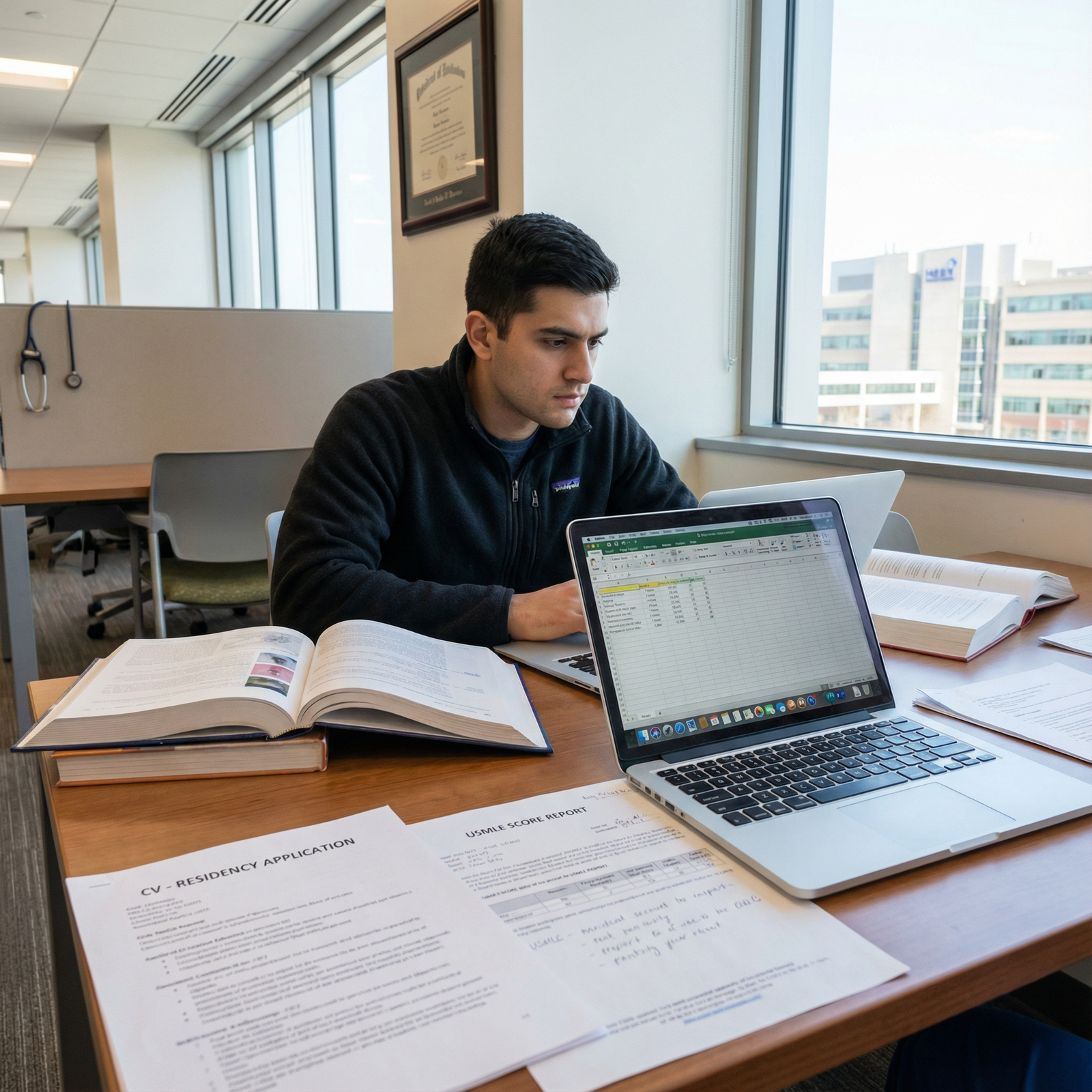
Understanding the Challenge: Low Step Scores as an IMG in PM&R
As an international medical graduate interested in Physical Medicine & Rehabilitation (PM&R), a low Step 1 or Step 2 CK score can feel like a major barrier. Programs are competitive, many use score filters, and the specialty is increasingly popular among both US and international graduates. Yet many applicants do successfully match into PM&R with below average board scores—including IMGs—by being strategic, realistic, and persistent.
This IMG residency guide focuses specifically on low Step score strategies for PM&R. It will help you:
- Understand how PDs think about scores in PM&R
- Realistically assess your competitiveness
- Build a compensating application profile (research, rotations, networking)
- Apply strategically to maximize your chances of a physiatry match even with low or failed attempts
Throughout, we’ll focus on actionable steps you can start today, even if your scores are already fixed.
How PM&R Programs View Low or Below-Average Scores
What counts as a “low” score?
With Step 1 now Pass/Fail, the emphasis has shifted heavily to Step 2 CK. For IMGs, program directors often use Step 2 CK as:
- A screening tool (minimum cutoffs)
- An indirect marker for whether you can pass boards on time
- A way to compare IMGs from very different medical education systems
A “low” Step 2 CK in PM&R often means:
- Below ~225 for IMGs at relatively competitive programs
- Around 210–220 or below at many community programs or less competitive locations
- Any failed attempt (even if later passed) is an extra red flag
However, this is not absolute. Some programs don’t have rigid cutoffs; others will consider your whole application if you reach their internal review stage.
Why PM&R is still accessible with lower scores
Compared to very competitive fields (Derm, Ortho, Plastics), PM&R:
- Places significant value on clinical performance, communication, and teamwork
- Cares about genuine interest in rehab, disability, function, and quality of life
- Is relatively more open to applicants with “non-traditional” profiles, including IMGs and career changers
For these reasons, your story and demonstrated commitment can matter more in PM&R than in many other specialties—especially at community and mid-tier university programs.
What program directors worry about with low scores
When an international medical graduate has below average board scores, PDs often worry about:
- Risk of failing future boards (PM&R written/oral boards)
- Difficulty handling US clinical workload and documentation
- Weak test-taking skills that may translate to in-training exam problems
- Possible gaps in basic medical knowledge
Your job is to build an application that systematically reassures them on each of these concerns.
Step Scores in Context: Analyze, Accept, and Reframe
Before building strategies, you need a clear, honest picture of your situation.
Step 1: Classify your score situation
Ask yourself:
- Did you have any failed attempts (Step 1, Step 2 CK, Step 3)?
- What is your Step 2 CK relative to:
- National average (~245–250 in recent years)
- IMG-friendly PM&R programs’ typical ranges (often 220–240, with exceptions)
- Do you have time to take Step 3 before applications/interviews?
Common scenarios:
- Pass on first attempt, but low Step 2 CK (e.g., 205–220)
- Multiple attempts or fail on Step 1 or Step 2 CK, then pass
- Decent Step 2 CK (≥225) but non-elite, combined with average or unknown school reputation
Each scenario requires you to compensate in other areas.
Step 2: Understand where you can still influence the narrative
Things you cannot change now:
- Past Step scores and attempts
- Medical school location and reputation
- Year of graduation
Things you can still influence:
- Step 3 timing and performance (if useful for you)
- US clinical experience (USCE) quality and recency
- Strength and specificity of Letters of Recommendation (LoRs)
- Research output and rehab exposure
- Personal statement and overall narrative
- Number and spread of programs you apply to
- Networking and visibility (interest emails, away rotations, conferences)
Your strategic focus should be on maximizing controllable factors to offset your low Step scores.
Step 3: Decide on Step 3 timing for IMGs with low scores
For international medical graduates with low Step scores, Step 3 can be a double-edged sword:
It can help by:
- Demonstrating improved test-taking
- Reducing PDs’ anxiety about future board failure
- Making you more attractive to programs concerned about visa timing
It can hurt if:
- You fail or score poorly, reinforcing the test-taking concern
Guidance:
- If you failed Step 1 or Step 2 CK, a solid Step 3 (>220 ideally) before interview season can help “prove” improvement.
- Only attempt Step 3 if:
- You have enough prep time
- You can realistically outperform your prior exams
- If scores are already borderline, do not rush Step 3 just to have it on your application.
Strengthening Your Application Beyond Scores
To be competitive for a physiatry match with a low Step 1 or Step 2 CK score, you must build a profile that says:
“Even though my scores are not high, I will be a safe, hardworking, engaged resident who will pass boards and enhance your program.”
1. Prioritize high-quality US Clinical Experience (USCE) in PM&R
For an IMG in PM&R, USCE is one of the most powerful tools to overcome low scores.
Aim for:
- At least 2–3 months of PM&R-related rotations (inpatient rehab, consult service, outpatient, pain, sports, neurorehab)
- At least one rotation at a program that has a PM&R residency or is PM&R-affiliated
Types of experiences (in descending order of impact):
- Sub-internships / Acting internships in PM&R units
- Clinical electives (hands-on, direct patient care)
- Observerships with meaningful involvement (notes, presentations, journal clubs even if not writing orders)
How this offsets low scores:
- Strong performance + enthusiastic comments in LoRs show that your clinical skills and work ethic are better than your scores suggest.
- PDs trust US-based faculty they know; a call or email from a known physiatrist can outweigh a low Step 2 CK.
Actionable tips:
- Target IMG-friendly PM&R departments, often at:
- Large county hospitals
- VA-based programs
- Universities historically known to accept IMGs
- During rotations:
- Be early, prepared, and visible
- Read around cases and volunteer for presentations
- Explicitly express your interest in PM&R to attendings
- Ask for feedback and improve during the rotation
2. Letters of Recommendation that speak louder than scores
With low Step scores, your Letters of Recommendation are critical.
Ideal LoR set for PM&R:
- 2 letters from PM&R attendings, ideally from programs with residencies
- 1 letter from Internal Medicine, Neurology, or another core specialty
- 1 optional letter (if allowed) from a research mentor or additional PM&R attending
What your letters should emphasize:
- Strong work ethic and reliability (“shows up early, stays late, follows up”)
- Clinical reasoning and ability to manage complex rehab patients
- Communication skills with interdisciplinary teams (PT, OT, SLP, nursing)
- Improvement over time—especially valuable if you have a history of failed exams
- Explicit advocacy, e.g., “I strongly recommend [Name] for your PM&R residency and would gladly work with them as a resident.”
How to help writers produce strong letters:
- Provide a short CV and personal statement draft
- Briefly and honestly discuss your low scores, and how you have learned and improved
- Ask if they can write a “strong, supportive letter” (this allows them to decline if they feel neutral)
3. Research and scholarly activity in PM&R
Research won’t instantly erase low Step scores, but for an IMG residency guide focused on PM&R, it’s one of the best ways to demonstrate:
- Genuine long-term interest in physiatry
- Ability to handle complex information and academic work
- Persistence and intellectual curiosity
Options:
- Prospective research position (1–2 years) in a PM&R department
- Retrospective chart reviews, case series, case reports, QI projects
- Systematic or narrative reviews on topics like stroke rehab, SCI, TBI, MSK pain, prosthetics, spasticity management
If you have limited time:
- Focus on case reports or retrospective reviews that can be submitted more quickly
- Present at regional or national PM&R or rehab-related conferences (AAPM&R, AAP, state PM&R societies)
Even 1–2 posters + 1 publication can significantly strengthen a low-score IMG application if tightly aligned with PM&R.

Applying Strategically: Where and How to Maximize Your Chances
Understand PM&R program tiers and IMG-friendliness
Broadly, PM&R programs can be categorized as:
Highly competitive academic centers
- Well-known national names, heavy research focus, top-tier reputation
- Often prefer high scores and US MD/DOs, but may take exceptional IMGs
Mid-tier university or university-affiliated programs
- Moderate research expectations, solid training
- More openness to IMGs, especially with strong USCE and LoRs
Community-based or hybrid programs
- Less research, more clinical service
- Often most IMG-friendly, especially for applicants matching with low scores
With a low Step 1 or Step 2 CK, your main focus should be tiers 2 and especially 3.
Use data to identify IMG-friendly PM&R programs
Strategies:
- Review NRMP Charting Outcomes and NRMP Program Director survey data for PM&R when available
- Look at programs’ resident lists:
- Are there IMGs?
- Do they have graduates from schools similar to yours?
- Check online forums, communities, or advising resources that list IMG-friendly PM&R programs
A realistic list for an IMG with below average board scores might be:
- 70–120 PM&R programs total (depending on your resources and visa needs)
- Heavy emphasis on:
- Programs that have accepted IMGs in recent years
- Programs in less popular geographic areas (Midwest, South, non-coastal regions)
Targeting prelim and transitional years wisely
Many PM&R programs are advanced positions, meaning you also need:
- A preliminary Medicine or Transitional Year (TY)
- Occasionally preliminary Surgery (less ideal for rehab interest but possible)
With low scores, it can be easier to match:
- A prelim IM spot at a community program, then
- Scramble or match separately into PM&R later
However, going this route without a secured advanced spot carries risk. For most IMGs with low scores, it’s better to:
- Apply to categorical PM&R + TY/prelim simultaneously, and
- Consider prelim-only applications as a backup strategy.
The power of signaling interest and networking
Networking can soften the effect of low Step scores by turning you from a “number” into a known, motivated person.
Practical steps:
Attend PM&R conferences (virtual or in-person):
- AAPM&R, AAP, state PM&R society meetings
- Introduce yourself briefly to faculty and residents
Email programs thoughtfully:
- Only after you’ve researched them
- Mention specific reasons for your interest in their program
- Highlight your USCE with PM&R, research, and your commitment
- Briefly, and positively, acknowledge your low scores if relevant but focus on improvement and current strengths
Stay in touch with mentors:
- Ask PM&R attendings where you rotated if they can advocate by sending a note or making a call on your behalf
These personal connections often determine whether a PD is willing to look past filters and grant you an interview.
Crafting Your Story: Addressing Low Scores Without Letting Them Define You
Personal statement: strategically addressing a low Step score
You do not need to obsess about your low Step score in your personal statement, but ignoring a failed attempt or very low score can feel like a missing piece.
If you choose to mention it:
- Keep it brief and mature
- Avoid blaming circumstances excessively
- Show what changed and how you improved
Example framing (paraphrased for your own use):
“Early in my medical training, I struggled with standardized exams, and my Step 2 CK score does not reflect the physician I am today. Since then, I have focused on strengthening my test-taking strategies and applied more structured study methods, resulting in improved performance on subsequent assessments and clinical evaluations. More importantly, my experiences caring for patients in rehabilitation settings have confirmed that my strengths lie in patient-centered care, teamwork, and persistence, qualities that I will bring to residency.”
The goal is to own the weakness, then pivot quickly to your strengths and growth.
CV and ERAS application: present your PM&R commitment clearly
Ensure your ERAS conveys a unified message:
“I am committed to Physical Medicine & Rehabilitation long term.”
Strategies:
- Put PM&R rotations and experiences high in your Experiences section
- List volunteer work related to disability, sports, geriatrics, neurorehab, pain, or chronic illness
- Include research and quality improvement with clearly PM&R-relevant titles and descriptions
- Use descriptions to demonstrate:
- Interdisciplinary teamwork
- Longitudinal patient follow-up
- Understanding of function, not just disease
This helps PDs see you as a dedicated future physiatrist, not someone picking PM&R as “backup” because of low scores.
Interview preparation for low-score IMGs
If you get an interview, you have already passed major filters. At this point, your performance can compensate for low Step scores.
Key goals:
- Show insight and maturity about your weaknesses (including scores, if asked)
- Demonstrate your passion for function, quality of life, and interdisciplinary care
- Convey reliability, teachability, and team orientation
Common questions you may face:
- “Can you tell me about a challenge you faced in your medical training?”
- This is often an opening to discuss exam struggles briefly and then focus on growth.
- “Why PM&R?”
- Use specific patient encounters and rotations that shaped your interest.
- “How do you handle stress and workload?”
- Program directors are probing your resilience, especially if you have exam failures.
Practice with mentors or mock interviews, especially focusing on transparent but optimistic answers about your low scores.
Putting It All Together: Example Roadmaps for Different Profiles
Scenario 1: IMG with single Step 2 CK attempt of 215, recent graduate
- 6–12 months before ERAS:
- Secure 2–3 months of PM&R USCE
- Begin research or at least one case report with a PM&R mentor
- Consider dedicated preparation for Step 3 if you can aim for a higher score
- 3–6 months before ERAS:
- Obtain strong PM&R LoRs
- Polish personal statement with brief mention of score only if needed
- Identify 70–100 PM&R programs, heavily weighted toward IMG-friendly/community
- Application season:
- Apply broadly to PM&R + appropriate prelim/TY programs
- Email select programs expressing sincere interest and highlighting PM&R USCE/LoRs
- Prepare specifically for interviews, including explanation of below average board scores
Scenario 2: IMG with prior Step 2 CK failure, then pass with 220, older graduate (YOG > 5 years)
- 12–18 months plan (if possible):
- Consider a research fellowship or observership in PM&R for US exposure
- Publish at least one PM&R-related article/poster
- Strengthen English communication and US clinical familiarity
- 6–12 months before ERAS:
- Do hands-on USCE if possible (sub-I, elective)
- Prepare intensively for Step 3 and aim to pass on first try with a better score
- Application season:
- Apply very broadly, accept more geographical flexibility
- Explicitly address the earlier failure as a learning experience and show improved pattern
- Consider prelim Internal Medicine as a secondary path while reapplying to PM&R if needed
FAQs: Low Step Score Strategies for IMGs in PM&R
1. Is it still possible to match into PM&R as an IMG with a low Step 2 CK or failed attempt?
Yes, it is possible, though more challenging. Many IMGs with below average board scores still match into PM&R, especially at community or mid-tier programs that value work ethic, clinical performance, and demonstrated PM&R interest. You must compensate with strong USCE, powerful PM&R letters, focused research or scholarly work, and strategic program selection.
2. Should I delay my application to first improve my profile (e.g., more USCE or research)?
If your scores are low and you currently have minimal USCE and no PM&R exposure, delaying one cycle to gain substantial USCE and research can significantly improve your chances. However, if your year of graduation is already older or you face visa expiration issues, you may need to balance time spent improving your profile against the risk of becoming “too far from graduation” for some programs.
3. Will taking Step 3 improve my chances of a PM&R match with low scores?
Step 3 can help an international medical graduate demonstrate academic recovery if previous scores were weak or if there were failed attempts. A solid Step 3 performance can reassure PDs about your board-passing potential and sometimes helps with visa-related concerns. However, a poor Step 3 score or another failure will hurt significantly, so you should only take it when you are thoroughly prepared and realistically expect to outperform your prior exams.
4. How many PM&R programs should I apply to as an IMG with low scores?
Most IMGs matching with low scores cast a very wide net. Common ranges are 70–120 PM&R programs, depending on your financial resources and visa needs. Focus heavily on:
- Programs that have previously matched IMGs
- Community and university-affiliated programs in less popular locations
- Places where your mentors or LoR writers have connections
Always pair your PM&R applications with appropriately broad prelim/TY applications as well.
By accepting your scores, strategically strengthening all other aspects of your application, and targeting programs thoughtfully, you can greatly improve your chances of a physiatry match—even with a low Step 1 or Step 2 CK score—as an international medical graduate.