
Understanding How Step Scores Fit into the OB GYN Match for IMGs
For an international medical graduate (IMG), Step scores can feel like the entire story of your OB GYN residency prospects. In reality, they are just one (very important) chapter.
Where Step 1 and Step 2 CK Matter Now
Step 1 is now pass/fail, but:
- Programs still care how you passed (first attempt vs repeat).
- A first-attempt pass is usually considered “good enough,” especially if supported by strong Step 2 CK.
- A fail or multiple attempts requires a deliberate, honest, and strategic plan to overcome.
Step 2 CK is now the primary scored exam:
- It is often used as a screening tool.
- Many programs have informal or formal cutoffs.
- For IMGs, Step 2 CK is often seen as:
- Proof of current clinical knowledge
- A predictor of board exam performance
- A way to compare you with U.S. graduates on the same scale
What OB GYN Programs Typically Look For in Scores
While exact numbers vary by program and year, a rough interpretation for an IMG applicant to OB GYN might look like:
- 220–235: Borderline competitive; needs strong application support (USCE, letters, research, networking).
- 235–245: Solidly competitive for many mid-tier community and some university-affiliated programs if other elements are strong.
- 245+: Strong for many programs, though no score guarantees a match.
- Below 220 or multiple attempts: You’re in the low Step score match group and will need a strategic, targeted approach and a broader program list.
These ranges are not official cutoffs; they’re practical guideposts. IMGs are evaluated in context: year of graduation, prior training, research, and especially U.S. clinical experience (USCE) in OB GYN.
Building Your Step 2 CK Strategy as an IMG in OB GYN
If you’re still planning or preparing for Step 2 CK, this is your best opportunity to influence your competitiveness for the obstetrics match.
Step 2 CK as Your “Redemption” and “Showcase” Exam
For many IMGs, Step 2 CK is:
A redemption exam if:
- Your Step 1 was borderline or had a fail/low score.
- You graduated several years ago and need to demonstrate up-to-date knowledge.
A showcase exam if:
- You passed Step 1 on the first attempt.
- You seek to stand out in a competitive specialty like OB GYN.
Your Step 2 CK strategy should reflect which category you’re in.
If Your Step 1 Was Strong (First Pass, No Concerns)
Your goal with Step 2 CK:
- Maintain or slightly exceed your Step 1 level.
- Aim for a Step 2 CK score at or above your Step 1 percentile range.
- Show consistent performance, not necessarily perfection.
Strategy focus:
- Targeted practice in OB GYN-heavy topics and medicine relevant to pregnancy.
- Early exam timing (before ERAS opens) so programs see your score in the initial review.
If Your Step 1 Was Weak, Low, or Required Multiple Attempts
Your goal with Step 2 CK:
- Demonstrate a clear upward trend.
- Obtain a significantly stronger score relative to the perceived deficiency.
- Show that your earlier struggles are resolved, not ongoing.
Strategy focus:
- Delay Step 2 CK until:
- You have adequate dedicated time.
- Your NBME practice scores are consistently within or above your target range.
- Build a written plan that includes:
- Daily question volume.
- NBME checkpoints.
- Content review and spaced repetition.
Designing a Concrete Step 2 CK Study Plan for OB GYN-Bound IMGs
A strong Step 2 CK strategy is planned, measurable, and tailored to OB GYN content.
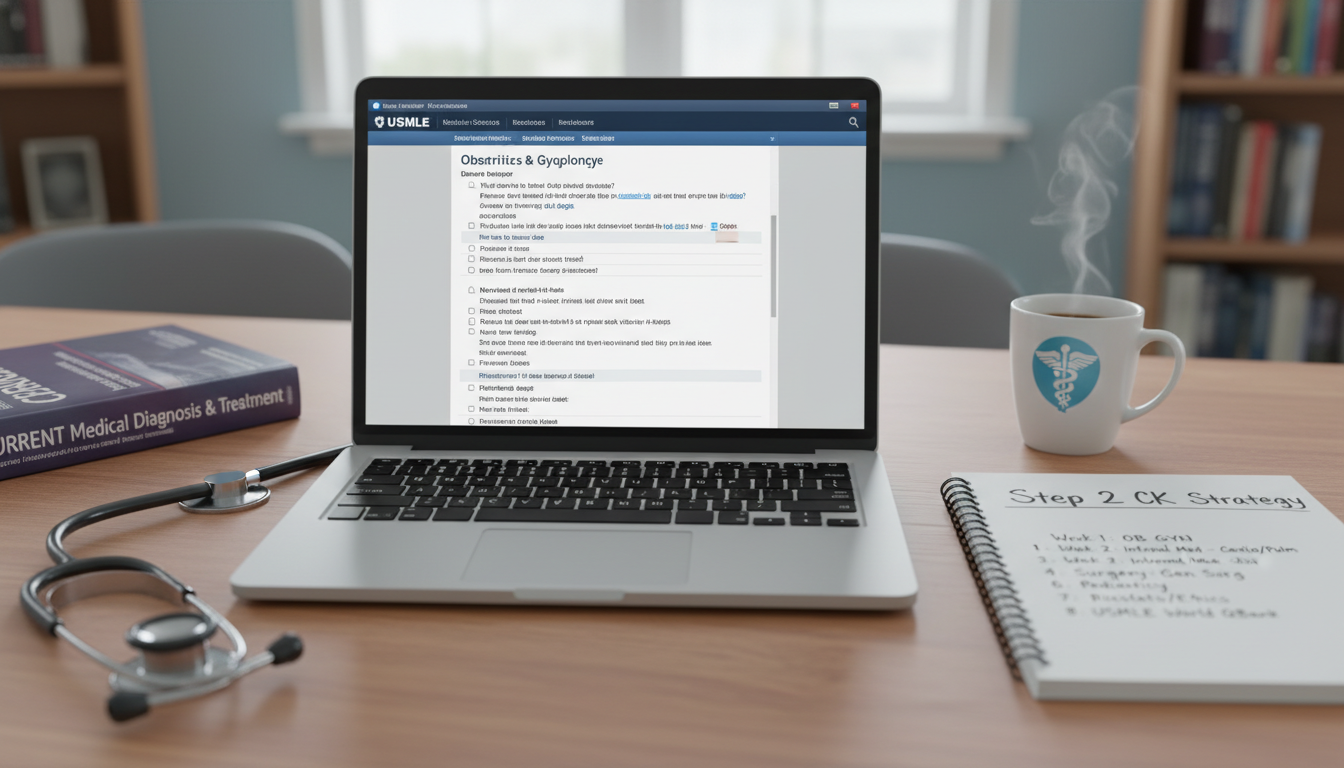
Step 2 CK Timeline Planning
For many IMGs:
- Dedicated period: 8–16 weeks, depending on:
- Baseline knowledge.
- Language and exam familiarity.
- Other obligations (work, family, visa-related tasks).
Planning backward from:
- ERAS opening (usually September).
- Your target exam date (ideally no later than July of application year).
Example Timeline (12-week Dedicated Period)
Weeks 1–4: Foundation + High-Yield Systems
- 40–60 UWorld questions/day, timed, random.
- Daily review and annotation.
- Focus systems: OB GYN, Medicine, Surgery (especially pregnancy-related conditions).
- One NBME at the end of Week 3 or 4 to calibrate.
Weeks 5–8: Intensification + Weakness Fixing
- 60–80 questions/day, timed blocks.
- Start second resource or separate OB GYN question sets.
- Weekly NBME or practice exam starting Week 6.
- Create “error log” with patterns (e.g., misreading questions, time management issues, particular topics like hypertensive disorders in pregnancy).
Weeks 9–11: Simulation & Refinement
- Full-length simulation days (4–6 blocks).
- Emphasis on test stamina and time management.
- Review high-yield OB GYN topics: labor management, postpartum complications, ectopic pregnancy, gynecologic oncology, contraception.
Week 12: Final Review + Light Practice
- Lighter question volume, focusing on your error log and weak topics.
- No new resources in the last week.
- Practice sleep schedule and exam-day routine.
Resource Strategy for OB GYN-Focused Step 2 CK Prep
Use few, high-yield resources well rather than many superficially.
Recommended core:
Question bank (e.g., UWorld Step 2 CK)
- Main driver of score improvement.
- Treat each question as a learning opportunity, not just right/wrong.
NBME practice exams
- Use as milestones.
- Do not take the real exam until NBMEs are consistently near or above your target.
OB GYN-specific references
- OB GYN chapters from major Step 2 CK review books.
- High-yield OB GYN notes (if you have access from rotations).
- A brief guideline review (e.g., ACOG practice bulletins via summaries or rotation materials if available).
Setting Realistic Step 2 CK Targets for IMGs in OB GYN
If your Step 1 is:
- Pass (first attempt, unknown numeric score):
- Aim for at least mid-230s or above to be broadly viable, higher if possible.
- Low or involved a fail:
- An increase into the 230s or higher sends a strong message of growth.
- Even a jump from low 200s to 220–230 is meaningful but will need stronger overall application strategy.
Always tailor targets to your practice exam performance, not just arbitrary numbers. Safe range = at or below the average of your last 2–3 NBMEs.
If Your Step Scores Are Already Low: Salvaging and Strengthening Your Application
Many IMGs reach this point: Step 1 is pass (or passed after multiple attempts), Step 2 CK is already taken, and the score is below what you hoped for. This does not end your OB GYN journey, but it changes your strategy.
Step 1 Pass with Low or Just-Adequate Step 2 CK
If your Step 2 CK is in the low 220s or below, or lower than what you aimed for:
Accept the data and analyze context
- Were there extenuating circumstances (health, family crisis, test center issues)?
- Are you frequently running out of time on NBME-style exams?
- Do you see patterns (e.g., poor OB GYN questions, misreading stems, management questions)?
Decide cautiously about a Step 3 attempt before applying
- Step 3 can be:
- A plus if done well (solid score, especially after lower Step 2).
- A risk if you underperform again and reinforce concerns.
- Consider Step 3 before application if:
- You can realistically score better based on practice tests.
- You have at least several months for preparation.
- You aim for states/programs where Step 3 helps with visa or contract decisions.
- Step 3 can be:
Shift primary energy to non-exam strengths:
- Build strong OB GYN USCE:
- Observerships, externships, sub-internships when possible.
- Obtain excellent letters of recommendation:
- At least 2 from U.S. OB GYN faculty, ideally where you worked closely and were observed in clinical settings.
- Enhance your OB GYN CV:
- Research, case reports, quality improvement projects, or audits.
- Teaching or leadership roles in women’s health or reproductive health.
- Build strong OB GYN USCE:
Addressing Step Score Concerns in Your Personal Statement and Interviews
For IMGs with a low Step score match profile, how you communicate about your scores matters.
Avoid:
- Long, defensive explanations.
- Blaming the exam, testing center, or question style.
- Overemphasis on “I am better than my score” without examples.
Instead:
- Provide short, factual context (if needed), then pivot to growth:
- “While my Step 2 CK score does not fully represent my current knowledge and clinical abilities, it prompted me to develop a more disciplined and structured study approach. Since then, I have successfully completed…”
- Highlight objective improvements:
- Honors in clinical rotations.
- Strong written evaluations.
- Successful completion of a rigorous observership or residency equivalent.
- Research with clear deliverables (abstracts, posters, publications).
In interviews:
- When asked about scores, respond with:
- Ownership: Acknowledge the result.
- Insight: What you learned.
- Action: What changed in your study or work habits.
- Evidence: How your more recent performance supports your growth.
Program Selection and Application Strategy for IMGs with Imperfect Scores
You can’t control your Step history once the scores are in, but you can target your applications strategically for the obstetrics match.

Researching OB GYN Programs that Align with IMG Profiles
Focus on data points that matter for an IMG residency guide strategy:
IMG-friendly history:
- Programs that have matched IMGs or FMGs in recent years.
- Check:
- Program websites (resident bios).
- NRMP Charting Outcomes (for trends).
- Online forums or databases that track IMG-matching programs.
Less rigid score cutoffs:
- Community-based or university-affiliated community programs often have more holistic reviews.
- Some academic programs are also IMG-friendly but will still expect stronger overall profiles.
Visa support:
- Clearly identify whether programs sponsor J-1, H-1B, or none.
- No visa support = non-viable no matter how strong your CV.
Geographic strategy:
- Programs in less competitive or less populated regions are often more open to IMGs with lower scores if they show strong commitment and reliability.
Crafting Your Program List by Score Tier
For an IMG applying to OB GYN:
Higher Step 2 CK (e.g., 240+)
- Cast a balanced net:
- A mix of mid-tier academic, university-affiliated, and IMG-friendly community programs.
- Include a few reach programs that match non-U.S. grads.
- Cast a balanced net:
Mid-range Step 2 CK (225–239)
- Emphasize:
- University-affiliated community programs.
- Broad selection of community-based programs with prior IMG matches.
- Consider:
- A larger number of applications (e.g., 60–80+ OB GYN programs, depending on budget).
- Emphasize:
Low Step 2 CK (<225) or multiple attempts
- Very broad application strategy:
- A wide net within OB GYN: possibly 80–120+ programs (as budget allows).
- Consider also applying to:
- Preliminary/transitional year programs.
- Another backup specialty if your absolute priority is training in the U.S.
- Very broad application strategy:
This is not about “giving up” on OB GYN; it is about risk management and having a realistic pathway to U.S. clinical training.
Strengthening the Application “Around” Your Scores
To offset lower scores, make other components clearly impressive:
US Clinical Experience (USCE) in OB GYN
- Minimum target: At least 2–3 months of hands-on or closely supervised OB GYN experience (externship, sub-I, robust observership).
- Demonstrate:
- Comfort with labor and delivery.
- Fundamental OB emergencies (e.g., postpartum hemorrhage, eclampsia, shoulder dystocia conceptually).
- Professional communication and teamwork.
Letters of Recommendation (LoRs)
- At least:
- 2 OB GYN attendings from U.S. institutions.
- 1–2 additional letters (e.g., internal medicine, research mentor, or home-institution OB GYN).
- Strong LoRs should:
- Use specific examples of clinical performance.
- Comment on work ethic, reliability, communication, and teachability.
- Indicate the writer has observed you closely.
- At least:
Personal Statement Tailored to OB GYN
- Clearly expresses:
- Why OB GYN specifically (not “I like women’s health” only).
- Experiences that shaped your interest: deliveries, surgical exposure, global women’s health, reproductive justice, etc.
- Your long-term goals (e.g., academic career, community women’s health, global maternal care).
- If appropriate, briefly and constructively address Step challenges and how you grew from them.
- Clearly expresses:
Research and Scholarly Work
- Any OB GYN-related:
- Case reports.
- Poster presentations.
- Retrospective chart reviews.
- Quality improvement (QI) projects.
- For low Step scores, research supports the argument that you can:
- Read and apply medical literature.
- Work in structured academic environments.
- Any OB GYN-related:
Practical Examples: Matching OB GYN with Different Step Profiles
These examples are fictional but realistic composites and can help you visualize strategy.
Example 1: IMG with Solid Step 2 CK, Pass Step 1
- Step 1: Pass, first attempt.
- Step 2 CK: 243.
- Graduation year: 2 years ago.
- USCE: 3 months OB GYN externship + 1 month internal medicine.
- Research: 1 OB GYN case report accepted at a regional conference.
- Strategy:
- Apply to ~70 OB GYN programs, focusing on IMG-friendly/university-affiliated programs.
- Emphasize clinical strengths and strong LoRs.
- No need for Step 3 before application; focus on interviews and communication skills.
- Outcome:
- Multiple interviews, matched at a university-affiliated community OB GYN program.
Example 2: IMG with Low Step 2 CK After Weak Step 1
- Step 1: Pass after 2nd attempt.
- Step 2 CK: 220.
- Graduation year: 5 years ago.
- USCE: 2 months OB GYN observership, 1 month research observership.
- Research: None yet.
- Strategy:
- Accept that scores will significantly limit options; build a robust, high-volume application.
- Apply to 100+ OB GYN programs (heavy emphasis on IMG-friendly community programs).
- Simultaneously apply to preliminary internal medicine or surgery positions as backup.
- Engage in at least one OB GYN research or QI project to show academic engagement.
- Outcome:
- Few OB GYN interviews but one very IMG-friendly program calls, impressed by commitment and letters.
- Matches into OB GYN at a smaller community hospital with strong mentorship.
Example 3: IMG with Delayed but Strong Recovery via Step 3
- Step 1: Pass, borderline performance.
- Step 2 CK: 215.
- Step 3: 235 (taken after extra focused preparation).
- Graduation year: 7 years ago, with 3 years of OB GYN experience abroad.
- USCE: 1 month OB GYN, 1 month family medicine.
- Strategy:
- Use Step 3 as evidence of improvement and readiness.
- Highlight prior OB GYN experience abroad as an asset.
- Apply widely to OB GYN, focusing on programs that value prior experience and older grads.
- Outcome:
- Interviews come mostly from community and IMG-friendly programs.
- Step 3 score and prior experience convince one program of reliability; matched.
FAQs: Step Score Strategy for IMGs in OB GYN
1. What Step 2 CK score do I need as an IMG to be competitive for OB GYN residency?
There is no absolute cutoff, but practical ranges for IMGs are:
- 235+: Reasonably competitive for many OB GYN programs if other parts of your application are strong.
- 220–234: Possible but will require:
- Strong USCE in OB GYN.
- Excellent LoRs.
- Carefully targeted program list.
- Below 220 or multiple attempts: Matching is more challenging but not impossible:
- Apply very broadly.
- Strengthen your profile with experience, research, and networking.
Always interpret your score alongside graduation year, USCE, research, and letters.
2. Should I delay my ERAS application to improve my Step 2 CK score?
If you haven’t taken Step 2 CK yet and your practice scores are significantly below your target, delaying exams (and possibly applying in a later cycle) can be better than entering the match with a clearly suboptimal score.
However:
- Delaying too long after graduation can also hurt, as some programs prefer recent grads.
- If you’re already several years out, completely skipping a cycle to retake exams may not be ideal; consider an individualized plan based on your specific history, finances, and future goals.
3. Will a strong Step 2 CK score compensate for a Step 1 fail?
A strong Step 2 CK score cannot erase a Step 1 fail, but it can significantly mitigate concerns. Program directors will look for:
- One-time vs repeated issues.
- Clear upward trajectory.
- Evidence that you can handle exam-style assessments now.
- Clinical evaluations and LoRs that confirm your abilities.
Many IMGs with an early exam struggle have matched once they demonstrate consistent improvement and strong clinical performance.
4. As an IMG with low Step scores, should I still apply to OB GYN or switch specialties?
The answer depends on:
- Your level of commitment to OB GYN.
- Your financial capacity to apply broadly.
- Your flexibility regarding geographic location and program type.
If OB GYN is your clear, long-term passion:
- Apply strategically to OB GYN with realistic expectations.
- Consider:
- Applying to prelim/transitional programs as a bridge.
- Developing OB GYN-aligned experience even if you start in another field.
If your primary goal is simply U.S. residency training in any field:
- You may add or shift focus to less competitive specialties while keeping a small number of OB GYN applications as a realistic long-shot.
A thoughtful Step score strategy for an international medical graduate in OB GYN is less about chasing perfect numbers and more about:
- Maximizing your Step 2 CK performance.
- Honestly assessing your existing scores.
- Building a strong, OB GYN-specific profile around them.
- Targeting programs that truly match your profile and goals.
With careful planning, many IMGs with imperfect scores still find a successful path into the obstetrics match.