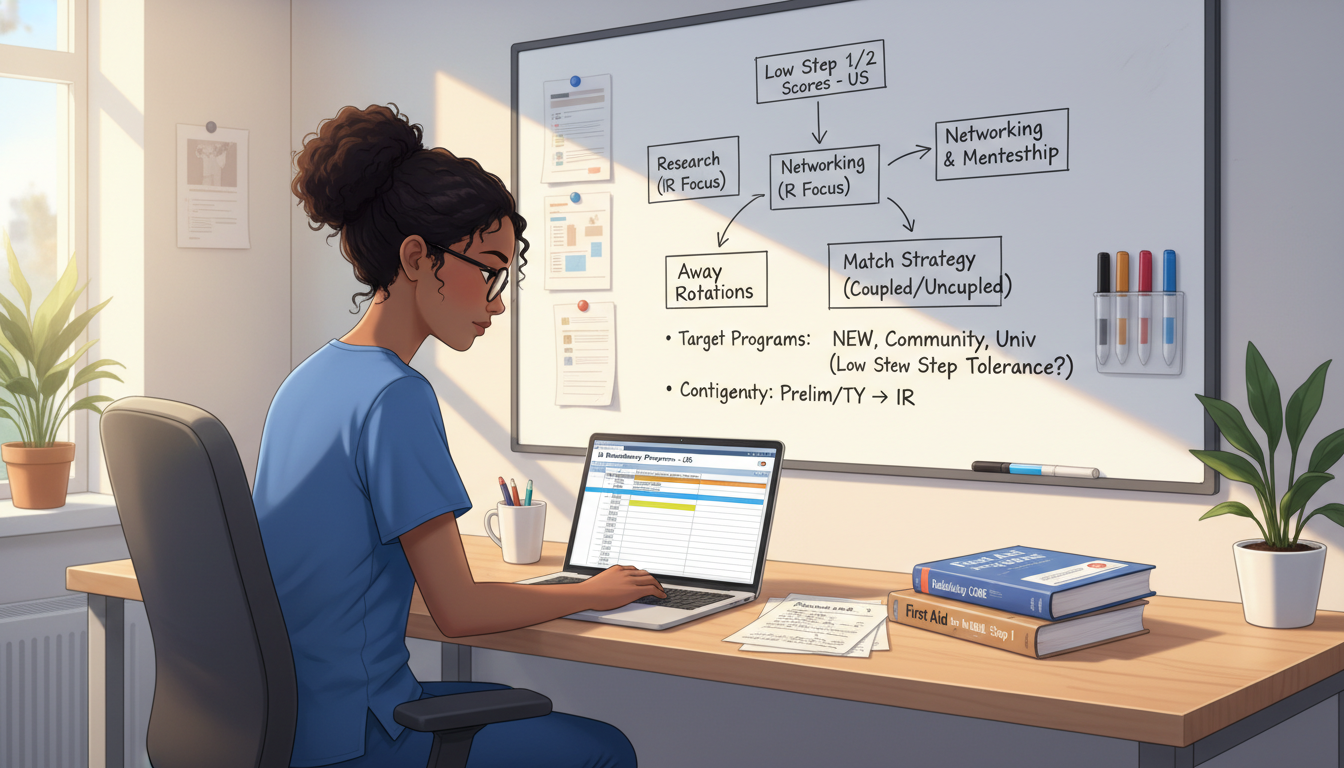
Understanding Step Scores in PM&R for IMGs
Physical Medicine & Rehabilitation (PM&R) is often perceived as a “less Step-driven” specialty compared with Dermatology or Orthopedics, but for an international medical graduate (IMG), Step scores still heavily influence interview chances, especially at university and ACGME-accredited programs.
In this IMG residency guide, we will focus on how to use your Step 1 and Step 2 CK scores strategically to build a competitive physiatry application—even if you have a low Step score and are worried about the match.
Key realities for PM&R and IMGs:
- PM&R is moderately competitive and becoming more popular.
- U.S. programs vary widely in how much they weigh scores.
- For IMGs, Step scores are often used as an initial filter before anyone reads about your rehab experiences or personal story.
- A smart Step 2 CK strategy can partially offset a weaker Step 1 score, and strong clinical alignment with PM&R can further boost your chances.
This article will walk you through:
- How program directors in PM&R think about Step scores
- Target score ranges for IMGs
- Strategy if you have a low Step score
- How to time your exams and application
- How to integrate your scores with the rest of your application to improve your physiatry match odds
How PM&R Programs View Step Scores for IMGs
Although Step 1 is now pass/fail for current students, many IMGs still apply with numerical Step 1 scores. Whether your Step 1 is numeric or pass/fail, the pattern of performance between Step 1 and Step 2 CK matters.
What PM&R Programs Look For
Evidence you can pass boards
- Program directors want reassurance you will pass the PM&R board exams and USMLE Step 3.
- Consistent or rising performance from Step 1 to Step 2 CK is a positive sign.
Ability to handle inpatient rehab & consult services
- Rehab physicians frequently manage medically complex patients (SCI, TBI, stroke, polytrauma).
- Programs look for enough test performance to suggest you can interpret labs, imaging, and manage acute issues.
Residency workload tolerance
- Scores are sometimes (imperfectly) used as a proxy for study habits and ability to handle a steep learning curve.
Approximate Score Tiers for IMGs in PM&R
These ranges are not official cutoffs, but they reflect a realistic landscape for many programs. Assume Step 1 is numeric if applicable; if not, focus on Step 2 CK.
Highly competitive for many PM&R programs (especially university-based):
- Step 2 CK: ≥ 250
- Suggests strong medical knowledge and can open doors even at historically IMG-limited programs.
Competitive for a broad mix of programs:
- Step 2 CK: 240–249
- Solid range; many academic and community-based programs will seriously consider you if the rest of your application aligns with PM&R.
Potentially competitive with targeted strategy:
- Step 2 CK: 230–239
- You may face filters at some academic programs, but can get interviews with strong PM&R fit, U.S. clinical experience, and good letters.
Challenging but possible (low Step score match zone):
- Step 2 CK: 220–229
- You must be highly strategic: broad applications, strong PM&R exposure, excellent personal statement, and often additional “proof” of competence (Step 3, research, or a second attempt with improvement if applicable).
Below 220:
- Realistically, chances fall significantly, especially if combined with other red flags (gaps, multiple attempts, no U.S. experience).
- Some community programs may still consider you if you have outstanding PM&R experience, U.S. LORs, and perhaps a strong Step 3.
Remember: Step scores are one piece. For IMGs, they are a gateway—but once you clear basic thresholds, your PM&R story and clinical fit become increasingly important.
Designing a Step 2 CK Strategy as an IMG Targeting PM&R
Your Step 2 CK strategy should balance score optimization with application timing. As an IMG, a strong Step 2 CK can be your single most powerful numerical signal.
When to Take Step 2 CK for PM&R
Consider these factors:
You have a weaker Step 1 score (or just passed):
- Aim to take Step 2 CK early enough so your score is available by ERAS opening (usually September).
- A significant improvement on Step 2 CK (e.g., from 215 Step 1 to 240+ Step 2 CK) can reframe your application and help you cross many program filters.
You already have a strong Step 1 score:
- Do not rush and risk a much lower Step 2 CK.
- Maintain at least the same performance tier (e.g., if Step 1 equivalent was high, keep Step 2 CK in the same or slightly higher range).
You are on a non-traditional timeline (e.g., multiple years after graduation):
- A recent, strong Step 2 CK shows you remain clinically and academically active.
- For older graduates, a fresh high Step 2 CK can counter concerns about being out of medical school for several years.
How Much Does Step 2 CK Matter in PM&R?
For IMGs, Step 2 CK often matters more than Step 1:
- It is more recent.
- It focuses on clinical decision-making—highly relevant to rehab.
- Program directors often use Step 2 CK for interview screening, especially as Step 1 transitions to pass/fail.
You should treat Step 2 CK as your main exam to define your academic profile.
Building a Study Plan Focused on PM&R-Relevant Skills
Even though there is no “PM&R section” on Step 2 CK, many domains overlap with rehab medicine:
- Neurology (stroke, TBI, neuropathies, myopathies)
- Musculoskeletal and orthopedics (fractures, joint disease, back pain)
- Rheumatology and pain management
- Cardiology and pulmonary (for medically complex rehab inpatients)
- Geriatrics and functional status assessment
Focus your prep on:
High-yield Qbanks
- UWorld as primary.
- Supplements (AMBOSS or similar) if you have time.
- Aim for 2 full passes if you’re improving from a low Step 1 score; 1 focused, high-quality pass if you already have a strong baseline.
NBME and practice exams
- Use NBME exams and UWSA tests to track readiness and predict your final score.
- For PM&R, a predictive score in the 230+ range is generally worth sitting for the exam; if your practice tests are low 220s, consider delaying if your timeline allows.
Targeted remediation
- If you struggled in Step 1 and have specific weak areas (e.g., neurology, MSK), spend extra time there.
- These are directly relevant to PM&R and will also impress interviewers if you can discuss cases confidently.

Strategies for IMGs with Low Step Scores Targeting PM&R
Many international medical graduates worry: “Is a low Step score the end of my PM&R dream?” Not necessarily. However, you need a deliberate, realistic strategy.
1. Understand What “Low” Means in Context
For an IMG, “low Step score match” scenarios usually mean:
- Step 2 CK < 230, or
- A large gap between Step 1 and Step 2 CK, especially if trending downward, or
- Multiple attempts on Step 1 or Step 2 CK.
Your task is to compensate in other areas and signal improvement where possible.
2. Prioritize a Strong Upward Trend
If Step 1 is weak:
- Aim for a clearly higher Step 2 CK.
- Example: Step 1 = 210, Step 2 CK = 238
- This tells programs you grew, matured, and can pass in-training and board exams.
- Highlight this in your personal statement:
- Briefly acknowledge earlier challenges.
- Emphasize how you changed your study methods, improved clinically, and now perform at a higher level.
If Step 2 CK is also low but passes on first attempt:
- Consider taking Step 3 before applying or early in the season if:
- You can realistically score well.
- You have time to study properly.
- A strong Step 3 (e.g., ≥ 230) can partially counterbalance weaker Step 2 CK, especially for community programs open to IMGs.
3. Optimize Program Selection Aggressively
Program choice is critical in any IMG residency guide, but especially when your test scores are not ideal.
Target:
- Community PM&R programs and university-affiliated community programs.
- Programs with a history of interviewing and matching IMGs.
- Programs that publicly share that they review applications holistically or do not have strict score cutoffs.
You can:
- Review program websites for:
- Current residents’ medical schools (look for IMGs).
- Statements about minimum Step scores or attempts.
- Use forums, NRMP data, and word-of-mouth from recent matched IMGs.
With low Step scores:
- Apply broadly:
- 60–80+ PM&R programs is not unrealistic for low scores, depending on finances.
- Consider transitional years (TY) or preliminary medicine spots:
- If you cannot match into PM&R directly, a strong U.S. clinical year may boost your future PM&R application.
4. Make PM&R Fit Unmistakable
When your Step 1 score residency profile is not ideal, your application must scream “PM&R”:
- Clinical electives or rotations in:
- Inpatient rehab units
- Brain injury or spinal cord injury rehab
- Outpatient MSK/sports or pain
- U.S. clinical experience in PM&R:
- Observerships, externships, or sub-internships.
- Letters of recommendation:
- At least 2 strong LORs from U.S. physiatrists who can comment on your clinical reasoning, communication, and teamwork.
- Ideal: A letter from a program director or faculty at a PM&R residency you rotated in.
On your CV and ERAS:
- List rehab-related experiences prominently:
- Stroke rehab research
- SCI/TBI volunteer work
- MSK ultrasound workshop participation
- Chronic pain clinic exposure
- Use your personal statement to:
- Connect your background to rehab-relevant themes: disability, function, neuro/MSK pathology, long-term patient relationships.
5. Address Red Flags Directly but Briefly
If you have:
- Multiple attempts
- Large gaps
- Very low Step scores
Use your personal statement or interview to:
- Acknowledge the issue honestly (1–2 sentences).
- Explain contributing factors without making excuses (e.g., illness, personal hardship, learning how to study in a new system).
- Emphasize your growth: improved clinical evaluations, stronger Step 2/Step 3, solid in-training exam performance if you are already in another residency or prelim year.
The goal: Programs should not feel they are guessing whether you can handle residency.
Integrating Step Scores with the Rest of Your PM&R Application
Your scores open the door; everything else convinces the program to let you in.
Step Scores + PM&R Story
To maximize your physiatry match chances:
Align your narrative
- Explain why PM&R specifically (not just “I like neurology and MSK”).
- Link experiences (family member with disability, rehab volunteering, sports injuries, neuro rehab work) to concrete insights about the specialty.
Show clinical maturity despite Step challenges
- Strong clinical evaluations from rotations in internal medicine, neurology, or orthopedics.
- Concrete examples in LORs:
- “She independently followed patients with complex polyneuropathy and presented thorough management plans.”
- “He demonstrated an early rehab mindset by focusing on functional outcomes and safe discharge planning.”
Emphasize teamwork and communication
- PM&R is heavily team-based (PT, OT, SLP, nursing, case management, social work).
- Highlight evidence you collaborate well and communicate clearly—often more important than a few extra Step points.
Step Scores + Research and Scholarly Activity
If your scores are not top tier:
- Leverage PM&R-related research:
- Case reports on stroke rehab, SCI, amputee care, spasticity, prosthetics, MSK ultrasound, etc.
- Posters or presentations at AAPM&R, state PM&R meetings, or other rehab-related conferences.
You do not need a PhD. Even:
- 1–2 case reports
- 1 poster
- A QI project in a rehab or neurology unit
can show intellectual curiosity and commitment to the field.
Step Scores + Timing of Application
Plan:
- Have Step 2 CK done early with a competitive score when possible.
- Submit ERAS on Day 1 with:
- Personal statement finalized and PM&R-focused.
- MSPE, transcripts, and LORs uploaded (or at least requested and in process).
- If you plan to take Step 3:
- Either complete before ERAS or very early in interview season.
- Notify programs of a strong Step 3 score via ERAS update or email (if allowed/recommended).
Late scores, especially for IMGs, can hurt you by:
- Missing auto-screening for interview invitations.
- Giving less time for programs to re-review your file.

Practical Step-by-Step Plan for IMGs Targeting PM&R
Below is a pragmatic roadmap that integrates your Step 1 score residency profile, Step 2 CK strategy, and overall PM&R preparation.
Year Before Application (or 12–18 Months Out)
Clarify your PM&R commitment
- Shadow or rotate with physiatrists if possible.
- Start rehab-related volunteering or research.
Plan your exams
- Map out Step 2 CK date to have the score ready by ERAS.
- If Step 1 is weak, allocate more time for Step 2 CK prep.
Start building PM&R-friendly connections
- Email PM&R departments about observership or elective opportunities.
- Attend local or virtual PM&R conferences or webinars.
6–9 Months Before ERAS Submission
Focus intensely on Step 2 CK
- 2–3 months of disciplined study with daily UWorld blocks, reviewing all explanations.
- Take at least 2–3 practice NBMEs/UWSAs and track progress.
Begin drafting your PM&R-focused personal statement
- Keep a document with key clinical stories and reflections from rehab-related experiences.
Secure rotations and LORs
- Schedule U.S. PM&R rotations if possible.
- Identify faculty who can write strong, specific letters.
3–6 Months Before ERAS
Take Step 2 CK when practice scores align with your target
- If your practice exams are persistently low, consider:
- Delaying the exam if feasible.
- Adjusting study methods (tutor, study group, more targeted review).
- If your practice exams are persistently low, consider:
Finish elective or observerships
- Ask for feedback.
- Confirm letter writers and give them enough time.
Update your CV with all PM&R-related activities
- Research, volunteering, teaching, leadership.
ERAS Season (September–March)
Apply broadly and strategically
- Emphasize programs with IMGs and community-based settings.
- Consider programs beyond large coastal academic centers.
Prepare for interviews
- Anticipate questions about your Step scores:
- Be honest, concise, and emphasize growth.
- Practice explaining why PM&R fits you and how your experiences prepared you.
- Anticipate questions about your Step scores:
Follow up professionally
- Thank-you emails where appropriate.
- Communication about new achievements (e.g., Step 3 score, new research poster) if programs accept updates.
Frequently Asked Questions (FAQ)
1. What Step 2 CK score should an IMG aim for to be competitive in PM&R?
A realistic target for international medical graduates is:
- Aim for at least 230+, which keeps many community and some academic PM&R programs open to you.
- 240–250+ makes you more competitive broadly, including some university programs that typically interview fewer IMGs.
- If your Step 1 score is low, prioritize showing a clear upward trend with Step 2 CK, even if you cannot reach 240+.
2. Can I match into PM&R with a low Step score?
Yes, but it is harder and requires a very strategic approach. With Step 2 CK in the 220–229 range, your chances are reduced but not zero. You will need:
- Strong PM&R exposure (U.S. rotations, observerships).
- Excellent letters from physiatrists.
- A compelling, well-aligned PM&R narrative.
- Broad application to programs with a track record of taking IMGs.
- Possibly a strong Step 3 score or additional clinical/research work to reassure programs.
3. Should I delay Step 2 CK to get a higher score even if it means applying late?
Usually, no. For IMGs, a late Step 2 CK score can severely limit interview invitations. However:
- If your current practice scores are far below your realistic target (e.g., 210s and you aim for ≥ 230), a short delay (weeks, not many months) to improve may be wise—provided you can still get your score in time for the main part of interview season.
- Balance the potential score gain against the risk of missing screening cycles at programs.
4. Is taking Step 3 before applying helpful for PM&R if my Step scores are low?
It can be, especially for IMGs with:
- Marginal but passing Step 2 CK scores or
- A previous low Step exam with improved knowledge now.
A strong Step 3 (e.g., ≥ 230) can:
- Demonstrate improved performance and readiness for board-style exams.
- Reassure community program directors that you are less risky academically.
However, do not rush Step 3. A poor Step 3 result can reinforce concerns. Only take it when you are well prepared.
By understanding how programs interpret Step 1 and Step 2 CK, and by building a targeted Step 2 CK strategy integrated with strong PM&R fit, you can significantly improve your odds of a successful physiatry match—even as an international medical graduate with imperfect scores.