
Understanding Step Scores in the EM‑IM Match as an IMG
Emergency Medicine–Internal Medicine (EM IM combined) is a small, competitive niche. As an international medical graduate, you face two challenges at once:
- Fewer total spots (only a handful of EM‑IM combined programs in the US)
- High emphasis on board readiness because EM and IM both rely heavily on standardized exams
Your Step 1 score and Step 2 CK score are not the only things that matter, but they are powerful filters. For many EM‑IM programs, your scores determine whether a human ever reads your application.
Because you are an IMG, program leadership is often asking:
- Can this applicant handle a fast-paced, high-acuity EM‑IM curriculum?
- Will this applicant pass the ABIM and ABEM boards on the first attempt?
- Is this applicant ready to navigate a US-style clinical environment?
Your Step exam performance is one of the clearest signals they have.
How EM‑IM Programs Think About Step Scores
While every program is different, several patterns are common:
Step 1: Now pass/fail, but many programs still see the numeric score from prior years, and some unofficially track whether applicants passed on the first attempt and whether the school’s curriculum is US‑like.
Step 2 CK: This is now the major objective academic metric. EM and IM both place substantial weight on Step 2 CK for:
- Predicting in‑training exam performance
- Predicting ABIM and ABEM board pass rates
- Managing risk when ranking IMGs
Multiple attempts: Multiple Step attempts (especially failures) raise concern in EM‑IM more than in some other specialties because dual-board training is demanding. They don’t want anyone struggling to pass exams.
At the same time, EM‑IM program directors know that standardized tests are only one part of the story. They also care deeply about:
- US clinical experience and strong letters
- Performance in acute care settings
- Evidence of resilience, work ethic, and teamwork
- Fit for a dual-residency lifestyle (longer training, high intensity)
Your goal is two-fold:
- Maximize your Step 2 CK strategy going forward
- Present any existing Step 1 or Step 2 weaknesses in a way that reduces concern and highlights growth
Mapping Your Current Step Profile: Honest Assessment First
Before building a Step score strategy, you need a precise understanding of where you stand. For an IMG residency guide specifically focused on EM‑IM, use this framework.
Step 1 Scenarios for IMGs
Because Step 1 is now pass/fail, IMGs fall into several categories:
Old numeric Step 1 score (pre–pass/fail):
- High (historically ≥240–245+): Helps you, especially as an IMG. Confirms strong basic science foundation. It somewhat offsets a modest Step 2 CK.
- Middle (220–240): Acceptable, but Step 2 CK needs to be strong to stand out in EM‑IM.
- Low (<220) or failed attempt: You are in a “low Step score match” risk category. You must:
- Show clear upward trajectory with Step 2 CK
- Build a compelling narrative and strong clinical portfolio
Pass/fail era Step 1 with a “Pass” only:
- Programs will focus heavily on:
- Step 2 CK score
- Quality of medical school and transcript
- Clinical performance and letters
- Programs will focus heavily on:
Failed Step 1 with later Pass:
- This is a serious red flag, but not automatically fatal.
- EM‑IM is competitive; some programs may filter you out.
- You will need:
- A notably strong Step 2 CK strategy
- US clinical excellence and strong advocacy from letter writers
- A carefully crafted explanation in your personal statement or MSPE/Dean’s letter (if possible)
Step 2 CK Scenarios
For EM‑IM, think about Step 2 CK ranges in practical tiers (numbers approximate, not guarantees):
- 260+: Outstanding, even as an IMG. You will clear many score filters.
- 250–259: Very strong; competitive for EM‑IM academically.
- 240–249: Solid; you are competitive with appropriate overall portfolio.
- 230–239: Borderline for EM‑IM at some programs, but still viable with strong clinical performance and EM‑specific strengths.
- 220–229: Low for EM‑IM combined; high-risk “low Step score match” territory; you must counterbalance with:
- EM Sub‑I honors, strong SLOEs/letters, and EM‑relevant research or experience.
- <220 or failed attempt: Very challenging for EM‑IM; you may still target:
- A carefully selected subset of EM‑IM programs (if they explicitly consider applicants with multiple attempts)
- Pure IM programs with EM‑heavy training tracks
- Reframing your specialty strategy if EM‑IM proves unrealistic
Quick Self‑Audit Checklist
Write down:
- Step 1: Pass/fail, numeric, failed attempt(s), date taken
- Step 2 CK: Score (or practice NBME/UWSA if not yet taken), target date
- Number of attempts on any Step
- Time gap between graduation and current date (IMG “YOG”—year of graduation—matters)
- US clinical experience completed or planned (especially EM, ICU, hospitalist‑type IM)
This becomes your baseline. Your Step score strategy is built on these realities—not wishful thinking.
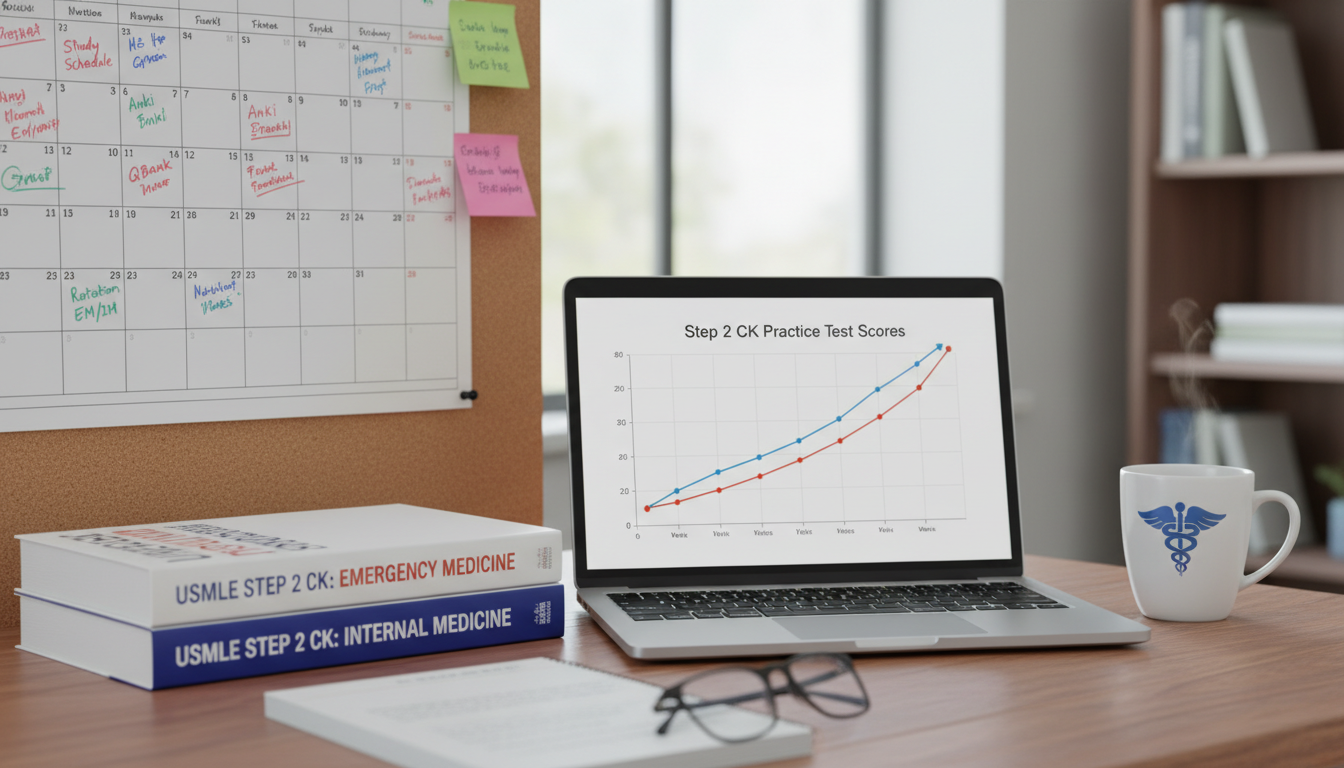
Designing a Targeted Step 2 CK Strategy for EM‑IM as an IMG
Because Step 2 CK is now the core metric, your strategy must be deliberate. This section covers how to plan and execute a Step 2 CK strategy designed for EM‑IM and tailored to IMGs.
1. Define a Realistic but Ambitious Target
Link your target to your current profile:
- If you have a low Step 1 score or a prior failure, aim for:
- At least 15–25 points above your Step 1 (if numeric)
- Or a Step 2 CK in the 240+ range to clearly demonstrate growth
- If your Step 1 was strong (old exam) but you’re an IMG, aim for:
- ≥245–250+ to be clearly competitive in EM‑IM
- If you’re unsure whether EM‑IM vs IM vs EM alone is realistic:
- Use Step 2 CK prep as your “pivot point.” A very strong score keeps options open.
- A modest score may push you to favor IM with heavy EM exposure or critical care.
2. Build a Study Plan That Reflects EM‑IM Demands
EM‑IM residents deal with:
- Undifferentiated acute complaints (classic EM)
- Chronic disease management and complexity (classic IM)
- High cognitive load and multitasking
Your Step 2 CK preparation should mirror that dual mindset.
Core resources:
- Question banks (UWorld is essential; Amboss or another bank as a second resource if time allows)
- NBME practice exams + UWSA for score prediction
- High‑yield review sources (e.g., OnlineMedEd, Boards & Beyond, or similarly reputable content)
Subject‑matter emphasis aligned with EM‑IM:
- Cardiology, pulmonology, and critical care topics
- Toxicology, trauma, and emergency presentations
- Infectious diseases and sepsis
- Endocrine emergencies (DKA, thyroid storm, adrenal crisis)
- Neurology emergencies (stroke, status epilepticus, meningitis)
- Procedures and acute management algorithms (ACLS/ATLS concepts at the cognitive level)
3. Structuring Your Daily and Weekly Study
A practical outline for an IMG preparing full-time (adjust if working or in clinicals):
Daily (6–8 hours effective study):
- 40–80 high‑quality questions/day (timed, random, mixed)
- Immediate review of all questions, with emphasis on:
- Why the correct answer is correct
- Why each wrong option is wrong
- How you could have recognized the pattern faster (EM skill)
- 1–2 hours of targeted content review (weak systems, missed questions)
Weekly:
- One self‑assessment or “mini‑NBME” style test every 2–3 weeks
- A “weakness review” session:
- Log your lowest‑performing systems/subjects
- Schedule extra questions on those topics for the coming week
- One EM‑focused and one IM‑focused “deep dive” session
- EM example: chest pain differentials, approach to GI bleed, trauma resuscitation
- IM example: diabetes management algorithms, chronic kidney disease, heart failure optimization
4. IMG‑Specific Challenges and Solutions
As an international medical graduate, you may face:
- Different exam style in your home country
- Less familiarity with US guideline‑based care
- Language and timing challenges on long exams
Strategies:
Train in English guidelines:
- Use US‑based materials (UWorld explanations, UpToDate/Guidelines when needed)
- Practice using US drug names and units
Improve reading speed and test stamina:
- Regularly do 40‑question timed blocks
- Once a week, simulate exam conditions (no phone, timed breaks, long session)
Close content gaps from non‑US curricula:
- Use system‑based review videos or texts to rapidly fill in weaker US‑specific topics (preventive care guidelines, screening, outpatient management, etc.)
5. Deciding When to Postpone vs When to Take the Exam
Your Step 2 CK strategy is not only “how to study” but also “when to sit.”
Use practice tests as your guide:
- If NBME/UWSA scores are consistently 5–10+ points below your target:
- Delay if possible, especially if your Step 1 is weak or you have a prior failure.
- If you’re close to your target and trending upward:
- Choose a date 2–4 weeks ahead and do focused consolidation.
- If your scores plateau well below a competitive EM‑IM level (e.g., low 220s):
- Have a parallel plan: this Step 2 CK will likely limit EM‑IM options; start exploring backup IM or other specialty strategies early.
Being strategic with timing is one of the few levers you fully control. For a “low Step score match” situation, avoiding an additional low score or failure is more important than rushing to meet a self‑imposed date.
Overcoming Low or Borderline Step Scores: Salvage and Positioning Strategy
If your Step 1 score residency profile is already weak—or your Step 2 CK ended up lower than you’d hoped—you’re in damage‑control mode. EM‑IM is not necessarily off the table, but you must pivot smartly.
1. Emphasize Upward Trajectory
Program directors are more comfortable with:
Step 1: 215 → Step 2 CK: 240
thanStep 1: 240 → Step 2 CK: 230
Even if your absolute Step 2 CK number isn’t ideal, demonstrable improvement mitigates concern.
In your application:
- Mention (briefly and factually) early struggles and what you changed:
- New study methods
- Improved time management
- Use of formative feedback
- Highlight any evidence of exam resilience:
- Better performance on in‑training exams (if you are already in another training program)
- Honors in high‑stakes clinical rotations
2. Use EM‑Relevant Clinical Excellence to Offset Test Concerns
For EM‑IM combined, nothing reassures a program more than outstanding performance in high‑acuity clinical settings.
Focus on:
- US emergency medicine rotations with strong, detailed letters
- EM Sub‑Internships (Sub‑I) or EM clerkships where attendings can comment on:
- Your ability to manage multiple patients
- Clinical reasoning under pressure
- Communication and teamwork skills
- Internal medicine rotations where you show depth and thorough follow‑up on complex patients
If you can’t obtain a formal SLOE (Standardized Letter of Evaluation) used in EM, aim for:
- Detailed narrative letters from EM physicians who:
- Have worked in US academic settings
- Can directly compare you to US graduates
3. Build a Narrative That Makes Sense of Low Scores
Low or failed Step scores without explanation can look like:
- Poor work ethic
- Chronic under‑preparation
- Inability to adapt
With a thoughtful narrative, they can instead reflect:
- Initial underestimation of USMLE format and content
- Cultural or educational transition challenges
- Event‑specific issues (illness, personal crisis) that are now resolved
In your personal statement (keep it concise):
- Acknowledge the low score or attempt once; don’t dwell on it.
- Emphasize what you learned:
- You adopted question‑based learning
- You sought mentorship
- You changed your time management or study environment
- Link the growth to EM‑IM qualities:
- Resilience
- Commitment to continuous improvement
- Ability to respond constructively to setbacks
4. Expand and Tier Your Program List
A classic IMG residency guide principle: a low Step score means your program list must be broader and better tiered.
For EM‑IM combined:
- Apply to every EM‑IM program you qualify for, recognizing:
- Total numbers are small
- Some may have strict filters (e.g., no failures, score cut‑offs)
Additionally, to increase your chance of matching:
- Include categorical Emergency Medicine programs that:
- Accept IMGs
- Emphasize holistic review
- Include categorical Internal Medicine programs with:
- Strong emergency/critical care exposure
- ED‑based electives and robust ICU experiences
You might conceptualize your target list like this:
- Tier 1: EM‑IM programs where your scores meet or are close to their historic averages
- Tier 2: EM‑IM and EM programs that explicitly mention holistic review and IMG friendliness
- Tier 3: IM programs with EM/critical‑care flavor where you could still live an “acute care” career (e.g., hospitalist with ED time, intensivist, etc.)
5. Consider a Strategic Delay or Bridge
If your exam picture is especially challenging (e.g., multiple attempts, <220 CK):
- Research year in the US (EM or IM focused):
- Gain US letters
- Show academic productivity
- Demonstrate persistence and professionalism
- Non‑categorical transitional/preliminary year in IM:
- Show success in a US residency environment
- Take in‑training exams seriously to prove exam performance
- Reassessment of target specialty:
- Some IMGs with low Step scores match into less competitive IM programs, then craft a career with EM‑adjacent practice (e.g., urgent care, rural ED coverage where allowed, hospital medicine with procedures).

Application Tactics: Presenting Your Step Scores Strategically for EM‑IM
Once your scores are fixed, what matters is how you present them within your overall application.
1. Personal Statement: Addressing Scores Without Over‑Explaining
For an international medical graduate applying to EM IM combined, your personal statement should prioritize:
- Why dual training fits your goals and personality
- Concrete experiences where you thrived in both acute and longitudinal care
- Evidence of stamina, flexibility, and curiosity
If you must mention low Step scores:
- One short, factual paragraph is enough:
- “Early in my medical education, I struggled to adapt to the USMLE style of testing, which contributed to a Step 1 performance below my expectations. Recognizing this, I sought mentorship, changed to a question‑driven study method, and improved my time management. These changes are reflected in my Step 2 CK performance and in my clinical evaluations, where I have consistently been recognized for my preparation and reliability.”
- Shift quickly back to your strengths and to EM‑IM fit.
2. ERAS Application: Highlighting Strengths That Matter More Than a Single Score
Because EM‑IM is small, many program directors personally skim applications that pass their basic filters. Make sure these stand out:
US Clinical Experience (USCE):
- Clearly labeled EM and IM rotations, with dates, sites, and responsibilities
- Any exposure to resuscitation, triage, and cross‑cover responsibilities
Awards and Honors:
- Clerkship honors in IM or EM‑adjacent rotations (ICU, CCU, ED, hospitalist)
- Any teaching or leadership positions
Research or Scholarly Activity:
- EM topics: sepsis, trauma, ED workflow, point‑of‑care ultrasound
- IM topics: chronic disease management, hospital medicine, quality improvement
- Even small projects, if explained well, show academic readiness.
3. Letters of Recommendation: Your Best Counterweight to Scores
For a “low Step score match” applicant, letters often decide your fate.
Aim for:
- At least one EM letter (preferably from a US academic ED)
- At least one strong IM letter
- If possible, a third letter from:
- EM‑IM faculty (rare but ideal)
- Someone who can speak to your resilience, work ethic, and teaching or teamwork skills
Ask your letter writers to comment (if they can truthfully do so) on:
- Your reliability and clinical judgment despite any test issues
- Your pace and ability to integrate feedback quickly
- Your potential to succeed in a rigorous dual‑training program
4. Interview Strategy: Owning Your Step Story
If asked about your Step scores:
- Be transparent but brief:
- Explain context without making excuses.
- Emphasize what you changed and how you’ve since performed.
- Pivot to strengths:
- Talk about specific challenging cases you managed.
- Highlight your adaptability to a new healthcare system as an IMG.
- Connect your growth mindset to the EM‑IM training environment.
Example response framework:
“My Step 1 performance was below what I hoped for. At that time, I underestimated how different USMLE testing is from my home-country exams and didn’t use enough question-based practice. I reflected on this, sought guidance from mentors, and changed my approach. For Step 2 CK, I adopted a more rigorous schedule and focused on active learning, which helped me improve. More importantly, these habits carried into my clinical work—my attendings in both the ED and on the wards have commented on my preparation and ability to handle complex patients. I’m confident in my ability to manage the academic demands of an EM-IM program.”
Putting It All Together: Action Plan for IMGs Targeting EM‑IM with Step Score Concerns
To translate this IMG residency guide into clear next steps, here’s a concise action plan.
If You Have Not Taken Step 2 CK Yet
- Baseline Assessment:
- Take a practice NBME/UWSA to understand your starting point.
- Set a Target:
- Aim for ≥240+, ideally ≥245–250 if feasible, particularly with any Step 1 concerns.
- Design a Focused Study Plan:
- Daily questions; weekly self‑assessments; EM/IM‑focused deep dives.
- Monitor Progress:
- If practice scores plateau far below your EM‑IM goals, consider:
- Extending prep
- Re‑evaluating whether EM‑IM vs IM alone is your best path
- If practice scores plateau far below your EM‑IM goals, consider:
- Schedule Strategically:
- Take Step 2 CK when:
- Your practice scores are near target
- You can realistically perform at that level on exam day.
- Take Step 2 CK when:
If You Already Have Low or Borderline Step Scores
- Accept and Reframe:
- You cannot change the number; you can change the context.
- Maximize Clinical Strength:
- Get high‑quality EM and IM USCE.
- Secure strong, specific letters.
- Craft Your Narrative:
- Acknowledge; show growth; focus on resilience and current competence.
- Broaden Your Application Strategy:
- Apply to all suitable EM‑IM programs.
- Add EM and IM programs that fit your updated competitiveness.
- Stay Flexible:
- If EM‑IM doesn’t work this cycle, consider:
- IM with EM/CC focus
- Research year
- Other acute‑care‑oriented paths
- If EM‑IM doesn’t work this cycle, consider:
FAQ: Step Score Strategy for IMGs in EM‑IM
1. What Step 2 CK score do I realistically need as an IMG for EM‑IM combined programs?
There is no universal cutoff, but as an international medical graduate aiming for a competitive field like EM‑IM combined, you should target at least the mid‑240s, with 250+ offering a clearer buffer. If your Step 1 is weak or you have a prior failure, a strong Step 2 CK (240+ with clear upward trajectory) becomes especially important to offset concerns.
2. Can I still match EM‑IM with a low Step score or a failed attempt?
It’s challenging, but not impossible. A “low Step score match” in EM‑IM is rare and requires:
- Significant improvement on later exams (especially Step 2 CK)
- Strong US EM and IM clinical performance
- Excellent letters that explicitly endorse you for rigorous training
- A compelling, honest narrative that explains the early struggles and shows that the issues are resolved
You will also need a broad, well‑tiered program list and a realistic openness to EM or IM alone as alternatives.
3. How important is Step 1 now that it’s pass/fail for EM‑IM programs?
Step 1 still matters in two ways:
- Pass vs fail on the first attempt: Programs are wary of exam failures, especially in dual‑residency tracks like EM‑IM.
- Overall pattern: Even without a numeric score, they look at:
- Speed of progression through medical school
- School rigor and transcript
- Consistency between Step 1 (pass/fail) and Step 2 CK
For EM‑IM, Step 2 CK carries more weight, but Step 1 serves as an initial screen for basic exam competence.
4. If I suspect EM‑IM is too competitive for my scores, should I still apply?
If EM‑IM is your genuine passion, it can be reasonable to apply strategically while also pursuing strong backup plans:
- Apply to all EM‑IM programs you reasonably qualify for.
- Simultaneously apply to a mix of EM and IM programs appropriate for your score range.
- Be prepared—emotionally and practically—for the possibility that your path might involve categorical IM with a strong acute care/critical care focus rather than EM‑IM combined. Many physicians still build highly satisfying, EM‑adjacent careers through IM routes (hospital medicine, critical care, ED coverage where allowed).
The key is to be honest with yourself about risk, maximize your Step 2 CK strategy, and build the strongest overall application possible, not just chase a number.