
Why Step Scores Matter So Much for IMGs Targeting a Transitional Year
For an international medical graduate, a Transitional Year (TY) residency can be a highly strategic entry point into the U.S. system. TY programs offer a strong clinical foundation, flexibility, and a bridge to advanced specialties like radiology, anesthesiology, dermatology, PM&R, and radiation oncology.
Yet even for a one-year preliminary-style program, USMLE performance is often a dominant filter—especially for IMGs. Understanding how your Step scores are interpreted and how to build a Step score strategy is critical if you’re aiming for a TY program and possibly dealing with a low Step score match risk.
Key realities:
- Step 1 is now pass/fail, but a failed attempt can still hurt, particularly for IMGs.
- Step 2 CK is king for clinical readiness—and carries more weight than ever.
- Many TY programs are linked to competitive advanced specialties whose departments may push for stronger metrics.
- IMGs often face higher thresholds: the same Step 2 CK score may be “average” for a U.S. grad but insufficient for some IMG-heavy programs.
This IMG residency guide will walk you through:
- How programs view Step 1 and Step 2 CK for Transitional Year
- What’s considered competitive vs. risky for an IMG
- Step 2 CK strategy if you have a low Step 1 or an attempt
- Damage control for low Step score match risk
- How to balance exams, applications, and backup plans
How Transitional Year Programs Evaluate Step Scores for IMGs
Transitional Year residencies vary enormously in competitiveness. Some are affiliated with top academic centers and advanced specialties; others are community-based with more flexible metrics. Your Step score strategy must adjust to where your profile realistically fits.
Step 1 (Pass/Fail) — What It Means Now for IMGs
Even though Step 1 is now pass/fail, for international medical graduates:
- A first-time pass is the baseline expectation.
- Any failed attempt is significant, particularly if:
- You are several years from graduation
- Your school is less known to U.S. programs
- You have other academic concerns (repeats, gaps)
How programs use Step 1 now:
- Screening: Some programs still auto-screen out applicants with Step 1 failures, even with a strong Step 2 CK.
- Risk assessment: PDs ask, “Will this resident pass Step 3 and any future board exams on time?”
- Contextual factor: If your Step 2 CK is excellent, a single failed Step 1 may be viewed as a past issue that you overcame, especially if you can explain it clearly.
For a Transitional Year, the absence of a numeric Step 1 score means greater weight shifts to Step 2 CK and overall trajectory.
Step 2 CK — The Central Metric for TY Programs
Step 2 CK now functions as the primary numeric academic indicator. For an IMG, it’s not just “important”; it can determine whether your application is even reviewed.
Broad ranges for IMGs aiming at Transitional Year (very approximate and variable by year/program):
- 250+: Highly competitive for most TYs; opens doors to more academic and advanced-specialty linked programs.
- 240–249: Strong for many TYs; potentially competitive even at some academic centers, depending on the rest of your profile.
- 230–239: Solid but not standout; likely competitive for many community-based TYs and some mid-tier university-affiliated programs.
- 220–229: Borderline for some TYs; still viable for a low Step score match strategy if you apply widely and have strong non-score assets.
- Below 220: Higher risk zone; you’ll need a very broad application strategy, strong clinical performance, and robust letters to remain in the running.
For low Step score match situations, your Step 2 CK strategy must be deliberate. You rarely get a second chance to change this impression.
How TY Programs Interpret Scores in Context
Program directors often discuss candidates in terms of patterns rather than isolated scores:
- Upward trajectory: Marginal Step 1 pass but 240+ Step 2 CK is viewed positively: “This candidate matured academically.”
- Stable excellence: Strong med school performance plus high Step 2 CK indicates reliability.
- Inconsistency: Poor clinical grades but high Step 2 CK, or vice versa, might trigger more scrutiny.
For IMGs, many programs are trying to predict:
“Will this candidate handle U.S. clinical workload, pass Step 3, and be safe and reliable from day one?”
Your job is to ensure your Step profile answers “yes” as clearly as possible.
Building a Step Score Strategy as an IMG Targeting a Transitional Year
A strong Step score strategy is not only about the exam itself; it’s about timing, storytelling, and alignment with your residency goals.
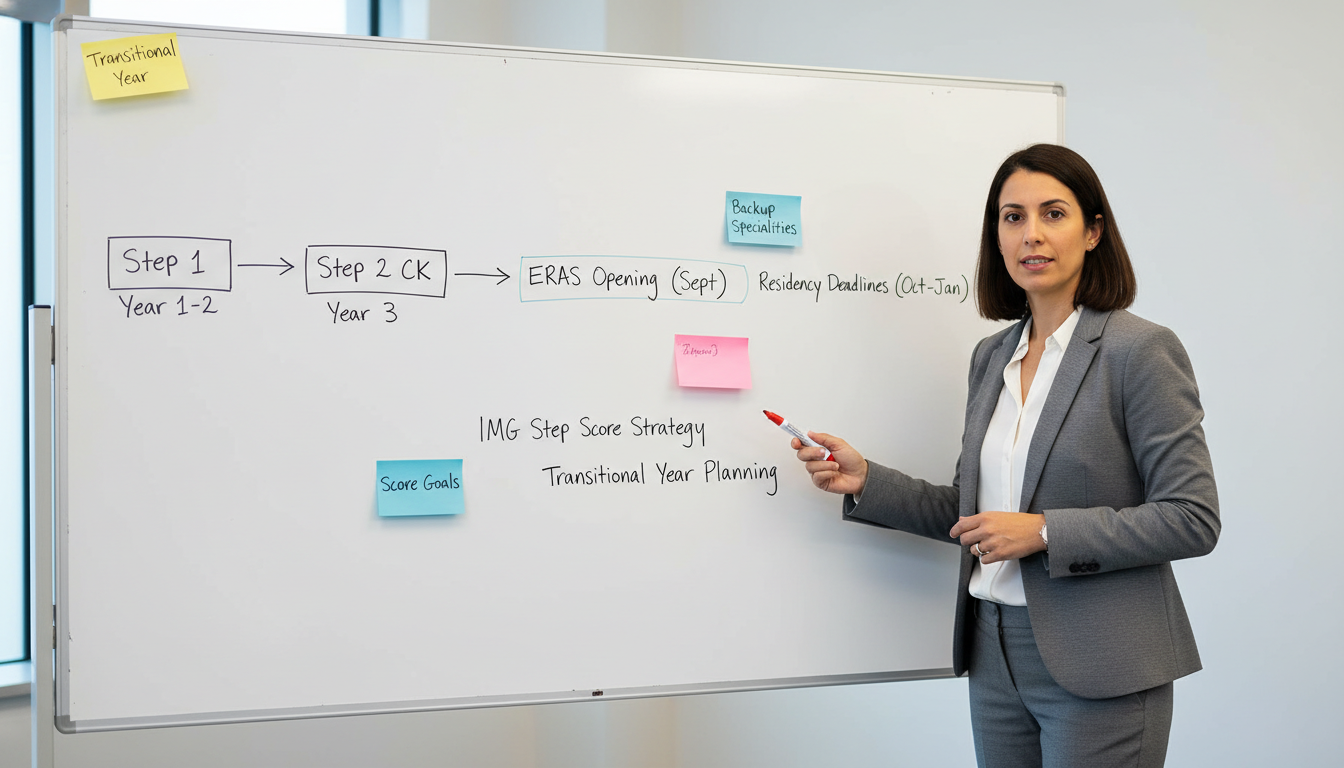
1. Clarify Your End Goal: Is TY Your Destination or a Bridge?
Transitional Year can serve two main purposes:
- Bridge to an advanced specialty (e.g., radiology, anesthesiology, derm, rad onc, PM&R)
- Clinical foothold in the U.S. system while you prepare for:
- Switching into another residency
- Reapplying to a categorical specialty
- Strengthening your CV for a future match
Your Step strategy depends heavily on which scenario fits you.
- If TY is linked to a highly competitive advanced specialty:
- You’ll likely need higher Step 2 CK scores (often 240+ as an IMG, sometimes higher).
- The affiliated advanced department may heavily influence interview and ranking decisions.
- If TY is your foothold or backup:
- You still need a solid Step 2 CK, but you may prioritize breadth of applications and geographic flexibility over chasing prestige.
2. Timing Step 2 CK: When Should You Take It?
For IMGs, late or weak Step scores are a common reason for non-matches. Think strategically about timing:
Ideal timing for most IMGs:
- Take Step 2 CK well before ERAS submission—ideally 3–5 months before applications open.
- This allows:
- Time to retake if the score is unexpectedly low (depending on local regulations and your comfort)
- Time to build the rest of your portfolio (USCE, research, LORs)
If you are at risk of a low score:
- Do not rush Step 2 CK just to “have it done” before ERAS.
- If your NBMEs or UWSAs are consistently below ~220, consider:
- Delaying the test and possibly delaying application cycle by one year.
- Intensively addressing weak areas with targeted prep.
A delayed but strong Step 2 CK is usually more beneficial in the long run than an early but weak score that follows you for years.
3. Setting a Realistic Step 2 CK Target Score
Your target should consider:
- Your academic history
- Your specialty aspiration (e.g., advanced specialties after TY may require higher scores)
- The competitiveness of the TY programs you’re eyeing
Examples:
- IMG with no failures, decent med school record, aiming for TY + radiology
- Target: 245+ Step 2 CK to be in a safer range.
- IMG with a Step 1 attempt but strong clinical evaluations
- Aim for 235–245+ to clearly show improvement and academic recovery.
- IMG a few years from graduation (YOG > 5 years), aiming for any TY foothold
- Try for 230+ minimum; below that, the late YOG + low score combination becomes challenging.
The more risk factors you have (failed attempts, older YOG, minimal U.S. experience), the more you should try to “compensate” with a higher Step 2 CK.
4. Practice Exams and Data-Driven Decisions
Rely on objective metrics before scheduling your exam:
- Use NBME forms and UWSA exams as your main predictors.
- Track a trend over time, not just one score.
Example interpretation for an IMG:
- NBME 1: 213 → NBME 2: 221 → UWSA1: 228 → UWSA2: 234
- Trend is upward; scheduling in 2–3 weeks with intensive review may be appropriate if your goal is around 230–240.
- NBME scores flat at 205–210 despite months of study
- Postpone the exam and revise your approach; consider formal courses, tutoring, or extending your timeline.
Step 2 CK Strategy If You Have a Low Step 1 or Failed Attempt
This is where a detailed IMG residency guide is most critical. Many international medical graduates are dealing with a low Step score match history or a Step 1 attempt and wonder if applying to a Transitional Year is realistic.

1. Accept the Reality but Control the Narrative
A Step 1 failure or very low score cannot be erased, but it can be:
- Contextualized: Briefly explain any legitimate issues (illness, family crisis, misunderstanding of exam style).
- Counterbalanced: With a strong Step 2 CK, robust clinical performance, and solid letters.
- Reframed: As evidence of growth, reflection, and resilience.
In your application and interviews, focus on:
- What you learned from that setback.
- Concrete changes you made in your study methods, time management, or wellness.
- The fact that you improved significantly on Step 2 CK.
2. Overcompensate with Step 2 CK Preparation
To rehabilitate a damaged Step 1 record:
Study strategy adjustments:
- Longer dedicated time (often 10–16 weeks) depending on baseline:
- First 2–4 weeks: Repair foundation (UWorld + videos/texts, targeted by system).
- Middle 4–8 weeks: Full-time Qbank + NBMEs.
- Final 2–4 weeks: Focused weak areas, high-yield memorization, stamina building.
- Use fewer resources deeply, rather than many resources superficially:
- UWorld (primary Qbank, ideally 1.5–2 passes).
- A structured text/video resource if foundational gaps are large.
- Simulate exam conditions often:
- Full-length, 7-block days at least twice before real exam.
Test-day quality matters:
Given your history, you cannot afford to underperform on test day due to logistics:
- Arrive early, know the route, test center, and check-in process.
- Sleep hygiene and caffeine strategy planned in advance.
- Nutrition and break schedule pre-planned (e.g., after blocks 2, 4, 5, 6).
3. Use Step 2 CK to Signal Specialty Alignment
For a Transitional Year applicant, your Step 2 CK can be used to:
- Show that you’re ready for intense clinical rotations.
- Support a specific advanced specialty interest:
- Strong medicine/pediatrics content → good for IM, peds, neurology.
- Strong surgery/OB-gyn content → aligns with surgical or procedure-heavy fields.
Mention in your personal statement how your improved performance on Step 2 CK reflects:
- Clinical reasoning growth
- Adaptation to U.S.-style multiple choice testing
- Readiness for U.S. residency rigor
How to Mitigate Low Step Score Match Risk as an IMG Applying to TY
Even with a smart Step 2 CK strategy, you may be in a low Step score match category: moderate Step 2 CK, a failure, older YOG, or limited U.S. experience. You can’t change past scores, but you can modify everything else.
1. Choose Programs Strategically
Not all Transitional Year programs weigh scores equally.
Generally more competitive TY programs:
- University-based programs with strong reputations
- TYs tied to advanced specialties like dermatology, radiology, radiation oncology, anesthesiology at major academic centers
- Programs in popular urban locations or “lifestyle” cities
Relatively more attainable for lower scores (but still variable):
- Community hospital TY programs
- Programs in less well-known or geographically less popular areas
- Newly accredited or recently expanded TY programs
Action steps:
- Use FREIDA, program websites, and past match analysis (Reddit, forums, alumni) to:
- Identify IMG-friendly TY programs.
- Check whether they explicitly accept IMGs and list minimum scores.
- Build a tiered list:
- Tier 1 (reach): Strong programs where your score is slightly below average.
- Tier 2 (realistic): Programs where IMGs are common, and your score is within or near their usual range.
- Tier 3 (safety): Community / less popular locations; may be more flexible on scores but value reliability and work ethic.
For a low Step score match situation, emphasize breadth: it may be appropriate to apply to 40–80 programs or more, depending on your risk factors and budget.
2. Strengthen the Non-Score Parts of Your Application
Scores open the door; everything else persuades the committee to interview and rank you.
Key areas for IMGs:
- U.S. Clinical Experience (USCE):
- Prioritize hands-on or direct patient care experiences (sub-internships, externships, observerships where possible).
- Ask for letters from U.S. faculty who see you in clinical settings and can comment on your work ethic, reliability, and communication.
- Letters of Recommendation (LORs):
- At least 2–3 from U.S. physicians.
- Ideally including one from internal medicine and one from a specialty aligned with your future goals.
- Letters that mention your improvement after a Step failure or your test-taking resilience can help reframe your story.
- Personal Statement:
- Briefly and honestly address major academic issues if necessary, but don’t dwell.
- Emphasize:
- Adaptability as an international medical graduate.
- Experience working in diverse systems.
- Desire to build a broad clinical foundation via a Transitional Year.
- CV and Activities:
- Highlight teaching, leadership, or quality improvement projects.
- Any U.S.-based research, poster presentations, or volunteer work in clinical settings.
3. Consider Step 3 Strategically
For some IMGs, taking and passing Step 3 before or during application season can:
- Reassure PDs worried about exam performance.
- Demonstrate your readiness to complete licensing exams.
- Make you more attractive to programs that sponsor H-1B visas (many require Step 3).
However, only do this if:
- You can realistically score well enough to pass on the first attempt.
- Preparing for Step 3 will not compromise your Step 2 CK performance (if you have not yet taken it).
Step 3 is a secondary tool—never let it distract you from optimizing Step 2 CK.
4. Build a Thoughtful Backup Plan
Even with a solid strategy, there is always some unpredictability in the Match. As an IMG:
- Consider applying to preliminary internal medicine or preliminary surgery in addition to Transitional Year programs, especially if your Step scores are borderline.
- Reflect on whether you could be happy in:
- A categorical IM or FM program, if offered
- A second-choice specialty
- Prepare mentally and practically for a SOAP or a reapplication year, focusing your “gap” time on:
- Additional USCE
- Research or QI projects
- Teaching or academic roles that keep you clinically active
Integrating Everything into a Coherent Application Plan
Putting your Step score strategy together means coordinating exams, applications, and professional development into one timeline.
Example Scenario 1: IMG with clean record, average scores, aiming for TY + anesthesia
- Step 1: First-time pass, no failures
- Step 2 CK: 236
- YOG: 2 years ago
- USCE: 3 months including one anesthesia observership
Strategy:
- Target a mix of university-affiliated and community-based TY programs, plus a handful of preliminary internal medicine spots.
- Emphasize:
- Clinical performance and interest in perioperative medicine.
- That your Step 2 CK, while not stellar, is solid and consistent with your evaluations.
- Apply broadly geographically, especially to IMG-friendly regions.
Example Scenario 2: IMG with Step 1 failure, strong recovery on Step 2 CK
- Step 1: Failed once, passed on second attempt
- Step 2 CK: 243
- YOG: 4 years ago
- USCE: 2 months inpatient internal medicine
Strategy:
- Use personal statement to briefly acknowledge Step 1 failure and emphasize:
- Shift in study methods
- Strong Step 2 CK as evidence of growth
- Prioritize community and university-affiliated Transitional Year programs known to accept IMGs.
- Consider taking Step 3 (if time and confidence permit) to reassure PDs further.
Example Scenario 3: IMG with low Step 2 CK, but strong CV and USCE
- Step 1: Pass (first attempt)
- Step 2 CK: 219
- YOG: 1 year ago
- USCE: 6 months, with excellent LORs
Strategy:
- Recognize you are in a low Step score match risk group.
- Apply very broadly to TY and preliminary internal medicine programs, favoring:
- Community hospitals
- Less competitive geographic regions
- Lean heavily on:
- Powerful LORs attesting to your clinical performance and reliability.
- A narrative of strong patient care and professionalism, acknowledging that standardized exams don’t fully capture your strengths.
FAQs: Step Score Strategy for IMGs Applying to Transitional Year
1. Is a Transitional Year easier to get than a preliminary internal medicine or surgery spot for IMGs?
Not necessarily. Some Transitional Year programs (especially those linked to radiation oncology, radiology, anesthesiology, or dermatology) can be more competitive than typical prelim positions. For IMGs with modest scores, community-based preliminary IM or surgery spots may sometimes be more attainable than certain TYs. Your score profile and the program’s IMG track record should guide your preference.
2. Can a strong Step 2 CK fully “erase” a Step 1 failure for an IMG?
It cannot erase it, but it can substantially mitigate the concern. A significant jump—e.g., a Step 1 failure followed by a 240+ Step 2 CK—shows growth, maturity, and adaptability. Some programs will still filter based on attempts; others will value the trajectory. Your letters, USCE, and explanation in your application are also crucial.
3. Do I need Step 3 before applying to a Transitional Year as an IMG?
You don’t need Step 3 in most cases, but it can be strategically beneficial if:
- You have previous exam concerns and want to reassure programs.
- You are targeting programs that sponsor H-1B visas (many require Step 3).
- You have enough time and confidence to pass it on the first attempt.
If you haven’t yet taken Step 2 CK or are unprepared for Step 3, prioritize Step 2 CK quality first.
4. How many TY programs should I apply to as an IMG with borderline scores?
There is no single number, but for an international medical graduate with borderline Step 2 CK (e.g., 220–230 range) or a Step 1 attempt, applying to 40–80+ programs (including TY and prelim IM/surgery) is common and often necessary. Your budget and willingness to relocate will shape your final list. Always include a mix of competitive, realistic, and safety programs across diverse geographic regions.
A solid Step score strategy for an IMG targeting a Transitional Year residency combines thoughtful exam timing, targeted Step 2 CK preparation, insight into program expectations, and realistic breadth in applications. You cannot change your past scores, but you can still craft a coherent, upward-moving narrative that shows you’re ready to contribute as a safe, hardworking, and teachable intern in the U.S. system.