
Understanding the Challenge: Low Step Scores as a US Citizen IMG in the Research Triangle
If you are a US citizen IMG or an American studying abroad, applying for residency in the Research Triangle (Raleigh–Durham–Chapel Hill, NC) with a low Step score, you’re navigating several overlapping challenges:
- You’re an IMG competing in highly academic markets (Duke, UNC, WakeMed, community programs closely affiliated with major universities).
- You may have Step 1 Pass/Fail with below-average Step 2, or an older low Step 1 score that still appears on your transcript.
- You’re targeting North Carolina residency programs that attract strong applicants nationally.
Despite this, US citizen IMGs match into Research Triangle programs every year, even with below-average board scores. They do it by:
- Choosing programs and specialties strategically
- Building a convincing “upward trajectory” narrative
- Leveraging geography, networking, and clinical experience in North Carolina
- Applying broadly and managing risk intelligently
This guide focuses on actionable strategies specifically for US citizen IMGs with low Step scores who want to be competitive for Research Triangle residencies, including aspirations like Duke residency or other local programs.
Step Score Reality Check: Where You Actually Stand
Before you design a strategy, you need a clear, unemotional understanding of your situation.
What Counts as a “Low” Step Score?
Terminology varies by specialty and year, but for planning purposes:
Step 1 (for those with a 3-digit score):
- Competitive: ≥230–235 for most core specialties
- Average: ~220–230
- Low / Below average: <220
- High risk for many academic programs: <210
Step 2 CK (still scored numerically):
- Strong: ≥245 for competitive specialties; ≥240 for relatively safer fields
- Average: ~235
- Below average: <230
- Concerning for many programs: <220
If your file includes:
- A low Step 1 score, or
- A low Step 2 score, or
- A combination of misses, multiple attempts, or significant score drops,
then your application falls into a “concern” zone for many Research Triangle programs. But concern ≠ disqualification—especially as a US citizen IMG with a well-built profile.
How Programs in the Research Triangle View Scores
In the Research Triangle, you have a spectrum of program types:
Highly academic university programs
- Example: Duke, UNC
- Tend to prefer solid or strong Step scores, high academic performance, research background.
- More likely to filter based on board scores, especially in competitive specialties.
University-affiliated community programs / regional medical centers
- Examples: WakeMed, UNC affiliates, regional hospitals in the Triangle orbit.
- Often use filters, but may be more flexible for US citizen IMGs with strong other attributes.
Pure community programs further from the academic core
- May have lower score thresholds, especially in less competitive specialties.
- Often receptive to IMGs who show reliability, good clinical performance, and strong communication skills.
Your low board scores will narrow your options, but in the Research Triangle there are still realistic strategies if you:
- Target specialties with lower score pressure
- Combine geographic presence, US clinical experience, and strong letters
- Present an application that screams: “My scores are the weakest part of my file—and they are not who I am as a clinician.”
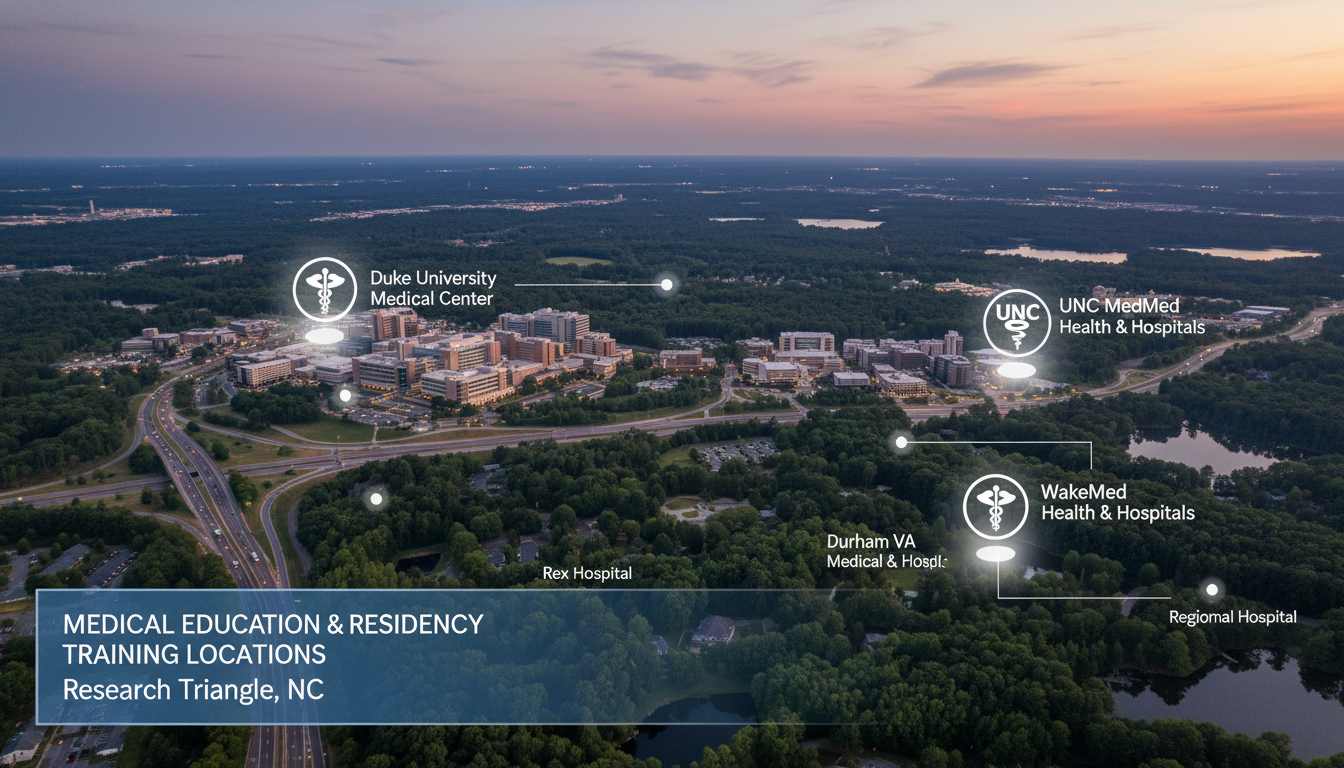
Strategic Targeting: Specialties, Programs, and the Research Triangle Context
Your choice of specialty and program type will have more impact on your chances of matching than almost any other single decision—especially when matching with low scores.
1. Choosing a Realistic Specialty Lane
As a US citizen IMG in the Research Triangle with below average board scores, it is critical to understand relative competitiveness:
Highly competitive (very difficult with low scores, especially in Duke/UNC region):
- Dermatology, Plastic Surgery, Orthopedic Surgery
- Neurosurgery, ENT, Ophthalmology
- Radiation Oncology
- Integrated Vascular / CT Surgery
Competitive but possible with exceptional non-score strengths (and often needing a hybrid strategy):
- Categorical Internal Medicine at top academic centers (e.g., Duke)
- Emergency Medicine
- Anesthesiology at university programs
- Neurology at top-tier centers
- OB/GYN in academic programs
- Pediatrics at highly ranked children’s hospitals
Moderately competitive / more forgiving with strong overall application:
- Family Medicine
- Internal Medicine (especially community-based or university-affiliated community programs)
- Pediatrics in non-elite programs
- Psychiatry
- Pathology (program-dependent)
Strategic takeaway:
If your primary goal is a North Carolina residency in the Research Triangle—with low Step 1 or Step 2 CK scores—you strongly increase your match probability by:
- Focusing on IM, FM, Psych, Peds, Pathology
- Being open to community or hybrid programs, not only Duke/UNC
You can still work with Duke or UNC later (fellowship, moonlighting, academic collaborations) even if your initial residency is elsewhere in the region.
2. Understanding the Duke / UNC Reality
Duke residency (especially in IM, surgery, EM, competitive subspecialties) is nationally competitive. For US citizen IMGs with low scores:
- A direct path into Duke from abroad is rare—but not impossible.
- It usually requires:
- Very strong Step 2 CK (often >240, which may not be your scenario)
- Home or away rotations there (if possible), with outstanding performance
- Significant research or academic distinction
- With clearly below-average board scores, it is more realistic to:
- Aim for nearby community or university-affiliated programs in NC or neighboring states.
- Build a strong clinical and research track record.
- Pursue fellowship or faculty roles at Duke or UNC later.
Your North Carolina goal can still be met by training in the area, even if not directly at Duke or UNC for residency.
3. Program Types in and Around the Research Triangle
Think of your options as layers radiating from the core:
Core academic programs (e.g., Duke, UNC)
- Hardest with low scores
- Consider applying only if you have exceptional other strengths, but don’t build your entire strategy around them.
Affiliated community programs / regional hospitals within commuting distance
- Examples: programs in Raleigh, Durham, Chapel Hill’s extended region, or within 1–2 hours’ drive.
- Often more open to US citizen IMGs and American studying abroad applicants, particularly in IM, FM, Psych, Peds.
More distant community programs in North Carolina or the Southeast
- Can still allow you to live in NC or close to the Triangle later.
- Often the most realistic match targets for low Step-score US IMGs.
Action step:
Create a tiered list of programs:
- Tier 1: Realistic community/affiliated programs in NC and nearby states (your core)
- Tier 2: Select academic programs where you meet filters but are a reach
- Tier 3: A few dream programs (including any Duke residency track you truly want) if you’re willing to spend the extra applications
Building a Compensatory Profile: How to Offset a Low Step Score
When programs see low Step 1 or below-average Step 2 CK, they ask:
“Is this an overall weak applicant, or is this a capable future resident with one metric that underestimates their ability?”
Your job is to answer that question clearly through the rest of your application.
1. Show a Strong, Upward Academic Trend
If your scores are low—but especially if they improved—emphasize trajectory:
- Improved performance from Step 1 to Step 2 CK
- If Step 1 is low and Step 2 CK is higher (even if not stellar), talk about:
- What you changed in your study approach
- How that demonstrates resilience and growth
- If Step 1 is low and Step 2 CK is higher (even if not stellar), talk about:
- Strong improvement between:
- Early medical school grades and later clinical grades
- First vs. second attempt at an exam (if applicable—be honest and specific)
Concrete example for your personal statement:
“While my Step 1 score was below my expectations, I recognized specific gaps in my preparation and test-taking strategy. I restructured my schedule, sought targeted mentorship, and treated each clerkship shelf as an opportunity to rebuild my foundation. This approach led to a [X]-point improvement on Step 2 CK and consistent honors in my core clinical rotations, which better reflect the physician I am becoming.”
2. Maximize Clinical Performance and US Clinical Experience (USCE)
For US citizen IMGs and Americans studying abroad, clinical performance in the US is often the single strongest antidote to low scores.
Prioritize:
Hands-on USCE (not just observerships) in:
- Internal Medicine
- Family Medicine
- Pediatrics
- Psychiatry
- Other specialties you may target
Geographically targeted rotations:
- If possible, secure rotations, externships, or short-term contracts in North Carolina or neighboring states.
- Even if not directly at Duke or UNC, being visibly committed to the region matters.
During rotations:
- Be reliable, on time, and proactive
- Get to know program leadership and potential letter writers
- Ask for specific, detailed letters that:
- Address your clinical reasoning
- Describe your work ethic, communication skills, and teachability
- Explicitly counterbalance your low Step scores (e.g., “His exam scores do not reflect the level at which he performs on the wards.”)
3. Leverage Research and Scholarly Work (Especially in the Triangle)
While research alone won’t erase a low score, it can get a second look at academic-minded programs in the Research Triangle:
If you’re aiming at any Duke residency or UNC-affiliated program:
- Try to secure remote or in-person research collaborations with faculty in the area.
- Even:
- Case reports
- Quality improvement projects
- Chart reviews
can help, if you’re first author or deeply involved.
If you’re still abroad:
- Reach out to faculty with ties to NC or US institutions.
- Use your status as a US citizen IMG with a clear NC goal as part of your pitch:
“I’m a US citizen IMG very interested in North Carolina residency programs, especially in the Research Triangle, and I’m eager to contribute to ongoing projects in [specialty] as I prepare for the Match.”
This shows initiative, geographic focus, and academic engagement that may offset your test performance.
4. Craft a Compelling Narrative Around Your Scores
You must address your low scores—briefly, honestly, and strategically—especially in your personal statement and possibly in ERAS experiences or the interview.
Key principles:
- Do not blame: no long rants about unfair exams, poor test conditions, or conspiracy.
- Own it and pivot: one or two sentences to explain; more space to highlight growth.
Example framing (adapt to your truth):
“My Step 1 score was below my expectations and below the benchmark I set for myself. I recognized that my approach was too focused on memorization and not enough on integration and self-assessment. For Step 2 CK, I corrected this by building a structured study plan, incorporating frequent practice questions, and seeking feedback from mentors. The improvement in my Step 2 score, along with my clinical evaluations, better reflect my current knowledge and readiness for residency.”
The goal is for program directors to think:
“This applicant understands their weakness, learned from it, and has demonstrated they can perform at a residency level.”

Targeted Application Strategy for the Research Triangle and Beyond
Even the strongest compensatory profile can fail if your application strategy is unrealistic. With low Step scores, volume, targeting, and timing matter.
1. Apply Broadly—and Intelligently
For a US citizen IMG matching with low scores, it is common to apply to 80–120+ programs in primary care fields and even more if targeting more competitive specialties.
For a Research Triangle–focused plan:
- Apply to all realistic North Carolina residency programs in your chosen specialty (not just Duke/UNC).
- Add programs in neighboring states (VA, SC, GA, TN) that:
- Are community or university-affiliated
- Have a track record of interviewing/matching IMGs
- Use tools like:
- NRMP’s Charting Outcomes
- Program websites (look at resident lists for IMGs and US citizen IMGs)
- Word-of-mouth via IMG forums, alumni, and advisors
Think of the Research Triangle as your anchor region, but not your only region. Over-constricting your geography is dangerous with low scores.
2. Craft Strong Program-Specific Signaling
With the advent of preference signaling (and even if not formally used), you should signal genuine interest in programs in and near the Research Triangle:
- In your ERAS geographic preferences, indicate a strong interest in the Southeast / North Carolina.
- In personal statements or supplemental essays:
- Highlight ties to the region (family, previous study/work, lifestyle preferences, future plans).
- Example:
“As a US citizen who grew up on the East Coast and has spent time in Raleigh-Durham, I am particularly drawn to the Research Triangle’s balance of strong academic medicine, diverse patient populations, and community feel. I plan to build my long-term career in North Carolina, which is why I’m especially invested in training in this region.”
- During interviews, reiterate:
- Your desire to live and practice in North Carolina
- That this is not just a stepping stone but a long-term plan
Programs are more willing to stretch on scores for applicants they believe will actually come and stay.
3. Letters of Recommendation as Score Offsets
Your letters of recommendation (LoRs) are your best opportunity to rebut concerns raised by low scores.
Aim for:
- At least 2–3 US-based letters from attendings who:
- Supervised you clinically
- Know you well enough to write specific examples
- If possible, secure 1 letter from:
- A North Carolina physician, or
- Someone with connections to Duke/UNC/NC institutions
Ask your letter writers to explicitly address:
- Your clinical judgment
- Your professionalism, maturity, and communication
- Any evidence that you function at or above the level expected of a new PGY-1
- (If they’re comfortable) a direct statement like:
“Although his Step scores are not as strong as some of his peers, his performance on our service was among the top students I have worked with this year.”
4. Backup and Parallel Plans
Because you’re dealing with low Step scores, always create Plan B and Plan C scenarios, such as:
- Applying to a slightly less competitive specialty in parallel
- Ranking:
- A mix of NC programs plus many out-of-state but IMG-friendly programs
- Considering:
- A transitional year or prelim IM year if categorical options are limited (only if it realistically improves your chances and you have mentorship)
- Additional research or a master’s program only if strategically planned and supported by mentors, not just as “something to do”
Your priority is to match safely, stay clinically active, and avoid gaps that make you less competitive in future cycles.
Interview and Ranking: How to Communicate Beyond the Numbers
Once you land interviews—especially in the Research Triangle—you’ve already overcome the score filter. Now your job is to convert those interviews into ranks and, ideally, a match.
1. Owning Your Story Without Over-Focusing on Scores
When asked about your low scores (and you will be), use the 3-part structure:
- Brief acknowledgment
- “My Step 1 score was lower than I had aimed for.”
- Specific learning or change
- “I realized my preparation lacked enough question-based practice and self-assessment.”
- Evidence of improvement and current readiness
- “I redesigned my Step 2 CK preparation, which led to a [X] point improvement, and my clinical evaluations have consistently been very strong. I’m confident in my knowledge base and performance at the residency level.”
Then pivot quickly back to:
- Your clinical strengths
- Your commitment to their program and region
- How you handle complex patients, work in teams, and communicate with diverse communities
2. Highlighting Your Identity as a US Citizen IMG in this Region
You have some advantages compared with non-US IMGs:
- No visa burden for the program
- Often better understanding of:
- US healthcare culture
- Patient communication norms
- System expectations
In interviews, you can frame your background as an American studying abroad or US citizen IMG as:
- Evidence of adaptability and cultural breadth
- A reason you are committed to bringing that global perspective to patients in North Carolina.
For example:
“As a US citizen who completed my medical education abroad, I’ve had the opportunity to see very different health systems up close. I’m excited to bring that broader perspective back home, particularly to a diverse and rapidly growing region like the Research Triangle.”
3. Smart Ranking Strategy
On your rank list:
- Rank all programs where you’d truly be willing to train, starting with your top-choice combination of fit + opportunity, not just prestige.
- Don’t overly prioritize a single Duke residency position or an NC university spot at the expense of:
- Several solid community or hybrid programs.
- Remember:
- A solid, supportive community program in or near North Carolina can be an excellent launchpad for:
- Fellowship at Duke/UNC
- Long-term practice in the Research Triangle
- A solid, supportive community program in or near North Carolina can be an excellent launchpad for:
FAQs: Low Step Score Strategies for US Citizen IMG in the Research Triangle
1. Can I realistically match into a Duke residency with a low Step 1 or Step 2 CK score as a US citizen IMG?
It is possible but uncommon. Duke’s programs are nationally competitive and often favor applicants with strong or above-average scores. To have a realistic shot, you usually need:
- A relatively higher Step 2 CK (even if Step 1 is low), or
- Exceptional strengths (research, strong letters from Duke faculty, outstanding US clinical performance).
With clearly below average board scores, consider Duke primarily as a reach and build your main strategy around less competitive, IMG-friendly programs in NC and the Southeast. You can still connect with Duke later through fellowships, research, or faculty positions.
2. I’m an American studying abroad with low scores. Should I still target North Carolina residency programs in the Research Triangle?
Yes, but not exclusively. The Research Triangle is an excellent region for training and long-term practice, but it’s also competitive. For a US citizen IMG with low scores:
- Apply to all reasonable NC programs in your specialty (especially IM, FM, Psych, Peds, Path).
- Also apply broadly to IMG-friendly programs outside NC.
- Use ERAS, your personal statement, and interviews to highlight your specific interest in North Carolina and the Research Triangle.
Think of NC as your primary goal, but hedge your risk by casting a wide geographic net.
3. Does a low Step 1 score matter as much now that it’s Pass/Fail for newer cohorts?
If you have a numeric Step 1 score that is low, it still matters—particularly for:
- Academic centers (e.g., Duke, UNC)
- Competitive specialties
However, many programs are shifting to place more weight on Step 2 CK and clinical performance. If you have:
- A low Step 1 but a significantly stronger Step 2 CK
- Solid clinical evaluations and strong letters
Then you can partially neutralize the impact of that low Step 1. Focus on presenting a convincing upward trajectory.
4. How many programs should I apply to if I have below-average board scores and want to match near the Research Triangle?
With low Step scores, you should think in terms of broad applications, not just NC:
- For Internal Medicine, Family Medicine, Pediatrics, Psychiatry:
- Often 80–120+ programs is reasonable for US citizen IMGs with below-average scores.
- For more competitive specialties:
- You may need to apply to even more programs, or
- Consider a parallel application in a less competitive field.
Include all appropriate North Carolina residency programs that are IMG-friendly, but don’t rely on them alone. Your primary goal is to match safely, then you can work your way toward living or practicing in the Research Triangle over time.
By honestly assessing your low Step scores, building a compensatory profile, and executing a broad, regionally smart application strategy, you can absolutely create a realistic path as a US citizen IMG to residency training in or near the Research Triangle of North Carolina—even when the numbers aren’t in your favor.