
Caribbean international medical graduates (IMGs) pursuing Medicine-Psychiatry (Med-Psych) face a unique set of challenges—and those challenges feel sharper if you have a low Step 1 score or overall below average board scores. But a low score is not the end of your residency aspirations, especially in a niche field like medicine psychiatry combined training.
This guide walks you through practical, step-by-step strategies tailored to a Caribbean medical school residency applicant targeting Med-Psych, with special attention to realities for SGU, AUC, Ross, Saba, and other offshore schools. The focus is not on generic encouragement, but on concrete moves that improve your odds of matching with low scores.
Understanding Your Starting Point: Low Scores in the Med-Psych Context
Before planning, you need a clear picture of what you’re up against—and where you still have leverage.
What counts as a “low Step score” for Med-Psych?
While specific thresholds vary by program and year, the following generalizations are helpful:
Step 1 (for those with numeric scores):
- Competitive/strong: ~230+
- Average: ~220–229
- “Low” (relative to Med-Psych expectations): below ~220
- Red flag territory: below ~210, multiple failures, or significant score drop
Step 2 CK:
- Competitive/strong: ~240+
- Average: ~230–239
- “Low”: below ~230
- Red flag: below ~220 or a major drop from Step 1
For many Caribbean IMGs, Step 1 is now pass/fail; in that case, “low” often refers to:
- Marginal pass (e.g., after a fail), or
- Pattern of multiple exam failures (NBME, school comps, Step 1, Step 2 CK).
Program directors increasingly lean on Step 2 CK as the main numeric filter, especially for IMGs and applicants from a Caribbean medical school residency pipeline.
How Med-Psych program directors typically think about scores
Combined Medicine-Psychiatry is:
- Small (fewer programs, very few spots per program)
- Often academic and niche
- Often skeptical of risk because they’re training future leaders for complex populations
What this means:
- Some Med-Psych programs do filter by score, especially for IMGs.
- Many have a “soft floor” but no rigid cut-off; they may review a low-scoring applicant if other elements are unusually strong.
- They know Caribbean schools have a wide range of student performance—your individual track record matters more than the school’s brand alone.
Your core task with low or below average board scores is to create an application that says:
“Yes, my Step numbers are not ideal, but here is clear, sustained evidence that I can master complex content, thrive clinically, and bring unique value to a Med-Psych residency.”
Strategic Self-Assessment: Clarify Your Risk Factors and Assets
Before you decide how hard to push for Medicine-Psychiatry, take an honest inventory.
1. Identify your risk factors
List them concretely:
Exam-related:
- Low Step 1 score or marginal pass
- Low Step 2 CK score
- Any exam failures (Step 1, Step 2, CS/OSCE equivalents, school exams)
- Long time gap between graduation and exams
Contextual:
- From a Caribbean medical school with weaker match history
- Lack of US clinical experience
- Gaps in training (leave of absence, delays, failed rotations)
- Prior SOAP participation without matching
Write these out—this is what your application must explain and counterbalance.
2. Identify your strengths and “hooks”
You need leverage points that can offset low scores. Typical strengths that matter heavily for Medicine-Psychiatry:
- Strong clinical evaluations in:
- Internal Medicine (especially inpatient, complex cases)
- Psychiatry (consult-liaison psych, addiction, emergency psych)
- Letters of recommendation (LORs) from:
- Med-Psych faculty
- Academic internists or psychiatrists known for teaching
- SGU residency match or other Caribbean IMG success stories in combined programs
- Research or scholarly work in:
- Mental health and chronic disease
- Psychosomatic medicine, integrated care models
- Substance use in medically complex patients
- Narrative strengths:
- Clear, sustained interest in integrated care or dual-diagnosis populations
- Robust personal/professional story that fits Med-Psych values (resilience, interdisciplinarity, systems thinking)
- Real-world experience:
- Work as a mental health counselor, case manager, RN, therapist, or scribe
- Public health, community psychiatry, addiction clinics
Your goal is to make at least two of these areas “standout-strong”, so programs can justify looking past scores.
Academic Recovery Tactics: Repairing and Reframing Low Scores
If your Step 1 or Step 2 CK is low, you must both (1) improve your academic signaling and (2) help programs interpret the low scores in context.
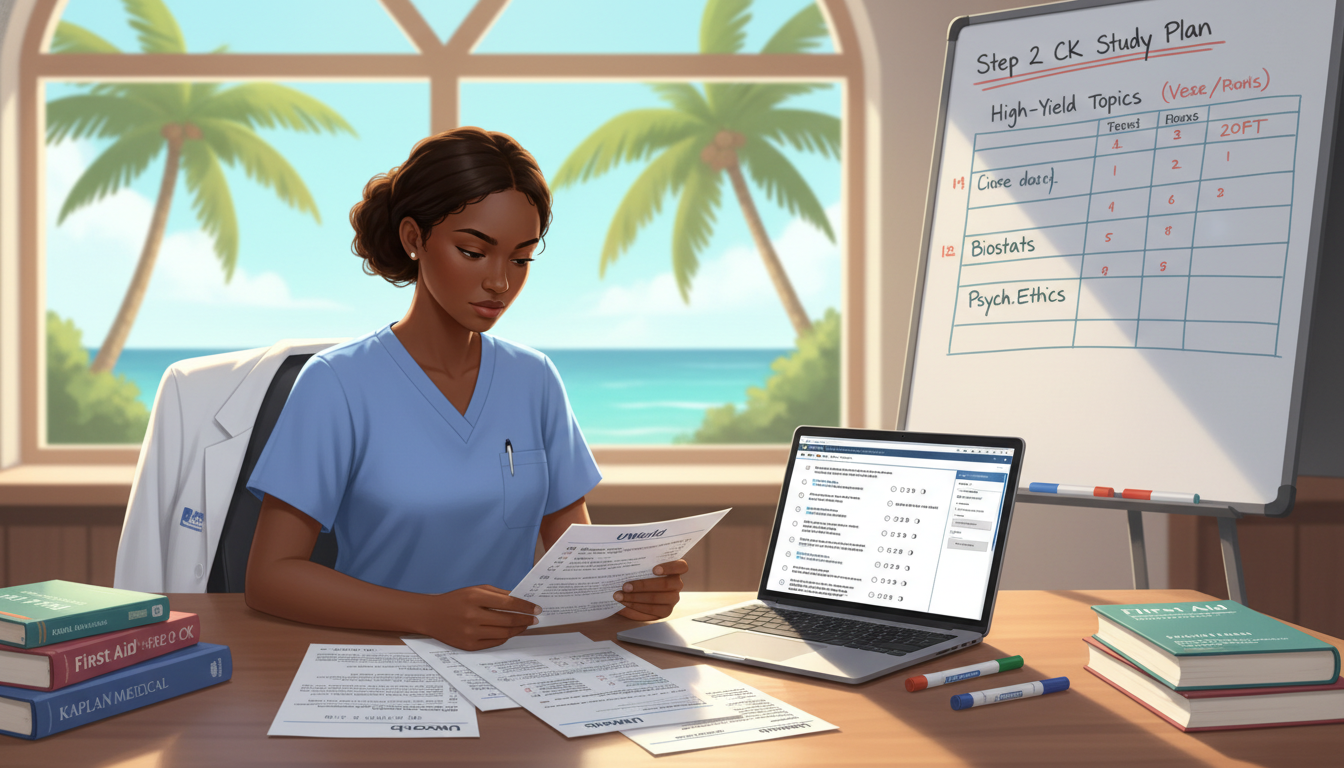
Maximize Step 2 CK as your “redemption exam”
If Step 2 CK is still ahead of you:
Slow down to speed up
If you already have a low Step 1, rushing Step 2 CK and scoring low again can be fatal. Consider:- Delaying graduation if your school allows
- Taking additional 4–8 weeks dedicated study
Treat Step 2 CK like your core job
- Dedicated schedule with daily blocks for:
- UWorld (full pass, ideally 1.5–2 passes on weak areas)
- Anki or equivalent spaced repetition
- NBME practice exams to track readiness
- Aim: significant score improvement vs. Step 1 (even if still not “high”)
- Dedicated schedule with daily blocks for:
Demonstrate an upward trend
Even if you end at a Step 2 CK 228 (technically below competitive averages), if Step 1 was 205, the positive trajectory itself becomes a talking point in your favor.
If Step 2 CK is already taken and also low:
- Consider whether a re-take is allowed and strategically beneficial (it’s not always).
- Shift your academic signaling to:
- Shelf exams / NBME subject exams: mention strong performance in MSPE / Dean’s letter if available.
- Medical school transcript: Honors or High Pass in Medicine and Psychiatry rotations are valuable.
- Post-graduate coursework or certificates in clinical research, public health, or psychopharmacology.
Proactively control the narrative around low scores
You can’t hide low scores, but you can frame them in your personal statement and (if appropriate) in a short ERAS “additional comments” section.
Keep your explanation:
- Brief (1–3 sentences)
- Accountable (no excuses; own what happened)
- Solution-focused (what you changed, how you improved)
Example (for a Caribbean IMG with a low Step 1 score):
During my preclinical years, I struggled with time management and test anxiety, which contributed to a Step 1 score below my potential. Since then, I sought formal coaching, changed my study habits, and consistently improved my performance, as reflected in my clerkship evaluations and Step 2 CK. This experience made me more deliberate, disciplined, and empathetic toward patients facing their own performance challenges.
Programs care less that you stumbled and more that you learned and won’t stumble again when exams and clinical responsibility escalate.
Building a Med-Psych-Ready Application with Low Scores
Scores open doors; your overall application decides if you walk through. For a Caribbean IMG aiming at Medicine-Psychiatry, you must be deliberate in how you signal your fit.
1. Targeted clinical experiences: show that you already “do” Med-Psych
You want your file to radiate: “This applicant thinks in both medicine and psychiatry daily.”
Prioritize:
- US Clinical Experience (USCE) in Internal Medicine and Psychiatry
- Inpatient medicine with high complexity (CHF, COPD, cirrhosis, diabetes)
- Inpatient or consult-liaison psychiatry
- Addiction medicine or psychiatry
- VA or safety-net hospitals where patients often have co-occurring medical and psychiatric illness
When possible, stack your rotations:
- Example rotation sequence (ideal 4–6 months before applications):
- 4 weeks: Inpatient Internal Medicine
- 4 weeks: Psychiatry inpatient or C/L
- 4 weeks: Addiction or dual-diagnosis unit
- 4 weeks: Outpatient primary care with integrated behavioral health
In your CV and ERAS entries, label and describe experiences in a way that highlights the Med-Psych interface:
- Instead of: “Psychiatry elective”
- Try: “Consult-Liaison Psychiatry elective – focus on management of delirium, catatonia, anxiety in medically ill inpatients.”
2. Letters of recommendation that speak directly to “combined” potential
With low or below average board scores, your letters carry disproportionate weight.
Aim for:
- At least 1 strong letter from Internal Medicine
- At least 1 strong letter from Psychiatry
- Ideally, 1 letter from someone with combined or integrated care experience, such as:
- Med-Psych faculty
- C/L psychiatrist who regularly collaborates with medicine teams
- Internist in an integrated primary care/behavioral health clinic
Coach your letter writers (politely) by providing:
- A 1-page summary of:
- Your career goal (Med-Psych residency)
- Key cases where you integrated medical and psychiatric thinking
- Examples of your reliability, work ethic, and response to feedback
- A brief note acknowledging you’re applying with low scores, and that any comments about your clinical knowledge and ability to learn quickly are especially meaningful.
The best letters for matching with low scores often mention:
- Rapid clinical growth despite early test struggles
- Strong bedside reasoning
- Ownership of learning, punctuality, and “intern-ready” behavior
- Emotional intelligence and team-based problem-solving
3. Crafting a Med-Psych personal statement that offsets low scores
You cannot afford a generic “I like both medicine and psychiatry” essay.
Your Med-Psych personal statement should:
Anchor in a specific population or clinical problem
Examples:- Patients with serious mental illness and chronic medical disease
- Substance use disorders with complex medical comorbidities
- Psychosomatic presentations, medically unexplained symptoms
Link your story to durability and resilience
Subtly connect how you overcame academic setbacks to:- Empathy for patients who relapse or struggle with adherence
- Insight into the long arc of recovery, not just “quick fixes”
Explicitly reference the dual identity you seek
Mention you want to be comfortable:- Managing insulin and antipsychotics in the same patient
- Running codes and psychiatric emergency evaluations
- Leading integrated care teams
Address scores succinctly (if not covered elsewhere)
Do not make the entire statement about your low Step 1 score or low Step 2 CK score, but include a concise, accountable paragraph if your deficits are large.
4. Program selection and application strategy
For a Caribbean IMG with low scores, where you apply is as important as how you apply.
Prioritize Med-Psych programs that:
- Have a history of interviewing or matching IMGs
Research:- Program websites and resident bios
- FREIDA and NRMP data
- Are university-affiliated but not hyper-elite academic centers
- Clearly emphasize:
- Community psychiatry
- Safety-net hospitals
- Integrated primary care
Use a two-tier strategy:
Because Med-Psych spots are limited, a purely combined-only strategy is dangerous with low scores.
Consider:
- Applying to:
- All Med-Psych programs that do not explicitly exclude IMGs
- A broad list of categorical Internal Medicine programs (community and academic-affiliated) where Caribbean IMGs historically match
- A more limited number of categorical Psychiatry programs receptive to Caribbean graduates
This approach keeps you in play for:
- A Medicine-Psychiatry combined slot (first choice)
- A strong back-up in Internal Medicine or Psychiatry alone
- Future pathways (e.g., Psychosomatic fellowship after IM, or strong primary care track after Psych) that allow you to practice in an integrated way even if you don’t match Med-Psych initially.

Tactics for Caribbean IMGs: School Reputation, Networking, and SGU-Specific Considerations
Being from a Caribbean school—whether SGU, AUC, Ross, Saba, or others—comes with both challenges and unique tools.
1. Leverage your school’s alumni network and match data
If you’re at a school with a substantial footprint in US residency (e.g., SGU residency match track record):
- Identify alumni who:
- Matched into Medicine-Psychiatry (even 5–10 years ago)
- Matched into strong IM or Psych programs with integrated care focus
- Reach out via:
- School alumni office
- Med-Psych or IM/Psych interest groups
Ask targeted questions:
- “Which programs were most receptive to Caribbean IMGs?”
- “How did you address your scores in your application and interviews?”
- “What electives or mentors were most helpful?”
Many SGU or Caribbean alumni are acutely aware of matching with low scores and can provide program-specific intel you won’t find online.
2. Use your school’s US clinical sites strategically
Caribbean schools have established contracts with numerous US hospitals. You may not have free choice of sites, but you can often:
- Rank or request sites with:
- Academic affiliations
- Large psychiatry departments
- Strong medicine + psych collaboration (VA hospitals, county hospitals)
- Seek:
- Extra observerships or sub-internships in hospitals where Med-Psych faculty rotate
- Opportunities to present at local case conferences or M&Ms, especially in integrated care topics
3. Networking with Med-Psych faculty and residents
Small specialty = strong impact of personal relationships.
Steps:
- Attend Med-Psych-related conferences or sessions, even virtually:
- APA (American Psychiatric Association) sessions on combined training
- ACP or SGIM sessions on integrated behavioral health
- Politely introduce yourself via email or at poster sessions:
- Briefly state:
- You are a Caribbean IMG interested in Med-Psych
- You’re aware of your low Step 1 or low Step 2 score
- You’re working on strengthening your application via X, Y, Z
- Ask:
- “What do you look for in IMGs applying to Med-Psych?”
- Briefly state:
- Follow up with:
- A thank-you email
- Occasional updates (e.g., when you complete a project or rotation)
Never ask directly for a LOR or a spot; instead, build a long-term professional connection that might support future rotation opportunities, informal advocacy, or research involvement.
4. Addressing Caribbean stigma head-on
Some reviewers will see “Caribbean medical school” and think “risk.” With low scores, this perception can intensify. You combat this by:
- Demonstrating insane reliability on rotations:
- First to arrive, last to leave
- Meticulous follow-up
- Strong notes, ownership of patients
- Collecting objective positive data:
- Honors-level evaluations
- Concrete written comments about knowledge, professionalism, and work ethic
- Emphasizing how the diverse and resource-limited environments in the Caribbean:
- Strengthened your adaptability
- Enhanced your cultural humility
- Prepared you for safety-net Med-Psych work in the US
Interview and Post-Interview Strategy: Converting Risk Into Opportunity
Getting the interview is often the hardest part with low scores. Once you’re in the room (or on Zoom), you must be practiced, honest, and focused on your Med-Psych value.
1. Prepare for “score and school” questions
Common forms:
- “Can you walk me through what happened with Step 1?”
- “How do you think your board performance will impact your residency training?”
- “Tell me about any academic struggles you’ve had.”
Your answer structure:
- Brief description of the issue
- “I underperformed on Step 1 due to weak early study habits and test anxiety.”
- Clear ownership
- “Those were my responsibility, and I didn’t adjust quickly enough.”
- Specific corrective actions
- “I sought coaching, created structured study schedules, and focused on active learning, which led to improved performance in clerkships and Step 2 CK.”
- Tie to residency readiness
- “Now, I’m disciplined with self-assessment and feedback, which is how I plan to approach both the clinical and exam components of residency.”
Avoid blaming your school, exam style, or personal crises; context is okay, but responsibility must stay with you.
2. Show you understand Med-Psych’s realities
Programs want residents who:
- Understand the workload (you’re doing full Internal Medicine and Psychiatry training)
- Recognize the emotional and intellectual demands
- Have concrete career goals where combined training is clearly useful
Have ready:
- 2–3 specific patient stories that show you navigating both medical and psychiatric complexity
- A clear 5–10 year vision:
- E.g., “I hope to lead an integrated primary care and behavioral health clinic for patients with serious mental illness and diabetes in a safety-net system.”
3. Post-interview communication and signaling
For such a small specialty, enthusiasm matters.
- Send personalized thank-you emails within 24–48 hours:
- Reference specific conversations
- Reiterate your Med-Psych motivation
- If the program is top choice:
- Consider a sincere, single “I will rank your program highly/first” email in late January/early February (following NRMP guidelines and avoiding coercive promises)
- Stay engaged professionally:
- Share any new achievements (accepted abstract, new LOR, post-clerkship distinction) if significant and relevant.
FAQs: Low Step Score Strategies for Caribbean IMGs in Medicine-Psychiatry
1. Can I realistically match into Medicine-Psychiatry with a low Step 1 score as a Caribbean IMG?
It’s challenging but not impossible. Your chances depend heavily on:
- How low the score is and whether there are exam failures
- Your Step 2 CK performance and overall academic trajectory
- Strength of letters, clinical evaluations, and Med-Psych fit
- Breadth of your application strategy (including IM and Psych backups)
Applicants with a single low score but strong upward trend, excellent USCE, and clear combined-care commitment have matched. Multiple low scores or failures make it significantly harder, but exceptional clinical and narrative strengths can still keep you in contention, especially at IMG-friendly programs.
2. Should I still apply to Med-Psych if I’m worried about matching with low scores?
If Medicine-Psychiatry is your genuine primary interest:
- Yes, apply, but:
- Apply to all Med-Psych programs that consider IMGs
- Also apply broadly to categorical Internal Medicine and Psychiatry programs
- Think of Med-Psych as your first choice and strong categorical programs as parallel pathways to similar integrated-care careers (e.g., Psychosomatic fellowship after IM, or medical-psychiatric clinics after Psych).
Do not rely solely on Med-Psych if your scores are substantially below average; the number of positions is small, and even stellar applicants sometimes don’t match.
3. Does it help to retake Step 2 CK if my score is already low?
Retaking Step 2 CK is high risk and should only be considered if:
- You failed or scored very low (e.g., significantly below 220)
- Your school and licensing pathways allow a retake
- You have a realistic, evidence-based plan to improve substantially (≥15–20 points)
A modest increase after a retake may not offset the “double-take” concern. Often, it’s more strategic to:
- Strengthen clinical performance
- Secure powerful letters
- Build Med-Psych-relevant scholarship and experiences
Discuss this with your dean’s office, a trusted mentor, and, if possible, a Med-Psych program director informally before deciding.
4. How many programs should I apply to as a Caribbean IMG with low Step scores targeting Med-Psych?
Numbers vary by cycle, but in general:
- All Med-Psych programs that:
- Accept ERAS applications
- Do not explicitly exclude IMGs
- Plus:
- ~40–60 Internal Medicine programs (mix of community and academic-affiliated, IMG-friendly)
- ~30–40 Psychiatry programs (specifically those with strong integrated care or psychosomatic emphasis and prior Caribbean IMG matches)
The goal is to cast a wide but thoughtful net, maximizing interviews while preserving a clear narrative: you are an integrated-care minded physician whose first choice is Medicine-Psychiatry, but who can thrive in categorical IM or Psych as well.
Using these strategies, a Caribbean IMG with a low Step 1 score, below average board scores, or test-related setbacks can still construct a credible, compelling path to Medicine-Psychiatry or adjacent integrated-care careers. Your application must be deliberate, honest, and strategically crafted, but low scores do not automatically close the door—especially if you demonstrate clear growth, strong clinical performance, and a genuine, well-articulated commitment to the Med-Psych mission.