
Understanding the Challenge: Low Step Scores as a Caribbean IMG
For a Caribbean International Medical Graduate (IMG) interested in vascular surgery, a low Step score can feel like a wall you cannot climb. Vascular surgery is small, competitive, and increasingly dominated by the 0+5 integrated vascular program pathway. Many programs screen heavily by board scores, and graduates from Caribbean medical schools often face additional bias in the selection process.
Yet, Caribbean medical school residency success stories—including many SGU residency match outcomes—show that applicants do match into surgical fields each year, even with below average board scores. The path is narrower and longer, but it exists.
To build a realistic, high-yield plan, you need to:
- Understand how programs use Step scores
- Know how Caribbean IMGs are perceived
- Choose between integrated vascular surgery and alternative routes
- Aggressively build the rest of your application to overshadow a low Step 1 score or low Step 2 CK score
This guide is written specifically for Caribbean IMGs with low scores who are serious about vascular surgery residency in the United States.
Key phrases like “Caribbean medical school residency,” “SGU residency match,” “vascular surgery residency,” “integrated vascular program,” and “matching with low scores” are all part of your reality. We’ll turn those into a strategy rather than a set of obstacles.
How Programs View Low Step Scores in Vascular Surgery
Vascular surgery—especially 0+5 integrated programs—is highly competitive and small in numbers. That means every metric is under the microscope, including your Step scores.
Step Scores in a Post–Step 1–Pass/Fail Era
If you took Step 1 when it still had a three-digit score, that number will continue to follow you. If you took it pass/fail, Step 2 CK is your make-or-break score.
Common scenarios for Caribbean IMGs:
Low Step 1, better Step 2 CK
- Example: Step 1 = 210, Step 2 CK = 236
This pattern suggests improvement. Many PDs will consider you if the upward trend is clear.
- Example: Step 1 = 210, Step 2 CK = 236
Low Step 1, low Step 2 CK
- Example: Step 1 = 205, Step 2 CK = 219
This is harder to overcome, especially for a vascular surgery residency. You’ll likely need a multi-stage path (e.g., general surgery or prelim → vascular fellowship).
- Example: Step 1 = 205, Step 2 CK = 219
Pass on Step 1, below average Step 2 CK
- Example: Pass on Step 1, Step 2 CK = 222
Programs will rely heavily on that Step 2 CK score plus your clinical performance and letters.
- Example: Pass on Step 1, Step 2 CK = 222
Programs typically use score thresholds when filtering applications. Caribbean IMGs often need to exceed these thresholds, not just barely meet them. With a low Step 1 score or low Step 2 CK, you may be auto-filtered out in some integrated vascular programs—but not all.
Additional Challenges for Caribbean IMGs
Caribbean medical school residency applicants carry built-in skepticism in the eyes of many PDs. Common program director concerns include:
- Variable quality of clinical rotations
- Inconsistent letters of recommendation
- Less rigorous preclinical education
- High volume of applications from Caribbean schools
As a Caribbean IMG, you must:
- Over-prove that you belong in a demanding, procedure-heavy specialty
- Show that you can function at the level of US MD/DO grads in both knowledge and clinical performance
- Demonstrate resilience, maturity, and a track record of improvement—especially if you have below average board scores
Choosing the Right Path: Integrated Vascular vs Alternative Routes
One of the most important strategic decisions you’ll make is how to approach vascular surgery: directly via an integrated vascular program, or through a more stepwise path.
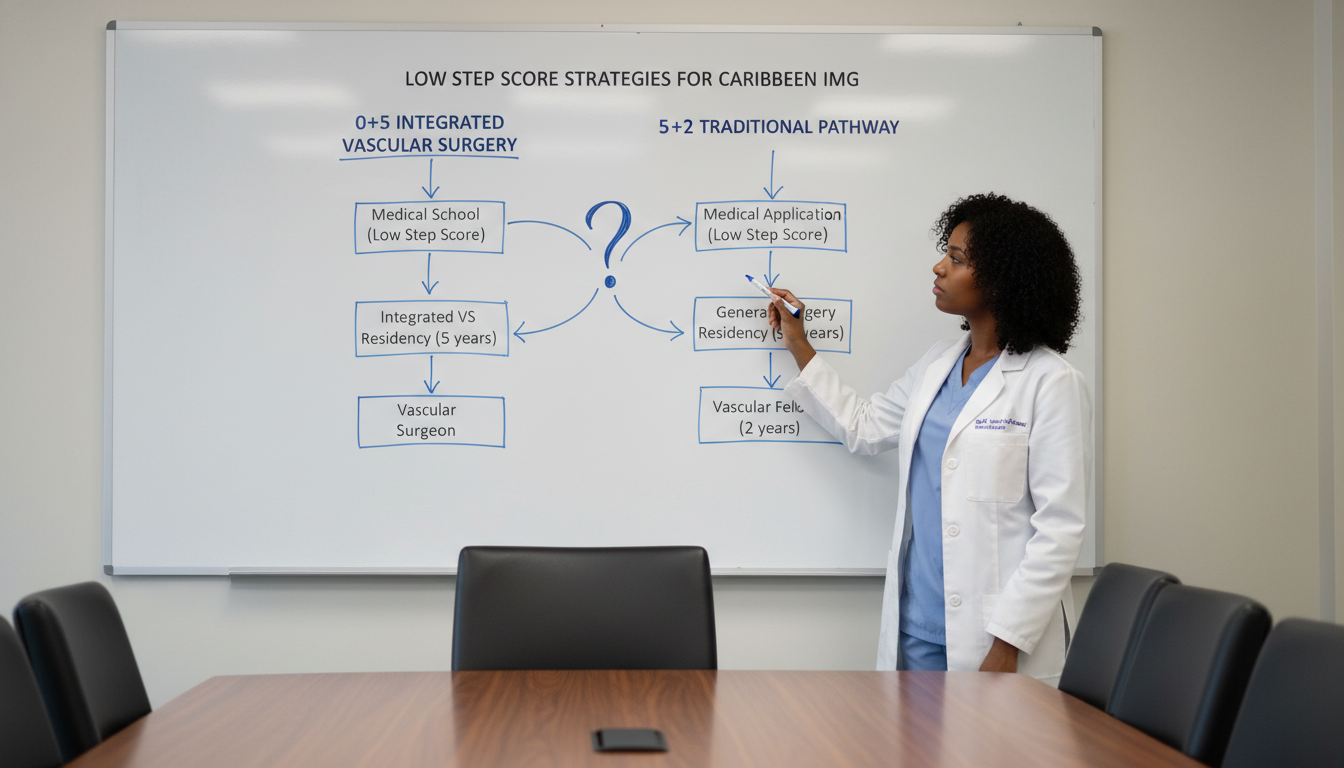
Route 1: 0+5 Integrated Vascular Surgery Programs
Pros:
- Direct path to becoming a vascular surgeon
- Focused training from PGY-1 in vascular disciplines
- Very attractive if you are certain about vascular surgery
Cons (especially with low scores):
- Small number of positions nationwide
- Highly competitive; many programs heavily score-screen
- Less forgiving of weaknesses in your record
- Caribbean IMG status + low Step scores = steep uphill battle
With a low Step 1 score and/or below average Step 2 CK, an integrated vascular surgery residency is not impossible—but it is unlikely unless:
- Your Step 2 CK shows a clear rebound (e.g., low Step 1 followed by significantly higher Step 2)
- You have strong U.S.-based vascular surgery research and letters
- You’ve impressed faculty at programs that know you personally (e.g., via an away rotation or research year)
Route 2: General Surgery Residency → Vascular Fellowship (5+2)
This is the more traditional pathway and, for a Caribbean IMG with low scores, often the most realistic.
Advantages:
- More general surgery categorical positions than integrated vascular spots
- A wider range of community and mid-tier academic programs that may be more open to Caribbean IMGs
- Time to rebuild your profile, improve operative skills, and collect vascular-specific letters
- Fellowship programs often care more about surgical performance, letters, and research than Step scores alone
Disadvantages:
- Longer training (7 years vs 5)
- No guarantee of vascular fellowship if you do not excel during general surgery residency
- You’ll need to fight to maintain vascular exposure during your general surgery training
If your priority is to maximize the probability of ending up as a vascular surgeon rather than pursuing the shortest possible path, the 5+2 route is often safer.
Route 3: Preliminary Surgery → Categorical → Vascular
If your scores and application are not competitive for categorical general surgery, you may consider:
- Preliminary general surgery (1–2 years) with the aim of:
- Securing strong letters
- Proving yourself clinically
- Then reapplying to categorical general surgery positions
- Eventually pursuing a vascular surgery fellowship
This route is high risk but can work for committed, high-performing applicants who simply need time to overcome low scores and show what they can do.
Actionable Decision Framework
Ask yourself the following:
- How low are my scores relative to published program data?
- If your Step 2 CK is significantly below the average for matched vascular surgery applicants (often >245–250 for integrated programs), your chances in integrated vascular are limited.
- Do I have or can I build strong vascular-specific research and mentorship?
- How flexible am I on timeline?
- If you are willing to take a longer route, your odds of ultimately practicing vascular surgery are higher.
Practical approach for most Caribbean IMGs with low scores:
- Primary plan: Categorical general surgery applications (with some vascular research programs flagged as priorities)
- Secondary reach: Apply broadly to a few integrated vascular surgery programs where you have some connection (research, away rotation, mentor introduction), understanding these are long shots
- Safety net: Consider prelim positions only at strong programs that genuinely use prelims as a pipeline to categorical spots
Rebuilding Your Competitiveness: Academic & Board Score Strategies
Even if your Step 1 score is fixed, you still control your trajectory from this point forward. Programs love applicants who demonstrate clear rebound and growth.
Step 2 CK: Your Redemptive Exam
For anyone with a low Step 1 score—or a pass on Step 1—Step 2 CK becomes your most important data point, especially for surgical fields.
If you haven’t taken Step 2 CK yet:
- Delay the exam rather than repeat a poor pattern. It is better to take an extra 1–2 months to raise your practice scores than to rush and add a second low score.
- Set a strict baseline: do not sit for Step 2 CK until your practice NBME/UWorld assessments are at or above your realistic target (for vascular aspirants, typically ≥235 as an IMG; higher if possible).
- If your goal is matching with low scores, your mindset should be:
“My Step 2 CK may not be stellar, but it must be less weak than my Step 1.”
If you have already taken Step 2 CK and it’s low:
- Focus on shelf exams, clinical evaluations, and other metrics of competence.
- Make sure your personal statement and MSPE explicitly highlight your improvement in clinical environments and your dedication despite test performance.
- Consider taking Step 3 earlier (during or before the match cycle) and do well. Some PDs see a strong Step 3 as evidence of progress.
Enhancing the Academic Side Beyond Scores
With below average board scores, other academic metrics become vital:
Core clinical grades (especially surgery and internal medicine):
- Aim for Honors/High Pass if your school uses this system.
- Ask attendings specifically: “Is there anything I can do to perform at an Honors level?”
Sub-internships in surgery or vascular surgery:
- Treat these as extended job interviews.
- Be first in, last out. Know your patients better than anyone else on the team.
Shelf exam performance:
- Shelf scores can demonstrate knowledge even when USMLE scores lag behind.
US-based letters of recommendation:
- At least one letter should be from a vascular surgeon (ideally fellowship-trained, academic, and known to PDs).
- Another from a general surgeon who can speak to your work ethic and technical aptitude.
Differentiating Yourself: Research, Clinical Exposure, and Professional Branding
With a low Step 1 score or low Step 2 CK, you need a narrative that makes a program director pause and think, “Despite the scores, this person is clearly cut out for vascular surgery.”

Vascular Surgery Research: Your Most Powerful Lever
Research can partially offset the disadvantage of matching with low scores, especially if:
- It is vascular surgery–specific
- You have multiple abstracts, posters, or publications
- Your mentors are known names in the vascular community
Strategies:
Seek out vascular surgery departments willing to take research volunteers or paid research assistants.
- Many large academic centers (e.g., university hospitals) have full-time research coordinators and ongoing projects.
- Cold email vascular faculty with a short, focused message:
- Who you are (Caribbean IMG, graduation year)
- Why you’re interested in vascular
- Specific skills (data analysis, statistics, previous research, languages)
- Willingness to relocate or work unpaid/low-paid for a defined time
Aim for visible output:
- Case reports and case series involving complex vascular disease
- Retrospective cohort studies of vascular procedures (AAA repairs, carotid interventions, critical limb ischemia)
- Conference abstracts (SVS, regional vascular meetings)
- Quality improvement (QI) projects in vascular clinics or OR workflows
Leverage SGU residency match and other Caribbean school alumni networks.
- Many SGU and other Caribbean grads have successfully matched into surgical or vascular training.
- Use alumni directories, LinkedIn, and professional societies to find mentors who understand your background and are sympathetic to your path.
Clinical Exposure and Skills
You need to show that you love—and understand—vascular surgery beyond the textbook.
Elective rotations in vascular surgery in the U.S.:
- Aim for at least one 4-week rotation at a program that has either:
- An integrated vascular program, or
- A strong vascular fellowship
- Your goal: secure a vascular surgeon’s letter that labels you as a “must interview” candidate for surgical training.
- Aim for at least one 4-week rotation at a program that has either:
Skills to display on rotation:
- Strong understanding of vascular anatomy and common procedures
- Ownership of vascular patients—knowing their imaging, labs, co-morbidities
- Early recognition of limb-threatening situations, ischemia, and complications
- Elbow-deep involvement in consults, pre-op planning, and follow-up
Professional Branding: Your Story
You cannot hide your scores. You can, however, frame them within a coherent, honest narrative:
Personal Statement Focus:
- Why vascular surgery specifically? (Not just “I like surgery.”)
- How have you shown resilience and growth after academic setbacks?
- What did you learn from your low Step 1 score or low Step 2 CK result?
- How do your clinical experiences and research demonstrate that you now perform far above what your test scores suggest?
Curriculum Vitae (CV):
- Group vascular-relevant activities together: research, electives, case reports, volunteer work in peripheral arterial disease screening, etc.
- Emphasize leadership roles, teaching, and long-term commitments (not just short bursts of activity for the sake of ERAS).
Letters of Recommendation:
- Ask letter writers explicitly to address your:
- Clinical reliability
- Growth after early struggles
- Suitability for a demanding surgical field
- A strong letter that says, “Do not be misled by his/her test scores; this is one of the best clinical students I’ve worked with,” can be transformative.
- Ask letter writers explicitly to address your:
Application Tactics: Where and How to Apply with Low Scores
You can work incredibly hard and still fail to match if your application strategy is misaligned with your profile. Program selection and application tactics are crucial for Caribbean medical school residency candidates, especially when matching with low scores.
Program Selection Strategy
Target program tiers realistically:
- Highly competitive academic vascular centers
- Apply if you have a genuine connection (research, rotation, mentor).
- Mid-tier academic and large community general surgery programs
- Likely your most important target group for categorical general surgery.
- Integrated vascular programs:
- Apply selectively—prioritize places where you have a clear link rather than spraying applications everywhere.
- Highly competitive academic vascular centers
Use data intelligently:
- Review programs’ past residents/fellows:
- Do they have Caribbean IMG grads?
- Does the program list Step score ranges (some do in FAQs)?
- Pay attention to whether programs actively advertise “welcoming IMGs” or list Caribbean graduates.
- Review programs’ past residents/fellows:
Volume of applications:
- For a Caribbean IMG with low scores aiming for surgical training, it’s common (and reasonable) to submit:
- 60–100+ general surgery programs (mix of academic and community)
- A handful of integrated vascular programs as reach options
- Be prepared financially and emotionally for a high-volume strategy.
- For a Caribbean IMG with low scores aiming for surgical training, it’s common (and reasonable) to submit:
Signals, Emails, and Communication
- Use ERAS signaling (when available) strategically on:
- Programs where you did an away/sub-I
- Programs where your vascular mentors have personal connections
- Send polite, concise emails to program coordinators or PDs:
- Reinforce your interest
- Highlight unique strengths (research, strong letters, significant clinical experience)
- Avoid oversharing about low scores; focus on what you’ve done since.
Interview Performance: Proving You’re More Than a Number
When you get an interview, your goal is to prove that, despite a low Step 1 score or below average Step 2 CK:
- You are clinically sharp and technically inclined
- You understand the rigors of a vascular surgery residency or general surgery pathway
- You are mature, reliable, and coachable
Be prepared to discuss:
- Why your scores do not reflect your actual abilities
- Specific examples of resilience:
- Retaking a course, turning around a poor grade, or managing personal challenges
- Concrete experiences in vascular:
- Cases you’ve been involved in, research you’ve done, what you learned
FAQs: Low Step Score Strategies for Caribbean IMGs in Vascular Surgery
1. Can I match directly into an integrated vascular surgery residency as a Caribbean IMG with low Step scores?
It is possible but rare. Integrated vascular programs are small and extremely competitive. If your Step 2 CK is significantly below commonly matched ranges and you lack standout vascular research or strong mentors, your odds are low. Most applicants in your situation are better served by targeting categorical general surgery positions and planning a 5+2 pathway. Still, if you have a strong personal connection (research, away rotation, mentor support) to a particular integrated vascular program, it may be worth a targeted application.
2. How important is vascular surgery research if I have below average board scores?
Vascular research can be one of your strongest tools. It demonstrates focused interest, perseverance, and the ability to contribute academically, which can partially compensate for low Step 1 or low Step 2 CK scores. Aim to join projects with clear deliverables (abstracts, posters, or publications) and visible mentors. While research alone will not erase low scores, it can be the deciding factor for a program on the fence about interviewing you.
3. Should I apply to both integrated vascular and general surgery programs in the same cycle?
Yes, in most cases. If you are a Caribbean IMG with low scores, integrated vascular programs should be your reach applications, not your sole plan. Apply broadly to general surgery categorical positions (and consider a few high-yield prelim spots as backups), then add a limited number of integrated vascular programs where you have meaningful connections. In interviews, be transparent about your genuine interest in vascular and your understanding that general surgery is a viable and honorable path to that goal.
4. How can I address my low scores in my personal statement or interviews without sounding defensive?
Acknowledge your low scores briefly and factually, then shift quickly to growth and action. For example:
“I did not initially perform at the level I expected on Step 1, which forced me to carefully evaluate my study methods and time management. I sought help, changed my approach, and my subsequent clinical evaluations, shelf exams, and Step 2 CK performance reflect that improvement.”
Avoid blaming others or giving lengthy justifications. Program directors are less interested in excuses and more interested in evidence that you’ve matured and can now handle a demanding surgical residency.
By combining realistic path selection, aggressive improvement efforts, strategic research, and thoughtful branding, a Caribbean IMG with low Step scores can still build a credible road to a career in vascular surgery. Your journey may be longer and more complex than that of a typical US MD graduate, but with persistence and targeted strategy, it remains within reach.