
Understanding Your Position as an IMG with a Low Step Score in the Research Triangle
For an international medical graduate, facing a low Step 1 or Step 2 CK score while dreaming of training in the Research Triangle (Raleigh–Durham–Chapel Hill) can feel intimidating. Yet every year, applicants with below average board scores match into strong programs in North Carolina, including the Research Triangle.
This IMG residency guide focuses on practical, evidence-informed strategies to improve your chances of matching with low scores, specifically in and around:
- Duke University Hospital and Duke residency programs (Durham)
- UNC Hospitals / UNC School of Medicine (Chapel Hill)
- WakeMed, UNC affiliate programs, and community programs in Raleigh and surrounding areas
The goal is not to ignore your Step performance but to reframe it as one part of a larger, stronger application story—especially important if you are an IMG targeting North Carolina residency positions.
We will cover:
- How programs in the Research Triangle actually view low scores
- Immediate next steps after receiving a low score
- Strategic ways to compensate (USCE, research, networking)
- Tailored strategies for Duke residency and other local programs
- A step-by-step application strategy for IMGs with low scores
How Programs in the Research Triangle View Low Step Scores
Programs in the Triangle are competitive, but they are not monolithic. Understanding how and why scores matter locally will help you plan realistic, high‑yield strategies.
1. How “Low” is a Low Score?
For the purposes of this article:
- Low Step 1 (historical, now Pass/Fail)
- Previously: < 220 for competitive academic programs
- Now: a Pass is required; context such as multiple attempts matters
- Low Step 2 CK (current high‑stakes exam)
- Below the national mean (~245) is “below average”
- < 230 often considered “low” for academic internal medicine, pediatrics, neurology, etc.
- < 220 is low for highly selective programs like Duke residency; some may use 230 or 235 as informal cutoffs
If your score is in these ranges, you are not alone—and you are not automatically disqualified, especially as an IMG with strong compensating strengths.
2. Program Types in the Research Triangle and Score Emphasis
Within the Research Triangle and broader central North Carolina, roughly three program “cultures” exist:
Highly Academic / Research-Heavy (e.g., Duke, UNC Chapel Hill, some subspecialties)
- More likely to:
- Use higher Step 2 CK cutoffs
- Review number of attempts carefully
- But also more likely to:
- Value research, advanced degrees, publications
- Appreciate special expertise, language skills, global health background
- For low scorers: these may be “reach” programs, but strategic positioning can keep them on your realistic list.
- More likely to:
Hybrid Academic-Community Programs (e.g., some UNC affiliates, Duke community partners, regional hospitals)
- Use scores to manage large applicant pools, but not as the only criterion
- Value:
- Strong clinical experiences in the U.S. (USCE)
- Good letters of recommendation
- Clear commitment to the region or patient population
- For low scorers: these are often the best balance of quality and attainability.
Community-Focused Programs in NC and Nearby States
- More flexible on scores, more holistic
- Emphasize:
- Reliability, communication, and work ethic
- Hands-on U.S. clinical experience
- Evidence you will be a safe, independent intern
- For low scorers: these should form the core of your application list, even if you also apply to Duke or UNC.
3. What Makes a Low Score Less Damaging?
In the Research Triangle context, a low score is more acceptable when:
- Step 2 CK shows significant improvement vs your prior academic performance.
- Your score is low but first attempt, no failures.
- You have strong US clinical experience (USCE) with excellent letters, ideally from:
- Duke University Hospital
- UNC Hospitals
- WakeMed, Duke Regional, UNC Rex, or nearby teaching affiliates
- You have North Carolina connections:
- Long‑term family residence in NC
- Prior study or work in the Triangle (NC State, Duke, UNC, RTI, etc.)
- Meaningful community involvement or regional health projects
Programs want reassurance: “Will this IMG succeed in our environment despite a low test score?” Your entire strategy should be built to answer yes, convincingly.

Immediate Steps After a Low Step Score: Damage Control and Repositioning
The weeks after receiving a low Step score are crucial. A thoughtful response now can have powerful long‑term impact on your chances of matching with low scores.
1. Perform an Honest but Structured Self‑Assessment
Instead of panicking, ask:
- Was my score low due to:
- Knowledge gaps?
- Timing issues (test fatigue, time zone, travel, personal issues)?
- Poor exam strategy (NBME misinterpretation, anxiety, pacing)?
- How did my NBME practice scores compare to my actual exam?
- Did I have other concurrent stressors (illness, family issues, visa complications)?
Write this down. This analysis will help you:
- Craft a credible explanation in your personal statement if needed.
- Design a step‑by‑step remediation plan, especially for Step 2 CK or a potential retake of Step 3 later.
2. Decide on Your Next Exam Strategy (Especially Step 2 CK)
If Step 2 CK is still pending or upcoming:
- Treat Step 2 CK as your redemption exam.
- Aim for:
- ≥ 240 if you are targeting academic programs like Duke or UNC.
- ≥ 230 as a strong improvement marker for most IM and FM programs in NC.
Action steps:
- Use your Step 1 experience to redesign your preparation:
- More UWorld, NBME, and practice tests.
- Strict study schedule with timed blocks.
- Incorporate U.S.-trained mentors or tutors familiar with recent trends.
- If you already took Step 2 CK and it is low:
- Strongly consider Step 3 before applying if:
- You can realistically score higher.
- You have enough time and resources.
- A solid Step 3 (and a pass on first attempt) can reassure programs about your knowledge trajectory, particularly in internal medicine and family medicine.
- Strongly consider Step 3 before applying if:
3. Avoid Multiple Failures
Multiple exam failures are more harmful than one low score.
- If you failed Step 1 or Step 2 CK:
- Do not rush a retake.
- Take at least 6–8 weeks of intensive study with structured assessments.
- If your low score is a pass on first attempt, think very carefully before voluntarily retaking any exam (if even allowed), as this sometimes raises concerns about judgment unless clearly necessary (e.g., Step 3 for visa or state licensure reasons).
4. Seek Early Mentorship—Especially in the Triangle
As an international medical graduate, you must not navigate this alone.
Look for mentors:
- Attending physicians at Duke, UNC, or area hospitals with experience working with IMGs.
- Faculty from your home medical school who have U.S. connections.
- Alumni from your school currently in North Carolina residency programs.
Ask explicitly:
- How have they seen candidates with low scores compensate successfully?
- Which programs in NC are:
- IMG‑friendly
- Score‑flexible
- Open to strong personal advocacy via letters or emails
Building Compensating Strengths: USCE, Research, and Regional Fit
With below average board scores, your strategy must be deliberately multidimensional. You need to convince programs that your true clinical ability and professionalism are much stronger than your test performance suggests.
1. Targeted U.S. Clinical Experience (USCE) in the Research Triangle
For IMGs wanting North Carolina residency specifically, local clinical experience is gold.
Types of USCE to Pursue
Prioritize (in descending order of impact):
Hands-on Clinical Electives / Sub-internships
- Unfortunately limited for non‑students, but if you are still a student, apply early to:
- Duke visiting student programs
- UNC visiting medical student programs
- Aim for 8–12 weeks total if possible.
- Unfortunately limited for non‑students, but if you are still a student, apply early to:
Hands-on Externships or Teaching-Clinic Roles
- Some private groups and community hospitals in NC may offer structured externships.
- Be cautious:
- Confirm they are reputable, and you will interact directly with patients, under supervision.
Observerships at Academic Centers
- Even if they are not hands-on, an observership at:
- Duke University Hospital
- UNC Hospitals
- can still:
- Provide strong LORs
- Demonstrate regional interest and familiarity with the U.S. system
- Even if they are not hands-on, an observership at:
Tele-rotations / Remote USCE
- Less impactful, but better than nothing—especially if paired with:
- Research collaboration
- Regular mentoring calls
- Less impactful, but better than nothing—especially if paired with:
How to Make USCE Count More
- Show up early, prepared, and professionally dressed.
- Ask for specific feedback and work to improve.
- Keep a log of:
- Cases you followed
- Skills observed or performed (even as observer)
- Teaching sessions attended
- At the end of the rotation, request a letter of recommendation on official letterhead:
- Highlighting your clinical reasoning, work ethic, communication skills, and growth.
Being remembered as the hardest‑working IMG on the team can offset a low Step score more than you might think.
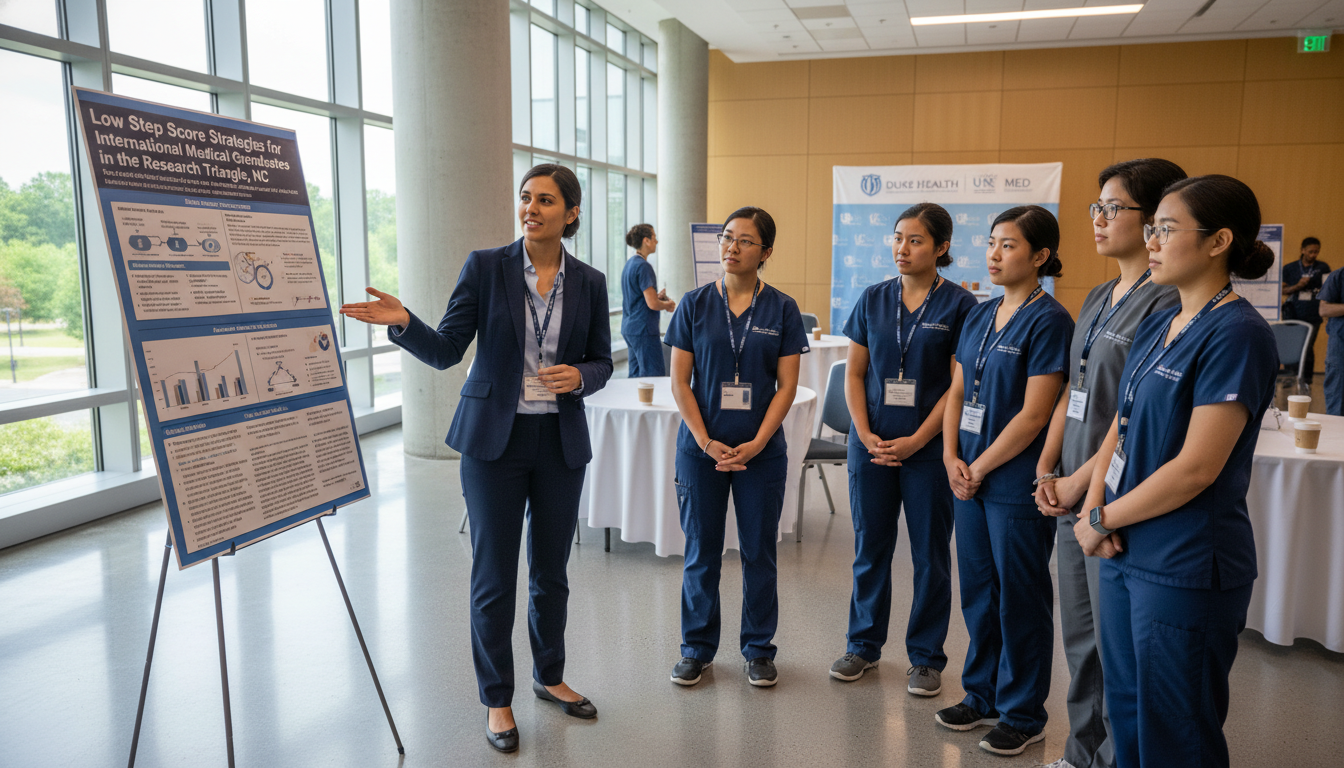
Research, Networking, and Program Selection: Smart Moves for the Triangle
1. Leveraging Research in the Research Triangle
The Triangle is one of the best research environments in the U.S., with:
- Duke: renowned for cardiovascular, oncology, and health services research.
- UNC: strong in public health, epidemiology, primary care, and global health.
- NC State: engineering, data science, and biomedical collaborations.
- RTI International and nearby research institutes: public health and policy.
For an IMG with low Step scores, research can:
- Prove you can handle complex intellectual tasks.
- Demonstrate persistence and teamwork.
- Create local mentors who may advocate for you.
Ways to engage:
- Volunteer as a research assistant in a Duke or UNC department.
- Reach out to faculty whose work aligns with your interests:
- Send a concise email:
- Introduce yourself (medical degree, IMG status).
- Share a very brief summary of your background and goals.
- Express specific interest in their work and ask if they have opportunities.
- Send a concise email:
- Be open to:
- Data analysis projects
- Chart reviews
- Quality improvement (QI) projects
- Systematic reviews and meta‑analyses
Even one abstract or poster with a Duke or UNC affiliation is extremely powerful on an IMG CV, especially when trying to match in the same region.
2. Networking in the Research Triangle Medical Community
Networking is not about favoritism; it is about allowing programs to see you as a real person, not just a low score on paper.
Opportunities in and around the Triangle:
- Grand Rounds and Departmental Conferences
- Many are open to visiting observers or researchers.
- Attend (even virtually) and introduce yourself briefly to faculty afterward.
- Local and regional specialty society meetings
- North Carolina chapters of ACP, AAFP, AAP, etc.
- Present posters if possible.
- Hospital volunteer or interpreter roles
- Particularly in Raleigh, Durham, Chapel Hill hospitals.
- Helps you build regional ties and show service commitment.
When networking:
- Respect people’s time.
- Prepare a 30‑second introduction:
- Who you are
- Your home country/school
- Your goal (residency in NC)
- Ask for one specific piece of advice or one small next step (e.g., “Is there a colleague who might be open to a brief informational call?”).
3. Smart Program Selection: Reaching vs Realistic vs Safety
With a low Step 1 or Step 2 CK, program selection becomes as important as your CV.
For the Research Triangle region, consider three tiers:
A. Reach Programs (Apply Strategically)
- Example: Duke residency programs in internal medicine, pediatrics, neurology, radiology; some UNC programs.
- You should still apply if:
- You have exceptional compensating factors:
- Strong research with Duke/UNC authors
- U.S. grad degree (MPH, PhD, MS) from a U.S. institution
- Significant USCE at these institutions with excellent letters
- You have exceptional compensating factors:
Expectations:
- Interview is not guaranteed, but each application is a lottery ticket for someone with your profile.
B. Core Targets (Maximize in This Tier)
These are programs in NC and nearby states that:
- Take IMGs regularly.
- Do not strictly advertise very high score cutoffs.
- Include community‑based but academically affiliated programs.
Actions:
- Identify NC and adjacent state programs via:
- FREIDA
- NRMP outcomes data
- Program websites (look for current IMGs among residents)
- Build a list of 20–40 programs where your score is below their average but not drastically (e.g., your Step 2 CK is 225 and their average is 235–240).
- Tailor your application messaging to this tier, emphasizing:
- Reliability
- Regional commitment
- Strong work ethic
C. Safety Programs (Must Include Enough)
These are typically:
- Smaller community programs
- Newer programs
- Programs in smaller cities or less saturated markets, including outside the Research Triangle but still in the Southeast.
For low scorers, apply to a robust number of these, especially if:
- You do not have significant U.S. research.
- Your USCE is limited or primarily observerships.
- You require visa sponsorship (J‑1 or H‑1B).
If the Research Triangle is your dream location, remember: matching anywhere first is better than not matching. You can still later return to NC for fellowship, job opportunities, or eventual relocation.
Crafting Your Application Story: How to Address Low Scores Without Being Defined by Them
1. Personal Statement: Acknowledging, Not Apologizing
For an IMG with a low Step 1 or Step 2 CK, your personal statement should:
- Briefly and honestly contextualize (if necessary) your score.
- Quickly pivot to the strengths and growth that followed.
Example structure:
- One or two sentences acknowledging the low score, if it is a major outlier:
- “While my Step 2 CK score does not fully reflect my knowledge and clinical ability, it was a turning point that led me to critically evaluate my study strategies and seek additional mentorship.”
- Immediately follow with:
- Concrete changes you made (e.g., structured study plans, practice questions, improved time management).
- Evidence of success (e.g., better performance in USCE, strong feedback, improved clinical grades, research productivity).
Do not:
- Write long explanations or excuses.
- Blame the exam system.
- Overfocus on personal hardships unless absolutely necessary and directly connected to the exam outcome.
2. Letters of Recommendation: Your Most Powerful Counterweight
For matching with low scores, strong U.S. letters are often more influential than a few extra exam points.
Aim for:
- 3–4 letters, with at least:
- 2 from U.S. clinical supervisors (attendings).
- 1 from a research supervisor if you have significant research.
- If possible, including at least one letter from:
- Duke, UNC, WakeMed, or another NC teaching hospital is a major asset.
Ask letter writers to address:
- Your clinical reasoning and ability to learn quickly.
- Communication skills with patients and staff.
- Work ethic, punctuality, responsibility.
- Improvement over time (showing that you respond well to feedback).
A letter that states:
“Although [Name] had a below average board score, I have no concerns about their medical knowledge or ability to manage complex patients safely,”
can decisively reshape how a program interprets your application.
3. ERAS Application Details: Precision Matters for Low Scorers
In ERAS:
- List your research and USCE experiences clearly by location:
- E.g., “Clinical Observership, Internal Medicine – Duke University Hospital, Durham, NC.”
- Fully describe your responsibilities in each role:
- Emphasize patient contact, presentations, EHR exposure, QI projects.
- Use the Experience Descriptions to show:
- Specific outcomes: “I led a QI project that decreased ED revisit rates by 10% over 6 months.”
- Leadership: “I coordinated weekly teaching sessions for rotating students.”
Choose Most Meaningful Experiences that highlight:
- U.S. clinical roles.
- Research with Duke/UNC/NC mentors.
- Community service in NC (e.g., free clinics, health fairs, interpreter work).
Timeline and Stepwise Action Plan for IMGs with Low Scores Targeting the Triangle
This sample timeline assumes you are 12–18 months from the Match.
12–18 Months Before Match
- Complete or plan remaining USMLE exams:
- Prioritize a strong Step 2 CK or Step 3.
- Begin outreach to:
- Duke/UNC/WakeMed for observerships or research.
- Start or strengthen research collaboration if possible.
9–12 Months Before Match
- Begin USCE in NC if feasible.
- Attend local or virtual conferences related to your targeted specialty.
- Draft a preliminary list of:
- Reach programs (Duke, UNC, strong regional programs)
- Core community‑academic programs
- Safety programs in NC and surrounding states
6–9 Months Before Match
- Finalize exam results (preferably no pending exams at ERAS submission).
- Request letters of recommendation early.
- Polish your personal statement, with careful attention to your low score narrative.
3–6 Months Before Match
- Submit ERAS on the earliest day applications open.
- Send respectful, concise emails to:
- Program coordinators or directors where you have local connections or USCE, briefly reminding them of who you are and your interest in their program.
- Prepare intensely for interviews:
- Practice explaining your low score:
- Briefly, honestly, and confidently.
- Emphasizing how you have grown and why it will not limit your performance in residency.
- Practice explaining your low score:
FAQs: IMGs, Low Scores, and the Research Triangle (NC)
1. Can I match into a Duke residency program with a low Step score as an IMG?
It is difficult but not impossible. Duke is highly competitive and generally prefers strong Step 2 CK performance. However, if you have below average board scores but:
- Strong Duke‑affiliated research with publications,
- Outstanding USCE at Duke with enthusiastic letters,
- A compelling story and evidence of growth,
you may still be considered. Treat Duke as a reach program, not your only plan.
2. Does a low Step 1 score matter now that it’s Pass/Fail?
For those who have a numeric Step 1 from earlier years, programs will still see it, and in competitive regions like the Triangle, it will be noticed. However:
- Step 2 CK now carries more weight.
- Programs will view your trajectory: low Step 1 followed by strong Step 2 CK and robust USCE is far less concerning than low scores on both exams.
3. I have a low Step 2 CK score. Should I take Step 3 before applying?
Consider Step 3 before applying if:
- You have time to prepare thoroughly and expect a clearly higher score.
- You are applying to internal medicine or family medicine, where Step 3 can be reassuring.
- You need it for certain state licensure or to strengthen an H‑1B case.
Do not rush into Step 3 simply to “add another exam”; a poor Step 3 can further hurt your chances.
4. Are there IMG‑friendly programs in North Carolina for those with low scores?
Yes. While Duke and UNC are competitive, several community and hybrid programs in NC and nearby states:
- Regularly accept IMGs.
- Are more open to candidates with low or below average board scores if they demonstrate:
- Good USCE,
- Strong letters,
- And a sincere commitment to primary care or hospital‑based practice.
Use FREIDA, program websites, and alumni or mentor guidance to identify which NC programs:
- List current IMG residents.
- Do not advertise strict high cutoffs.
- Emphasize holistic review and community service.
By combining honest self‑assessment, focused remediation, and strategic development of USCE, research, and regional ties, an international medical graduate with low Step scores can absolutely remain a competitive candidate for North Carolina residency programs—including those in the Research Triangle. Your scores are one data point, not your destiny; the way you respond to them is what programs will truly remember.