
Navigating the residency match is challenging for any applicant, but it can feel especially daunting as a non-US citizen IMG with a low Step score who is aiming for a competitive combined Emergency Medicine-Internal Medicine (EM IM) program. While you cannot change an existing low Step 1 score or below average board scores, you can systematically build a persuasive application that convinces programs you will be a safe, capable, and committed resident.
This guide focuses on practical, step-by-step strategies to help a foreign national medical graduate target EM-IM combined programs despite academic setbacks. The same principles apply to categorical emergency medicine and internal medicine applications, but the emphasis here is on the Emergency Medicine–Internal Medicine pathway.
Understanding the Challenge: EM-IM and Low Scores
Before planning your strategy, you need to understand what you are up against as a non-US citizen IMG with a low Step 1 score applying to emergency medicine internal medicine combined programs.
Why EM-IM Is Uniquely Competitive
EM-IM combined training is attractive because it:
- Provides dual board eligibility (Emergency Medicine and Internal Medicine)
- Prepares you for academic medicine, critical care, hospital leadership, or resource-limited practice
- Attracts applicants with strong credentials and clear long-term goals
These programs are few in number, have limited positions, and often receive applications from highly competitive US grads and high-performing IMGs. Programs commonly use board scores as an initial screen to handle volume.
How Low Scores Affect You as a Non-US Citizen IMG
As a foreign national medical graduate, you often already face:
- Less familiarity with your medical school from US PDs
- Visa sponsorship constraints (especially H-1B vs J-1)
- Less accessible US-based mentorship and advocacy
Adding below average board scores or a low Step 1 score (or marginal Step 2 CK) intensifies these hurdles:
- You may be auto-filtered out by score cutoffs in some EM and EM-IM programs.
- PDs may question whether your low scores reflect knowledge gaps, test-taking issues, or potential struggles with the clinical curriculum.
- For EM-IM, where residents balance two demanding specialties, PDs may be especially cautious.
However, many PDs also recognize that scores are just one data point and that:
- Step exams are now pass/fail for Step 1 (for recent takers), causing programs to rely more on Step 2 CK, clinical performance, and narrative evidence.
- Some outstanding residents had non-linear journeys, including low scores followed by strong performance later.
The key is to acknowledge the weakness, then overwhelm it with strength in other parts of your application.
Step Scores in Context: What “Low” Really Means
Defining “Low” or “Below Average”
For EM, IM, and combined EM-IM programs, “low” often means:
- Step 1 (if numeric): below national average or close to pass; any failure is a red flag.
- Step 2 CK: a score below national mean, especially if < 220–225 (depending on cycle) can be problematic for competitive programs.
- Any attempt failure (Step 1 or Step 2 CK): more serious than just a lower passing score.
For a non-US citizen IMG, program directors may apply stricter informal thresholds than for US grads. But this does not mean an automatic rejection everywhere, especially if:
- The low score is isolated (e.g., Step 1 only) and Step 2 CK shows significant improvement.
- You have a compelling portfolio of clinical excellence, US experience, and strong letters.
Prioritizing Step 2 CK and Beyond
If your Step 1 is low or you had a failure:
- Step 2 CK becomes your single best opportunity to demonstrate medical knowledge.
- A strong Step 2 CK score (especially with clear upward trend) can reframe your narrative.
If Step 2 CK is also low or borderline:
- Your strategy must heavily emphasize non-score strengths:
- US clinical evaluations and SLOEs
- Consistent excellence in rotations
- Research and scholarly work
- Communication skills and professionalism
- Grit and resilience

Academic Rehabilitation: Turning Low Scores into a Strength
You cannot hide bad scores, but you can show that you learned from them. EM-IM programs care deeply about residents who can handle complexity, self-reflect, and grow.
1. Analyze What Went Wrong—Precisely
Reflect honestly on:
- Content gaps (e.g., physiology, pharmacology, EKG interpretation, acid-base)
- Language or reading speed issues (especially as a foreign national)
- Test-taking strategy problems (time management, second-guessing, anxiety)
- External circumstances (illness, family stress, financial pressure)
Write these insights down. This reflection will shape:
- Your study remodeling for future exams (e.g., Step 3, in-service exams)
- A concise, mature explanation in your personal statement or interview
2. Show Documented Academic Improvement
Programs want proof that low scores are not the full story. Concrete steps:
Retake Step exams wisely (if applicable):
- For failed attempts, show clear pass with margin on the next try.
- Wait to sit for an exam until your practice scores are consistently above target.
Excel in clinical exams:
- High-quality clinical evaluations from US rotations.
- Honors or high pass in EM and IM clerkships (if still a student).
Consider additional academic credentials (if time/finances allow):
- MPH, MS in Clinical Research, or other US graduate work can help if:
- It demonstrates strong performance in a structured academic setting.
- You use it to build research output relevant to EM or IM.
- Avoid degrees just for “CV padding” without results.
- MPH, MS in Clinical Research, or other US graduate work can help if:
Step 3 strategy (for those applying with ECFMG certification):
- Strong Step 3 performance can reassure PDs about your test-taking and knowledge.
- Especially valuable for H-1B–sponsored non-US citizen IMGs, where Step 3 is often required.
3. Build an “Academic Comeback Narrative”
In your personal statement and interviews, frame your low or below average board scores as:
- A turning point, not a permanent label.
- The moment you:
- Realized weaknesses
- Sought help
- Restructured your approach
- Demonstrated improvement on subsequent benchmarks
Example (paraphrasable for your use):
“My initial performance on Step 1 was disappointing and did not reflect the depth of my understanding or my work ethic. I discovered that my test-taking strategies and speed in English were limiting me. I addressed this by working with a mentor, using timed question blocks daily, and focusing on weak systems. My significant improvement in Step 2 CK and my strong evaluations on US EM and IM rotations reflect the changes I made. This experience taught me how to recognize deficits early and build a structured plan to correct them—skills I now apply consistently in clinical practice.”
Programs do not expect perfection; they expect insight and growth.
Maximizing Non-Score Strengths: Making PDs Want You Anyway
When you are matching with low scores, you must build every other part of your application as strong as possible. For EM-IM, this includes both EM and IM-focused elements.
1. US Clinical Experience Tailored to EM and IM
For a non-US citizen IMG, US clinical experience (USCE) is essential, ideally in both:
- Emergency Medicine
- Internal Medicine (wards, ICU, or hospitalist exposure)
Aim for:
- Hands-on electives or subinternships if you are still a student
- Observerships or externships if you have graduated (preferably in academic centers)
In each setting:
- Be reliable, proactive, and humble.
- Ask for specific feedback and implement it.
- Demonstrate core EM-IM traits:
- Ability to manage acute emergencies and complex chronic conditions
- Comfort with ambiguity and multi-problem patients
- Team communication across departments (ED, ICU, ward)
2. High-Impact Letters: SLOEs and IM Letters
For EM-IM (and EM in general), Standardized Letters of Evaluation (SLOEs) from EM faculty and EM clerkship directors are extremely powerful.
Aim to secure:
- At least 1–2 strong EM SLOEs (from different institutions if possible)
- 1–2 strong IM letters, ideally:
- From ward / ICU attending who directly supervised you
- Who can speak to your reliability, reasoning, and patient ownership
What makes letters high impact?
- Specific examples (not generic praise)
- Explicit mention that:
- You are safe and ready for residency
- You improved over time
- You are capable of handling the demands of dual training
3. Research and Scholarly Work in EM, IM, or Critical Care
You do not need dozens of publications, but targeted scholarly activity can help you stand out:
- Case reports on ED/ICU patients, complex comorbidities, or resuscitation
- Quality improvement projects in sepsis care, ED throughput, readmission reduction
- Posters or abstracts at EM or IM national/regional conferences
For a non-US citizen IMG, research can:
- Build US-based mentorship
- Demonstrate curiosity and persistence
- Provide talking points for interviews showing your commitment to EM-IM–type careers (e.g., critical care, global EM, health systems)
4. Communication and Professionalism as Your Brand
PDs know EM-IM residents will:
- Talk to countless consultants
- Guide multidisciplinary teams
- Handle critical, emotional, and culturally complex encounters
As a foreign national, your language, cultural adaptation, and professionalism are scrutinized. You can turn this into a strength:
- Ask attendings and residents for feedback on:
- Clarity of your presentations
- Patient communication
- Interprofessional interactions
- Volunteer for roles that show teamwork—e.g., leading sign-out, organizing teaching sessions, or helping with simulations.
Every attending who sees you as a mature, reliable teammate becomes a potential advocate.
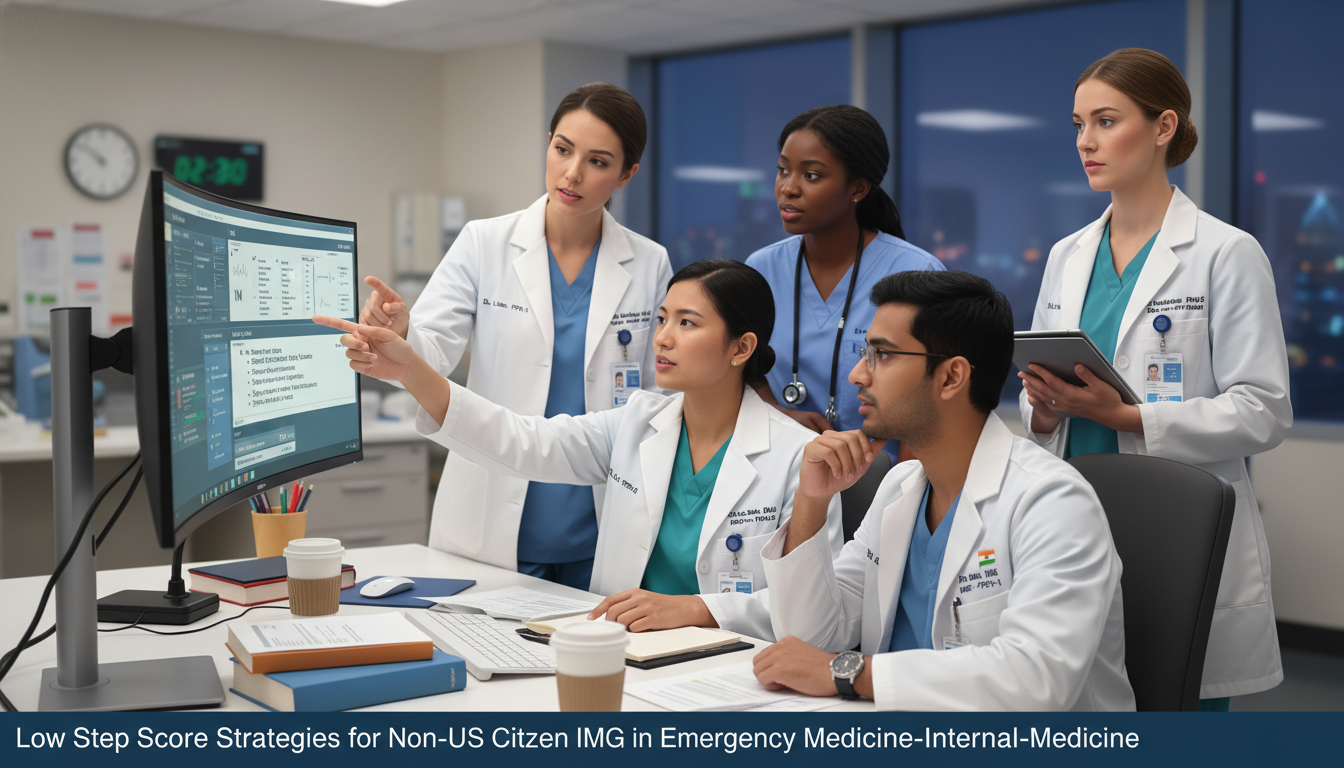
Application Strategy: Targeting EM-IM and Managing Risk with Low Scores
Even with the best profile, strategy matters. As a non-US citizen IMG with a low Step 1 score or below average board scores, you must be realistic and smart about where and how you apply.
1. Understand EM-IM Program Realities
EM-IM programs are:
- Few in number
- Often university-based
- Frequently filled by highly competitive candidates
Some may rarely take non-US citizen IMGs, especially those requiring visa sponsorship. You need to:
- Review program websites and NRMP/FRIEDA data for:
- Past IMG matches
- Visa policies (J-1 vs H-1B)
- Reach out politely to coordinators or residents (if appropriate) to gauge:
- How often they consider foreign national medical graduates
- Whether low scores automatically screen applicants out
If a program has no recent IMGs, no visa sponsorship, and strong US MD bias, it may not be worth prioritizing with limited resources.
2. Balance EM-IM vs Categorical EM vs IM
If EM-IM is your dream, still consider risk management:
- Apply to EM-IM programs where:
- They have historically interviewed/matched IMGs
- You meet at least their published minimums (if any)
- Simultaneously apply to:
- Categorical Internal Medicine (university-affiliated community or academic programs more open to IMGs or lower scores)
- Possibly categorical EM at IMG-friendly, community or hybrid programs (if they consider your profile)
This broadens your chances:
- You may still match into EM-IM.
- You keep realistic alternatives if EM-IM doesn’t work in this cycle.
- Matching into strong categorical IM with EM electives, ultrasound exposure, and ICU experience can still set you up for:
- Critical care
- Hospitalist/ED collaboration roles
- Possible future EM pathway (in some countries or systems)
3. Tailoring Your Personal Statement for EM-IM
For EM-IM, your personal statement must convincingly answer:
- Why both Emergency Medicine and Internal Medicine?
- Why are you a good fit for a 5-year, high-intensity combined pathway, despite low scores?
- How do your experiences show you can handle complexity and ambiguity?
Key elements to include:
- Stories where you managed:
- Acute emergencies (e.g., sepsis, MI, trauma) in the ED
- Complex chronic conditions (e.g., heart failure, cirrhosis, COPD) on wards or clinics
- Evidence that you thrive when:
- Coordinating between ED, ICU, and floor
- Following patients across settings (acute stabilization → inpatient course → follow-up)
Briefly and honestly address your scores only if necessary:
- Keep it short and focused on:
- What changed
- How you’ve grown
- Why your current performance matters more
4. Application Mechanics: ERAS, Filters, and Signaling
To improve your odds of matching with low scores:
- Apply broadly:
- For a non-US IMG with low scores: consider well over 100 applications across EM-IM, EM, and IM, depending on finances and strategy.
- Use program signaling (if available in that year's ERAS for EM/IM):
- Signal EM-IM programs most aligned with your interests.
- Signal a mix of ambitious and realistic programs.
- Make it easy for programs to see your strengths:
- Ensure USCE, SLOEs, and IM letters are clearly highlighted in your experiences.
- Use concise, active descriptions of your duties and achievements.
5. Interview Preparation: Converting Chances into Offers
If you secure interviews, you’ve passed the initial score screen. Now your goal is to demonstrate that:
- You are more than your test scores.
- You clearly understand EM-IM demands and fit their culture.
Prepare for common themes:
- “Tell me about your Step scores.”
- “Why EM-IM instead of just EM or IM?”
- “How do you manage stress and heavy workloads?”
- “Describe a time you made a mistake and how you responded.”
For the Step question:
- Be honest but non-defensive.
- Keep it brief, focused on:
- Lessons learned
- Specific changes you made
- Subsequent strong performance (rotations, Step 2 CK, research)
For EM-IM motivation:
- Show that you love:
- The acute resuscitation of EM
- The longitudinal, complex care of IM
- Connect this to your experiences as a non-US citizen IMG:
- Resource-limited settings
- Continuity of care in your home country
- Desire to practice in environments where you bridge inpatient and ED systems
Visa, Timeline, and Backup Planning for Non-US Citizen IMGs
As a foreign national medical graduate, visa and timing issues can impact your match strategy as much as your scores.
1. Visa Type and Program Compatibility
Common visas:
- J-1 (ECFMG-sponsored):
- Accepted by most academic programs.
- Two-year home requirement (unless waived).
- H-1B:
- Requires Step 3 passed before residency start.
- Fewer programs sponsor due to cost/complexity.
- More common in some IM programs than EM; EM-IM may vary.
Action steps:
- Early in your planning, decide:
- Are you open to J-1? If yes, your pool is larger.
- If you aim for H-1B, prioritize passing Step 3 early and filter for H-1B–friendly programs.
- Check each EM-IM, EM, or IM program’s website for visa policies.
2. Timing of Exams and ECFMG Certification
For a competitive application:
- Aim to have:
- ECFMG certification completed (or nearly completed) by application submission.
- Step 2 CK score reported before programs start reviewing.
- If you plan to use Step 3 as a strength:
- Take it early enough that a strong result appears on your ERAS before interview offers.
3. Backup Plans and Multiple Cycles
If your profile is significantly constrained (very low scores, exam failures, limited USCE), you may need to consider:
- Two-cycle strategy:
- Cycle 1: Build USCE, research, and possibly match to categorical IM or preliminary spots.
- Cycle 2: Reapply after building a stronger record (e.g., from a prelim year, additional research, or improved Step 3 performance).
- Alternate pathways:
- IM → Critical Care / Hospital Medicine with ED focus.
- EM abroad, then later academic affiliation with US EM groups.
The goal is to remain realistic yet optimistic—prioritizing training that moves you closer to what you want to do clinically, even if the path is indirect.
FAQs: Non-US Citizen IMG, Low Scores, and EM-IM
1. Can a non-US citizen IMG with a low Step 1 score realistically match into EM-IM?
Yes, but it is challenging and depends on how low the scores are and what you have done since. You need:
- Strong Step 2 CK (or clear upward trend)
- Excellent US clinical experience with strong SLOEs and IM letters
- Demonstrated maturity, insight, and resilience
- A broad application strategy, including categorical IM (and possibly EM) programs
Pure EM-IM targets without backup are risky; diversify while still authentically emphasizing your interest in the combined pathway.
2. Is it better to focus on EM-IM or just internal medicine if my scores are very low?
If your scores are significantly below average or include failures, categorical IM may offer:
- More programs willing to consider non-US citizen IMGs with lower scores
- A path to critical care, hospitalist roles, or ED-focused hospital medicine, which can overlap with EM-IM career goals
You can still apply to some EM-IM programs that are IMG-friendly, but your main safety net should likely be IM unless your other credentials are exceptionally strong.
3. Will strong US clinical experience and SLOEs really offset low board scores?
They cannot erase low scores, but they can convince some programs to overlook them, especially if:
- The low score is old or isolated, and later metrics (Step 2 CK, clinical performance) are stronger.
- Your SLOEs clearly state you are ready for residency, compare you favorably to peers, and demonstrate steady improvement.
- You articulate a compelling EM-IM–specific narrative during interviews.
Many program directors value real-world clinical performance and professionalism more than a single exam score once you reach a certain threshold of competence.
4. Should I delay my application to improve my profile if my scores are already low?
Delaying makes sense if you can substantially strengthen your candidacy, for example by:
- Completing robust US clinical rotations with the potential for strong letters
- Passing Step 3 with a solid score (especially if you seek H-1B)
- Producing meaningful research or scholarly work related to EM or IM
- Improving your English fluency and communication skills for clinical practice
If, however, you have already maximized these elements and your scores are fixed, additional time may not dramatically change your odds. In that case, focus on:
- Crafting the best possible application now
- Applying broadly and strategically
- Remaining open to categorical IM and other realistic pathways
As a non-US citizen IMG with low Step scores, applying to Emergency Medicine–Internal Medicine is undeniably uphill. Yet many residents with imperfect exam histories have become outstanding EM, IM, and EM-IM physicians by demonstrating resilience, growth, and consistent clinical excellence. Your task is to build a coherent, evidence-based story—through your scores, rotations, letters, research, and interviews—that you are one of them.