
If you are a non-US citizen IMG with a low Step score, you are not alone—and you are not out of the match. Many foreign national medical graduates have successfully matched into IMG friendly residency programs with below average board scores. The key is to be strategic, realistic, and proactive in how you design your path.
This guide walks you through practical, step-by-step strategies for matching with low scores—specifically tailored to non-US citizen IMGs targeting IMG-friendly programs.
Understanding “Low” Step Scores and What They Really Mean
What counts as a “low” score?
“Low” is relative, but for most competitive US residencies:
Step 1 (if you still have a 3-digit score)
240: strong
- 225–239: average to slightly below
- <220: generally “low,” especially for competitive specialties
Step 2 CK
255: highly competitive
- 245–254: strong
- 235–244: solid/average
- <230: usually categorized as “low,” especially for non-US citizens
If your Step 1 or Step 2 CK is below these ranges, you’re facing a steeper climb—but not an impossible one, especially if you aim for IMG friendly residency pathways and build the rest of your application strategically.
How programs actually use Step scores
Program directors rarely look at your score in isolation. They use it to answer three core questions:
Can you pass the boards?
Low scores raise concern about future board failure, which affects their accreditation.Can you handle the workload?
Scores are (imperfect) proxies for test-taking, knowledge, and discipline.Are you worth investing in?
If you’re a non-US citizen IMG, visa sponsorship adds cost/effort; programs want reassurance you’ll succeed.
Your mission is to counterbalance your low Step score by sending a clear, consistent message elsewhere in your application: “I have the skills, work ethic, and support to succeed in your program.”
Choose the Right Targets: Specialties and Programs That Fit Low Scores
For a foreign national medical graduate with a low Step 1 score or low Step 2 CK, specialty and program selection can make or break your match chances.
1. Prioritize specialties that are more IMG-friendly
As a non-US citizen IMG, your safest route with below average board scores is usually in specialties with high IMG representation and more international graduate programs.
Commonly more IMG friendly (and realistic with lower scores):
- Internal Medicine (categorical and prelim)
- Family Medicine
- Pediatrics (more competitive than FM/IM, but still accessible)
- Psychiatry (has gotten more competitive, but still IMG-friendly in specific locations)
- Pathology (requires strong interest, often overlooked by applicants)
- Neurology (moderate competitiveness; IMGs do match here)
Often unrealistic with significantly low scores, especially for non-US citizens:
- Dermatology
- Plastic Surgery
- Orthopedic Surgery
- Neurosurgery
- ENT
- Ophthalmology
- Interventional Radiology
- Integrated programs (Vascular, CT surgery, etc.)
If you have a low Step 1 or Step 2 CK and insist on a hyper-competitive specialty, your odds drop dramatically. Combining low scores + non-US citizen status + competitive specialty is usually a triple disadvantage.
2. Identify truly IMG-friendly residency programs
Not every program that has matched one IMG is “IMG friendly.” You need data.
How to research:
Use FREIDA (AMA)
- Filter by specialty and region.
- Check: Percentage of IMGs, average Step scores (if listed), visa sponsorship, program size.
Look up NRMP/ERAS reports + program websites
- Identify programs with consistent IMG matches over several years.
- Check if they explicitly mention J-1 or H-1B visas on their websites.
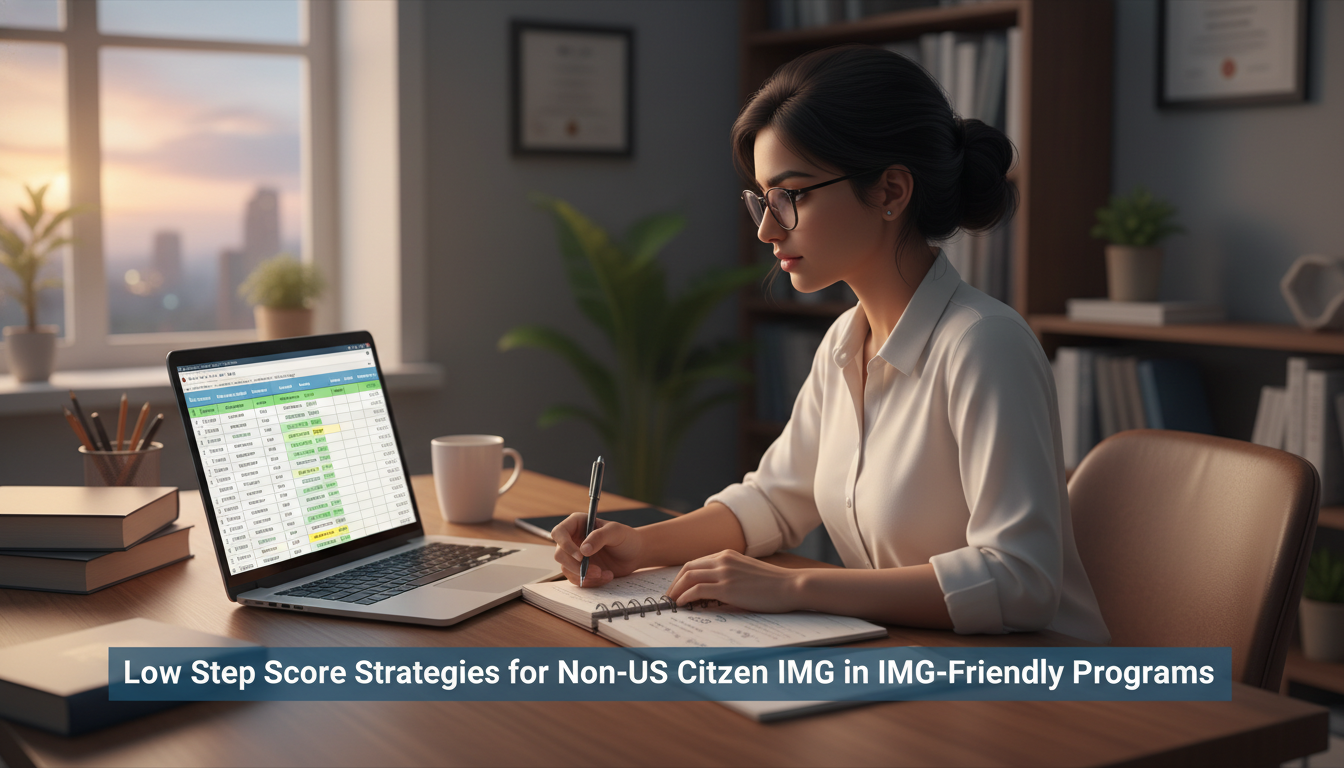
Excel tracking system
Create a sheet with columns:- Program name, city, state
- Specialty (e.g., IM categorical vs prelim)
- IMG percentage
- Visa type supported
- Known average Step 2 CK range (if any)
- Notes (e.g., requires US experience, prefers recent grads)
This systematic approach helps you focus on international graduate programs where non-US citizen IMGs with low scores have historically matched.
3. Be realistic about geography
Certain states and regions consistently show more openness to IMGs:
More IMG-friendly regions:
- New York, New Jersey
- Michigan, Ohio
- Pennsylvania
- Illinois
- Texas (many IMG friendly, but visa policies vary)
- Some community programs in the Midwest and South
Often tougher for non-US citizen IMGs:
- California (complex licensing rules, higher competition)
- Pacific Northwest (small number of programs)
- Some prestigious academic centers everywhere
If your scores are low, double down on states and cities with high IMG representation and a track record of sponsoring visas.
Strengthening Your Application Around a Low Step Score
You cannot erase a low score, but you can strategically build strength in every other part of your application.
1. Turn Step 2 CK into your “redemption arc”
If your Step 1 score is low (or borderline) and you still haven’t taken Step 2 CK, this exam becomes your best opportunity to demonstrate improvement.
Actions:
- Delay applying a year if necessary to ensure a strong Step 2 CK, rather than rushing with another weak exam.
- Aim for at least 10–15 points higher than your Step 1. For example:
- Step 1: 212 → target Step 2 CK: 230+
- Use high-yield resources aggressively (UWorld, NBME/CCSSA practice exams, targeted review of weak systems).
In your application and interviews, you’ll later emphasize:
“I learned from my early exam attempt, adapted my study methods, and my Step 2 CK demonstrates my true capability.”
2. Leverage US clinical experience (USCE) strategically
For a non-US citizen IMG, strong USCE can partially offset low Step scores, especially in IMG-friendly residency settings.
Prioritize:
- Hands-on experiences (sub-internships, externships, US-based postgraduate training)
- Inpatient rotations in your target specialty (e.g., inpatient IM for internal medicine applicants)
- Settings where attendings know you well and can write detailed, personalized letters
Avoid relying only on:
- Pure observerships with no patient contact
- Shadowing where you’re invisible to the team
- Generic or one-week experiences that won’t generate meaningful letters
Try to arrange 2–4 months of solid USCE in the year prior to your application, especially in international graduate programs or community hospitals known for IMGs.
3. Secure powerful letters of recommendation
With low scores, your letters of recommendation (LoRs) must work harder for you.
What strong letters should communicate:
- Your clinical reasoning and work ethic
- Your reliability, professionalism, and adaptability
- Explicit statements like:
- “I would rank this applicant in the top 10% of international trainees I have worked with.”
- “Despite a below average board score, their performance on the wards and knowledge base are excellent.”
Ideal letter writers:
- US attending physicians in your chosen specialty
- Program directors, clerkship directors, or chief residents supervising you directly
- Faculty in IMG-friendly residency programs who understand the context of being a non-US citizen IMG
Make it easy for them:
- Provide your CV, personal statement draft, and a short bullet list of cases or contributions they saw you handle well.
- Politely ask if they can write a strong, supportive letter—and give an option to decline if they cannot.
4. Build a narrative that explains (not excuses) low scores
If your Step 1 or Step 2 CK is low, most program directors will wonder why. Your personal statement and interviews should provide a coherent, honest story:
Examples of acceptable framing:
Adjustment period:
“I struggled initially with adapting to a new testing format and language, and my Step 1 reflects that. Since then, I have adjusted my study strategies and improved my time management, as reflected by my stronger performance on Step 2 CK and in my clinical evaluations.”Circumstances, followed by growth:
“During my Step 1 preparation, I faced significant family and financial stressors which affected my performance. I addressed those issues and learned to create structured routines, which helped me perform much more consistently in clinical rotations and Step 2 CK.”
What to avoid:
- Blaming the exam, the system, or other people
- Over-explaining with unnecessary personal detail
- Sounding like you’re making excuses rather than describing growth
Your story should support the message:
“I faced a challenge, learned from it, and now I have stable, higher-level performance.”
Maximizing Your Match Odds as a Non-US Citizen IMG
Even with a low Step 1 score or a low Step 2 CK, non-US citizen IMGs match every year by being hyper-strategic.
1. Apply broadly—and smartly
With below average board scores, your safety net is wide application coverage.
- For IM or FM with low scores, a non-US citizen IMG may need:
- 100–150+ applications in the US for a reasonable chance (depending on visa needs and YOG).
- Target mostly community programs and smaller university-affiliated programs that are known international graduate programs.
Avoid wasting applications on:
- Highly prestigious academic centers with minimal or no IMGs
- Programs that clearly state they do not sponsor visas
- Programs with stated minimum scores well above yours (e.g., “minimum Step 2 CK 240” if you have 222)
2. Emphasize your strengths in your CV and personal statement
Make it easy for program directors to see value beyond your score.
Highlight:
- Research or QI projects, especially with US collaborators or in the specialty you’re applying to
- Teaching experience (tutoring students, leading study groups, teaching sessions)
- Leadership roles (student organizations, hospital committees)
- Unique experiences (global health, underserved populations, language skills)
Example positioning for low scores:
“While my numerical scores on Step exams do not fully reflect my clinical abilities, my supervisors have consistently rated me highly in clinical evaluations. I am particularly proud of my work on [specific project], where I [measurable impact].”
3. Understand timing and reapplication strategy
If you have both low Step scores and no USCE, consider delaying your application by one cycle to:
- Complete US clinical rotations
- Retake an exam if allowed and strategically beneficial (e.g., Step 3)
- Build a stronger research or QI record
When reapplying:
- Update your personal statement to reflect what you learned from your first attempt.
- Emphasize progress since last cycle: more USCE, stronger LoRs, new achievements, Step 3 pass, etc.
- Target even more tightly defined IMG-friendly residency lists.
4. Use Step 3 strategically (but only if advantageous)
For non-US citizen IMGs, Step 3 can be:
A positive signal if you:
- Have low Step 1 or Step 2 CK and then pass Step 3 with a decent score
- Need to improve your competitiveness for H-1B sponsoring programs
A risk if:
- You are not ready and may fail, reinforcing program concerns
- You cannot dedicate focused time to preparation
If you decide to take Step 3 before applying:
- Aim to pass convincingly, not just barely.
- Use it as evidence: “I can pass US boards and will not be a liability to your program.”

Visa, Networking, and Long-Term Strategy
Your status as a non-US citizen IMG adds complexity—but also gives you clear areas to focus on.
1. Be upfront and strategic about visa needs
Programs differ widely in their approach:
J-1 visa
- Most common for IMGs
- Sponsored through ECFMG
- Many IMG friendly residency programs are comfortable with this
H-1B visa
- Less common, more complex and expensive
- Many community programs do not sponsor H-1B
- Often requires Step 3 completion before residency start
Actions:
- Explicitly track in your Excel sheet which programs:
- Sponsor J-1
- Sponsor H-1B
- Do not sponsor any visas
- Don’t waste applications on clearly non-sponsoring programs, especially with low scores.
2. Network deliberately (not randomly)
With below average board scores, personal connection can push your file from “maybe” to “interview.”
How to network productively:
During USCE:
- Show interest in the residency program.
- Politely ask attendings or residents for honest advice on your chances and how to improve.
- If appropriate, ask if they might consider forwarding your CV to the program coordinator or PD.
Virtual networking:
- Attend virtual open houses and Q&A sessions for IMG-friendly residency programs.
- Prepare brief, thoughtful questions that show you’ve researched the program.
- Follow up with a short thank-you email expressing continued interest.
Alumni connections:
- Reach out to graduates from your medical school who are now in US residency.
- Ask specific questions about how they framed low scores, or how their program views IMGs.
Aim to be remembered as serious, humble, and hardworking, not as someone begging for special treatment.
3. Think in stages, not all-or-nothing
If your scores are significantly low and you face repeated unmatched cycles, consider stepping-stone options:
- Transitional or preliminary year (IM or Surgery prelim):
- Prove yourself clinically and reapply with US residency performance in your favor.
- Non-categorical IM or other entry:
- Some use this route to later secure a categorical spot with strong in-program performance.
- Research positions with clinical exposure:
- Particularly in IMG friendly academic departments.
- Over 1–2 years, this can lead to stronger LoRs and better program familiarity.
These routes are not guaranteed, but they can convert low scores into a “second chance” narrative when combined with excellent work.
Putting It All Together: A Sample Strategy Scenario
Profile:
- Non-US citizen IMG, YOG 2020
- Step 1: 211 (3-digit)
- Step 2 CK: 228
- No USCE yet
- Wants Internal Medicine
Risk factors: low Step scores, no USCE, older YOG, visa need.
One-year rebuild strategy:
6–8 months before application:
- Secure 3–4 months of USCE in IM (preferably at IMG-friendly community hospitals).
- Commit fully: punctual, read on patients, ask thoughtful questions.
During USCE:
- Identify 2–3 attendings who are supportive and ask (politely, early) for strong LoRs.
- Express clear interest in internal medicine and their program.
- Participate in any available QI or case presentations.
Parallel work (throughout year):
- Enroll in or initiate a small QI project or case series with US mentors.
- Strengthen CV with teaching, volunteer work, and structured study sessions.
Application season:
- Prepare a personal statement that briefly explains low Step scores as an early challenge.
- Emphasize growth: improved clinical performance, strong LoRs, QI/research.
- Apply to 120–150 IM programs, focusing on:
- High IMG percentages
- Programs known to sponsor J-1
- Community and smaller university-affiliated hospitals in IMG-rich states
Post-interview:
- Send tailored thank-you emails to programs you are genuinely interested in.
- Rank widely but strategically, giving priority to programs where you felt a good fit and they seemed comfortable with IMGs and visa issues.
This type of deliberate, staged approach turns a low-score profile into a credible, trainable candidate for IMG friendly residency programs.
FAQs: Low Step Score Strategies for Non-US Citizen IMGs
1. Can I still match into residency with a low Step 1 or Step 2 CK score as a non-US citizen IMG?
Yes. Many non-US citizen IMGs with low Step scores match every year, especially into Internal Medicine, Family Medicine, Pediatrics, Psychiatry, Pathology, and Neurology. Success depends on:
- Applying broadly to IMG friendly residency programs
- Strengthening USCE, LoRs, and clinical record
- Demonstrating improvement (e.g., better Step 2 CK or Step 3)
- Being realistic about specialty, geography, and visa limitations
Your chances are lower than someone with high scores, but they are very far from zero if you plan carefully.
2. Should I retake a Step exam if my score is low?
Retakes are tricky and depend on:
- Whether the exam is still retake-eligible
- How low the original score is
- Your realistic ability to significantly improve
A small improvement (e.g., 211 → 218) may not justify the risk and time, while a large jump (e.g., 210 → 235) can meaningfully change how programs view you. For many candidates, it’s safer and more impactful to:
- Focus on Step 2 CK (if not yet taken or low)
- Consider Step 3 later as a positive sign, especially for H-1B-supporting programs
- Strengthen the rest of the application
Discuss your specific numbers with mentors or advisors who work with IMGs regularly.
3. Is it better to apply immediately with low scores or wait a year to improve my profile?
If you currently have:
- Low scores
- No USCE
- Weak or non-US letters
- No research/QI/teaching involvement
…it is often wiser to wait one cycle and invest a year in:
- US hands-on clinical experience
- Building strong LoRs
- Possibly completing Step 3
- Adding research or QI projects
Applying too early with an unprepared application can result in no interviews, which may make reapplication more difficult. A targeted “gap year” often yields much better outcomes for non-US citizen IMGs.
4. How many programs should I apply to with low scores?
There is no universal number, but as a foreign national medical graduate with below average board scores applying in IM or FM, it’s common to see:
- 100–150+ applications needed to generate a reasonable number of interviews, particularly if:
- You graduated >3 years ago
- You require visa sponsorship
- You have limited USCE
More important than the raw number is where you apply: focus heavily on international graduate programs and community-based IMG friendly residency programs that have a consistent history of matching non-US citizen IMGs.
By focusing on what you can control—specialty and program selection, USCE, letters, narrative, and long-term planning—you can significantly improve your chances of matching with low scores as a non-US citizen IMG. Low Step scores close some doors, but with strategy and persistence, they do not close all of them.