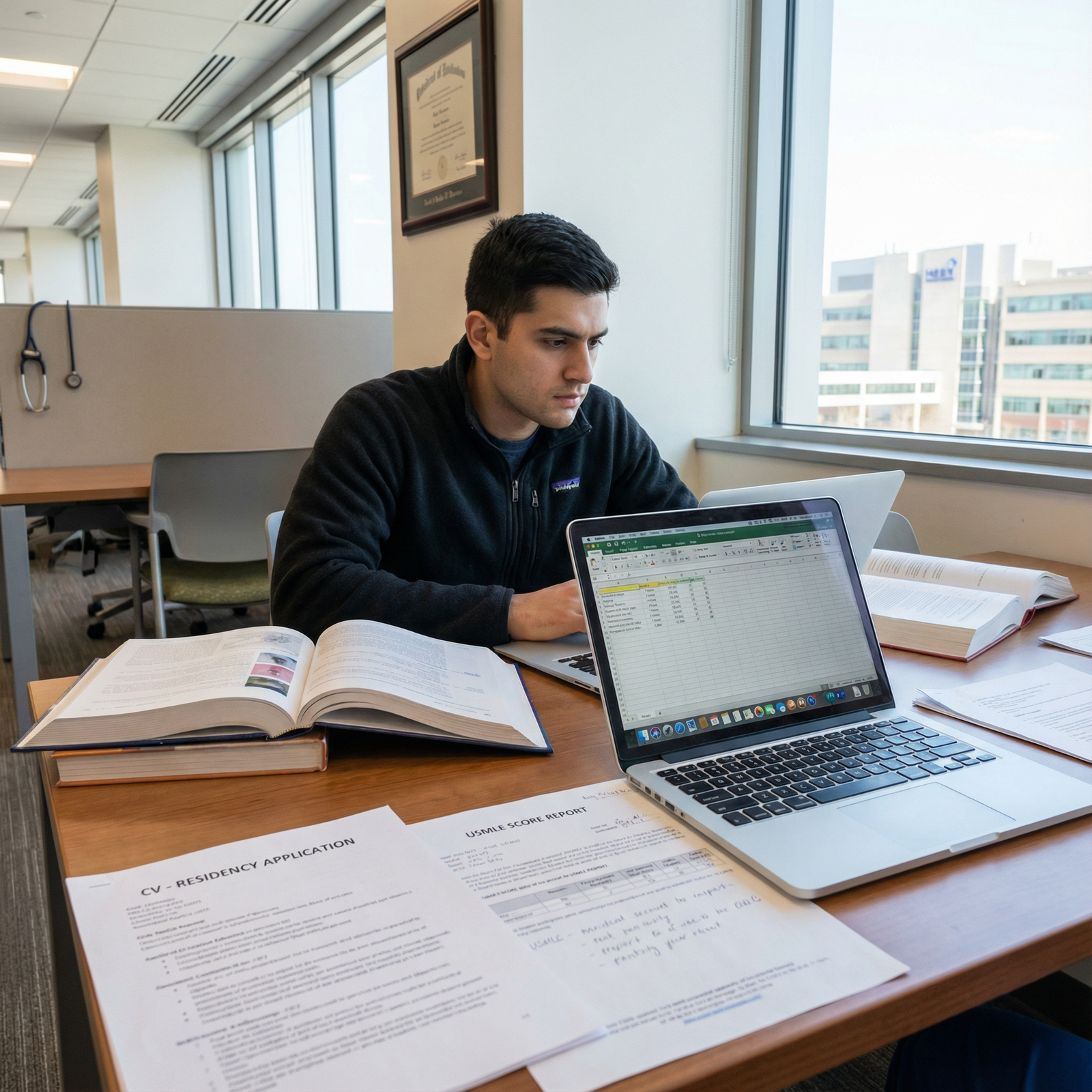
Understanding the Challenge: Low Scores, EM, and Non-US Citizenship
Emergency Medicine (EM) is a competitive specialty, and it is especially challenging for a non-US citizen IMG with a low Step 1 score or below average board scores. However, a low score is not an automatic rejection—it simply means you must be more strategic, focused, and realistic in how you build and present your application.
In this context:
- Non-US Citizen IMG = you completed medical school outside the US and you require a visa (e.g., J-1, H-1B).
- Low Step 1 score / Below average board scores = typically below the national mean or a score that is at or near common “cutoffs” (historically 220–230 for EM, though each program is different; now applied to Step 2 CK since Step 1 is pass/fail).
- Emergency Medicine residency remains attainable, but the path is narrower and requires deliberate choices.
Your goals are to:
- Avoid automatic filters (score and visa).
- Overcompensate with strengths in clinical performance, EM exposure, and letters.
- Target programs intelligently where you are competitive.
- Communicate your story clearly: why EM, why you, despite the scores.
This article focuses on practical, step-by-step strategies to improve your chances in the EM match as a foreign national medical graduate with low or below average scores.
Step Scores in EM: How Much Do They Matter Now?
With Step 1 now pass/fail, Step 2 CK has become a major objective metric. For many EM programs, Step 2 CK is:
- A screening tool to reduce the applicant pool.
- A prediction tool for passing in-training exams and boards.
- A way to compare applicants from different schools and countries.
For a non-US citizen IMG, scores are even more scrutinized because:
- Some programs have hard score cutoffs and receive many applications; they do not manually review all IMG files.
- Some hospitals and GME offices have policies on visa sponsorship and may use scores to justify sponsorship.
If you have a low Step 1 score (older format) or failed Step 1, and/or a below average Step 2 CK, you must understand:
Where your score fits:
- Look at NRMP Charting Outcomes in the Match (EM & IMG sections) to see typical ranges.
- If you are >1 SD below the mean, you are in the “matching with low scores” group and must apply more broadly and strategically.
Programs differ a lot:
- Some EM programs explicitly state no minimum score.
- Some list numeric cutoffs or preferences.
- Some are historically IMG-friendly and more flexible.
One low score is not everything:
- A single low Step 1 with a strong Step 2 CK can be overcome.
- A low Step 2 CK is harder to hide, but you can still compensate with US clinical performance, SLOEs, research, and fit.
The rest of this article focuses on how to build a file that compels programs to look beyond your numbers.
Academic Recovery: Turning Low Scores Into an Academic Narrative
1. Maximize Step 2 CK Performance (If Not Taken Yet)
If you have not taken Step 2 CK or are planning a retake (if allowed), this becomes your single most important academic opportunity.
Actionable strategies:
Treat Step 2 CK as “Step 1 redemption”
Explicitly plan to score well above average (ideally >240–245 if possible) to counteract a low Step 1.- Use UWorld as your primary Qbank; 2 full passes if time allows.
- Add an NBME and/or UWSA practice exam schedule and track progress.
- Set a target score range and don’t rush the exam just to apply earlier—one strong score is more valuable than an early weak one.
Document your improvement
Keep a log of NBME/UWSA scores to show upward trajectory. If you go from e.g., Step 1=210 to Step 2 CK=245, your personal statement and interviews should clearly communicate:- What changed in your study strategies.
- How you adapted and improved.
- What this says about your resilience and growth.
2. Addressing a Low Step 2 CK or Multiple Low Scores
If Step 2 CK is already low, you cannot erase it—but you can reframe it and build a different narrative:
Excel in every subsequent exam:
- CCS cases (for Step 3) if you are taking it early.
- In-training exams during prelim/TY if you go that route.
Show consistency outside test scores:
Your medical school grades, honors, or distinction in clinical rotations (especially EM, medicine, surgery) are important to highlight in your CV and MSPE.Be ready to explain, not excuse
In your personal statement and interviews:- Briefly explain true contributors (family crisis, language transition, poor early strategy), then
- Spend more time on what you learned and how your performance since then has improved.
3. Strategic Use of Step 3 (Selective, Not Automatic)
For a non-US citizen IMG, Step 3 can help in two ways:
- Some programs prefer or even require Step 3 completion to sponsor H-1B visas.
- A solid Step 3 (e.g., >230) can demonstrate that your previous low scores do not reflect your current capability.
However:
- Do not rush into Step 3 just to “fix” a low Step 2 CK if you are unlikely to score significantly higher.
- It’s most helpful if:
- You have time for serious preparation.
- You know you’ll target H-1B-friendly EM or prelim/TY programs.
- You can reasonably expect a clear upward trend.
In your application, highlight Step 3 as part of a consistent improvement story, not merely as another exam.

Building a “Beyond the Numbers” EM Profile
With low or below average board scores, your non-test components must be excellent—especially in ways that EM programs value most.
1. U.S. Clinical Experience in Emergency Medicine
For a foreign national medical graduate, U.S. clinical experience (USCE) in EM is critical:
- Aim for at least 2 EM rotations in the U.S., ideally:
- One at a university or large academic center.
- One at a community-based EM program.
During these rotations:
- Be visible and proactive:
- Arrive early, stay late when possible.
- Ask for feedback and improve daily.
- Volunteer for procedures and challenging cases.
- Demonstrate “EM traits”:
- Calm under pressure.
- Clear communication with nurses and consultants.
- Efficient task management on busy shifts.
- Build real relationships:
- Identify attendings who know you well enough to write a strong SLOE (Standardized Letter of Evaluation).
2. SLOEs: The Most Important Letters in EM
In EM, SLOEs are more influential than generic letters, especially if your scores are weak. Programs want to know:
- How you perform on shift compared to U.S. grads.
- How quickly you learn.
- Whether attendings would want you in their residency.
Key strategies:
- Prioritize rotations at sites that produce SLOEs regularly (most EM programs do).
- Explicitly ask if a SLOE can be written based on your performance and the program’s policy.
- Aim for 2–3 strong SLOEs:
- At least one from an academic EM program.
- Others from community or hybrid EM residency sites.
Inside your SLOE, your advocates can address:
- Your growth and resilience if they know about your score struggle.
- Your clinical strengths that will not appear on a test (e.g., bedside manner, work ethic, leadership).
3. EM-Focused Research and Scholarship
You do not need a PhD or dozens of publications, but EM programs appreciate:
- Any involvement in EM-related research, quality improvement (QI), or education:
- Chart reviews, simulation projects, ED throughput or sepsis protocols.
- Medical education projects (e.g., EM teaching modules).
- Abstracts, posters, or presentations at:
- ACEP, SAEM, EMRA, local or regional EM conferences.
- Even virtual or online EM research consortia.
This helps you:
- Signal a serious commitment to the specialty beyond just liking shift work.
- Build connections with EM faculty who can support your application.
If research options in EM are limited:
- Consider adjacent fields: critical care, trauma, toxicology, ultrasound.
- Use remote/online research collaborations or data analysis roles; many EM departments are open to international collaborators who are reliable and communicative.
4. Demonstrating Non-Academic Strengths That EM Values
Emergency Medicine values:
- Teamwork and interprofessional respect.
- Communication under stress.
- Adaptability across diverse settings and populations.
- Systems-based thinking (flow, safety, triage).
You can highlight these through:
- Leadership roles (student organizations, global health projects, ED-based outreach).
- Work or volunteer experience in:
- Prehospital care/EMS.
- Disaster response.
- Underserved clinic work, especially if fast-paced or acute care-focused.
- Unique experiences as a non-US citizen IMG:
- Working in resource-limited EDs, war zones, refugee clinics.
- Language skills that serve diverse U.S. populations.
Your CV and personal statement should clearly illustrate how these experiences translate into being a strong EM resident.
Application Strategy: Where and How to Apply as a Non-US Citizen IMG with Low Scores
1. Targeting Programs Realistically
You cannot change your scores, but you can change where you apply and how your application is perceived.
Key steps:
Identify IMG-friendly EM programs:
- Use tools like FREIDA, residency explorer, and program websites.
- Look for:
- Programs with current or recent IMGs in their roster.
- Programs that explicitly sponsor J-1 (and possibly H-1B).
- Programs in regions historically more open to IMGs (e.g., Midwest, some South, certain community-based programs).
Check for score cutoffs:
- Some programs list minimum Step 2 CK scores on their websites.
- If your score is significantly below their cutoff, it is usually not worth applying.
Apply broadly:
- For a non-US citizen IMG with below average board scores, it’s common to apply to 60–120+ EM programs depending on:
- Your budget.
- How low your scores are.
- How strong your other components (SLOEs, research, USCE) are.
- For a non-US citizen IMG with below average board scores, it’s common to apply to 60–120+ EM programs depending on:
Avoid over-concentrating on top-tier academic programs:
- A few are reasonable if you have strong SLOEs or research, but most of your list should be mid-tier or community-based, IMG-friendly hospitals.
2. Visa Strategy: J-1 vs H-1B
As a foreign national medical graduate, visa type matters:
J-1 visa:
- More commonly offered.
- Often less administrative burden for programs.
- If you are open to J-1, you expand your program options significantly.
H-1B visa:
- Fewer programs offer it.
- Many require passed Step 3 before residency.
- May be more restrictive for EM applicants with lower scores because programs are selective about who they invest extra effort in.
Strategy:
If you have low Step scores, you maximize opportunities by:
- Being open to J-1 sponsorship.
- Targeting J-1-friendly and IMG-friendly EM programs.
If you must have H-1B:
- Plan to complete Step 3 early with a strong score if possible.
- Focus your list on H-1B sponsoring EM programs (fewer, more competitive).
- Recognize that some applicants may need an intermediate step (e.g., prelim year, research) before qualifying for EM with H-1B.
3. Crafting a Targeted Personal Statement
Your personal statement is your opportunity to interpret your file for the reader:
Address low scores briefly and maturely:
- 2–4 lines is often sufficient.
- Example:
“My Step 1 performance did not reflect my capabilities at the time; I struggled with inefficient study strategies and test anxiety. Recognizing this, I changed my approach fundamentally, as reflected in my later clinical performance and Step 2 CK preparation.”
Emphasize your EM story:
- When and why you chose EM.
- Specific EM experiences (cases, mentors, rotations) that shaped your decision.
Highlight your strengths as a non-US citizen IMG:
- Adaptability to new systems and cultures.
- Rich clinical experiences in different healthcare environments.
- Bilingual or multilingual abilities.
End with a forward-looking perspective:
- What you hope to contribute to your future EM program and its patient population.
- Your long-term goals (community EM, academic EM, global EM, etc.).
Avoid over-apologizing; your tone should be honest but confident.
4. Letters Outside EM and Supplemental Materials
Besides SLOEs, you may have:
- Letters from:
- Internal medicine or surgery attendings who can speak to your work ethic and clinical reasoning.
- Research mentors in EM or related fields.
- Supplemental ERAS experiences:
- Publications, posters, leadership.
Use these to reinforce reliability, maturity, and compatibility with U.S. systems—all vital for programs willing to look past low numbers.

Backup Plans, Parallel Paths, and Long-Term Strategy
For some non-US citizen IMGs with low scores, matching EM on the first try may not happen, even with a strong application. This is not the end of your EM journey; it simply means you may need a multi-step path.
1. Parallel Planning: EM + Another Specialty or Pathway
While applying to EM, consider parallel options such as:
Preliminary or Transitional Year (prelim/TY):
- Gives you U.S. clinical experience, in-training exam performance, and time to earn new letters.
- Use electives to rotate in EDs, build SLOEs, and bolster EM credentials.
- Perform excellently; your performance here can outweigh prior scores in some PDs’ minds.
Family Medicine or Internal Medicine with strong EM exposure:
- Some FM/IM programs offer robust ED experiences and fellowships (e.g., FM-EM tracks, hospitalist-EM hybrid roles).
- May lead to urgent care, ED coverage in some settings, or later EM fellowships in certain countries (though not always ABEM-certified in the U.S.).
Research year in EM:
- Full-time research coordinator or research fellow in an EM department.
- Build:
- Publications and presentations.
- Close relationships with EM faculty.
- A much deeper understanding of U.S. ED workflows.
- After a strong research year, your application can look very different—even with the same board scores.
2. If You Go Unmatched in EM
If you do not match in EM:
Participate in SOAP (Supplemental Offer and Acceptance Program):
- Be open to prelim/TY spots, categorical IM/FM, or any program that can keep you clinically active in the U.S.
After SOAP:
- Immediately seek:
- Research roles in EM departments.
- Non-ACGME fellowships or observer roles that can lead to USCE.
- Immediately seek:
For the next application cycle:
- Add a clear description of what you did in the intervening year and how it strengthened you as an EM candidate (research, improved English communication, new SLOEs, Step 3, etc.).
3. Managing Expectations and Mental Health
The EM match is stressful, and even more so for non-US citizen IMGs with low scores. You must:
- Be realistic about probabilities:
Combine ambition with a pragmatic backup plan. - Limit comparison:
Your peers’ scores or match outcomes do not define your worth or your future. - Seek support:
- Mentors (especially EM physicians familiar with IMGs).
- Online IMG communities and EM mentorship programs.
- Wellness resources—burnout and depression are common in this process.
Matching with low scores is challenging but not impossible; persistence, strategic planning, and self-awareness are as important as any test score.
Frequently Asked Questions (FAQ)
1. What counts as a “low” Step score for Emergency Medicine as a non-US citizen IMG?
While there is no universal cutoff, for EM:
- Historically, Step 2 CK scores below ~230 are often considered below average for competitive EM programs.
- For a non-US citizen IMG, programs may prefer scores closer to or above the national mean due to visa and screening concerns.
However, your competitiveness also depends heavily on:
- Quality and number of SLOEs.
- U.S. EM rotations.
- Research and EM commitment.
- How IMG-friendly the program is.
2. Should I still apply to EM if my Step 2 CK is low?
If EM is your genuine passion, yes—but you must:
- Apply broadly and strategically to IMG-friendly programs.
- Have excellent SLOEs and meaningful USCE in EM.
- Consider parallel or backup plans (prelim/TY, IM/FM, EM research).
- Be prepared to explain and reframe your scores in your personal statement and interviews.
Just understand that your match probability is lower than average, and plan accordingly.
3. Will taking Step 3 help me overcome low Step scores?
Step 3 can help in specific situations:
- It may improve your chances at H-1B sponsoring programs that require it.
- A strong Step 3 performance can show academic improvement and consistency.
It is less useful if:
- You cannot realistically score significantly higher than your previous exams.
- Preparing for Step 3 would severely limit your ability to strengthen other parts of your application (USCE, research, SLOEs).
Use Step 3 strategically, not reflexively.
4. As a foreign national medical graduate, is it better to focus on J-1 or H-1B for EM?
With low or below average scores, being open to a J-1 visa usually increases your chances because:
- More EM programs sponsor J-1 than H-1B.
- Programs may be more hesitant to commit H-1B to an applicant with weaker objective metrics.
If you must pursue H-1B:
- Plan for Step 3 early and aim for a solid score.
- Target only those EM programs that explicitly sponsor H-1B.
- Recognize that you may need an intermediate step (prelim year, research, etc.) to build a more competitive profile.
By understanding how programs use scores, emphasizing your strengths beyond exams, and planning realistic pathways—even if they are multi-step—you can still build a compelling candidacy for Emergency Medicine as a non-US citizen IMG, even with low Step scores.