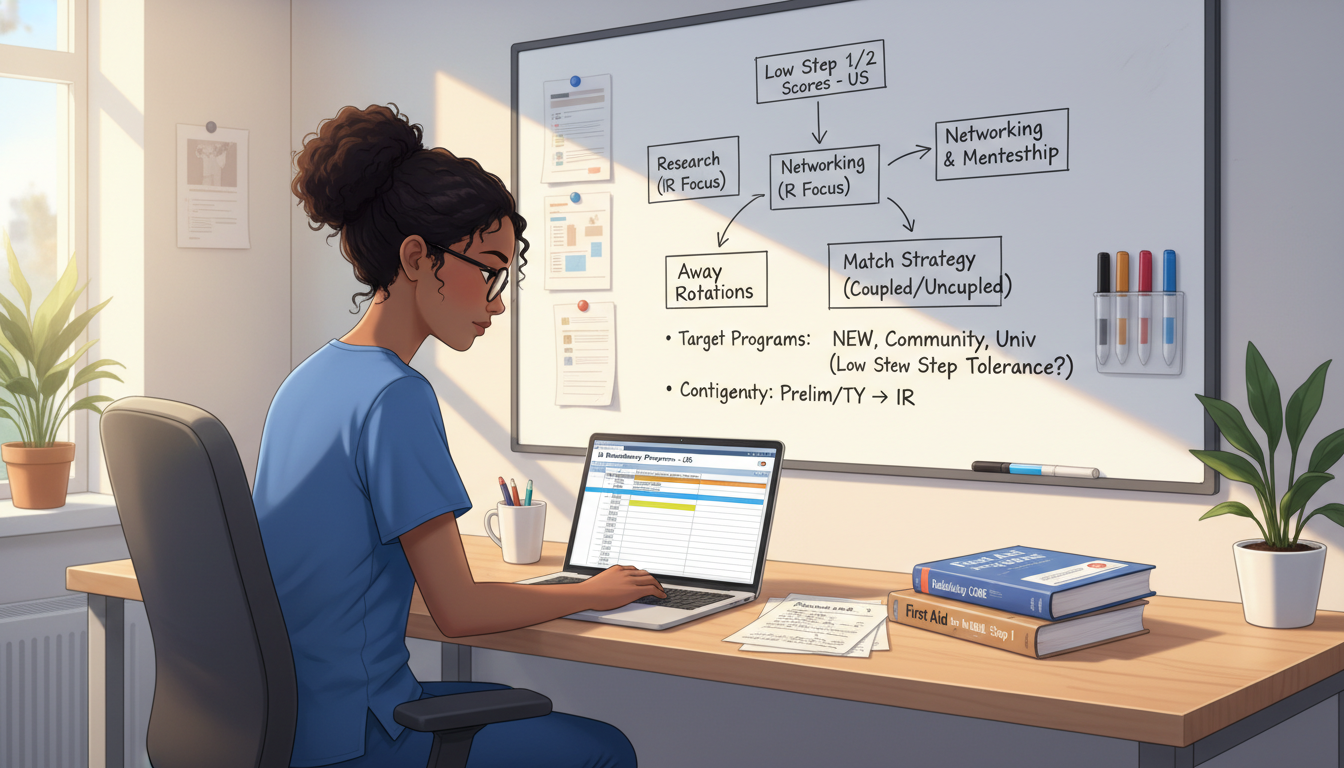
Understanding PM&R Competitiveness When You Have Low Scores
Physical Medicine & Rehabilitation (PM&R) remains moderately competitive, often more accessible than some surgical and highly sought medicine subspecialties. That said, the specialty is becoming more popular, and program directors do care about Step/COMLEX performance—especially for ensuring you can pass boards.
When we talk about a low Step 1 score or below average board scores, we’re usually referring to:
- Step 1: Historically <215–220 (for pass/fail eras, prior failures or marginal passes on COMLEX/other exams)
- Step 2 CK: <220–225 or significantly below your school’s/region’s average
- COMLEX Level 1/2: Scores below the 25th percentile, or any failures
Yet many applicants successfully match into PM&R residency each year with scores in these ranges, or even with a prior failure, because:
- PM&R programs generally use holistic review more than some other specialties
- The field values clinical skills, communication, and long-term patient relationships
- Many programs are looking for residents who are team-oriented, empathetic, and interested in function and quality of life
Your goal is to reframe your application so that board scores are just one small data point in a much richer story.
Key realities to keep in mind:
- A low score does not automatically prevent a successful physiatry match.
- A failed Step/COMLEX is a red flag—but it can be mitigated with a strong upward trend, Step 2 CK success, and a polished application.
- PM&R program directors are often influenced by:
- Strong letters from PM&R faculty
- Performance on away rotations
- Evidence of genuine interest in rehabilitation medicine
- Professionalism and fit on interview day
Your strategy should be to neutralize your weak points and maximize every other signal that you’re ready for a PM&R residency.
Step Scores in PM&R: What They Actually Mean
To strategize effectively, you need to understand how program directors think about scores.
How Programs Use Step 1 and Step 2 CK
Even in the current pass/fail Step 1 era, program directors may still look at:
- Step 2 CK (or COMLEX Level 2) as the objective academic metric
- Your transcript for:
- Course failures/remediations
- Shelf exam performance (if reported)
- Clinical evaluations
Historically, many PM&R programs:
- Used screening cutoffs for Step 1 and/or Step 2, often around 210–220.
- But not all programs reject automatically—especially for applicants with strong compensatory strengths.
Think in terms of “risk assessment”:
- Programs want to know: Can this applicant pass the PM&R boards and USMLE Step 3?
- A low score suggests risk, but:
- A strong Step 2 after a low Step 1 is reassuring.
- A clear explanation and remediation plan after a failure can reduce concern.
If You Have a Low Step 1 Score
If Step 1 was numeric and low:
- Your Step 2 CK becomes critical:
- Target substantial improvement (e.g., +15–20 points vs Step 1 if possible).
- Study systematically and consider structured prep (UWorld, dedicated review, tutoring if needed).
- Aim to take Step 2 early enough that a strong score is available when you apply.
If Step 1 is pass/fail and you passed with difficulty or after a repeat:
- You need to prove mastery with:
- Strong Step 2 CK or COMLEX Level 2 performance
- Strong clinical evaluations
- Relevant PM&R knowledge (e.g., strong performance on PM&R electives)
If You Have a Low Step 2 CK Score
This is more challenging, but still workable, especially in PM&R:
- Focus on demonstrating:
- Strong clinical skills and professionalism
- Reliable work ethic on rotations
- Understanding of functional outcomes and rehab principles
- Address the score honestly in your personal statement or interview if it’s likely to be noticed, focusing on:
- What went wrong (briefly, without making excuses)
- How you changed your approach
- Evidence that your clinical performance does not match that test result
How COMLEX Scores Fit In (DO Applicants)
For osteopathic applicants:
- Some PM&R programs are very DO-friendly; others may prefer or require USMLE scores.
- If your COMLEX scores are low:
- A solid USMLE Step 2 CK (if taken) can help balance them.
- Highlight clinical strengths and strong letters, particularly from MD and DO PM&R attendings.
- Check each program’s website and FREIDA profile to see:
- Whether they accept COMLEX alone
- Whether they require or strongly prefer USMLE
Building a PM&R-Strong Application When Your Scores Are Weak
With below average board scores, your strategy becomes: overwhelm the reader with PM&R fit and demonstrated competence.
1. Lean Hard Into PM&R Clinical Exposure
Programs want proof you understand what PM&R is and truly want this specialty.
Concrete steps:
Core PM&R elective at your home institution
- Aim to excel: show up early, be proactive, volunteer for presentations or mini teaching sessions.
- Ask explicitly for feedback during the rotation, and act on it in real time.
Away rotations (“audition rotations”) at PM&R programs
- Target programs that:
- Are DO-friendly or historically more holistic.
- Have a track record of interviewing/sponsoring IMGs, if relevant.
- Regionally align with where you want to live and train.
- Treat each away rotation as an extended job interview:
- Always be on time (ideally early).
- Offer to help with notes, discharge plans, family meetings.
- Demonstrate curiosity: ask intelligent questions about rehab goals, assistive devices, spasticity management, etc.
- Target programs that:
Diverse PM&R settings, if possible:
- Inpatient rehab
- Outpatient musculoskeletal / sports
- Brain injury / stroke rehab
- Spinal cord injury
- Pain or EMG clinics
The more concrete exposure you have, the easier it is to tell compelling stories in your application and interviews.
2. Secure Powerful PM&R Letters of Recommendation
With low scores, letters of recommendation (LORs) become especially important.
Aim for:
- 2–3 letters from PM&R attendings, ideally:
- One from your home institution, if you have a PM&R department
- One or more from away rotations where you worked closely with attendings
What makes a letter powerful?
- Specific comments like:
- “Top 10% of students I’ve worked with in the past five years.”
- “Demonstrated exceptional empathy and communication with a complex spinal cord injury patient.”
- “Reliable, proactive, and functionally operated at the level of an intern.”
- Clear endorsement of:
- Work ethic and reliability
- Clinical reasoning
- Teamwork and communication
- Fit for a PM&R residency
How to set this up:
- Before your rotation ends, ask:
“Do you feel you know my work well enough to write a strong letter of recommendation for PM&R residency?” - Provide:
- Your CV
- Personal statement draft
- Reminder of particular cases or projects you worked on with them
For low scores, enthusiastic, detailed letters can move your application from “maybe” to “interview.”
3. Use Your Personal Statement Strategically
Your personal statement should not be a long apology for your Step score. Instead:
Focus on:
Why PM&R genuinely fits you:
- Interest in function, disability, and quality of life
- Enjoyment of longitudinal patient relationships
- Comfort with interdisciplinary teams (PT, OT, SLP, nursing, social work, psychology)
- Fascination with neurologic or musculoskeletal recovery
A compelling patient story or clinical experience:
- For example: following a stroke patient from ICU to inpatient rehab to outpatient therapy, seeing their progress and the role of the rehab team.
Evidence of resilience and growth:
- If you choose to mention your low score, keep it brief and forward-looking.
- Emphasize:
- What you learned (time management, test strategy, stress management)
- How it changed your habits and led to improved clinical performance
Avoid:
- Detailed score narratives
- Blaming systems, schools, or “bad luck”
- Overly generic or cliché language about “helping people”
4. Demonstrate Academic Recovery and Commitment
Even with low scores, you can show that you’re academically reliable:
Highlight:
- Improvement from Step 1 to Step 2 CK or from Level 1 to Level 2
- Strong clinical grades and honors in relevant clerkships (IM, neurology, family medicine)
- Any awards or recognition for clinical excellence
If you have time before application:
- Take and excel in an elective with rigorous evaluation (e.g., critical care, neurology) to show high-level clinical reasoning.
- Consider targeted board-style question practice to prepare for future exams and to discuss in interviews how you’ve adjusted your study strategies.
Selecting PM&R Programs Strategically With Low Scores
Where you apply matters almost as much as how you apply. With low or below average board scores, program selection and list-building are critical.
1. Build a Deliberate, Tiered Application List
Aim for a broad and realistic list:
- For most low-score applicants:
- 40–60+ PM&R programs if you are MD with significant weaknesses
- 50–80+ programs if DO, IMG, or with a major red flag (exam failure), depending on your broader profile and finances
Create tiers:
Reach programs
- More competitive, high academic reputation, but still PM&R
- Apply to a handful; a strong PM&R profile and fit may still yield interviews.
Target programs
- DO-friendly, IMG-friendly, or known for holistic review
- Medium-sized university-affiliated or community-based university programs
Safety-ish programs
- Smaller community programs
- Newer programs that are still building their reputation
- Programs in less competitive geographic locations
2. Research Program Culture and Score Cutoffs
Use resources like:
- FREIDA
- Program websites
- Residents’ bios and social media
- Word-of-mouth from upperclassmen, mentors, and residents
Look for:
Programs that explicitly state:
- “Holistic review”
- “No strict Step cutoff”
- History of accepting DOs, IMGs, or applicants with nontraditional backgrounds
Signs of more flexible screening:
- Larger number of residents per year
- Greater geographic spread of medical schools represented
- Visible mix of MD/DO/IMG grads among current residents
Be realistic:
- Some top-tier academic PM&R programs may have more rigid filters.
- With a low Step 1 or Step 2 CK score, prioritize breadth and fit over prestige.
3. Consider a Transitional or Preliminary Year Strategy
If you’re worried about the physiatry match due to very low scores or multiple red flags, consider:
- Applying to:
- Categorical PM&R programs (include both categorical and advanced)
- Advanced PM&R programs + Transitional Year (TY) or Preliminary Medicine positions
Benefits:
- Matching into a TY or prelim year can buy you time to:
- Gain stronger clinical evaluations
- Perform PM&R electives during intern year (where allowed)
- Reapply with a stronger clinical record and fresh letters
Keep in mind:
- This approach requires careful advising and planning.
- You must be proactive about networking and expressing interest in PM&R during your intern year.
Application Tactics and Interview Performance With Low Scores
Once your application is submitted, two levers remain especially critical: interview invites and interview performance.
1. Maximize Your Chance of Interview Invitations
With low scores, every small edge helps.
Tactical moves:
Apply early:
- Have all materials ready at the opening of ERAS.
- Ensure USMLE/COMLEX transcripts, MSPE, and LORs are uploaded as early as possible.
Program signaling (if in use):
- If PM&R participates in signaling during your cycle, use your signal slots strategically:
- Prioritize programs where you have:
- Family/geographic ties
- Completed or scheduled away rotations
- Genuine strong interest and good fit
- Prioritize programs where you have:
- If PM&R participates in signaling during your cycle, use your signal slots strategically:
Targeted “interest emails”:
- For programs you are particularly interested in:
- Send a brief, professional email to the program coordinator and/or PD after applications are released:
- Introduce yourself
- Highlight a strong PM&R-relevant feature (e.g., away rotation, research, meaningful rehab experience)
- Mention any geographic or personal connection
- Keep it short; this isn’t a second personal statement.
- Send a brief, professional email to the program coordinator and/or PD after applications are released:
- For programs you are particularly interested in:
Advisor and mentor advocacy:
- Ask well-connected PM&R faculty (especially those with national or regional roles) if they would be willing to:
- Contact programs on your behalf
- Send a brief email or make a call, especially for programs where your application might be borderline
- Ask well-connected PM&R faculty (especially those with national or regional roles) if they would be willing to:
2. Addressing Low Scores in Interviews
If your low Step 1 score or below average board scores come up, you need a clear, calm, and concise narrative.
A simple framework:
Own it
“I underperformed on Step 1 and that was disappointing, and ultimately my responsibility.”Explain briefly (without excuses)
- One short sentence about context, if relevant:
- “I underestimated the exam and didn’t use enough practice questions.”
- “I had difficulty with test anxiety that I wasn’t managing effectively at the time.”
- One short sentence about context, if relevant:
Show growth
- Then immediately pivot:
- “Since then, I changed my approach: I started using question banks daily, incorporated spaced repetition, and sought help for test-taking strategies.”
- Then immediately pivot:
Point to evidence
- “That led to improved performance on Step 2 CK / clinical shelves / in-service exams as well as stronger clinical evaluations.”
Reassure them about future exams
- “I now have a consistent study system I use to prepare for exams, and I’m confident I can apply this approach to PM&R boards and Step 3.”
Avoid:
- Long justifications
- Blaming your school, test writers, or personal crises in excessive detail
- Getting defensive or visibly uncomfortable
Your tone should be:
- Calm
- Mature
- Forward-focused
3. Show That You Are a “Low-Risk, High-Value” Resident
Program directors ask themselves: “If I match this applicant, what will it be like to have them on my service at 3 a.m.?”
You want to project:
Reliability:
- Share stories that highlight following through, staying late to help with complex discharges, or covering for teammates.
Team orientation:
- Talk about working with PT/OT/speech therapy, nursing, and families to reach goals.
Communication skills:
- Give examples of difficult family meetings, breaking down complex rehab plans, or working with interpreters.
Commitment to PM&R:
- Discuss specific areas of PM&R that excite you (e.g., spinal cord injury, sports, cancer rehab), and why.
When your scores are weaker, these interpersonal and professional attributes must stand out clearly.
Backup Plans and Long-Term Career Thinking
Even with a strong strategy, the physiatry match has some unpredictability. You should plan for:
1. Parallel Planning (Dual-Track Applications)
Depending on your risk tolerance and advisor feedback, consider:
- Applying primarily to PM&R but:
- Also applying to a small number of preliminary medicine or transitional year programs.
- Or, in more severe cases (multiple failures, very low scores, significant visa issues):
- A formal dual specialty application (e.g., PM&R + family medicine or internal medicine).
This is highly individual—discuss with a trusted advisor and PM&R mentor.
2. Strengthening for a Reapplication Cycle (If Needed)
If you do not match:
An unmatched year can be used to transform your profile:
- Work in a clinical research role within PM&R or related fields (neurology, orthopedics, pain).
- Obtain additional US clinical experience if you’re an IMG.
- Publish or present rehab-related research.
- Prepare systematically for any remaining or repeat exams.
- Seek observerships or externships where you can earn new letters.
When you reapply:
- Emphasize the continuous commitment to PM&R.
- Highlight new skills, publications, and stronger letters.
- Clearly explain how this additional year has made you a stronger, more resilient applicant.
3. Keeping Your Identity Larger Than Your Score
Throughout this process, it’s easy to fixate on numbers. Remember:
- PM&R as a specialty values:
- Recovery, adaptation, and function in the face of limitations.
- You are demonstrating those same values by:
- Facing a setback (low Step score)
- Adapting your strategy
- Focusing on what you can control
- Moving forward with purpose
A low or below average board score can be part of your story—but it doesn’t have to be the defining chapter.
FAQs: Matching PM&R With Low Step Scores
1. Can I match into a PM&R residency with a low Step 1 score or Step 2 CK?
Yes. Many applicants match each year with below average board scores, particularly if they:
- Show strong clinical performance and PM&R exposure
- Demonstrate improvement on later exams (when possible)
- Obtain excellent PM&R letters of recommendation
- Apply broadly and strategically
Your odds depend on the combination of your scores, clinical record, letters, and overall application strength.
2. Should I still take Step 2 CK early if my Step 1 is already low?
In most cases, yes. With a low Step 1:
- A strong Step 2 CK can significantly help “reset” perceptions of your academic ability.
- Taking it early enough ensures programs see it in time to offer interviews.
- Only delay if you are genuinely not ready and an early attempt would likely produce another weak score. Always discuss timing with an advisor.
3. How many PM&R programs should I apply to if I have below average scores?
Numbers vary, but for many low-score applicants:
- MD grads: 40–60+ PM&R programs
- DO or IMG with low scores or a failure: 50–80+ programs, depending on other strengths and geographic flexibility
You should build a tiered list (reach, target, and safer programs) and consider geographic and program-type diversity.
4. Should I address my low score in my personal statement?
You don’t have to, but it’s reasonable if your score is significantly low or includes a failure. If you choose to mention it:
- Keep the explanation brief and non-defensive.
- Focus on what you learned and how you changed your study habits.
- Provide evidence of improvement (strong Step 2, better clinical performance).
- Avoid turning your statement into an extended apology—your primary goal is to show why you’re a great fit for PM&R.
By approaching your application with intention—highlighting your PM&R passion, clinical strengths, and growth mindset—you can significantly improve your chances of matching with low scores into a fulfilling career in Physical Medicine & Rehabilitation.