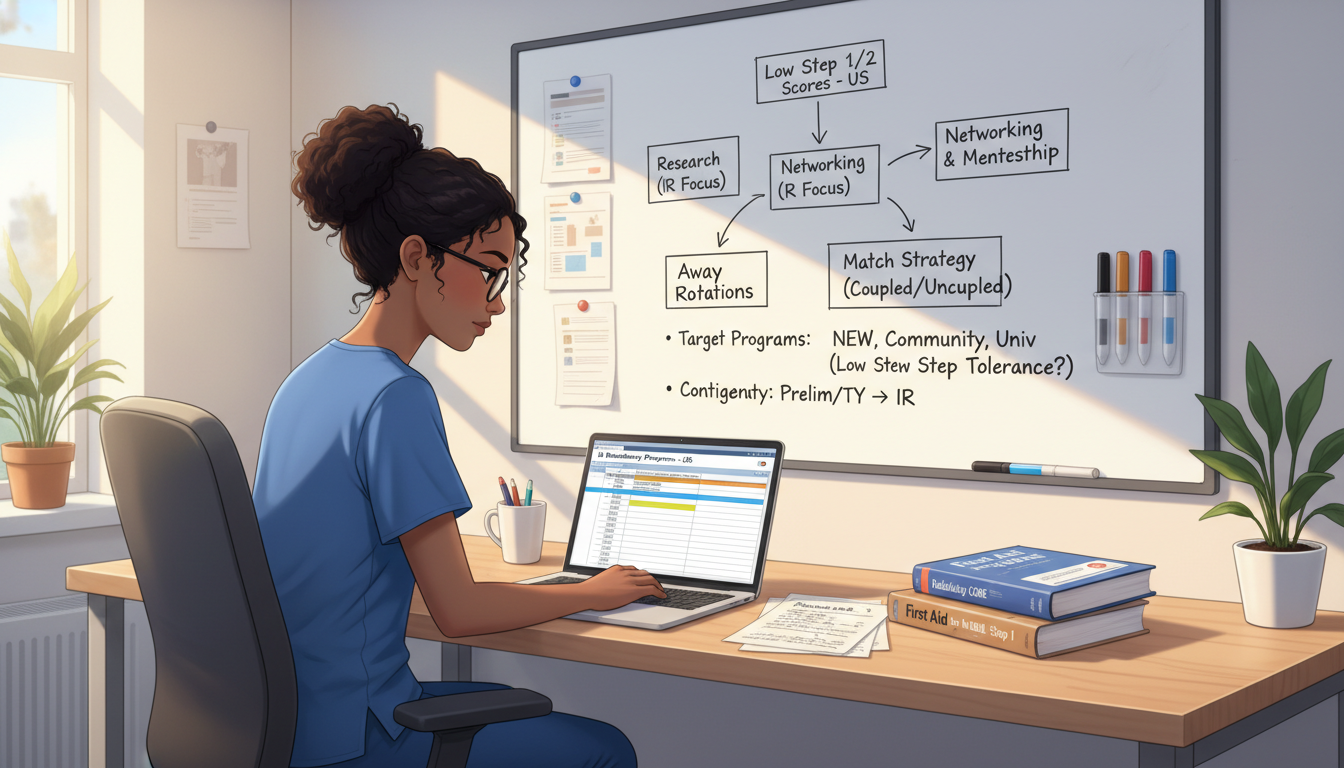
Understanding the Challenge: Low Step Scores and Interventional Radiology
Interventional Radiology (IR) is one of the most competitive specialties in the Match. For a US citizen IMG or an American studying abroad, applying in IR with a low Step 1 score or below average board scores can feel intimidating. Many applicants worry that a single number has already determined their fate.
It hasn’t.
Your Step scores matter—especially in IR—but they are part of a broader story. Many US citizen IMGs have successfully navigated the IR match, even when they started with a lower Step 1 score or needed a Step 2 CK retake. The key is to understand:
- How IR program directors think about scores
- Where your application has flexibility and leverage
- How to compensate aggressively in other domains
This article breaks down a strategic, step-by-step approach specifically for:
- US citizen IMG applicants
- Interested in Interventional Radiology (Integrated IR or Independent IR)
- Concerned about low Step scores or below average board performance
The goal is not to sugarcoat the challenge. IR is tough. But with a focused, realistic plan, you can significantly upgrade your chances of an IR match or an IR-accessible pathway.
How Programs See Your Scores as a US Citizen IMG
Interventional Radiology program directors are balancing three questions when they see your exam history:
- Can this applicant pass boards and handle the cognitive load?
- Will they be safe and reliable in a high-stakes, procedure-heavy field?
- Do their other accomplishments offset or contextualize the score?
For a US citizen IMG or American studying abroad, low scores can raise more concern than they might for a US MD at a highly ranked school. But directors still look at patterns and trajectory:
- Single low Step 1, strong Step 2 CK → Often seen as recovery and maturity.
- Low Step 1 and modest Step 2 CK, strong clinical evaluations, and research → Mixed but can be rescued with strength elsewhere.
- Multiple failures without explanation, no improvement → Hardest to overcome, but still not completely impossible with intermediate goals (e.g., diagnostic radiology, transitional pathways).
What Counts as “Low” in IR?
Definitions vary by program, but broadly:
- Historically competitive IR applicants often had Step 1 and Step 2 CK scores at or above national averages for matched applicants in radiology and surgical fields.
- “Low Step 1 score” or “below average board scores” in IR terms often means:
- Score around or below the national mean, especially when compared to other IR applicants
- Any fail on Step 1 or Step 2 CK
- A Step 2 CK score that doesn’t clearly recover from a weaker Step 1
Even if Step 1 is now Pass/Fail for many applicants, older scores or failed attempts are still visible. For US citizen IMGs, your Step 2 CK will likely be the primary numerical screen, so it becomes your most important testing opportunity going forward.
Step-by-Step Score Strategy: Repair, Recover, and Reframe
You can’t change a low Step 1 score, but you have significant control over everything that happens next. Your strategy begins with understanding your current testing profile and building a narrative of growth.
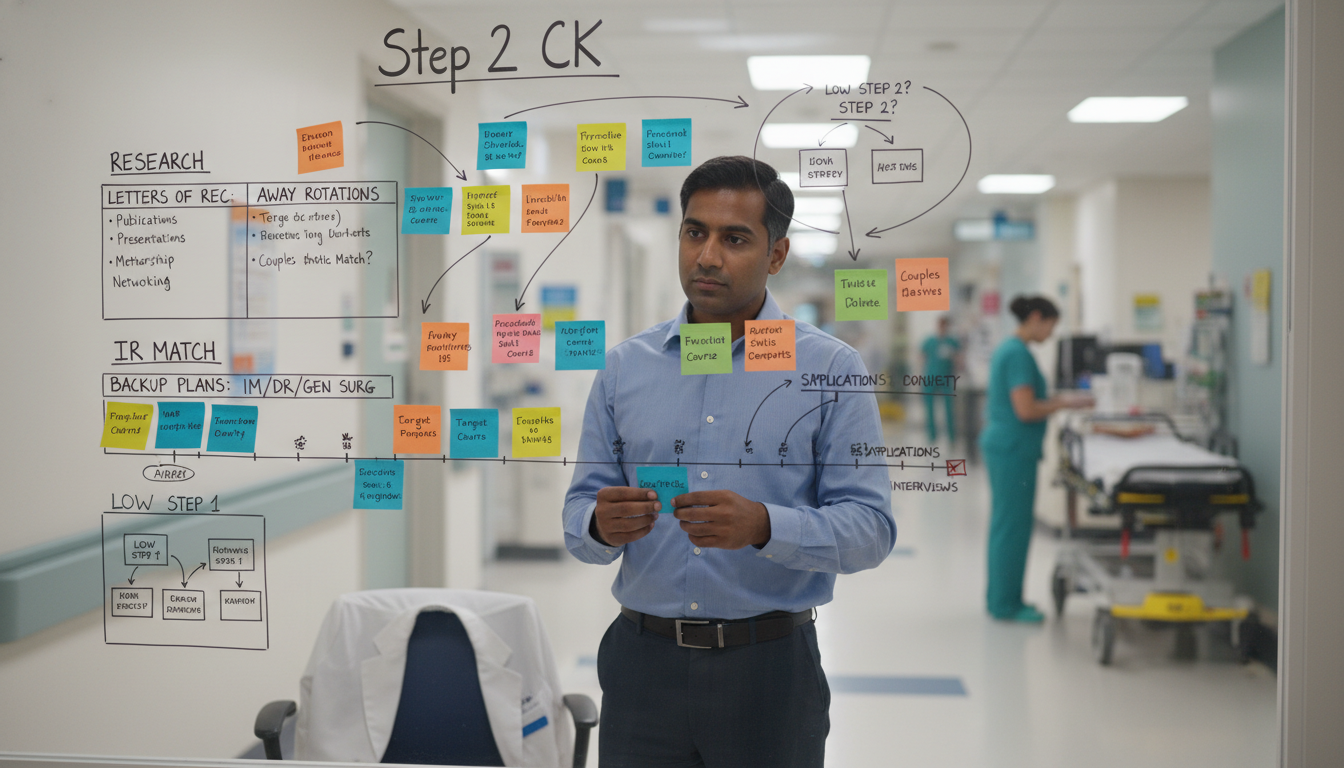
1. Step 2 CK: Your Critical Second Chance
If your Step 1 score is low, your Step 2 CK becomes your primary tool for changing the conversation. For a US citizen IMG aiming at IR:
- Goal: Step 2 CK that is clearly higher than Step 1 and at or above the national mean, preferably meaningfully above.
- Strategy:
- Delay the exam rather than repeat a poor performance. Program directors prefer a slightly later strong score versus an earlier mediocre one.
- Do an honest self-assessment using NBME practice tests and UWorld self-assessments; only schedule when you are consistently in your target range.
- Pay attention to discipline: IR is procedural, but programs still want to see internal medicine, surgery, and emergency topics handled well.
If you already have a low Step 2 CK:
- Look for evidence of upward trend in other exams if available (COMLEX, shelf exams, in-training exams later).
- Double down on non-exam strengths—research, away rotations, and letters—to show your real clinical capability.
2. Explaining a Low Score Without Making Excuses
Every low score prompts the unspoken question: What happened?
Your goal is to provide a brief, credible explanation and focus on what you learned and how you improved. Appropriate contexts can include:
- Underestimation of the exam and poor early strategy
- Personal or family challenges (described briefly, without oversharing)
- Transition struggles as an American studying abroad adjusting to a new educational system
Poor explanations or red flags:
- Blaming professors, the school, or the test itself
- Long, emotional narratives without a clear pivot to improvement
- No mention of concrete steps taken afterwards
Where to address this:
- Personal statement (brief paragraph)—focus on resilience and growth
- Dean’s letter / MSPE—if your school comments on it
- Interviews—have a polished, honest 1–2 minute explanation ready
3. Demonstrating Cognitive Strength Beyond the USMLE
If your board scores are not your best feature, show intellect and clinical reasoning in other ways:
- Shelf exams: Strong performance on core clerkship exams (especially surgery and medicine) is a positive signal.
- Research output: IR and radiology research often demands image interpretation, data analysis, and concise scientific writing. Publications and abstracts can offset doubts about your academic capabilities.
- Presentations: Being first author on a poster or oral presentation at SIR (Society of Interventional Radiology) or other reputable meetings shows commitment and professional-level thinking.
Building an IR-Competitive Portfolio When Scores Are Weak
A lower Step score means you must be exceptional in other dimensions. As a US citizen IMG, you’ll want to build a portfolio that screams: “I belong in IR, and I’ve proven it in real-world ways.”
1. IR Exposure: Show You Know What You’re Signing Up For
Program directors want confidence that you understand the lifestyle, demands, and realities of interventional radiology. For an American studying abroad, this is especially critical because IR exposure at your school may be limited.
Concrete steps:
IR Electives (US-based):
- Try to secure at least one, ideally two, IR rotations in the US at institutions with integrated IR programs.
- During your rotation, be early, prepared, teachable, and visible in the suite. Read patient charts in advance, volunteer for consults, and practice case presentations.
- Ask for mid-rotation feedback and correct issues quickly—this translates into stronger letters.
Shadowing and Procedural Clinics:
- If formal electives are hard to secure, consistent shadowing over several months with a dedicated IR attending at a US hospital still counts.
- Track your experiences: types of procedures observed, cases discussed, and specific patients followed. This gives you rich content for your personal statement and interviews.
IR Societies and Online Education:
- Join the Society of Interventional Radiology (SIR) as a medical student member.
- Complete IR-related online modules or certificate courses and list them in your CV.
2. Research Strategy: Depth Over Volume
Research is one of the most powerful counters to a low Step score, especially in a procedure-based specialty like IR.
Aim for:
- At least 1–2 IR-related projects ideally leading to:
- Abstracts/posters at SIR, RSNA, or other major conferences
- Manuscripts submitted or accepted in peer-reviewed journals
How to get involved as a US citizen IMG:
- Cold Emailing IR Faculty:
- Target US institutions (especially those with IR-DR programs) and look up faculty doing clinical or outcomes research.
- Send a concise email: who you are, your IR interest, your willingness to help with data collection/literature review, and your timeline.
- Remote or Virtual Research Roles:
- Many projects can be done remotely (chart reviews, database analyses, literature syntheses). Emphasize your reliability and clear communication.
- Case Reports from Home Institution:
- If your overseas school has IR or interventional procedures in radiology, ask attendings to let you write up interesting cases.
Programs will often forgive a low Step 1 score if they see serious, sustained IR research output that demonstrates curiosity, persistence, and intellectual engagement.
3. Letters of Recommendation: Your Most Important Non-Numerical Asset
For someone matching with low scores, LORs can move the needle dramatically.
Priority order:
- Strong letters from US-based IR attendings
- Supportive letters from US diagnostic radiology attendings
- Letters from US surgical or medicine attendings who saw you in high-acuity settings
What makes a letter powerful?
- Specific examples: “She came in early to prepare for complex TIPS cases and followed patients on the ward.”
- Improvement narrative: “His Step 1 score does not reflect his current capabilities; on my service he consistently performed at or above the level of US MD students from top schools.”
- Comparative language: “Among the top 10% of students I have worked with in the past five years.”
Give your letter writers:
- Your CV and personal statement draft
- A concise summary of your scores, and—if you feel comfortable—a brief explanation of prior test struggles and your subsequent growth
- Clear deadlines and instructions (ERAS upload, etc.)
Application Tactics: Program List, Signaling, and Backup Plans
With suboptimal scores, how you apply becomes as important as who you are. You must use strategy to maximize your chances of getting interviews.

1. Targeting IR Programs Realistically
For integrated IR:
Research “IMG-friendly” programs:
- Look at historical matches (FRIEDA, program websites, residency forums).
- Programs that have previously taken IMGs—including US citizen IMG applicants—are more likely to consider your file despite lower scores.
Consider smaller or less well-known programs:
- Community-based or university-affiliated programs in less popular locations may be more flexible on scores if you bring strong commitment and work ethic.
Apply broadly:
- With low scores, a narrow application strategy is risky. Many applicants in your position apply to every IR program plus a large number of DR programs.
2. Diagnostic Radiology as a Strategic Pathway
Many US citizen IMGs with low Step scores successfully match into Diagnostic Radiology (DR) and later pursue:
- Independent IR residency (after a DR residency)
- Early specialization in IR within DR programs where available
- Hybrid IR/DR-focused careers in community practice
Advantages:
- DR is more accessible than integrated IR at many institutions.
- Once you are inside a DR program and prove yourself clinically and academically, your original board scores fade in importance.
- You can still end up practicing a significant volume of IR procedures depending on your fellowship and job choices.
Application strategy:
- Apply to both IR and DR in the same cycle.
- Use your personal statement to express:
- Primary interest in IR
- Genuine enthusiasm and respect for DR as a field
- Flexibility in career path: e.g., “My goal is an image-guided procedural practice, whether through integrated IR or a DR residency followed by IR fellowship.”
3. Supplemental Pathways and Transitional Steps
If both IR and DR seem out of reach directly because of particularly low scores or multiple failures, consider transitional strategies:
- Preliminary year in surgery or internal medicine with strong radiology/IR research during that time.
- Research fellowship in Radiology or IR at a US academic center:
- 1–2 years of full-time research can transform your CV and yield multiple publications, presentations, and strong letters.
- Some programs informally “feed” their successful research fellows into their DR or IR training programs.
These options require time and patience but can significantly alter your long-term odds of practicing IR.
Standing Out on Paper and in Person: Narrative, Personal Statement, and Interviews
When your scores are not your selling point, your story must be exceptionally compelling.
1. Crafting a Personal Statement That Works With—not Against—Your Scores
Your personal statement is not the place to re-litigate your low Step 1 score in detail. It is the place to:
- Highlight your genuine fit for IR: love of procedures, patient interaction, problem-solving, and imaging.
- Show sustained commitment: IR rotations, research, mentorship relationships.
- Show maturity and resilience: if you mention your scores, do so briefly in the context of growth.
Example structure:
- Opening vignette from an IR case you participated in (e.g., emergent embolization, TIPS, limb salvage).
- Development: how your interest in IR evolved, including specific rotations and research.
- Acknowledgment of challenge: one short paragraph about your score setback and what you learned.
- Evidence of growth: stronger clinical performance, research achievements, letters, and deliberate preparation.
- Closing: your vision for your career in IR/DR, with emphasis on teamwork, patient-centered care, and procedural excellence.
2. Interview Performance: Turning a Potential Weakness Into a Strength
If you’re invited to interview, your file has already cleared the main score-based filters. Interviews are your chance to:
- Directly address concerns about your testing history without sounding defensive.
- Show personality: humility, reliability, curiosity, and team orientation are vital in IR.
- Demonstrate knowledge of the field: discuss IR cases, patient follow-up, and research with nuance.
When asked about your low Step 1 score:
- Be honest and concise:
- “I underestimated the exam early in medical school and didn’t have an effective study structure.”
- Pivot quickly to growth:
- “Since then, I completely changed how I study—building daily question blocks, spaced repetition, and peer teaching. You can see that reflected in my later clinical performance, my IR research productivity, and my evaluations.”
- Avoid sounding bitter or blaming: keep the tone professional and forward-looking.
FAQs: Low Step Scores, IR Match, and US Citizen IMG Concerns
1. Can a US citizen IMG with a low Step 1 score still match into interventional radiology?
Yes, but it is challenging. A low Step 1 score, especially for a US citizen IMG, means you must:
- Make Step 2 CK as strong as possible
- Build substantial IR exposure and research
- Obtain excellent US-based letters, ideally from IR attendings
- Apply broadly and be open to DR as a pathway toward IR
Direct integrated IR matches with low scores are less common, but DR → IR pathways are very realistic, especially if you use your residency years to build a strong IR profile.
2. How low is “too low” to apply in IR?
There is no absolute cutoff that applies to every program. However:
- If you have multiple exam failures or both Step 1 and Step 2 CK far below the mean, many integrated IR programs may screen you out automatically.
- In that scenario, your best strategy is usually to:
- Focus heavily on DR programs that are IMG-friendly
- Consider a research year or transitional year to strengthen your file
- Plan for independent IR training down the road
If you have a single low Step 1 but better Step 2 CK, it is often still worth applying to both IR and DR, especially at programs with a history of taking IMGs.
3. Does being an American studying abroad help compared to non-US IMGs?
Being a US citizen IMG can help with:
- Avoiding visa-related concerns
- Perceived familiarity with the US healthcare environment (especially if you did US clinical rotations)
However, for IR, the main concerns remain your training background, clinical performance, letters, and scores. Your citizenship alone will not overcome serious deficiencies in other areas, but it reduces one administrative barrier.
4. Should I delay graduation or take a research year if my scores are low?
A dedicated research year in IR or radiology can be a powerful asset if:
- You can secure a position with active mentorship and likely publications
- You use the time to network, present at conferences, and build strong US letters
- You are willing to invest an extra year in training for a stronger long-term position
This is particularly valuable for US citizen IMGs with borderline scores who want to shift the focus of their application toward research productivity and commitment to IR.
Low Step scores close some doors—but far fewer than most anxious applicants fear. As a US citizen IMG, you have unique advantages (no visa needs, often strong English proficiency and cultural familiarity) that you can leverage alongside carefully chosen IR rotations, deliberate research, excellent letters, and a smart application strategy.
With disciplined effort and realistic planning, matching into an interventional radiology residency—either directly or through a diagnostic radiology pathway—remains within reach, even when you’re starting from behind on the score sheet.