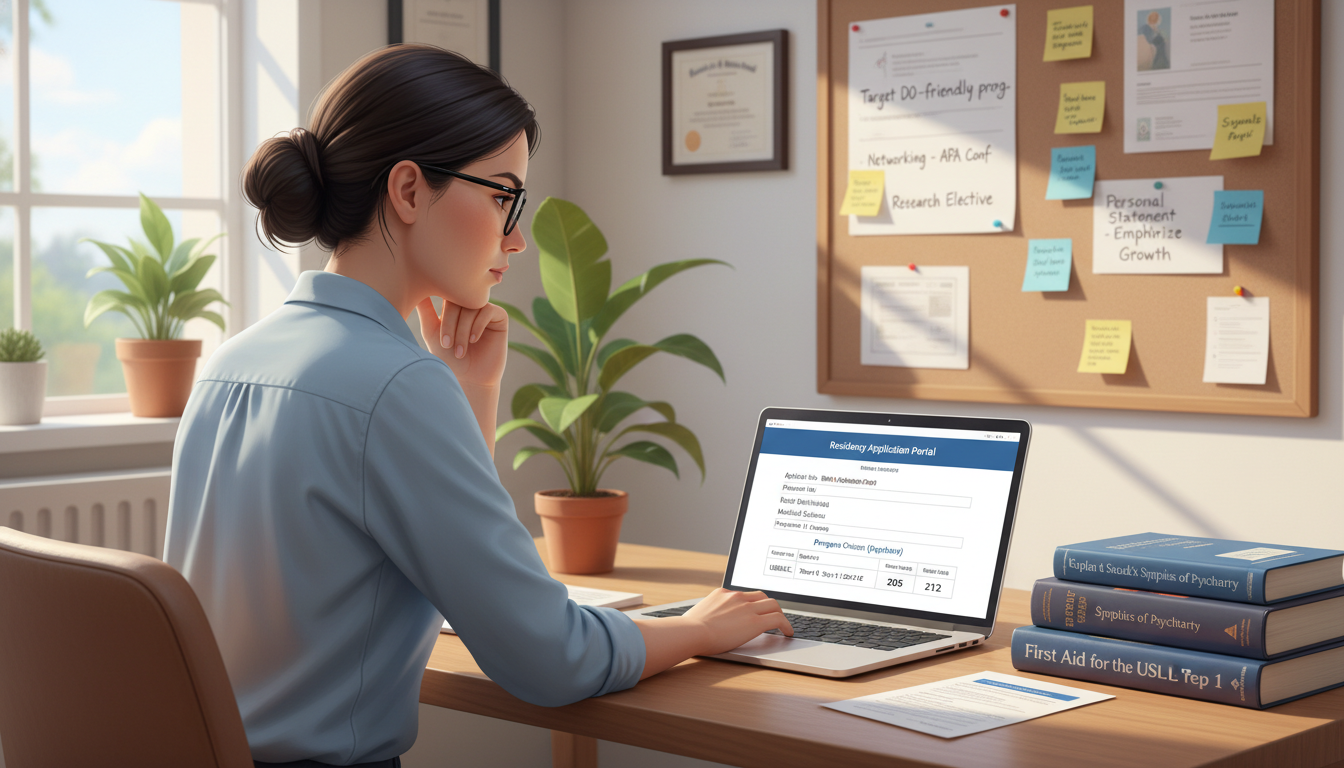
Understanding the Landscape: Low Step Scores as a US Citizen IMG in Psychiatry
If you are a US citizen IMG or an American studying abroad with a low Step 1 or Step 2 score, pursuing psychiatry residency can feel intimidating. You may be wondering whether a psych match is still realistic, how much your scores matter, and what you can do to offset a low Step 1 score or below average board scores.
The honest answer: psychiatry does care about scores, but it is also one of the more holistic, narrative-driven specialties. For US citizen IMGs, matching with low scores is absolutely possible—but it requires deliberate strategy, smart program targeting, and a compelling story that highlights why you belong in psychiatry.
This article breaks down:
- How psychiatry programs view US citizen IMGs and low scores
- What “low score” actually means in the current match climate
- How to reframe your application to highlight strengths beyond numbers
- Concrete, step-by-step strategies to improve your chances of a psych match
- How to choose programs and design a realistic, data-driven application plan
Throughout, we’ll focus specifically on the perspective of a US citizen IMG or American studying abroad aiming for psychiatry residency.
How Psychiatry Programs View Low Step Scores and US Citizen IMGs
Before planning your strategy, you need clarity on how program directors think.
What counts as a “low score” in psychiatry?
With Step 1 now Pass/Fail, “low scores” mostly refer to:
- A failed Step 1 attempt (even if you later passed)
- Marginal Step 2 CK (e.g., <220–225, depending on your cohort)
- Significant discrepancy between Step 1 and Step 2 (e.g., large drop)
- Below average board scores compared to typical IMG applicants
Psychiatry’s average USMLE Step 2 scores are generally lower than surgical subspecialties, but they are trending upward as the field becomes more competitive. A “low” score is context-dependent:
- For highly academic, big-name university programs, “low” may be <235–240.
- For community or IMG-friendly programs, “low” may be <220–225.
- Multiple failures or very low scores (<210) are more concerning anywhere.
If your Step 2 CK is below the national mean or you have a failure, you should approach the process as a “low score” applicant and build a compensatory strategy.
How programs evaluate US citizen IMGs and Americans studying abroad
Program directors typically categorize IMGs into:
- US citizen IMGs (including Americans studying abroad)
- Non–US citizen IMGs (visa requiring)
As a US citizen IMG, you have important advantages:
- No need for visa sponsorship (simplifies logistics for programs)
- Often stronger English proficiency and cultural familiarity
- Frequently some US clinical exposure or family ties in the US
But you also share many IMG-related challenges:
- School name or country may be less familiar to PDs
- Limited or shorter US clinical experiences
- Fewer built-in connections to US residency programs
For psychiatry, programs tend to value:
- Evidence of genuine interest in psychiatry (electives, research, advocacy, mental health work)
- Strong communication skills, empathy, and professionalism
- Reliable performance (no pattern of academic or professionalism issues)
- Letters from psychiatrists who know you and can speak specifically about your fit
Low scores make programs worry about:
- Your ability to pass Step 3 and ABPN boards
- Possible underlying issues: poor test-taking, burnout, inconsistency, or professionalism concerns
Your job is to reassure them with your narrative and evidence that you will be safe, reliable, and successful in training.

Step 1: Analyze and Own Your Score Profile
You cannot build a strong strategy without an honest self-assessment. Avoid vague labels like “bad” or “terrible.” Get specific.
Break down your exam history
List out:
- Step 1: pass/fail, number of attempts, date of completion
- Step 2 CK: numerical score, number of attempts, date
- Any NBME or shelf trends (especially psych-related performance)
- Any failed clerkships or remediation
Then ask:
- Is there a pattern? One-time low score vs. repeated marginal performance
- Is there a clear turning point? Improvement over time, evidence of growth
- Are there mitigating factors? Health, family, pandemic disruptions (be careful; these must be credible, not excuses)
Programs respond better to: “I improved and here’s how” than “It’s not my fault.”
Example: Turning a low Step 1 into a narrative asset
Imagine this profile:
- Step 1: Failed on first attempt, passed on second
- Step 2 CK: 223
- Psych shelf: Above average
- Psychiatry clinical evaluations: Strong narrative comments on empathy, teamwork, communication
You might frame it like:
- You initially struggled with the massive content load and test anxiety.
- You sought support, changed your study methods, did more practice questions, and addressed anxiety.
- Your improved Step 2 CK, stronger shelf exams, and solid clinical performance show you’ve developed resilience and more effective strategies.
You’re not hiding your low score—you’re showing growth, insight, and reliability, which are central to psychiatry.
When to address scores in your personal statement vs. MSPE vs. interviews
Personal Statement:
- Address a low Step 1/Step 2 only if:
- There was a major event (illness, family crisis, war) and
- You can show clear improvement afterward.
- Keep it brief (2–3 sentences), focused on what changed and how you grew.
- Address a low Step 1/Step 2 only if:
ERAS Additional Information section or Program-Specific Questions:
- Good place to give a concise, factual explanation if invited.
Interviews:
- Be prepared with a polished, 30–60 second explanation:
- Own it
- Explain what you did differently
- Show evidence of sustained improvement
- Be prepared with a polished, 30–60 second explanation:
Avoid blaming your school, faculty, or “test style.” Psychiatry favors self-awareness and accountability.
Step 2: Build a Psychiatry-Centric Application That Outshines Your Scores
The more your application screams “future psychiatrist,” the less dominant your scores will appear in the reviewer’s mind.
1. Maximize psychiatry clinical exposure in the US
For a US citizen IMG or American studying abroad, US clinical experience (USCE) in psychiatry is one of the most powerful ways to offset low scores.
Aim for:
- At least 2–3 months of psychiatry-focused USCE if possible
- Mix of:
- Inpatient psychiatry
- Outpatient clinics
- Consultation-liaison psychiatry (CL)
- Addiction or geriatric psychiatry (if available)
Prioritize:
- Hands-on rotations over observer-only experiences
- Sites with a residency program, especially if they historically interview or match IMGs
- Supervisors who are known to write detailed, supportive letters
During each rotation:
- Show up early, stay engaged, volunteer for tasks
- Learn the basics of psychiatric interviewing and documentation
- Ask for feedback and actively implement it
- Express your interest in psychiatry clearly but professionally
By the end, you want attendings who think:
“This applicant will be a great psychiatry resident, regardless of their scores.”
2. Cultivate psychiatry letters of recommendation that carry weight
For a psych match, aim for:
- 3 letters total, ideally:
- 2 from psychiatrists (US-based if possible)
- 1 from another specialty (IM/FM/neurology) or a psych researcher
For low-score applicants, the quality and specificity of letters are critical. A strong psych letter might include:
- Detailed comments on your interpersonal skills, empathy, and boundaries
- Examples of your work with complex patients
- Evidence of reliability and conscientiousness (documentation, follow-up, attendance)
- Comparison to prior residents or students: “Among the top 10% I have worked with”
Ask for letters early, and specifically say:
“I’m planning to apply to psychiatry with a score profile that isn’t as strong as I’d like. I’m working hard to show programs I will be a strong resident. Do you feel you know me well enough to write a strong letter that speaks to my fit for psychiatry?”
If they hesitate, move on to another potential letter writer.
3. Demonstrate a sustained commitment to mental health
Psychiatry values trajectory: your story should show a long-standing, evolving interest—not a last-minute pivot because scores were low.
Ways to build that narrative:
- Pre-med/undergrad: mental health advocacy, hotline volunteering, psychology major, research
- Medical school:
- Psychiatry interest group leadership
- Electives in addiction, child/adolescent, forensics, CL psychiatry
- Community mental health work, free clinics, outreach programs
- Post-graduation gap years (if applicable):
- Paid or volunteer positions in mental health clinics
- Research coordinator roles in psychiatry departments
- Work with underserved or high-need communities
Document these clearly in ERAS with concise descriptions highlighting:
- Your role and responsibilities
- Skills gained (communication, crisis assessment, team collaboration)
- Any outcomes (e.g., projects, QI initiatives, patient education materials)
This helps programs see you as a psychiatry person with low scores, not a low-score person applying everywhere.
4. Use your personal statement to show insight, not numbers
The personal statement is especially important for psychiatry. Program directors look for:
- Reflective capacity
- Ability to talk about difficult experiences with nuance and boundaries
- Genuine interest in mental health, not just generic “I like talking to patients”
For a US citizen IMG with low scores, your PS should:
- Tell a coherent story of why psychiatry and why now
- Highlight key experiences that shaped your interest
- Demonstrate self-awareness about challenges (without oversharing or therapeutic confessions)
- Emphasize resilience, growth, and traits that matter in psychiatry: patience, empathy, reliability, curiosity
If you briefly mention a low Step 1 score or below average board scores, do so in the context of growth and adaptation, not self-pity.

Step 3: Strategic Program Selection for Matching with Low Scores
Your chance of matching with low scores depends heavily on where you apply, not just how you present yourself.
1. Know your competitiveness band
Consider the following red flags:
- Step 1 fail (eventually passed)
- Step 2 CK <220–225
- Multiple exam attempts or repeated clerkship failures
If you have one of these issues, you’re in the “mild-to-moderate concern” group.
If you have two or more, you’re in the “significant concern” group and must be especially strategic.
Ask yourself honestly:
- Do I have strong offsetting factors? (e.g., robust US psych experience, glowing letters, research, US citizen IMG advantage, strong communication skills)
- Am I flexible on geography and program type?
The more flexible you are, the better your odds.
2. Target programs that historically consider IMGs and lower scores
Focus your psychiatry residency list on:
- Community-based programs affiliated with universities
- State programs in less competitive locations (Midwest, South, some rural areas)
- Newer programs (but vet them for accreditation status and training quality)
- Programs that list IMGs among recent residents or faculty
- Programs that do not publish strict Step cutoffs, or that explicitly state they review applications holistically
Use tools and strategies like:
- FREIDA: filter for psychiatry programs and check “IMG percentage” of residents.
- Program websites: look at current residents; are there IMGs, US citizen IMGs, or Americans studying abroad?
- NRMP Charting Outcomes / Program Director Survey: to understand general thresholds and IMG match patterns.
If a program states: “We require Step 2 CK ≥ 240” and your score is 218, apply your time and money elsewhere.
3. Build a broad, tiered application list
For a US citizen IMG with low Step scores, a reasonable approach might be:
- 60–100 psychiatry programs total, depending on how low your scores are and your resources
- Tier your list into:
- 15–20 “reach” programs (slightly above your stats, but IMG-friendly)
- 30–50 “realistic” programs (scores and background align with their historical patterns)
- 10–20 “safety-ish” programs (heavier IMG representation, new programs, less popular locations)
Do not restrict yourself only to big coastal cities or brand-name universities. Many excellent psychiatrists train in smaller or community-heavy programs.
4. Be realistic about dual-application strategies
If your scores are quite low (e.g., Step 2 CK <215 or multiple failures), consider a dual application strategy:
- Primary focus: Psychiatry
- Secondary: Related specialties or transitional-year/preliminary programs (if you are open to this path)
However:
- Do not dilute your psychiatry narrative by submitting a generic application to multiple specialties.
- If you dual-apply, tailor personal statements and program signals accordingly.
Step 4: Enhance Your Application During Pre-Application and Interview Seasons
Even after your scores are fixed, you have opportunities to strengthen your profile.
1. Consider an additional psych-focused research or clinical year (if feasible)
If you have significant score concerns and are still 1–2 cycles away from applying:
- Look for research assistant or coordinator positions in psychiatry departments
- Explore postgraduate clinical observer/fellow roles in mental health settings
- Join ongoing quality improvement or community mental health projects
This can:
- Generate US-based psychiatry letters
- Add publications/posters to your CV
- Demonstrate dedication and improvement over time
2. Prepare meticulously for interviews
With low scores, every interview invitation is precious. You must convert a high percentage of interviews to strong “rankable” impressions.
Focus on:
Practicing behavioral questions:
- “Tell me about a time you dealt with a difficult patient.”
- “Describe a failure and how you handled it.”
- “How do you take feedback?”
Crafting a polished explanation of:
- Why psychiatry
- Why your scores do not reflect your true potential
- What you learned from your challenges
Demonstrating:
- Warmth, empathy, and professionalism
- Clear communication, good listening, and insight
- No defensiveness about scores or past setbacks
Programs might ask directly about your low Step 1 score or below average board scores. Your response should:
- Acknowledge the reality
- Provide a succinct explanation
- Emphasize specific actions you took to improve
- Reference better performance in clinical work, psych shelf exams, or other objective measures
3. Use the Supplemental ERAS Application and Signaling Wisely (if available)
In some cycles, psychiatry participates in program signaling or a supplemental application. If so:
- Signal programs where you have real connections:
- USCE completed there
- Geographic ties (family, spouse, prior residence)
- Long-standing interest in their clinical or research focus
As a low-score US citizen IMG, do not waste signals on programs unlikely to consider you. Target places where your combination of:
- US citizenship
- Psychiatry-focused experience
- Genuine interest
may push you into the interview pile despite your numbers.
4. Post-interview communication and ranking
After interviews:
- Send brief, sincere thank-you emails to program coordinators and, if appropriate, select faculty.
- Avoid repetitive or overly emotional messages. Focus on:
- Appreciation
- One specific thing you liked or learned about the program
- A clear statement of continued interest (if true)
When building your rank list:
- Rank programs in true order of preference, not by perceived competitiveness.
- Do not self-eliminate based solely on scores if you had a positive interview.
Step 5: Contingency Planning and Long-Term Perspective
Even with a strong strategy, some low-score applicants do not match on their first try. Planning ahead does not mean expecting failure—only being prepared.
If you don’t match in psychiatry the first time
If you go unmatched:
Do a calm, structured post-mortem:
- How many interviews did you receive?
- Did you target programs appropriately?
- Did you have enough US psych experience and strong letters?
- How was your interview performance (feedback from mentors or mock interviewers)?
Strengthen your application during the gap year:
- Get more US psych clinical exposure or a full-time mental health job
- Pursue research or QI projects
- Improve communication or test-taking skills (if Step 3 is ahead)
Retake an exam only if recommended and allowed:
- In most cases, you can’t retake a passing USMLE for a higher score.
- But you can work to pass Step 3 strongly if you haven’t taken it yet, which may reassure future PDs.
Stay in touch with psychiatry mentors:
- Ask them candidly how they perceive your competitiveness.
- Request feedback on your personal statement, letters, and program list for the next cycle.
Long-term, your Step scores matter less than you think
Within residency:
- Colleagues and attendings rarely care about your Step 2 number.
- They care about your work ethic, reliability, empathy, and team skills.
- Board certification is pass/fail—you either pass or you don’t.
Years from now, your identity as a psychiatrist will be shaped far more by:
- How you treat your patients and colleagues
- Your clinical judgment
- Whether you continue learning and growing
Your Step scores are an obstacle now—but they do not define your eventual value as a psychiatrist.
FAQs: Low Step Scores and Psychiatry Match for US Citizen IMGs
1. I’m a US citizen IMG with a Step 2 CK below 220. Do I still have a real chance at psychiatry?
Yes, but you must be strategic and realistic. Focus on:
- Strong US psychiatry clinical experiences
- Excellent, detailed psych letters
- A compelling, psychiatry-centered narrative
- Broad applications to IMG-friendly, community, and newer programs
- Well-practiced interview skills
Your odds will not be the same as someone with a 250, but many programs value US citizenship plus strong clinical performance and commitment to psychiatry more than a single test score.
2. I failed Step 1 but passed on the second attempt. Should I explain this in my personal statement?
If you have a clear, concise, and growth-oriented explanation, it can be reasonable to include 1–2 sentences. For example:
“I failed Step 1 on my first attempt after struggling with test anxiety and inefficient study strategies. I sought support, changed my approach, and subsequently passed Step 1 and improved my performance on clinical exams.”
Do not go into excessive detail or blame others. Focus on what changed and how your later performance reflects that.
3. How many psychiatry programs should I apply to if my scores are below average?
For a US citizen IMG with low Step 2 CK or prior failures:
- Commonly 60–100 psychiatry applications is reasonable, depending on finances and how low your scores are.
- The lower your scores or the more red flags you have, the broader your list should be—and the more it should tilt toward community/IMG-friendly programs.
Discuss a specific range with a trusted advisor, mentor, or dean’s office who knows your full profile.
4. Does doing research in psychiatry really help if my Step scores are low?
Psychiatry research by itself will not erase low scores, but it can:
- Show sustained interest in the field
- Connect you with faculty who may advocate for you
- Strengthen your application through additional letters and experiences
- Signal academic curiosity and perseverance
It’s especially helpful if combined with US clinical experience and strong performance in actual patient care settings.
You can’t change your past scores, but you can absolutely shape the story they sit inside. As a US citizen IMG or American studying abroad, your combination of US ties, evolving experience, and a genuine commitment to mental health can be more powerful than you realize—if you present it thoughtfully and target your psychiatry residency applications wisely.