
Understanding the VA Residency Landscape When You Have a Low Step Score
If you have a low Step 1 score, a below average Step 2 CK, or overall weaker board metrics, it can feel like doors are closing—especially in competitive environments. Yet VA residency programs (residencies that include major training time at Veterans Affairs hospitals) offer real opportunities for applicants who know how to position themselves.
VA hospitals are affiliated with academic institutions across the country and participate in almost every specialty: internal medicine, psychiatry, general surgery, emergency medicine, neurology, PM&R, family medicine, and more. Importantly, many VA-affiliated programs evaluate applicants holistically, and often value maturity, service, and clinical performance as much as (or more than) pure test scores.
This guide will walk you through targeted, practical strategies to strengthen your application and improve your chances of matching with low scores into VA residency programs or veterans hospital–based tracks.
We’ll focus on:
- How VA hospitals fit into the residency ecosystem
- The real impact of low Step scores on VA-based applications
- High-yield strategies to offset low scores
- How to write and communicate your narrative effectively
- Specialty-specific nuances within VA residency programs
- Frequently asked questions about VA residency programs and low Step scores
1. How VA Residency Programs Work (and Why They’re Unique)
VA hospitals don’t run most residency programs directly; instead, they partner with medical schools and teaching hospitals. Understanding this structure helps you strategize.
1.1 Affiliate-Based Structure
Most VA residency programs are actually:
- University-based programs with VA as a major training site, or
- VA-based training tracks within a broader residency program
Examples (hypothetical but realistic):
- “University X Internal Medicine Residency – VA Medical Center Track”
- “State Y Psychiatry Residency – Primary VA Site”
- “University Z Neurology – VA Chief Resident in Quality & Safety (CRQS) positions”
What this means for you:
- You’re applying through ERAS to the university program, not “the VA” itself.
- The VA component may have a special focus: geriatrics, mental health, trauma-informed care, chronic disease, health systems, quality improvement, or telehealth.
1.2 What VA Sites Often Value
VA residency programs frequently look for:
- Commitment to service, veterans, and public health
- Maturity and professionalism (many veterans are older, complex patients)
- Team-based, interprofessional collaboration skills
- Interest in:
- Chronic, multi-morbidity care
- Mental health and PTSD
- Addiction medicine
- Rehabilitation and prosthetics
- Health systems improvement and quality/safety
- Rural or underserved care (for some VA sites)
These are non-test-score attributes—a huge opportunity if you’re matching with low scores.
1.3 How VA Involvement Affects Competitiveness
Program competitiveness varies widely:
- A highly ranked university internal medicine program with a big VA campus may still be quite competitive.
- Smaller or mid-tier academic centers with VA sites may be more accessible to applicants with a low Step 1 score or below average board scores, especially if you show strong fit with VA patient care.
In short: Not all VA residency programs are “less competitive,” but many VA-heavy tracks are more open to holistic review, especially in fields like psychiatry, internal medicine, family medicine, PM&R, and neurology.

2. The Real Impact of a Low Step Score in VA-Associated Programs
2.1 What Counts as a “Low” Score?
Even though USMLE Step 1 is now pass/fail, PDs still consider:
- Step 1 performance (pass on first attempt vs multiple attempts)
- Step 2 CK numeric score
- Any COMLEX scores for DO applicants
- Attempt history, failures, and trends
A “low” score is relative, but broadly:
- Below average Step 2 CK (e.g., < 230–235 for many core specialties)
- Any failed attempts
- Score notably below the average of the prior year’s matched applicants in that specialty
For veterans hospital residency programs, specific thresholds vary by:
- Specialty (surgery vs psychiatry vs internal medicine)
- Program reputation (elite vs community-affiliated)
- Applicant pool (US MD vs US DO vs IMG)
2.2 How Programs Use Scores: Screening vs Selection
Most programs first use scores for screening:
- Automatic filters (e.g., Step 2 CK ≥ 220)
- First attempt pass vs repeat attempts
Then, among screened applicants, fit, narrative, and experiences become more important.
In VA-associated programs, PDs may be more flexible when:
- You have strong VA-related or service-oriented experiences
- You show clear clinical strength (honors, strong letters)
- Your scores show upward trajectory (e.g., borderline pass Step 1, but strong Step 2 CK)
- You are a US grad with positive clerkship performance at a VA site
2.3 When a Low Score Hurts Most
Your low Step 1 or below average Step 2 CK tends to hurt most if:
- You’re applying to highly competitive specialties (e.g., derm, ortho, ENT, neurosurgery)
- You have multiple exam failures
- You have limited clinical letters from US settings
- Your application lacks a coherent, service-oriented narrative
However, many veterans hospital residency tracks exist in specialties where holistic review holds more weight, such as:
- Internal Medicine (including VA-focused primary care)
- Family Medicine (especially at VA community-based outpatient clinics)
- Psychiatry (VA has extensive mental health services)
- PM&R (veterans with amputations, spinal cord injury, TBI)
- Neurology
- Some Emergency Medicine, Anesthesiology, and Surgery programs with substantial VA time
If you align with these fields and can tell a compelling story, matching with low scores is absolutely possible.
3. High-Yield Strategies to Offset Low Scores for VA Residency Programs
3.1 Master the “VA Fit” Narrative
A compelling VA-focused narrative can move your application to the interview pile even with below average board scores.
Reflect and highlight experiences that show:
- Service to military, veterans, or underserved populations
- Volunteering at VA clinics or veteran-centered organizations
- Work with homeless shelters, substance use programs, or mental health outreach
- Personal connection:
- Military family background
- ROTC, prior service, or National Guard/Reserve
- Close relationships with veterans in your life
- Understanding of VA priorities:
- Chronic disease, multimorbidity, polypharmacy
- PTSD, depression, anxiety, substance use disorders
- Rehabilitation after trauma or neurologic injury
- Health systems/quality improvement and patient safety
In your personal statement and ERAS experiences, explicitly connect these themes to:
- Why VA-based training fits your values
- How your past experiences have prepared you to care for veterans
- How you plan to contribute to VA care (e.g., quality improvement, research, education)
Example: Reframing a Low Score
Instead of:
“I had trouble with Step 1 and my score does not reflect my abilities.”
Try:
“Early in medical school, I underestimated the adjustment required to learn medicine in a new system and language, and my Step 1 performance suffered. In response, I sought mentorship, overhauled my study strategies, and prioritized consistent self-assessment. This led to stronger clinical performance and a significantly improved Step 2 CK score. The same persistence and adaptability now guide my approach to caring for veterans with complex medical and psychosocial needs.”
This frames your low Step 1 score as evidence of growth, resilience, and maturity, traits VA programs value.
3.2 Lean Hard on Clinical Excellence
When your test scores are weaker, clinical performance can be your anchor.
Focus on:
- Honoring core clerkships, especially:
- Internal Medicine
- Psychiatry
- Family Medicine
- Neurology
- Surgery or PM&R, depending on your specialty interest
- Achieving strong sub-internship (sub-I) or acting internship evaluations
- Seeking VA-based rotations if your school offers them:
- Inpatient internal medicine or psychiatry at the VA
- VA ambulatory clinics
- VA spinal cord injury, TBI, or rehab units (for PM&R/neurology)
Ask attendings and preceptors at the VA who see your work ethic and bedside manner to:
- Write detailed, specific letters of recommendation
- Comment explicitly on:
- Clinical reasoning
- Professionalism
- Empathy in working with older adults and complex veterans
- Communication within interprofessional teams
Action step: Identify at least two potential letter writers with VA experience who can speak to your skills beyond test scores.
3.3 Build a VA-Relevant CV: Research, QI, and Service
Even modest scholarly or service projects can carry extra weight if they clearly relate to veterans.
Examples:
- Research:
- PTSD or depression in veterans
- Chronic pain management
- Opioid stewardship or addiction medicine
- Telehealth interventions for rural veterans
- Outcomes after amputation or prosthetic technologies
- Quality Improvement:
- Reducing hospital readmissions among veterans with heart failure
- Improving vaccination rates (flu, COVID, pneumococcal) in VA primary care
- Medication reconciliation projects in VA inpatient units
- Service/Leadership:
- Organizing a veteran health screening event
- Leading a student interest group on military/veteran health
- Participating in VA-focused outreach or advocacy initiatives
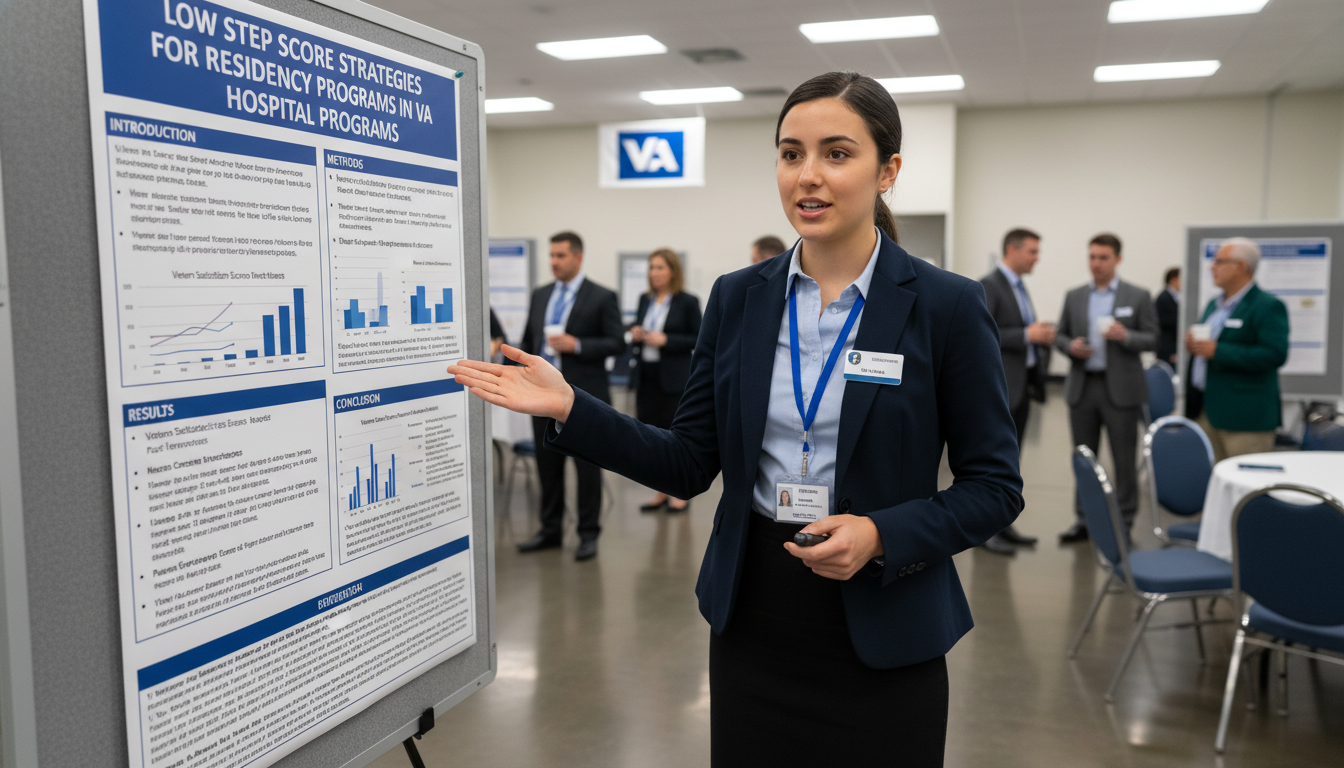
Even if you don’t have first-author publications, posters at regional or national conferences (especially those focused on VA or federal health systems) are valuable talking points.
3.4 Be Strategic About Specialty and Program Tiers
With below average board scores, your strategy should balance ambition with realism.
Select specialties with better alignment for low Step scores, especially at VA sites:
- Internal Medicine
- Family Medicine
- Psychiatry
- PM&R
- Neurology
- Some community-affiliated Emergency Medicine programs
Apply broadly within your chosen specialty, including:
- A mix of academic centers with VA hospitals
- “Hybrid” programs that combine VA with community hospitals
- Programs in less densely populated or less competitive regions
Within VA-affiliated programs, consider:
- Mid-tier academic centers
- Programs not located in “destination” cities
- Institutions known for primary care or mental health rather than cutting-edge subspecialty prestige
3.5 Use Away Rotations (Auditions) Wisely
If you can secure an away rotation at a VA site, it can dramatically help matching with low scores, provided you perform well.
Tips:
- Choose programs you’d realistically attend and that have a substantial VA presence.
- Request rotations where you interact with potential letter writers (attendings, chiefs, program leadership).
- Consistently:
- Show up early, prepared, and organized
- Volunteer for tasks and follow through
- Ask for mid-rotation feedback and act on it
- At the end, ask directly if your performance is strong enough to merit a letter and if the writer can speak positively about you despite lower scores.
4. Communicating About Low Step Scores Without Undermining Yourself
4.1 When (and Where) to Address Low Scores
You can discuss your low Step 1 score or below average Step 2 CK in:
- The personal statement (briefly, not the main focus)
- An ERAS “Additional Information” or “Education” section (if structured for that)
- Interviews, especially when asked:
- “Tell me about a time you faced a setback”
- “Tell me about your Step scores”
- “What is a weakness in your application?”
Avoid turning your entire application into an apology. The goal is to:
- Acknowledge the issue briefly and honestly
- Demonstrate insight
- Show concrete improvement and resilience
- Pivot to your strengths and your fit for VA residency programs
4.2 Framework for Explaining a Low Score
Use a simple structure:
- Context – what was happening at the time (brief, not an excuse)
- Challenge – your low score or failure
- Response – actions you took to improve
- Result – subsequent performance, maturity, and lessons learned
Example:
“During my preclinical years, I was adjusting to a new country and educational system while supporting my family financially, and I struggled to find an effective study routine. This contributed to my lower Step 1 performance. Recognizing this, I sought support from faculty, joined a structured study group, and adopted evidence-based study strategies. These changes helped me significantly improve my Step 2 CK performance and excel on my clinical rotations, particularly at the VA medical center where I received honors in internal medicine. This experience has made me a more intentional, resilient learner, which I bring to every veteran I care for.”
4.3 Align Your Story With VA Values
Whenever you explain your low scores, connect the experience to traits VA programs value:
- Humility and teachability
- Persistence and reliability
- Empathy for people facing complex challenges
- Ability to work through bureaucratic and systems-level obstacles
- Commitment to long-term, relationship-centered care
For example:
“Working through my board challenges required persistence over many months and careful use of available resources—skills that mirror the long-term, team-based care that veterans often need. It reinforced my appreciation for systems of support, something I see every day in VA interdisciplinary teams.”
5. Specialty-Specific Considerations Within VA Residency Programs
5.1 Internal Medicine and Family Medicine
These are among the most common veterans hospital residency specialties and can be accessible even if you’re matching with low scores, especially when you:
- Demonstrate:
- Strong clinical evaluations
- A clear interest in primary care for complex adults
- Comfort with polypharmacy, multimorbidity, and chronic disease
- Highlight:
- VA QI or primary care projects
- Continuity clinic experiences
- Cardiometabolic disease, COPD, heart failure, and geriatrics exposure
Programs may be more flexible on scores if you show potential to become:
- A dedicated outpatient primary care provider for veterans
- A hospitalist with interest in systems improvement
- A future VA clinician-educator or QI leader
5.2 Psychiatry
VA psychiatry programs often place strong emphasis on:
- PTSD, depression, anxiety, and substance use disorders
- Collaborative care with primary care and social work
- Recovery-oriented, trauma-informed approaches
With below average board scores, your leverage points are:
- Demonstrated interest in mental health (electives, research, advocacy)
- Volunteer work in crisis lines, homeless shelters, or addiction programs
- Strong letters from psychiatry and/or VA mental health faculty
- Insight into stigma, trauma, and systems of care
Psychiatry, especially at mid-tier or non–big-city VA-focused programs, can be relatively welcoming of holistic candidates.
5.3 PM&R and Neurology
VA training in PM&R and neurology is often outstanding because of:
- High volumes of:
- Stroke
- TBI
- Spinal cord injury
- Amputations and prosthetics
- Integrated rehabilitation programs
If your scores are lower:
- Emphasize:
- Neurologic and rehabilitation electives, especially at VA sites
- Any experience with disability advocacy or adaptive sports
- Consider:
- Doing research or QI related to neuro or rehab topics
- Rotating at a VA spinal cord injury unit or rehab service
Programs in these fields may prioritize clinical interest and fit over pure score thresholds, particularly in VA-heavy tracks.
5.4 Surgery, EM, and Anesthesiology
These specialties are more score-sensitive on average, but VA time can be a plus if:
- You show strong OR, ED, or procedural performance on rotations
- You have solid letters from surgical or EM faculty (ideally VA-based)
- You’re open to less-competitive geographic regions and mid-tier programs
You’ll need:
- A robust parallel plan (e.g., prelim year, transitional year, or backup specialty)
- Very strong preparation for interviews and rotations to overcome initial score concerns
6. Practical Action Plan: Step-by-Step for Applicants With Low Scores
6.1 Early (6–12 Months Before ERAS)
- Clarify specialty choice with realistic self-assessment of competitiveness.
- Identify 2–4 specialties or program types where VA training is strong and more holistic.
- Arrange VA rotations (home or away) in your target fields.
- Seek out mentors with VA affiliations—attendings, chiefs, or program directors.
6.2 Mid (3–6 Months Before ERAS)
- Secure letters of recommendation from VA or VA-affiliated faculty.
- Start a small research or QI project, ideally VA- or veteran-related.
- Draft your personal statement with a clear VA-centered and service-oriented narrative.
- Make a realistic program list:
- Include a wide geographic spread
- Prioritize mid-tier and smaller markets with VA hospitals
- Balance reach, target, and safety programs
6.3 Application Season
- Submit ERAS early, with all elements polished.
- In your program signaling and emails (if used), highlight:
- Your VA interest
- Your VA faculty mentors
- Related QI or research projects
- Respond to interview invitations quickly.
- Prepare for interviews:
- Mock interviews emphasizing your explanation of low scores
- Practice answering “Why VA?” and “Why this program?” concretely
- Speak confidently about your growth and strengths
6.4 Ranking Strategy
When creating your rank list:
- Rank all programs where you would truly be willing to train, including those in smaller cities or states.
- Don’t underrank VA-heavy or veterans hospital residency tracks—they may be your best alignment.
- Avoid over-prioritizing “prestige” if it reduces the total number of realistic options.
FAQs About Low Step Scores and VA Residency Programs
1. Are VA residency programs easier to get into if I have a low Step score?
Not uniformly. Many VA residency programs are embedded in highly competitive academic centers and remain selective. However, some VA-heavy tracks and programs in less competitive regions are more open to applicants with a low Step 1 score or below average board scores, especially when you show:
- Strong clinical performance
- Genuine commitment to caring for veterans
- Service, QI, or research activities related to VA populations
2. Can strong letters from VA attendings compensate for my low scores?
They can help significantly. Detailed, enthusiastic letters from VA attendings who:
- Worked closely with you
- Describe your clinical reasoning, professionalism, empathy, and teamwork
- Mention that your performance outpaced what your test scores might suggest
…can persuade program leaders to read past your board metrics and offer an interview. They are particularly powerful if the letter writers are known within the VA system or at affiliated universities.
3. Should I directly mention my low Step score in my personal statement?
Yes, but briefly and strategically. A short, honest explanation that:
- Provides context without making excuses
- Describes specific steps you took to improve
- Highlights your subsequent success (e.g., better Step 2 CK, strong clinical evaluations)
…shows insight and maturity. The majority of your personal statement should focus on your VA-related motivations, experiences, and future goals, not your test scores.
4. As an IMG with low scores, do I have a chance at VA-related residency programs?
It’s harder but not impossible. IMGs with low scores face steeper competition, yet some VA-affiliated internal medicine, family medicine, psychiatry, and neurology programs do match IMGs, especially when:
- You have US clinical experience, ideally including VA rotations
- Your application shows a strong, clear commitment to veteran or underserved care
- You have excellent letters from US (and ideally VA) faculty
- Your overall application (research, service, personal story) stands out
Applying broadly, targeting IMG-friendly programs with VA sites, and emphasizing your VA fit is critical.
By understanding how VA residency programs evaluate applicants and deliberately building a service-oriented, veteran-focused narrative, you can significantly improve your odds of matching with low scores. Scores matter, but they are not the whole story—especially in environments like the VA, where commitment to patients, resilience, and clinical excellence often matter just as much.