
Understanding Low Step Scores in the Research Triangle Context
The Research Triangle in North Carolina—anchored by Duke, UNC, and NC State—is a highly desirable region for residency training. Programs at Duke, UNC, and WakeMed, along with community-based and smaller academic programs in Raleigh, Durham, and Chapel Hill, attract thousands of applicants every year. If you have a low Step 1 or Step 2 CK score, it can feel like the door to this region is closing—but that’s not necessarily true.
To use effective low Step Score strategies, you first need to understand how programs in this area think about scores and what “low” really means.
What Counts as a “Low” Step Score?
Because Step 1 is now Pass/Fail, the concept of a “low Step 1 score” has shifted:
For older test takers / IMGs with numeric Step 1:
- Below ~215–220 often gets labeled as a low Step 1 score in competitive regions.
- Below ~210 is considered clearly below average for many academic programs.
For Step 2 CK (still numeric):
- National mean is typically around 245–250.
- Below average board scores here usually mean:
- < 235–240 for more competitive specialties or academic centers.
- < 230 for community-based programs, depending on the year.
In the Research Triangle, large academic centers like Duke residency and UNC programs often see applications with very high Step 2 CK scores. But not every resident at these institutions has top-tier board scores. Programs balance test performance with clinical excellence, professionalism, and fit.
How Programs in the Research Triangle Use Board Scores
Programs in the region use Step scores in three fundamental ways:
Screening tool
- Large programs may apply score cutoffs to quickly narrow the pool.
- For example, Duke residency programs in competitive fields may use thresholds around:
- USMDs: 225–230+
- IMGs: 235–240+
These are not official numbers, but realistic ranges from applicant reports and match data.
Signal of readiness for in-training and board exams
- Programs want residents who will pass specialty boards on the first attempt.
- A low Step 1 score is less problematic if Step 2 CK shows strong improvement.
Context-dependent data point
Programs increasingly view performance in context, considering:- Medical school rigor
- Personal and academic challenges
- Upward trajectory
- Clinical evaluations and letters of recommendation
Understanding this helps you design a strategy: you’re not hiding your low score—you’re reframing it and overpowering it with stronger parts of your application.
Strategic Self-Assessment: Clarifying Your Position and Goals
Before you target North Carolina residency programs in the Research Triangle, you need a clear-eyed self-assessment. This step is often skipped, but it’s where applicants with low scores can create a realistic path to matching.
Step 1: Define “Low Score” in Your Specialty and Profile
Ask yourself:
- What’s my Step 2 CK score (and Step 1 if numeric)?
- Am I a:
- US MD senior?
- US DO senior?
- IMG / FMG (US citizen or non-US citizen)?
- Which specialty am I targeting?
For example:
Applicant A
- US MD senior
- Step 1 Pass, Step 2 CK = 228
- Wants Internal Medicine in Durham/Raleigh
This is a below average score but not disqualifying, especially if other domains are strong.
Applicant B
- IMG
- Step 1 = 208, Step 2 CK = 221
- Wants categorical pediatrics at a flagship academic program in the Research Triangle
This is challenging and likely requires broad geographic flexibility plus strengthening other areas.
Step 2: Know the Competitive Landscape in the Research Triangle
The region includes:
- Highly competitive academic programs
- Duke residency programs (IM, surgery, neurology, radiology, etc.)
- UNC programs in Chapel Hill
- Strong community and hybrid academic programs
- WakeMed (Raleigh)
- Duke-affiliated community programs in Durham and surrounding areas
- UNC-affiliated community hospitals
In general:
- Duke and UNC categorical spots: Higher score expectations and more emphasis on research and academic track records.
- Community-based residency programs in the Research Triangle: Often more holistic and potentially more forgiving of a low Step 1 score or below average board scores, especially if there’s strong clinical performance and genuine regional interest.
Step 3: Clarify Your Priority: Region, Specialty, or Program Prestige?
You can control only some variables. Decide what matters most:
Top priority = Region (Research Triangle NC)
- Be more flexible on specialty (e.g., Family Medicine or Psychiatry over Dermatology).
- Be more flexible on academic prestige (community programs are excellent training sites).
Top priority = Specialty (e.g., Radiology, Orthopedics)
- You may need to look beyond North Carolina residency options in the Triangle at first.
- Consider a less competitive specialty in the Triangle, then fellowship in your target field elsewhere.
Top priority = Elite institution (e.g., Duke residency specifically)
- You must offset a low Step 1/Step 2 with standout research, strong home institution support, and often backup options in other regions.
A written self-assessment forces you into realistic, data-driven decision-making and guides the rest of your strategy.

Strengthening Your Application Beyond the Score
If you have a low Step 1 score or below average board scores, your path to matching in the Research Triangle is to overwhelm programs with evidence of excellence elsewhere. Think of it as building a case in your favor.
1. Maximize Step 2 CK (and Step 3 if appropriate)
If Step 2 CK is still ahead of you, it becomes your redemption exam:
- Aim for a significant jump above your Step 1 performance (≥15–20 points improvement if you had a numeric score).
- Focus on:
- Structured question banks (UWorld, AMBOSS)
- Dedicated study period with a schedule you can actually follow
- NBMEs to track progress and adjust
If you’ve already taken Step 2 and it’s low:
- Consider Step 3 before application if:
- You are an IMG or a reapplicant.
- You can realistically score well and demonstrate an upward trend.
- In your application, explicitly frame the progression:
- “Initial standardized test challenges → learning new strategies → improved performance.”
2. Clinical Excellence: Rotations in the Research Triangle
Hands-on performance can outweigh a number on a score report, especially in this region where programs value teamwork and clinical judgment.
Consider Targeted Rotations / Away Rotations
If possible, arrange:
- Sub-internships (Sub-Is) or electives at:
- Duke-affiliated hospitals in Durham
- UNC hospitals in Chapel Hill
- Major community sites in Raleigh (e.g., WakeMed) or Durham
- For IMGs:
- US clinical experience (USCE) in North Carolina is particularly valuable if you’re targeting NC residency programs.
During these rotations, your goal is to:
- Demonstrate consistency:
- Show up early, stay late when appropriate
- Volunteer for presentations and extra learning
- Build relationships:
- Ask for feedback and implement it
- Identify potential letter writers
Strong clinical evaluations from well-known faculty in the Triangle can balance below average board scores.
3. Letters of Recommendation: Quality Over Quantity
For applicants with low scores, letters become pivotal.
Aim for:
- 3–4 strong letters, ideally including:
- One from a core specialty faculty at an academic center.
- One from someone with a known connection to programs in the Research Triangle (Duke, UNC, WakeMed, or affiliates).
- Request letters from people who:
- Know you well clinically.
- Can speak to your growth, resilience, and reliability.
Help your letter writers by:
- Sharing your CV, personal statement draft, and a summary of your journey (including how you’ve addressed prior academic struggles).
- Politely asking if they can write a “strong, supportive letter”—this wording gives them an option to decline if they cannot.
4. Research and Scholarly Activity in the Triangle
While not mandatory for every specialty, research in this region can be particularly powerful:
- Look for:
- Short-term projects at Duke or UNC (case reports, retrospective reviews, QI projects).
- Opportunities through remote collaboration with faculty in the Research Triangle.
- Even a few:
- Posters
- Case reports
- QI projects can distinguish you, especially if they are regionally anchored (e.g., presented at local NC or Duke/UNC-affiliated conferences).
If your scores are low, research can convey that you engage deeply with academic medicine and can handle complex, analytical tasks.
5. Regional and Program Fit: Show Why North Carolina
Programs in the Research Triangle care about retention and regional ties. If you want a North Carolina residency, you must clearly answer: “Why here?”
Demonstrate:
- Personal connections:
- Family in Raleigh, Durham, or Chapel Hill
- Prior schooling or work in NC
- Long-term goals:
- Intention to practice in North Carolina after residency
- Interest in serving specific NC communities (rural, underserved, particular populations)
Your personal statement and interview answers must make it obvious you’re not just using these programs as generic backup options; you’re intentionally choosing the Triangle.
Application Strategy: How to Apply Smart with Low Scores
A candidate with a low Step 1 score or below average board scores can still match in the Research Triangle, but needs a deliberate, high-yield application strategy.
1. Program Selection: Balance Aspirational and Realistic
Create a tiered list for the broader region, not just Duke residency:
Tier 1 (Reach programs)
- Duke IM / Surgery / subspecialties, UNC primary academic programs.
- Apply if you have:
- Strong upward trend in scores.
- Excellent letters and meaningful research or leadership.
- Some existing exposure to these institutions (rotations, research).
Tier 2 (Realistic programs)
- Community or hybrid academic programs in Raleigh, Durham, Chapel Hill and nearby areas.
- Programs associated with:
- WakeMed
- Duke Regional/UNC affiliate sites
- More holistic review is common here.
Tier 3 (Safety programs)
- Programs outside the Research Triangle but still in North Carolina or neighboring states.
- Smaller community programs and newly-accredited programs.
- Important if your scores are considerably below average and you are especially geographically restricted.
Plan to apply:
- Generously in your specialty, especially if you are an IMG or repeat applicant.
- Across a wide geographic range in addition to your top-choice Triangle programs.
2. Tailoring Your ERAS Application
Use every section of ERAS to proactively address your low scores:
Education section
Note academic honors, clerkship awards, and any remediation transparently, if relevant.Experience entries
Highlight:- Leadership roles (e.g., free clinic director, peer tutor).
- Longitudinal community service, especially in NC or similar populations.
“Most meaningful experiences”
Select entries that:- Demonstrate resilience and growth.
- Connect to patient care in ways that are stronger than test-based assessment.
3. The Personal Statement: How to Address a Low Step Score
If you choose to address your low score (recommended when significantly below average), follow this structure:
Brief acknowledgment
- “Early in my training, I faced challenges adapting to high-stakes standardized exams, reflected in my Step 1 score.”
Insight and reflection
- Show you understand why you underperformed (study method, personal stressors, test anxiety).
Action and change
- Describe concrete strategies you adopted:
- Changed study techniques
- Started regular NBME self-assessments
- Sought mentoring or counseling
- Describe concrete strategies you adopted:
Evidence of improvement
- Point to Step 2 CK or Step 3 performance.
- Mention improved clerkship or in-training exam results.
Tie-back to residency
- Emphasize skills gained:
- Time management, resilience, self-awareness
- Ability to adapt to feedback and improve
- Emphasize skills gained:
Keep this to a single concise paragraph, not the focus of your entire statement.
4. Timing Your Application and Test Scores
- Apply early in the ERAS season—first week of submissions is ideal.
- If awaiting Step 2 CK:
- Try to have it reported by the time programs initially review applications (usually October).
- If Step 2 CK is low:
- Avoid late retakes unless advised by a trusted faculty member; a second low score can be harder to explain.
- For reapplicants:
- Consider a dedicated research year, US clinical experience, or master’s program to strengthen your application—especially if you remain set on a North Carolina residency.
Excelling in Interviews: Turning a Weakness into a Strength
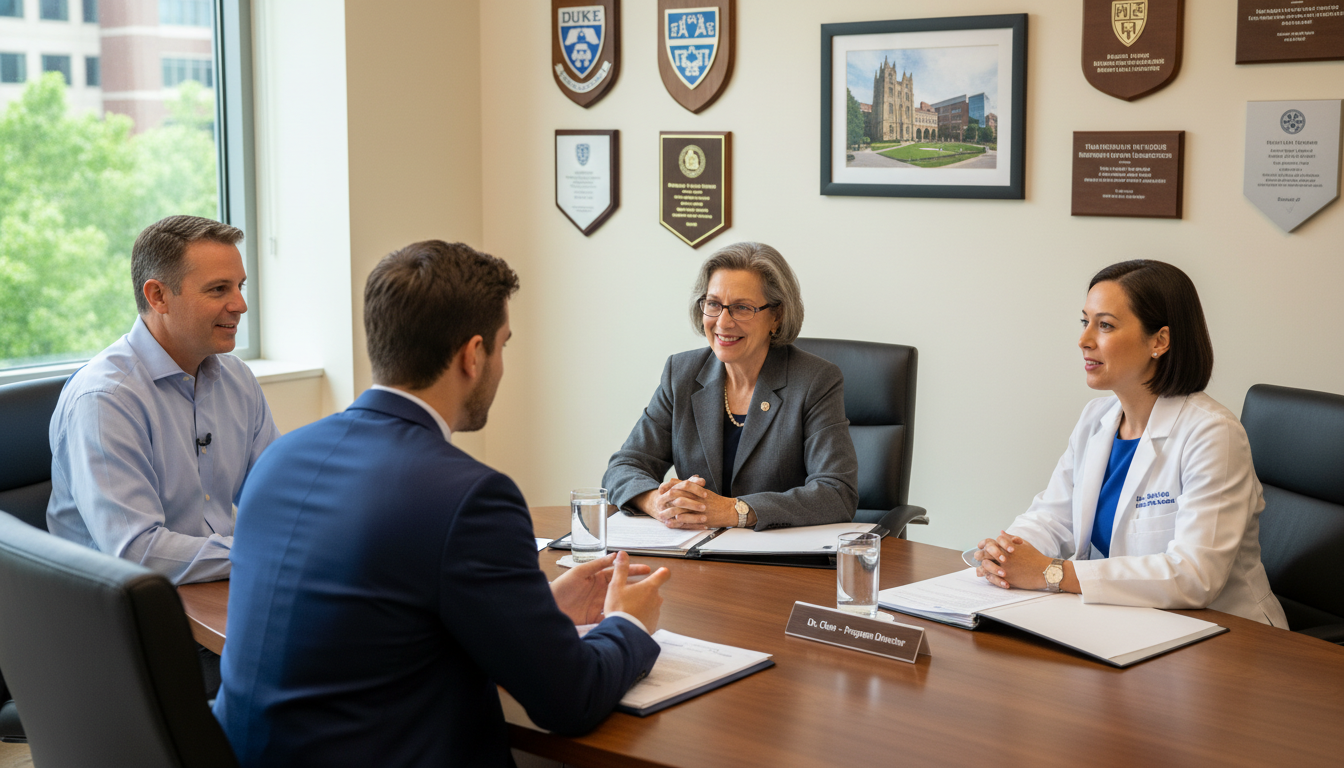
Once you secure interviews at programs in the Research Triangle, your goal is to own your narrative and make your low scores a small, well-explained part of a much stronger overall picture.
Common Interview Concerns with Low Scores
Programs may silently wonder:
- Is this applicant at risk for failing in-training exams and boards?
- Will they struggle with the cognitive load of residency?
- Do low scores indicate poor discipline or poor test-taking only?
You need to preempt these doubts through your behavior and explanations.
Preparing Your “Score Story”
Have a polished, honest, and concise explanation ready:
Acknowledge without defensiveness
- “My Step 1 score was lower than the program average, and I understand that raises questions.”
Provide context, not excuses
- “I struggled initially with building a consistent study system and test-taking strategies in a new environment.”
Describe corrective actions
- “I met with advisors, changed my approach to questions, and studied in a much more structured way for Step 2 CK…”
Show evidence of improvement
- “…which led to a significantly better Step 2 CK score and consistently strong in-course exams and clinical evaluations.”
Reassure and reframe
- “This experience taught me how to identify weaknesses early, seek help, and adjust—skills that I believe will help me adapt quickly to residency expectations.”
Practice this out loud; it should take 30–60 seconds, not five minutes.
Demonstrating Fit with Research Triangle Programs
In interviews for Duke residency, UNC, WakeMed, and other local programs, emphasize:
Local knowledge and commitment
- Mention specific aspects of their program: unique tracks, community engagement, research emphasis.
- Show familiarity with the health needs of North Carolina populations (e.g., rural health, underserved communities, chronic disease patterns in the Southeast).
Teamwork and teachability
- Programs in this region prioritize collegiality.
- Use examples that show you seek feedback and thrive in collaborative settings.
Future plans in NC
- If true, articulate your intention to practice in the area or remain in North Carolina after training.
Non-Verbal and Behavioral Signals
Because of your low scores, interviewers may (even unconsciously) be hyper-aware of:
- Preparation: Do you know their program details?
- Organization: Do you arrive early, bring a notepad, ask thoughtful questions?
- Communication: Are you clear, respectful, and concise?
Everything you do can either confirm or counteract the concern that test scores might reflect broader issues. Overprepare so that your performance visibly contradicts that worry.
Practical Examples: How Different Applicants Can Match in the Triangle
To make these strategies concrete, here are sample profiles and approaches.
Example 1: US MD with Low Step 1, Strong Step 2 CK
- Step 1: 205
- Step 2 CK: 245
- Target: Internal Medicine in the Research Triangle
Strategy:
- Emphasize upward trajectory in personal statement and interview.
- Apply broadly, including:
- Duke and UNC as reach.
- Community IM programs in Raleigh/Durham as realistic.
- Obtain letters from IM clerkship director praising clinical skills.
- Arrange an away elective at a Triangle institution if possible.
- Prepare a concise explanation of Step 1 performance issues and corrective measures.
Example 2: DO Applicant with Below Average Board Scores
- COMLEX Level 1 & 2: Slightly below national average
- Took USMLE Step 2 CK: 230
- Target: Family Medicine in NC, ideally near Raleigh
Strategy:
- Focus on community and unopposed FM programs in the Triangle and surrounding areas.
- Highlight:
- Continuity clinic experiences.
- Interest in primary care for North Carolina communities.
- Obtain FM-specific letters from DO and MD faculty.
- Show that, although board scores are modest, clinical and interpersonal strengths are outstanding.
Example 3: IMG with Low Scores, Strong Clinical Experience
- Step 1: 212
- Step 2 CK: 224
- Some USCE in internal medicine
- Target: Any categorical position in the Research Triangle
Strategy:
- Prioritize increasing meaningful US clinical experience (especially in NC if possible).
- Seek strong letters from US attendings who can attest to clinical reliability.
- Apply extremely broadly across the country, including but not limited to NC.
- Consider transitional year or preliminary positions as foot-in-the-door if categorical spots in the Triangle are not obtained.
- Continue academic improvement (possible Step 3, research projects) while in prelim year.
FAQs: Matching in the Research Triangle with Low Step Scores
1. Can I match a Duke residency program if I have a low Step 1 or Step 2 CK score?
It’s difficult but not impossible. A single low Step 1 score may be overshadowed by:
- A strong Step 2 CK (preferably near or above national mean).
- Exceptional letters, particularly from Duke-affiliated faculty.
- Robust research with publications or notable projects.
- Demonstrated fit with Duke’s specific values and training mission.
However, if both Step 1 and Step 2 CK are significantly below average, Duke residency in a competitive specialty becomes very unlikely. In that scenario, target more holistic community or hybrid programs in the Research Triangle and maintain Duke as a high-reach option rather than an expectation.
2. Should I mention my low Step score in my personal statement?
If your scores are only slightly below average, you can often let your improved performance speak for itself and address it only if asked in interviews. If your scores are significantly low or you had a failure, it’s usually better to:
- Briefly acknowledge the issue.
- Explain what you learned and how you improved.
- Move on to your strengths and your motivation for the specialty and the region.
Keep the focus on growth, not just on the problem.
3. Are community programs in the Research Triangle more forgiving of low scores?
Generally yes, community and hybrid academic/community programs in and around Raleigh, Durham, and Chapel Hill:
- May use lower or more flexible score thresholds.
- Often weigh clinical performance, letters, and interpersonal skills heavily.
- Appreciate regional commitment and genuine interest in community-based practice.
These are excellent training environments and often the best path to matching with low scores while still training in the Triangle.
4. If I don’t match in the Research Triangle initially, how can I improve my chances next cycle?
For reapplicants targeting North Carolina residency programs:
- Strengthen your profile with:
- Additional US clinical experience, ideally in NC.
- Stronger or updated letters of recommendation.
- Possible additional test (Step 3) if you can reasonably score well.
- Consider a research year at Duke or UNC or a non-categorical/prelim year to gain US experience.
- Work closely with mentors who know the region and can advocate for you.
- Reassess specialty competitiveness if your scores are far below average.
Low Step 1 or below average board scores do not automatically close the door to residency in the Research Triangle (NC). With deliberate strategy—strong Step 2 performance, stellar clinical work, targeted rotations, excellent letters, and a clear case for your regional fit—you can still build a compelling application for Duke, UNC, WakeMed, and other North Carolina residency programs.