
Understanding Your Starting Point: Low Step Scores in the Context of Medical Genetics
For a US citizen IMG (American studying abroad), a low Step 1 score or below average board scores can feel like a permanent barrier. In medical genetics, where programs are smaller and often affiliated with academic centers, this anxiety can be intense.
But the reality is more nuanced:
- Many medical genetics programs struggle to fill and are genuinely interested in motivated, trainable residents.
- The specialty values cognitive curiosity, communication skills, and longitudinal patient care as much as test-taking.
- Step scores are one piece of a complex puzzle: for US citizen IMGs especially, programs also care a lot about your US clinical exposure, professionalism, and long-term fit.
Before building a strategy, you need clear-eyed insight into what “low scores” mean and how programs actually use them.
What Counts as a “Low” Step Score Today?
With Step 1 now pass/fail, the phrase “low Step 1 score” usually means:
- You barely passed on a retake
- You had a fail (now shown as “F” + later “P”)
- You passed but your school transcript or dean’s letter exposes a weak preclinical record
For Step 2 CK, “below average” typically means:
- A score below the national mean (often around the mid‑240s for recent years)
- <230 is often perceived as “low” for more competitive fields, but for medical genetics, ~220–230 can still be workable, especially if everything else is strong.
As a US citizen IMG, you are often judged against both:
- Other IMGs (for basic thresholds, visa status, etc.)
- US grads (for perceived readiness and communication skills)
That dual comparison can be intimidating, but also gives you levers: US citizenship removes the visa barrier, and strong US clinical experiences can offset test-related concerns.
How Genetics Programs Typically View Board Scores
Most medical genetics residencies fall into two categories:
Combined programs
- Pediatrics–Medical Genetics (4–5 years)
- Internal Medicine–Medical Genetics
- OB/Gyn–Medical Genetics (less common)
Medical Genetics & Genomics categorical programs
- Usually require completion of another primary residency (peds, IM, etc.)
Because combined programs are often smaller, they focus heavily on fit and long-term commitment to genetics. Many programs:
- Use Step 2 CK (and Step 3 if available) more than Step 1 to gauge current knowledge
- Expect steady improvement and no pattern of repeated failures
- Are more forgiving of a single low score if the rest of the application clearly demonstrates growth and potential
Your task is not to pretend the low score doesn’t exist; it’s to construct a compelling story that:
- Explains it briefly and professionally
- Demonstrates robust, measurable improvement
- Proves that you’re already functioning at (or above) intern level, especially in genetics-related domains
Clarifying Your Goals as a US Citizen IMG in Medical Genetics
Before you design your strategy, you should clarify exactly what you are aiming for and over what timeframe.
Decide Your Training Pathway
As an American studying abroad, your path into medical genetics will often be one of:
Apply directly to combined Pediatrics–Medical Genetics (or IM–Genetics)
- Most realistic if you are fresh graduate or 0–2 years out
- Step 2 CK becomes the key metric
- Programs will evaluate your pediatric/IM potential and genetics interest together
Complete a primary residency first, then Medical Genetics
- Do peds, IM, or OB/Gyn first, apply to a Medical Genetics & Genomics fellowship-like residency (2–3 years)
- This route can be more forgiving of early low scores if you:
- Match into a less competitive primary specialty
- Prove yourself clinically and on in-training exams
- Particularly strategic if your scores are very low and you need time to rebuild your profile
Transitional/Preliminary year then apply to genetics-linked programs
- Less common and riskier
- Workable if you leverage an early mentor in genetics at that institution
Define Your Risk Tolerance and Timelines
Ask yourself:
- How many cycles are you willing to apply?
- Would you accept another specialty (e.g., peds or IM) even if genetics doesn’t work out initially?
- Are you willing to relocate for observerships, research, or a prelim year?
Your honest answers affect strategy:
- If you must match this year: focus on broad, realistic program lists and maximizing near-term impact (US clinical letters, research, personal statement).
- If you can wait 1–2 years: invest in substantial genetics research, US clinical work, or a preliminary/transitional year, and aim to show dramatic growth.

Step Scores Triage: Damage Control and Strategic Recovery
Once you know where you’re going, address your test record strategically.
Situations and Specific Responses
1. You Failed Step 1 (or Barely Passed on a Repeat)
Action plan:
- Ace Step 2 CK relative to your baseline.
- Target ≥240 if possible; if that’s unrealistic, aim to improve significantly from any prior NBME practice thresholds.
- Use structured planning (e.g., 8–12 weeks, daily question blocks, tracking weak systems).
- Consider taking Step 3 early if:
- You have a Step 2 CK ≥230–235
- You can dedicate 4–6 weeks to solid prep
- You can realistically score decently (just passing is not ideal; aim for an above-pass performance)
Why it helps: A strong Step 2 and/or Step 3 tells programs, “I’ve solved the problem that caused Step 1 issues.”
2. You Have a Low Step 2 CK (e.g., 215–230)
Action plan:
- Do NOT rush Step 3 just to “add another score.”
- A second low score or fail harms more than helps.
- Instead focus on:
- NBME practice exams to identify specific weak areas
- In-depth rotations (especially in pediatrics, IM, or genetics) where attendings can attest to strong clinical reasoning.
- If you can significantly improve on practice tests, then consider Step 3 soon; otherwise, wait until you are better prepared.
3. Pattern of Below Average Scores (but no failures)
Action plan:
- Accept that scores will be a screening issue at some programs.
- Your primary job is to build a portfolio of excellence elsewhere:
- Multiple strong US clinical letters
- Genetics-related research or quality improvement projects
- Clear narrative of persistence and growth in your personal statement and interviews
How to Address Low Scores in Your Application
You must talk about it—but strategically:
Personal Statement
- 2–3 sentences, honest but concise:
- “During my early basic science years, balancing clinical work and exam preparation was a challenge, reflected in my Step 1 performance. Since then, I reassessed my study approach, sought mentorship, and my subsequent performance on Step 2 and in clinical rotations better represents my abilities.”
- Immediately pivot to growth and evidence: improved Step 2, honors on clinicals, research productivity.
- 2–3 sentences, honest but concise:
ERAS Additional Comments Section
- Good place to briefly clarify context:
- Health issues (if you’re comfortable sharing)
- Family emergency or major disruption (without oversharing)
- Change in learning strategies or support utilization
- Good place to briefly clarify context:
Interviews
- Practice a 30–60 second, non-defensive explanation:
- Acknowledge → Explain briefly → Show insight → Emphasize improvement
- Practice a 30–60 second, non-defensive explanation:
Example:
“I didn’t perform as well as I expected on Step 1. At the time, I underestimated how much structured practice questions and spaced repetition mattered. I changed my approach for Step 2, focusing on daily question blocks and discussion with peers and mentors, and my score and clinical evaluations improved. That experience pushed me to become a more deliberate learner, which I now apply in my genetics work as well.”
Strengthening the Rest of Your Application: Turning Weakness into Context
With low or below average board scores, you must make the non-test parts of your application exceptional, especially for a more academic specialty like medical genetics.
1. US Clinical Experience (USCE) with Genetics Exposure
As a US citizen IMG, you have the advantage of fewer visa-related barriers. Use this fully.
Aim for:
- At least 2–3 months of US clinical rotations in:
- Pediatrics or Internal Medicine (inpatient and outpatient)
- Directly in Clinical Genetics, Metabolic Clinic, or Dysmorphology if available
- Include at least one rotation at a site with a medical genetics program; proximity builds familiarity.
Optimize each rotation:
- Show up early, be proactive, and demonstrate genuine interest in genetics:
- Ask to see patients with suspected genetic conditions, metabolic disorders, or congenital anomalies.
- Offer to start drafting consult notes and pedigrees under supervision.
- Politely ask attendings or genetics fellows:
- “I’m very interested in medical genetics—would it be possible for me to spend some time in genetics clinic or on consults this month?”
Goal: Earn strong, specific letters of recommendation that say things like:
- “She functioned at the level of an intern on our genetics service.”
- “Despite below average board scores, his clinical reasoning, dedication, and communication skills are excellent.”
2. Genetics-Focused Research and Scholarly Activity
Medical genetics is inherently academic. Research—even modest—can significantly offset weaker scores.
Options, even without a big-name institution:
- Case reports:
- Unusual presentations of common genetic conditions
- New mutations or variants of unknown significance (VUS) with interesting phenotypes
- Complex counseling scenarios
- Chart reviews or small retrospective projects:
- Time from suspicion to diagnosis in rare genetic diseases
- Impact of genetic counseling on patient understanding or adherence
- Quality improvement (QI):
- Improving referral pathways to genetics from primary care
- Developing standardized family history tools in clinics
How to get involved as a US citizen IMG:
- Email genetics faculty at institutions where you have rotations:
- Attach a 1-page CV and briefly state your interests and availability.
- Offer to:
- Help with data collection
- Draft introductions or methods sections
- Prepare posters or presentations for local conferences
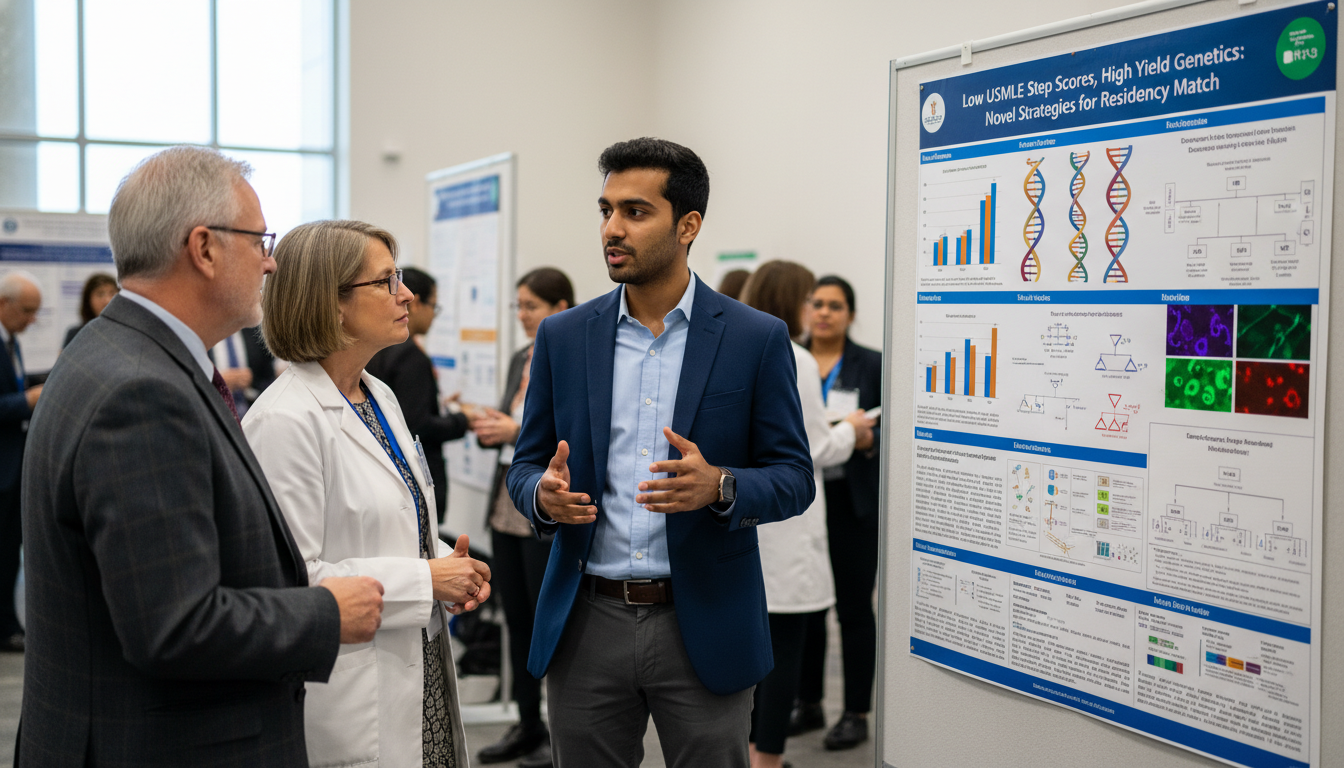
Even one poster or small publication specifically in genetics can strongly signal commitment to the field.
3. Building a Mentorship Network in Medical Genetics
A serious, authentic mentor can be more valuable than a raw Step score bump.
Steps:
- During rotations, identify:
- Geneticists who enjoy teaching
- Pediatric or IM attendings with strong genetics connections
- Genetic counselors open to involving you in projects
- Request a brief meeting:
- “Could I have 20–30 minutes of your time to discuss a career in medical genetics? I’m a US citizen IMG and would appreciate your guidance on how best to become a competitive applicant despite my below average board scores.”
What mentors can do for you:
- Give honest feedback about your competitiveness
- Suggest programs that may be more IMG-friendly
- Offer opportunities in clinics, research, or local conferences
- Write high-impact letters that explicitly advocate for you
- Especially powerful from someone respected in the genetics community
Application Strategy: Maximizing Your Match Chances in Medical Genetics
Now that you’ve stabilized your testing story and strengthened your portfolio, you need a smart genetics match strategy tailored to US citizen IMGs with low Step scores.
1. Targeting the Right Programs
Not all programs weigh scores equally. For matching with low scores, prioritize:
- Programs with a history of taking IMGs or US citizen IMGs
- Check FREIDA, program websites, and past resident photos/biographies.
- Newer or smaller programs
- They may be more flexible on scores and more focused on fit and interest.
- Programs in less saturated geographic regions
- Midwest, South, certain non-coastal areas sometimes are more open than high-demand coastal academic centers.
For each program:
- Look for faculty with interest in:
- Education and mentorship
- Autism spectrum disorders, congenital heart disease, metabolic disorders, etc.
- Identify if they explicitly welcome IMGs or US citizen IMGs.
2. Crafting a Compelling, Genetics-Focused Personal Statement
Your personal statement must do four things simultaneously:
- Show your authentic passion for medical genetics
- A specific patient story: a child with a complex syndrome, a family with recurrent metabolic crises, etc.
- Emphasize your suitability for longitudinal, family-centered care
- Communication skills and empathy matter greatly in genetics.
- Explain your test history briefly, then pivot to growth
- Do not center the essay on your low Step score.
- Demonstrate long-term commitment to the field
- Mention concrete steps you’ve already taken: genetics clinic work, research, mentorship, conferences.
Example framing:
“Working with a child who had an undiagnosed congenital syndrome transformed how I view medicine. I saw the emotional toll on his parents as they searched for a name for his condition. When our team finally obtained a molecular diagnosis, it reframed their grief into understanding and allowed us to develop a comprehensive care plan and provide accurate recurrence counseling. That experience cemented my commitment to medical genetics, a field that merges detailed diagnostic reasoning with deeply human conversations.”
3. Letters of Recommendation: Quality Over Prestige
For a US citizen IMG with below average scores, the content of your letters matters more than the brand name of the letter writer.
Aim for:
- 3–4 strong letters, including:
- At least one from someone directly in genetics (MD or PhD)
- One from a core specialty relevant to your path (pediatrics or IM)
- One from a US clinical setting attesting to professionalism and communication
Ask for letters that specifically:
- Comment on:
- Clinical reasoning
- Reliability and work ethic
- Communication with families
- Interest and aptitude in genetics
- Address the board score concern indirectly:
- “Despite board scores that do not fully reflect his abilities, in my clinic he consistently functioned at or above the level of an intern.”
4. ERAS Application Details That Matter More When Scores Are Low
When trying to match with low scores into a small field like medical genetics, pay attention to:
- Clinical descriptions:
- Be specific: “Assisted with pedigrees and variant interpretation discussions during weekly genetics clinic” is more powerful than “Did genetics rotation.”
- Research section:
- Include abstracts, posters, and even submitted manuscripts, clearly labeled.
- Work and volunteer experiences:
- Highlight anything that shows commitment to chronic disease management, disability advocacy, or family counseling (e.g., autism support, rare disease groups, patient advocacy organizations).
Interview and Post-Interview Strategy: Converting Interest into a Match
Once you’ve secured interviews despite low Step scores, your goal is to eliminate any remaining doubt that you can thrive in a medical genetics residency.
1. Preparing for Common Interview Themes
Expect questions about:
- Why medical genetics?
- Have 2–3 concise, specific stories ready.
- How do you handle complexity and uncertainty?
- Genetics often deals with uncertain variants and evolving knowledge.
- Communication challenges with families:
- Describe a time you communicated bad news, explained risk, or navigated cultural differences.
And, almost certainly:
- Your low Step score(s)
- Use your practiced, honest, growth-oriented explanation.
- Emphasize what you’ve done since then.
2. Demonstrating Fit for a Genetics Team
Programs want residents who:
- Are curious, willing to read around complex cases.
- Are empathetic communicators, able to explain technical material simply.
- Enjoy collaboration with pediatricians, internists, surgeons, and genetic counselors.
During interviews:
- Ask thoughtful questions:
- “How do your residents balance clinic, inpatient consults, and genomics teaching?”
- “What kinds of projects have recent residents done in dysmorphology, metabolic genetics, or cancer genetics?”
- Reference your preparation:
- “On my rotation, I helped build three-generation pedigrees and observed variant interpretation meetings; I’m especially interested in the interface between clinical phenotyping and molecular diagnostics.”
3. Post-Interview Communication
For a niche specialty like medical genetics, post-interview signals can be influential—used ethically and honestly.
- Send personalized thank-you emails:
- Mention specific cases or teaching points you discussed.
- Reiterate why their program’s structure or patient population fits your goals.
- If you have a clear first choice:
- After all interviews are done, a single, honest communication such as:
- “I will be ranking your program very highly” or
- “Your program is my top choice” (only if that is absolutely true).
- After all interviews are done, a single, honest communication such as:
Never imply you will rank multiple programs #1.
Frequently Asked Questions (FAQ)
1. As a US citizen IMG with a low Step 1 score, do I realistically have a chance to match into medical genetics?
Yes, especially if:
- You have no pattern of repeated failures
- You can show improvement on Step 2 (and possibly Step 3)
- You invest in genetics-specific experiences, strong US clinical letters, and mentorship
Medical genetics is relatively small and often underfilled; programs can overlook a low Step 1 if you demonstrate clear commitment, clinical maturity, and an authentic interest in the specialty.
2. Should I delay my application to take Step 3 and improve my chances?
It depends:
- Consider taking Step 3 before applying if:
- Your Step 2 CK is modest but not terrible (e.g., ≥230)
- You are prepared to score at least solidly (no more fails or very low scores)
- You have time to study properly
- Delay Step 3 if:
- You are under time pressure and may underperform
- You are still building your foundation in IM/pediatrics content
A strong Step 3 can help mitigate a low Step 1, but a weak Step 3 will make programs more worried.
3. Is it better to aim directly for a combined medical genetics program, or complete a primary residency first?
If your scores are borderline but not disastrous, and you have good genetics experiences and letters, applying directly to a combined Peds–Genetics or IM–Genetics program can work and saves time.
If your scores are very low or you have multiple attempts:
- It may be more strategic to:
- First match into pediatrics, internal medicine, or OB/Gyn at a supportive program
- Prove yourself clinically, possibly improve on in-training or Step 3
- Then apply to Medical Genetics & Genomics as a second residency
This two-step approach takes longer, but can substantially strengthen your overall profile.
4. How many genetics programs should I apply to if my scores are below average?
For US citizen IMGs with low or borderline scores, it’s wise to:
- Apply broadly to most or all programs offering your desired pathway (combined or categorical).
- Also consider:
- Applying to pediatrics or IM programs at institutions with genetics departments, if you are open to the longer path.
- If your budget is limited, prioritize:
- Programs with history of taking IMGs,
- Regions with fewer applicants,
- Places where you have connections, USCE, or mentors.
The key is a broad but targeted strategy, backed by a clear story, strong letters, and visible growth beyond your test scores.