
Applying to radiation oncology is challenging for any applicant—but as a non-US citizen IMG with a low Step score, it can feel nearly impossible. It is not impossible, but it does require a highly strategic, long-term plan.
This guide will walk you through realistic, evidence-based strategies to maximize your chances of a radiation oncology residency (rad onc) match, even with below average board scores.
Understanding Your Starting Point as a Non-US Citizen IMG
Radiation oncology is a small, competitive specialty. For a foreign national medical graduate with a low Step 1 score (or Step 2 CK), there are three simultaneous hurdles:
- Specialty competitiveness
- IMG and visa status
- Numeric screening by programs
Before you plan your path, you need clear insight into these issues.
1. How Competitive Is Radiation Oncology for IMGs?
Key realities:
- Rad onc has fewer residency positions compared with internal medicine, pediatrics, or family medicine.
- Many programs receive far more applications than they can review and may filter heavily based on board scores, school type, and visa needs.
- IMGs do match into radiation oncology, but their numbers are small each year, and non-US citizen IMGs needing visas are an even smaller subset.
You are not competing with “average” applicants—you are competing with:
- US MD seniors with strong clinical and research profiles
- Applicants with publications, AOA membership, and strong letters from major cancer centers
2. Why Low Scores Matter So Much in Rad Onc
Even though Step 1 is now pass/fail, your exam history and Step 2 CK performance still matter. Many programs use filters to manage application volume. With a low Step 1 score (if taken before P/F) or low Step 2 CK, your application may:
- Be automatically screened out by many programs
- Get less benefit of the doubt without strong compensating strengths
- Require much stronger research, networking, and letters than an applicant with high scores
Programs also worry that low scores may predict:
- Difficulty passing the ABR (American Board of Radiology) exams
- Struggles with didactics, physics, and complex treatment planning
Your job is to change that narrative by building evidence that you can excel despite your test performance.
3. Non-US Citizen and Visa Issues
As a non-US citizen IMG, you must also deal with:
- Some programs not sponsoring visas at all
- Others preferring J-1 only and avoiding H-1B because of cost/complexity
- Institutional or GME policies limiting foreign national hiring
This doesn’t make matching impossible, but it does:
- Shrink your realistic program list
- Increase the importance of institutional fit and networking
Action item: Early in your planning, create a spreadsheet of rad onc programs, noting:
- Whether they have ever taken IMGs
- Whether they sponsor J-1 and/or H-1B visas
- Whether they are at large academic cancer centers (more likely to be open to research-focused IMGs)
This will guide your target strategy later.

Step Scores in Context: Reframing a Weak Point
You cannot erase a low Step 1 score, but you can reframe it—and you can avoid adding new weaknesses.
1. Honestly Assess Your Exam Profile
List all of your board-related metrics:
- Step 1: score (if scored) or P/F status + number of attempts
- Step 2 CK: score and attempts
- Any failed attempts on Step exams or OET/IELTS (if applicable)
- Planned or completed Step 3
Then categorize your situation:
- Mild risk: Slightly below average Step 2 CK (e.g., 220–230) with no failures
- Moderate risk: Clearly below average (e.g., <220) or borderline pass with first attempt
- High risk: Step failures, very low scores, or multiple attempts
The lower you are, the more heavily you must weight research, networking, and longitudinal US experience.
2. Mitigate With Strong Step 2 CK and Step 3
If Step 1 is low (or if you just passed P/F), you need to protect Step 2 CK at all costs:
- Delay your US application by a year if needed to ensure a strong Step 2 CK score.
- Use structured prep (e.g., UWorld with at least one complete pass, NBME self-assessments, and an organized study calendar).
- Aim to show “score recovery” or clear improvement—even if you’re still not stellar, an upward trend matters.
If your Step 2 CK is already low:
- Consider taking Step 3 before applying, especially if you’re seeking H-1B eligibility.
- A decent Step 3 score can:
- Reassure programs about your board performance
- Strengthen your profile for pre-residency research or observer roles
- Increase your visa flexibility (H-1B often requires Step 3 completed at the time of visa application)
3. Addressing Low Scores in Your Application
You should not center your whole application around your low scores, but you can:
Briefly acknowledge them in your personal statement or interview, if initiated:
- Frame it as a challenge you learned from, followed by concrete improvements:
- “I struggled initially with the US-style standardized testing, reflected in my Step 1 score. I recognized I needed a structured approach and, with dedicated preparation, improved significantly on Step 2 CK and Step 3. This experience has made me a more disciplined and self-aware learner.”
- Frame it as a challenge you learned from, followed by concrete improvements:
Back this narrative with evidence:
- Honors in clinical rotations
- Strong performance in radiation oncology electives or sub-internships
- High-rated performance evaluations and letters of recommendation
The goal is to shift the narrative from “low Step 1 score” to “resilient, improving learner who has already shown recovery and readiness.”
Building a Rad Onc-Friendly CV: Beyond Test Scores
With below average board scores, your best path into radiation oncology is through a compelling, focused CV that screams “rad onc commitment” at every level.
1. Targeted Research in Radiation Oncology
For a non-US citizen IMG, research is your single most powerful lever in this specialty.
A. Aim for US-Based Rad Onc Research If Possible
Spending 1–2 years in a US radiation oncology department as a research fellow or scholar can:
- Give you direct access to rad onc attendings who can write strong US letters
- Help you accumulate:
- Abstracts at ASTRO or other oncology meetings
- Peer-reviewed publications
- Involvement in clinical trials, quality improvement, or outcome projects
- Integrate you into the program’s daily culture, making you a known applicant rather than just a CV on paper
If you have low scores, you’ll need more than just a few short projects—think:
- 1–2 years of productive research with:
- Multiple abstracts
- At least a few first- or co-author papers
- Evidence of high commitment (e.g., evening/weekend work, taking ownership of projects)
B. How to Find Research Positions as a Foreign National Medical Graduate
Concrete steps:
Identify rad onc departments with a history of hosting IMGs:
- Major NCI-designated cancer centers
- Universities with large international trainee communities
Email faculty (especially junior attendings and physician-scientists) with:
- A brief, focused email (3–4 paragraphs)
- 1-page CV highlighting:
- Any research experience
- Oncology interest
- Exam status (Step 1/2/3)
- Clear statement about visa needs (e.g., “I am currently outside the US and would require J-1 research visa sponsorship.”)
Apply widely and follow up politely every 2–3 weeks.
Use networks:
- Alumni from your medical school who matched into US programs
- LinkedIn connections
- Attending physicians with prior US collaborations
If funding is an issue, look for positions labeled as:
- Research volunteer (unpaid)
- Visiting scholar
- Observational fellow (some may transition to paid roles later)
C. Maximize Productivity Once You’re In
Once you land in a research position:
- Meet with your PI early to clarify expectations and your timeline for applying to residency.
- Volunteer to help with:
- Retrospective chart reviews
- Data cleaning and analysis
- Drafting manuscripts and IRB protocols
- Ask specifically to be included in ASTRO abstracts and poster projects.
- Keep a running list of:
- Projects you’re working on
- Your specific contributions
- Deadlines, target journals, and conferences
The goal is to build a cohesive rad onc research narrative that clearly outweighs your low scores.
Clinical Exposure, Networking, and Letters: Your Differentiators
For competitive specialties, who knows you and what they can say about you often matter more than a few points on a board exam.
1. US Clinical Exposure in Radiation Oncology
As a non-US citizen IMG, you should aim for:
- Rad onc observerships, electives, or sub-internships at US institutions
- Rotations in internal medicine, oncology, or related fields if rad onc options are limited
Best-case scenario:
- 1–2 months of radiation oncology observerships or electives at:
- The same institution where you’re doing research
- Or at other academic centers that regularly take residents
During these rotations:
- Arrive early, stay late, be present at:
- Simulation sessions
- Contouring and treatment planning
- On-treatment visit clinics and tumor boards
- Ask thoughtful questions, show you’ve read about:
- Disease sites (breast, prostate, CNS, head and neck, etc.)
- Basic radiobiology and radiation physics
- Politely express your interest in residency, but do not pressure faculty immediately for letters.
2. Networking With Intent
Networking for a rad onc match is not about random social media messages—it is targeted relationship-building.
Strategies:
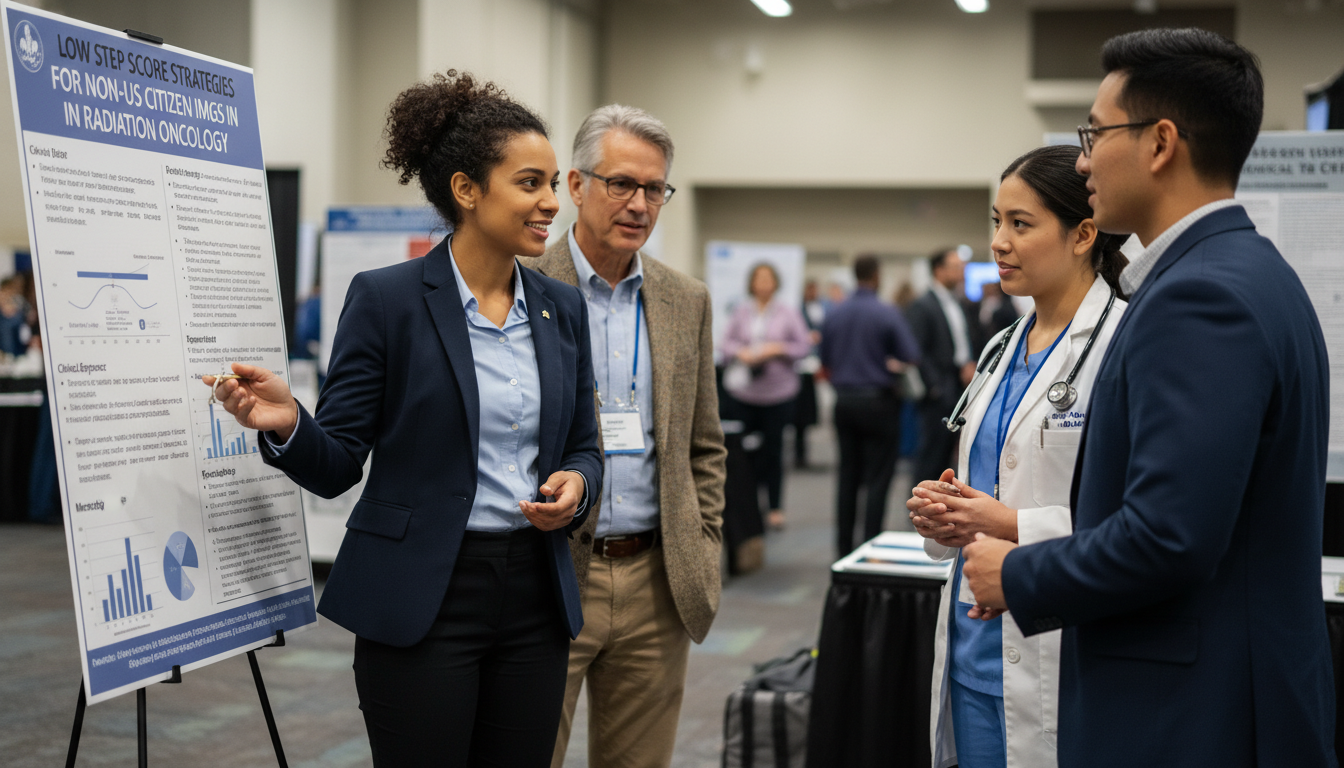
Attend ASTRO or regional oncology meetings:
- Present posters
- Introduce yourself to program directors from institutions where you have research or clinical connections
- Join early-career or trainee interest groups
Get involved in:
- Departmental journal clubs
- Educational initiatives (student teaching, rad onc interest group talks)
Ask mentors for warm introductions:
- “Would you feel comfortable introducing me to Dr. X at [Program Y]? I’m particularly interested in their work on [disease site/topic].”
Aim for networking that is:
- Specific (aligned with your research/clinical interest)
- Respectful of others’ time
- Longitudinal (several brief, meaningful contacts over months, not one-time asks)
3. Securing Strong Letters of Recommendation (LoRs)
With matching with low scores, your letters must be among your strongest assets.
Ideal letter writers:
- US radiation oncologists who:
- Supervised you directly in research or clinical settings
- Know your work ethic, curiosity, and communication skills
- Oncologists or internists who can speak to:
- Your clinical reasoning
- Professionalism and teamwork
- Reliability under pressure
Aim for:
- At least 2 strong letters from rad onc attendings
- 1–2 additional letters from internal medicine/oncology/research mentors
When requesting letters:
- Ask if they feel they can write a “strong, supportive letter” for radiation oncology.
- Provide:
- Your updated CV
- Personal statement draft
- Cover note reminding them of specific projects, cases, or contributions
- Politely remind them of your timeline (and follow up 2–3 weeks before deadlines).
Letters should ideally avoid emphasizing your scores; instead, they should highlight:
- Analytical skills in complex oncology cases
- Attention to detail in treatment planning or research
- Empathy with patients and families
- Growth over time and capacity for handling a demanding residency
Choosing the Right Strategy: Pure Rad Onc vs Hybrid and Backup Plans
For a non-US citizen IMG with a low Step score, you must balance ambition with probability. There are three main strategic pathways.
1. All-In Radiation Oncology Strategy
Best for:
- Applicants with:
- Low but not disastrous scores
- Significant US-based rad onc research (1–2 years)
- Multiple rad onc letters from US attendings
- Strong networking and visible presence at academic meetings
Key features:
- Apply to **every program that:
- Accepts IMGs
- Sponsors your visa type
- Has a track record (even minimal) of non-US citizen IMGs
- Consider preliminary year in medicine or transitional programs at institutions with rad onc departments that know you.
Risks:
- High chance of going unmatched the first cycle, especially if research is still early.
- Need to be prepared to reapply after another year of strengthening your profile.
2. Hybrid Strategy: Rad Onc + Related Fields
In a hybrid strategy, you:
- Apply to radiation oncology programs strategically, plus:
- Internal medicine
- Transitional year
- Possibly a few categorical IM or other specialties
Why this helps:
- Internal medicine or categorical positions at cancer-focused institutions can keep you:
- Close to rad onc research opportunities
- Positioned to re-apply in a future cycle
- You can build:
- More US clinical experience
- Additional rad onc research
- Stronger letters from multidisciplinary teams (med onc, rad onc, surgery)
This route can be effective for matching with low scores, especially when the rad onc match is extremely uncertain.
3. Two-Step Pathway: Research/Clinical Position → Later Rad Onc Match
For foreign national medical graduates with very low Step 2 CK or prior exam failures, a realistic path might be:
- 1–3 years of:
- Rad onc research fellowship in the US
- Possibly combined with:
- MPH, MS, or PhD in epidemiology/oncology/radiation sciences
- Parallel improvement in:
- Exam portfolio (Step 3)
- Publications and conference presentations
- Then apply to:
- Rad onc residencies
- Possibly from a position of:
- Postdoc fellow
- Clinical research associate
- Or even a non-rad onc clinical residency (e.g., internal medicine) with ongoing rad onc collaboration
This route is longer and requires patience, but it:
- Builds true credibility
- Makes you a more mature, proven candidate
- Sometimes converts directly into a rad onc spot when programs see your long-term value
Tactical Application Tips for the Rad Onc Match
When it’s finally time to apply, tactical decisions matter.
1. Program List Construction
For a non-US citizen IMG with below average board scores, your program list is a survival tool.
Steps:
- Prioritize programs that:
- Have current or recent IMGs listed on their website
- Reside within big academic systems or cancer centers
- Clearly sponsor J-1 (and H-1B if needed)
- De-prioritize or exclude programs that:
- Explicitly state “no IMGs” or “US grads only”
- Have zero evidence of non-US trainees in recent years
- Include:
- Every reasonable program that doesn’t exclude you explicitly, even if they are long shots
2. Application Materials
With matching with low scores, your application packet must be:
- Laser-focused on radiation oncology
- Free of inconsistencies or red flags
Key elements:
Personal Statement:
- Focus on:
- Your journey into oncology
- Specific patient stories or experiences that sparked your interest
- Your research and clinical exposure
- Briefly and constructively allude to low scores only if needed, without excuses.
- Focus on:
ERAS Experiences:
- Categorize experiences clearly:
- “Radiation Oncology Research Fellow”
- “Radiation Oncology Observership”
- “Oncology Volunteer”
- Emphasize leadership, teaching, and long-term involvement.
- Categorize experiences clearly:
Publications and Posters:
- Highlight oncology or radiation oncology first.
- Clearly separate peer-reviewed articles from abstracts/presentations.
3. Interview Preparation
If you reach interviews, your low scores become less central—but you should still be ready.
Prepare to answer:
- “Tell us about your Step performance”
- Have a concise, honest explanation + improvement narrative.
- “Why radiation oncology, especially given its competitiveness?”
- Speak to:
- Your sustained commitment
- Your deepened understanding via research and clinical exposure
- Your realistic view of the field’s demands
- Speak to:
- “What is your backup plan if you don’t match?”
- Show that you are pragmatic:
- “I will continue my research work and strengthen my profile further. I am committed to oncology long-term and recognize that my path may be non-linear.”
- Show that you are pragmatic:
Content expertise:
- Be ready for:
- Basic oncologic principles by disease site
- Simple radiobiology concepts (e.g., fractionation, radiosensitivity)
- Understanding of multidisciplinary cancer care
- Use specific examples from your experience:
- A complex head and neck case you followed
- A research project on prostate radiotherapy outcomes
Frequently Asked Questions (FAQ)
1. As a non-US citizen IMG with a low Step 1 score, is radiation oncology realistically achievable?
It is possible but unlikely without a strong mitigating profile. You will need:
- At least 1–2 years of substantial US radiation oncology research
- Strong letters from US rad onc attendings
- Demonstrated recovery or stability in later exams (Step 2 CK, Step 3)
- Thoughtful networking and targeted applications
If your scores are extremely low or you have multiple failures, rad onc is still not impossible, but you will almost certainly need a multi-year path with heavy investment in research and academic productivity.
2. How many years of research should I plan before applying?
For below average board scores, most successful non-US citizen IMGs who match rad onc have:
- At least 1 year, often 2 or more years of focused research
- Multiple abstracts and publications
More research time is beneficial if it translates into quality output and stronger relationships, not just time spent.
3. Should I take Step 3 before applying to radiation oncology?
If you have:
- Low Step 1/2 CK
- Or plan to seek H-1B sponsorship
Then Step 3 before applying is recommended, provided you can prepare adequately and pass comfortably. A reasonable Step 3 result can:
- Reassure programs about your board performance trajectory
- Expand your visa options
- Strengthen applications for research or transitional clinical roles
4. Is it smarter to match into internal medicine first and then move to radiation oncology?
This can be a viable two-step strategy, especially if your scores are low and you are uncertain about a direct rad onc match. Internal medicine at an institution with:
- A strong cancer center
- A radiation oncology department familiar with you
Allows you to:
- Continue oncology-related research
- Build deeper clinical experience
- Potentially transfer or reapply to rad onc later
However:
- Transfers are rare and not guaranteed.
- You must be genuinely willing to complete internal medicine if rad onc doesn’t materialize.
By approaching your rad onc match with a realistic understanding of your low Step score, a structured plan for research and networking, and a flexible long-term strategy, you significantly improve your odds despite the challenges. As a non-US citizen IMG, your path may be longer and steeper—but with persistence, focused effort, and smart positioning, it remains within reach.