
Understanding Step Scores in the Context of Pediatrics-Psychiatry
Pediatrics-Psychiatry-Child & Adolescent Psychiatry (“peds psych residency” or “triple board”) is a small, highly specialized pathway. For a non-US citizen IMG (foreign national medical graduate), Step scores are often scrutinized more closely than for US graduates, especially when you need visa sponsorship.
Even though Step 1 is now pass/fail, program directors still:
- Check whether you passed on the first attempt
- Look at Step 2 CK as the primary numeric score
- Use your step performance as a screening tool when they receive hundreds of applications
For a non-US citizen IMG, a smart Step 2 CK strategy can significantly counterbalance:
- A low Step score match concern (e.g., borderline Step 2 CK)
- Lack of US clinical experience
- Coming from a lesser-known medical school
- Needing a visa (J-1 or H-1B)
In triple board, however, USMLEs are only one piece. Programs expect:
- Demonstrated interest in both pediatrics and psychiatry
- Evidence of resilience, maturity, and communication skills
- Longitudinal commitment to child and adolescent mental health
Your exam strategy must support this bigger narrative: you are not just “a non-US citizen IMG with a number,” but a candidate who uses the exams strategically to prove readiness for a demanding integrated program.
How Programs Really View Step Scores for Triple Board
1. Step 1 in a Pass/Fail Era
For triple board and pediatrics-psychiatry combined tracks, Step 1 is now mainly:
- A hurdle (must pass)
- A signal of risk if failed or multiple attempts
What still matters:
- Pass on first attempt: Major plus
- Fail with later pass: Not disqualifying, but you must:
- Show clear improvement on Step 2 CK
- Explain briefly and professionally in your application if necessary
As a foreign national medical graduate, some PDs may still informally ask:
- Did you pass Step 1 on the first try?
- Did your medical school have strong basic science training?
You cannot change your Step 1 history—but you can control the narrative by how you perform later.
2. Step 2 CK: The Critical Score for Non-US Citizen IMGs
For most non-US citizen IMG applicants, Step 2 CK is the primary differentiator. Programs often:
- Set filters for Step 2 CK (e.g., ≥220–230)
- Look for upward trajectory (especially if Step 1 was borderline or failed)
For peds psych residency and triple board, Step 2 CK helps PDs decide:
- Can you handle the medical complexity of pediatrics?
- Do you have enough clinical understanding for psychiatry rotations?
- Are you a safe bet academically, given the structure of triple board?
Many strong programs see:
- 240+ Step 2 CK: Very competitive numerically
- 230–239: Competitive, particularly if paired with strong experiences
- 220–229: Possible, but you need a strong application and story
- <220: Challenging, especially for non-US citizen IMGs, but not impossible with a targeted strategy
3. The “Low Step Score Match” Reality for Foreign Nationals
Being a non-US citizen IMG with a low Step score means:
- Some programs with strict cutoffs will never see your application
- Others will look more carefully at red flags (repeats, large gaps, poor English, weak recommendations)
- But some IMG-friendly peds and psych programs (and a few triple board programs) are willing to consider holistic profiles
Your task is to:
- Maximize Step 2 CK (and Step 3 if you take it) as much as possible
- Build a compelling, coherent portfolio around your scores
The strategy below is built to do both.
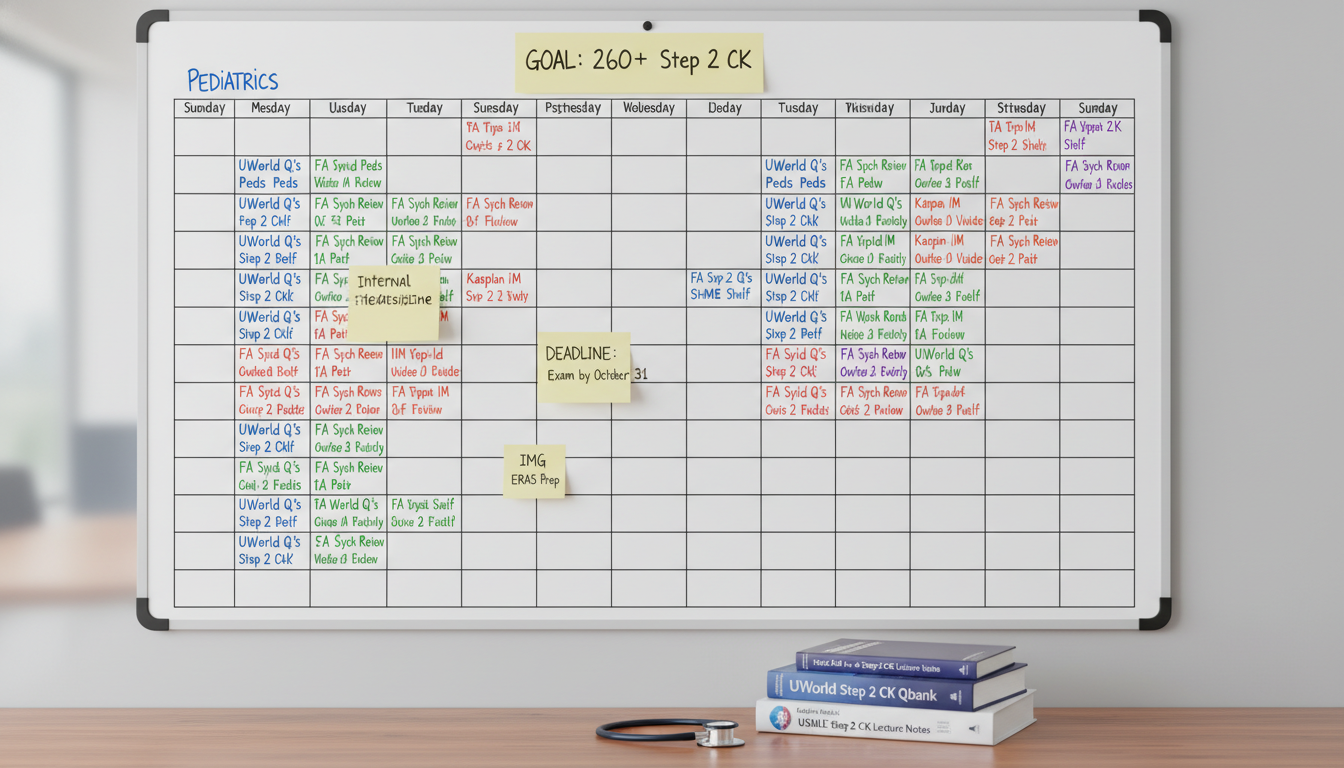
Building a Step 2 CK Strategy Specifically for Pediatrics-Psychiatry
1. Set a Realistic but Ambitious Target Score
For a non-US citizen IMG aiming at peds psych / triple board, it is wise to set:
- Primary target: 240+
- Minimum comfort threshold: At least 230
Why so high?
- You are competing not only with other IMGs but also with US MD/DO applicants, some with strong pediatric or psychiatry backgrounds.
- A stronger Step 2 CK makes PDs more confident about you as a visa-dependent candidate.
If your NBME/UWorld self-assessments are below 220:
- Extend your study timeline
- Focus on foundational weaknesses
- Consider delaying application by one cycle rather than rushing a poor score
2. Design a 3- to 6-Month Focused Study Plan
A foreign national medical graduate often faces additional constraints:
- Time zone differences with tutors or study groups
- Limited access to US-style clinical teaching
- Possible language barriers (English medical slang, patient communication)
A 3–6 month Step 2 CK strategy might look like:
Phase 1 (Weeks 1–4): Solidify Foundations
- Complete 25–40 UWorld questions per day in tutor mode, focusing on:
- Pediatrics (especially developmental milestones, congenital disorders, infections, emergency scenarios)
- Psychiatry (especially diagnostic criteria, treatment algorithms, side effects)
- Simultaneously review:
- OnlineMedEd, Boards & Beyond, or similar videos for core medicine & pediatrics
- NBME-style questions in your weakest subjects (OBGYN, surgery, internal medicine)
Phase 2 (Weeks 5–10): Intensify Practice & Timed Blocks
- Increase to 40–60 UWorld questions per day in timed, random mode
- Add NBME self-assessments every 2–3 weeks
- Track performance in key triple board-relevant domains:
- Child neurology and neurodevelopment
- Adolescent psychiatry (substance use, mood disorders, eating disorders)
- Pediatric emergencies (status epilepticus, sepsis, DKA)
- Build a review notebook or Anki deck focused on:
- High-yield pediatric conditions
- DSM-5 criteria and treatment steps
Phase 3 (Weeks 11–12+): Exam Simulation & Fine-Tuning
- Take at least two full-length practice tests under real conditions:
- USMLE Free 120
- UWSA1 and/or UWSA2
- Focus on:
- Stamina (sitting for 7–8 hours)
- Timing (finishing blocks with 5–10 minutes to review)
- Error pattern analysis (not just content gaps but reading errors, impulsive changes, misinterpretation)
At every stage, log your weaknesses:
- Are you missing psychiatry questions because of subtle word differences or misreading?
- Are you missing peds questions due to unfamiliarity with US immunization schedules or growth charts?
Then, tailor your daily review to attack those patterns.
3. Emphasize Peds and Psych Content Deliberately
Triple board programs love to see:
- Strong Step 2 CK performance in pediatrics and psychiatry domains
- A sense that you understand the interface between medical and mental health
You can shape your Step 2 CK prep to support that by:
- Doing extra UWorld/AMBOSS blocks focused on:
- Pediatric infectious diseases, cardiology, pulmonology
- Childhood developmental and behavioral disorders (ADHD, ASD, learning disorders)
- Mood, psychotic, anxiety, and neurocognitive disorders across the lifespan
- Practicing integrated questions, e.g.:
- A teen with abdominal pain due to depression or eating disorder
- A child with seizures and regression requiring neuro and psych input
This not only helps your score but shapes your clinical thinking toward triple board.
4. Address Language and Test-Taking Issues Proactively
Many non-US citizen IMGs lose points not for lack of knowledge, but for:
- Misreading clues
- Misunderstanding idioms
- Rushing through long stems
Build specific habits:
- Read every question once slowly, underlining key words (age, duration, lab trend, modifiers like “most appropriate next step” vs. “best initial test”)
- Practice thinking in English as you read—avoid translating in your head
- After each block, identify:
- Questions you missed due to language misunderstanding
- Questions where you changed from the correct to the wrong answer
Consider:
- Watching US-based teaching videos with subtitles
- Discussing questions in English-speaking study groups
When Your Step Score Isn’t Ideal: Damage Control and Recovery
Not everyone will hit a 240+ Step 2 CK, and some foreign national medical graduates will have:
- A low Step 1 score (from before pass/fail)
- A borderline or low Step 2 CK score
- A failed Step attempt
You can still become a competitive peds psych or triple board candidate by strategic compensation.
1. If Step 1 Was Low or Failed
If Step 1 was low (or failed) but now pass/fail is in effect, programs will:
- Look for a clear upward trend:
- Step 2 CK substantially better
- Strong clinical evaluations and MSPE/dean’s letter
How to respond:
- Study aggressively for Step 2 CK and ensure a noticeably higher level of performance
- In your personal statement, you may briefly mention:
- Early in medical school, you were still adapting to English/US-style questions
- You recognized weaknesses and changed your study methods
- Your improved performance on Step 2 CK reflects this growth
This shifts the narrative from “weak student” to “resilient learner who improved.”
2. If Step 2 CK is Lower Than You Hoped
If Step 2 CK is below 230, especially <220:
- Triple board becomes more competitive, but still not impossible if:
- You have strong peds/psych letters
- You have outstanding US clinical experiences
- Your application tells a coherent story about child mental health commitment
Steps you can take:
a. Consider Step 3 (Advanced but Strategic)
For a non-US citizen IMG, a good Step 3 score may:
- Reassure programs about your independent license potential
- Make some programs more comfortable offering H-1B sponsorship
- Partially offset concerns about a low Step 2 CK
However:
- Do not rush into Step 3 if you are not prepared; another low Step score hurts more than helps.
- Ideally, take Step 3 when your knowledge is fresh (within 6–12 months of Step 2 CK) and after a solid preparation period.
b. Strengthen the Rest of the Application
If your Step 2 CK is modest, you need to over-deliver elsewhere:
- Exceptional letters of recommendation from:
- A pediatrician who can attest to your clinical reasoning and bedside manner
- A psychiatrist or child psychiatrist who can speak to your insight into mental health
- US clinical experience in both peds and psych (observerships, externships)
- Research or quality improvement (QI) projects linking pediatrics and mental health, if possible
c. Apply Broadly and Realistically
Don’t only apply to triple board programs:
- Include categorical pediatrics and categorical psychiatry programs that are IMG-friendly
- Consider programs known to accept foreign national medical graduates with visas
- Use resources like FREIDA, program websites, and alumni networks to identify realistic options
3. Owning Your Story in the Personal Statement and Interviews
If you have a low Step score match concern, never ignore it completely. Instead:
In your personal statement:
- Mention your exam challenges only briefly, if at all
- Focus on:
- What you learned about your study habits
- How those lessons made you a better, more reflective physician
- Your passion for children’s health and mental health integration
In interviews, if asked:
- Be honest and concise:
- “I struggled early with standardized exams because of language and test format differences. I analyzed my errors, changed my approach, and my later performance and clinical evaluations reflect that improvement.”
- Turn the conversation toward how those experiences made you:
- More empathetic toward struggling patients
- More disciplined and self-aware

Integrating Your Step Strategy with a Triple Board Application Plan
Your Step scores cannot be separated from the rest of your residency strategy. For a non-US citizen IMG pursuing triple board or peds psych residency, your plan should integrate:
1. Timelines: When to Take Exams Relative to Application
Ideal timeline:
- Step 2 CK: Completed by June–July of the year you apply, so your score is available in ERAS at upload time
- Step 3 (optional but strategic):
- Before or during the application season if you want to signal academic strength and visa readiness
- Or during your gap year if you are reapplying
Avoid:
- Taking Step 2 CK too late (September/October), which may delay your score release and hurt your chances for early interview offers.
2. Aligning Exam Performance with Clinical Experiences
Your clinical experiences should reinforce your exam narrative:
- If you scored very well on pediatric and psychiatric blocks in Step 2 CK:
- Highlight peds and psych rotations and any honors grades in your CV
- If your scores are average:
- Show that in real clinical settings you excel:
- Strong evaluations from supervising attendings
- Active participation in child psychiatry clinics, liaison services, or developmental pediatrics
- Show that in real clinical settings you excel:
For non-US citizen IMGs, US clinical experiences (even observerships) help PDs see:
- You can communicate with families in English
- You understand US healthcare culture and documentation
- Your exam scores reflect your potential, not your limits
3. Tailoring Your Program List
Because triple board is limited (only a handful of programs), your list should have tiers:
Reach
- Triple board programs at larger academic centers
- Categorical peds/psych programs in highly competitive cities
- Requires stronger Steps or exceptional experiences
Middle
- IMG-friendly categorical pediatrics and psychiatry programs
- Medium-sized academic or community-affiliated institutions
- Some familiarity with visa processes
Safety / High-Likelihood
- Community-based peds or psych programs with a history of taking foreign national medical graduates
- Programs in less competitive geographic areas
Your Step scores heavily influence how many programs you need to apply to:
- 240+ Step 2 CK: 40–60 applications may be sufficient (mix of triple board, peds, psych)
- 230–239: 60–80 applications
- <230: Often 80–120 applications, with a heavy focus on IMG-friendly programs
Practical Examples: Case Scenarios for Non-US Citizen IMGs
Scenario 1: Strong Step 2 CK, Weaker Step 1
- Non-US citizen IMG, Step 1 = Pass with borderline performance, Step 2 CK = 245
- Several pediatrics and psychiatry electives in home country
- Limited US experience (2-month observership in pediatrics)
Strategy:
- Emphasize Step 2 CK and clinical honors in application
- Target triple board plus strong categorical peds and psych programs
- Expand US experience if possible (additional observership before the match)
- Obtain strong letters from pediatricians and psychiatrists
Outcome:
- Competitive for some triple board interviews
- Strong candidate for categorical peds or psych, especially at IMG-friendly institutions
Scenario 2: Moderate Scores, Strong Child Mental Health Experiences
- Step 1: Pass, Step 2 CK: 228
- Extensive research and clinical exposure in child & adolescent psychiatry in home country
- Several first-author publications or posters
Strategy:
- Highlight long-term commitment to child mental health
- Apply broadly to:
- Triple board (understanding it is a reach)
- Many categorical psychiatry and pediatrics programs
- Consider preparing for Step 3 to offset moderate Step 2 CK
Outcome:
- Possibly 1–2 triple board interviews if letters and narrative are excellent
- Reasonable chance of matching into categorical psychiatry (especially with child psych focus) or pediatrics
Scenario 3: Low Step 2 CK, Strong Clinical Narrative
- Step 1: Pass, Step 2 CK: 216
- Top of class clinically, excellent narrative comments
- English is strong, and applicant has 6 months of US pediatric and psychiatry observerships
Strategy:
- Delay Step 3 unless thoroughly prepared—don’t risk another low score
- Apply very broadly to:
- Categorical peds and psych programs with clear IMG acceptance
- Focus personal statement on:
- Clinical excellence
- Commitment to underserved children and mental health
- Ask US attendings to directly address exam vs. clinical performance in letters
Outcome:
- Triple board unlikely in first cycle, but:
- Good chance to match into an IMG-friendly categorical program
- Can later pursue child & adolescent psychiatry fellowship if matched into peds or psych
FAQs: Step Score Strategy for Non-US Citizen IMG in Pediatrics-Psychiatry
1. What Step 2 CK score do I realistically need as a non-US citizen IMG for triple board?
There is no universal cutoff, but as a foreign national medical graduate, aim for:
- ≥240 to be comfortably competitive
- ≥230 can still be viable, especially with strong experiences and letters With scores <230, triple board becomes more of a reach, and you should focus heavily on strong categorical peds or psych programs as well.
2. Should I take Step 3 before applying to triple board or peds psych residency?
Step 3 can help in these situations:
- Your Step 2 CK is modest, but you are confident you can score significantly higher on Step 3
- You want to be competitive for H-1B visa sponsorship For many IMGs, the safest approach is:
- Focus first on maximizing Step 2 CK
- Plan Step 3 only when you are well-prepared and sure you can outperform your prior scores
3. Can a low Step score completely prevent me from matching into pediatrics-psychiatry or triple board?
A low Step score makes matching harder, but not always impossible:
- Some triple board programs may screen you out automatically
- However, categorical pediatrics and psychiatry programs vary widely in their Step expectations Your best response to a low Step score match concern is:
- Strong clinical performance
- Outstanding letters that emphasize your clinical judgment and reliability
- Clear, consistent dedication to child health and mental health integration
4. As a non-US citizen IMG, how can I compensate for average Step scores in my application?
You can compensate by:
- Gaining US clinical experience in both pediatrics and psychiatry
- Securing excellent letters from US attendings
- Demonstrating long-term interest in child and adolescent mental health (research, volunteering, advocacy, teaching)
- Communicating maturity, insight, and resilience in your personal statement and interviews When your scores are average, program directors need evidence that you are an outstanding clinician and learner, not just a test-taker.
By combining a thoughtful Step 2 CK strategy, realistic expectations, and a strong narrative around your passion for both pediatrics and psychiatry, you can position yourself as a compelling non-US citizen IMG applicant—even in a competitive field like triple board and pediatrics-psychiatry.