Understanding the Challenge: Low Step Scores as a Non‑US Citizen IMG
For a non-US citizen IMG or foreign national medical graduate interested in addiction medicine fellowship and substance abuse training, a low Step 1 score or below average board scores can feel like a career-ending obstacle. It isn’t. It does, however, dramatically change how you must plan, sequence, and execute your path into the US system.
Addiction Medicine is evolving rapidly: the opioid crisis, increasing recognition of substance use disorders (SUD), and expansion of integrated behavioral health have all increased demand for physicians with specialized addiction expertise. This is good news for you—there is real workforce need. But program directors still use USMLE scores as an initial screen, and this can hit a non-US citizen IMG with low Step scores especially hard.
Your overall goal is to build such a strong, addiction-focused profile that your low Step 1 score or low Step 2 CK score becomes only one small data point in a much more compelling story. This article will walk through practical, step-by-step strategies tailored to:
- Non-US citizen IMG / foreign national medical graduate status
- Low Step 1 score / below average board scores
- Interest in addiction medicine, substance abuse training, and eventual addiction medicine fellowship
The focus will be on residency match first (usually Internal Medicine, Family Medicine, Psychiatry, or sometimes Pediatrics), then positioning yourself for Addiction Medicine fellowship after residency.
Step Scores in Context: How Bad Is “Low” and What Can You Control?
Before building a strategy, you need a realistic assessment of your situation. “Low” is relative, and programs think about scores differently depending on their mission, competitiveness, and how many IMG applications they receive.
What Counts as a “Low” Step Score?
While exact cutoffs vary by program and year, a rough guide:
- Step 1 (numeric era)
- Below ~215–220: Often “low” for many categorical programs
- Below ~200: Very concerning for many programs; major red flag
- Step 2 CK (still numeric)
- < 220: Below average; many university programs may filter
- 220–230: Acceptable at many community and IMG-friendly programs
235: Helps offset a low Step 1 or pass/fail Step 1
If you have a low Step 1 score but a strong Step 2 CK, that is different from having low scores on both. If you have multiple attempts, that also changes your strategy; some programs filter out repeat attempts automatically.
How Program Directors Actually Use Scores
Program directors commonly use USMLE scores to:
- Filter large volumes of applications
- Identify potential concerns about test-taking ability
- Predict board pass rates for their program (especially important for IM and FM)
For a non-US citizen IMG:
- Visa sponsorship makes programs more selective
- Many PDs use stricter score filters for IMGs than for US grads
- Below average board scores can raise additional concern about future ABIM/ABFM/ABPN exam performance
However, addiction medicine is not a core match specialty itself—most Addiction Medicine fellowships are applied to after residency. That means:
- You must first beat filters at the residency level
- Once in residency, fellowship PDs care much more about your clinical performance, letters, and addiction-focused work than your original USMLE scores
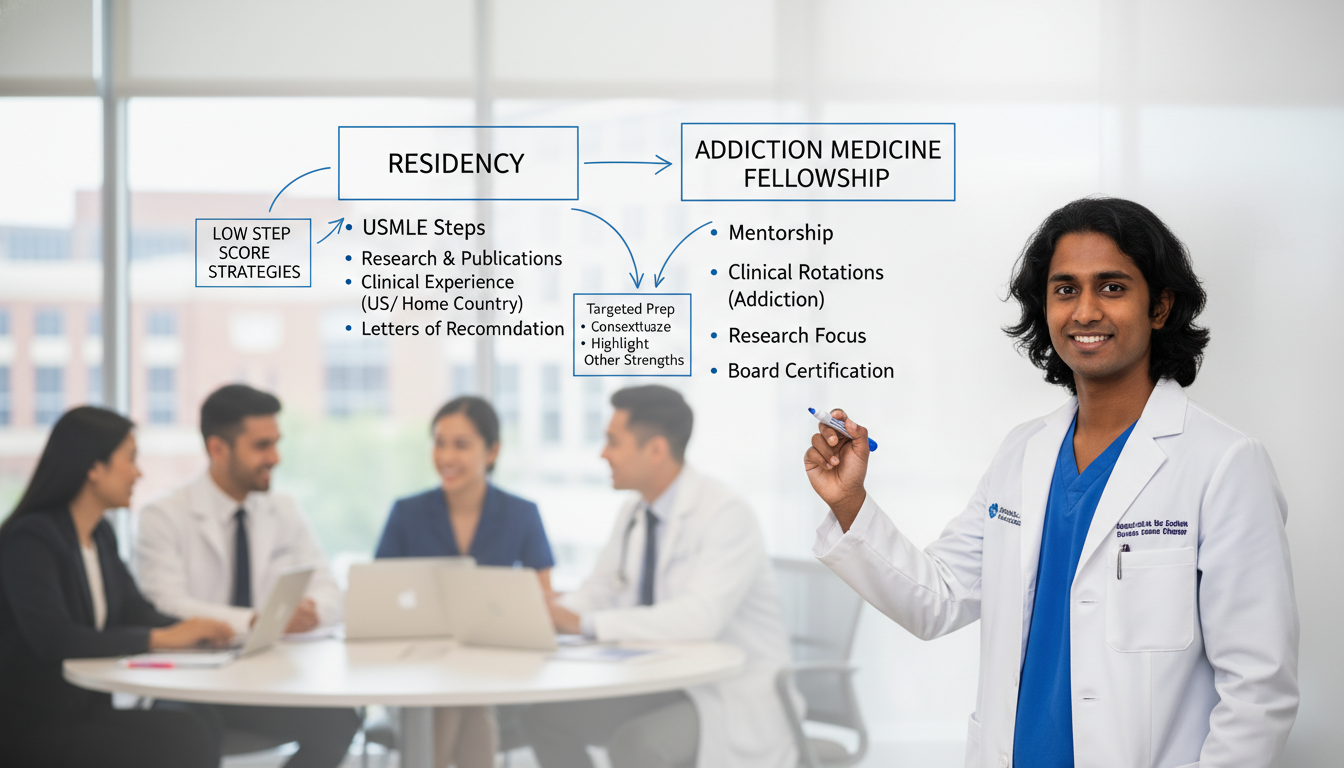
Your strategy must therefore be two-phased:
- Get into a residency: Mitigate low scores, maximize IMG and visa-friendly options
- Position for addiction medicine fellowship: Build a clear addiction-focused track record during residency
Phase 1: Strengthening Your Application Despite Low Step Scores
This phase is about getting interview invitations despite filters. You cannot change a low Step 1 score, but you can:
- Show improvement and upward trajectory
- Build a laser-focused addiction medicine narrative
- Maximize IMG-friendly and visa-sponsoring programs
1. Optimize Remaining Exams (Especially Step 2 CK)
If you still have Step 2 CK or Step 3 ahead:
- Treat them as make-or-break opportunities
- A strong Step 2 CK (e.g., 235+) can partly compensate for a low Step 1 score
- A pass on Step 3 can reassure programs about test-taking ability and future board success
Actionable steps:
- Take at least 2–3 NBME practice exams before your real test
- If practice scores are far below your target, delay the exam rather than risk a second low score
- Consider a formal prep course or tutor if your baseline is low or you have failed previously
For some non-US citizen IMGs, taking Step 3 before applying can help:
- Signals commitment to US training
- Some community and IMG-heavy programs like to see it passed upfront
- Particularly valuable if you have a low Step 1 score but solid Step 3
2. Use Addiction Medicine to Create a Coherent Personal Narrative
Residency programs value applicants with clear interests and a demonstrated record of following through. Addiction medicine and substance use disorders are high-impact, mission-driven areas. You can turn your interest into a strength that partially offsets lower test scores.
Examples of addiction-focused activities that strengthen your profile:
Clinical exposure:
- Rotations in psychiatry, internal medicine, or family medicine settings that include SUD care
- Observerships in US clinics or hospitals with addiction consult services or methadone/buprenorphine programs
Research and quality improvement:
- Retrospective chart reviews on overdose admissions
- Projects on reducing benzodiazepine co-prescribing
- QI projects on screening for alcohol or opioid misuse in primary care
Public health and advocacy:
- Work with NGOs addressing substance abuse in your home country
- Community education campaigns on harm reduction, safe prescribing, or overdose response
- Participation in naloxone distribution or education programs
Tie everything into a cohesive story in your personal statement:
“Although my USMLE Step 1 score does not fully reflect my capabilities, my subsequent performance and my sustained commitment to patients with substance use disorders demonstrate who I am as a clinician. In my home country, I initiated a naloxone training program… During my US observership in an addiction consult service, I…”
Programs may forgive numbers when they see evidence of resilience, growth, and authentic passion for an underserved area like addiction medicine.
3. Letters of Recommendation That Directly Counter Score Concerns
For a non-US citizen IMG with below average board scores, letters become critical. You need:
- At least 2 strong US clinical letters, ideally from:
- Internal Medicine, Family Medicine, or Psychiatry attendings
- Faculty who explicitly mention your work with patients with SUD if possible
Ask letter writers to address:
- Your clinical reasoning and knowledge base (“performs at the level of our interns”)
- Reliability and professionalism
- Ability to manage complex, comorbid patients (e.g., SUD + psychiatric + medical illnesses)
- Evidence that your exam scores underestimate your clinical ability
Sample wording you might request (do not script them, but you can suggest themes):
“If you feel it is appropriate, I would be grateful if you could comment on my clinical performance and ability to handle complex patients, especially given that my Step 1 score is not as strong as I would like.”
4. Strategic Program Selection: Where Low Scores Hurt Less
Matching with low scores is possible if you apply broadly and intelligently.
Focus on:
- Community-based programs
- IMG-friendly programs with a history of non-US citizen residents
- Programs that explicitly state they accept J-1 or H-1B visas
- Locations with high SUD burden, which often have more interest in addiction-focused applicants (e.g., many parts of the Midwest, Appalachia, rural areas)
Avoid relying solely on:
- Top-tier university programs with strict score cutoffs
- Programs that historically take few or no IMGs
- Highly desired cities with intense competition (NYC, CA coastal cities, major East Coast metros) unless you have other strong differentiators
Practical application strategy:
- Apply to at least 100+ programs in your chosen specialty if your scores are significantly below average
- Diversify between Internal Medicine, Family Medicine, Psychiatry depending on your interests and background (all are common pathways to addiction medicine fellowship)
- Use resources like:
- Program websites (look at current residents—how many IMGs?)
- NRMP and FREIDA data
- Alumni from your medical school who matched as non-US citizen IMG

Phase 2: Maximizing Your Chances on Interview Day
Securing interviews with low Step scores is the hardest part; once you’re in the (virtual) room, your scores matter much less. Your performance in interviews can fully reframe your application.
1. Own Your Scores—Without Making Excuses
You will likely be asked about your USMLE performance.
How to respond:
- Be direct and concise
- Take responsibility, but don’t over-explain
- Immediately pivot to growth and evidence of improvement
Example response:
“My Step 1 score was below my expectations. At that time, I struggled with test strategy and adapting to a new educational system. Recognizing this, I changed my preparation approach—using more practice questions, structured schedules, and regular feedback. As a result, my Step 2 CK score improved significantly, and in clinical settings I’ve consistently been evaluated as strong and reliable. I believe my current performance is a better reflection of my abilities.”
Avoid:
- Blaming others or circumstances as your main message
- Bringing up the score if they haven’t asked
- Sounding rehearsed but not reflective
2. Highlight Addiction Medicine as a Strength and Mission
Program directors love applicants who can articulate why they want this specialty and how they will contribute. For someone targeting substance abuse training:
Be specific:
- Share a patient encounter that shaped your interest (protecting confidentiality)
- Explain what you’ve already done in SUD care
- Express clear long-term goals: e.g., “I hope to complete an addiction medicine fellowship and work in an integrated primary care–addiction clinic serving underserved populations.”
This makes you stand out as:
- Purpose-driven
- Likely to commit to the program’s patient population
- Someone who can help with the real-world SUD challenges the program faces
3. Emphasize Strengths That Matter More Than Scores
Residency is demanding. For addiction-focused careers, programs look for:
- Resilience: Working with patients with SUD can be emotionally heavy
- Communication skills: Motivational interviewing, non-judgmental approach
- Teamwork: Collaborating with social work, counseling, nursing, pharmacy
- Cultural competence: Particularly strong for non-US citizen IMG applicants who have cared for diverse populations
Use concrete examples:
- Times you managed challenging communication with family members
- Experience caring for patients with both mental illness and substance use
- Multidisciplinary collaboration in your rotations or home-country system
Planning the Long Game: From Residency to Addiction Medicine Fellowship
Even if low Step scores limit your initial residency options, Addiction Medicine fellowship is often more influenced by your performance during residency than by your USMLE history.
1. Choose a Residency Pathway That Leads Naturally to Addiction Medicine
Common pathways into Addiction Medicine fellowship:
- Internal Medicine (very common; strong medical focus on SUD)
- Family Medicine (broad primary care & community emphasis)
- Psychiatry (focus on co-occurring mental health and SUD)
- Less commonly: Pediatrics, Emergency Medicine, Obstetrics & Gynecology, or Anesthesiology
When rank-ordering programs, consider:
- Does the program serve a high SUD population?
- Are there buprenorphine prescribers on faculty?
- Is there an addiction consult service, methadone clinic, or integrated behavioral health clinic?
- Do any graduates go into addiction medicine fellowship?
2. Build a Fellowship-Ready Profile During Residency
Once matched, treat residency as your audition for future addiction medicine fellowship programs.
Key elements:
a. Clinical Track Record
- Volunteer for rotations that involve SUD care (detox units, dual-diagnosis units, inpatient consults, jail health, etc.)
- Ask attendings for direct feedback and act on it; strong in-service scores and clinical ratings help overshadow old exam numbers
b. Addiction-Focused Scholarship
- Case reports of complex SUD patients
- QI projects: screening for alcohol misuse, ED-initiated buprenorphine, reducing stigma in documentation
- Research with faculty involved in SUD or behavioral health
c. Leadership and Advocacy
- Start or lead a resident interest group in addiction medicine
- Organize grand rounds on opioid use disorder or harm reduction
- Participate in hospital committees on pain management or safe prescribing
d. Networking With Addiction Medicine Faculty
- Seek mentors early—they can provide:
- Project opportunities
- Strong letters of recommendation for fellowship
- Guidance on which addiction medicine programs are IMG- and visa-friendly
3. Visa Considerations for Non-US Citizen IMG
Your status as a non-US citizen IMG shapes your path:
J-1 Visa: Most common route for foreign national medical graduates
- After residency and fellowship, requires either a home-country return or a J-1 waiver job (often in underserved areas, which frequently have high SUD needs—this can be an advantage for addiction-focused careers)
H-1B Visa: Less common for residency; some fellowships do not sponsor H-1B
- Check early which addiction medicine fellowship programs accept H-1B
Plan ahead:
- Identify addiction medicine fellowship programs that are IMG-friendly and visa-sponsoring
- Aim for fellowships within systems that already sponsor your visa type for residency
Additional Practical Tips for Matching With Low Scores in Addiction-Relevant Fields
Targeting Addiction-Relevant Specialties With Slightly Lower Score Pressure
Compared to some ultra-competitive fields, Family Medicine and Psychiatry can be somewhat more flexible with scores, especially at community programs that depend on IMGs.
If your scores are very low, consider:
- Family Medicine: Many programs are deeply involved in SUD care in the community
- Psychiatry: Higher interest in SUD, though competitiveness has increased recently
Both paths lead naturally to addiction medicine fellowship and can be slightly more forgiving when it comes to matching with low scores, especially if you demonstrate clear addiction medicine interest.
Building a Parallel “Plan B”
Because non-US citizen IMGs with below average board scores face higher risk of not matching, consider:
- Parallel specialty applications: e.g., applying to both Internal Medicine and Family Medicine
- Backup geographic strategies: rural or less-popular states may be more open to IMGs with low scores
- Strengthening your CV with ongoing clinical roles in your home country or research positions if you need to reapply
If you do not match the first cycle:
- Request feedback from any interviewers who are willing to share
- Strengthen weak areas:
- Explore US research positions in addiction or public health
- Gain additional US clinical exposure (observerships, externships where allowed)
- Improve English communication skills if they were a concern
Frequently Asked Questions (FAQ)
1. I am a non-US citizen IMG with a very low Step 1 score but a better Step 2 CK. Do I still have a chance at a residency that can lead to addiction medicine?
Yes. Many foreign national medical graduates with low Step 1 scores have successfully matched into Internal Medicine, Family Medicine, or Psychiatry and later completed addiction medicine fellowship. A strong Step 2 CK (and ideally Step 3) helps significantly. Your strategy should focus on:
- Applying broadly to IMG- and visa-friendly programs
- Emphasizing your improvement and resilience
- Showcasing a strong addiction-focused profile (clinical experience, research, advocacy)
- Securing strong US letters that explicitly endorse your clinical competence
2. Does my low Step score matter when applying to Addiction Medicine fellowship after residency?
It matters much less. Once you’re a resident, addiction medicine fellowship programs mainly look at:
- Your residency performance and in-service exams
- Letters from faculty who know your addiction-related work
- Any addiction-related research or QI projects
- Your demonstrated commitment to SUD care
Your low USMLE Step 1 score or below average board scores may still appear on paper, but if you are known as a strong, dedicated resident with a clear addiction medicine focus, most fellowship directors will prioritize your current performance over older exam numbers.
3. Which residency specialties are best for a non-US citizen IMG aiming for addiction medicine, especially with low scores?
The most common and accessible pathways, especially for a non-US citizen IMG with low scores, include:
- Internal Medicine: Broad medical foundation; addiction medicine fellowships frequently accept IM grads
- Family Medicine: Strong community orientation; many addiction programs value FM’s broad scope
- Psychiatry: Excellent fit if you’re drawn toward mental health and dual-diagnosis patients
Choose the field where you can realistically match (given your scores) and where you can see yourself enjoying both general practice and substance abuse training.
4. How can I find programs that are more forgiving of low scores for IMGs interested in addiction medicine?
Look for:
- Programs with a high percentage of IMGs among current residents
- Explicit statements about accepting J-1 or H-1B visas
- Geographically less competitive areas (Midwest, South, smaller cities, rural)
- Hospitals that serve high-risk populations (e.g., safety-net hospitals, VA, public hospitals)
Search for terms like “addiction consult service,” “substance use disorder clinic,” or “buprenorphine clinic” on program websites. These programs are more likely to value your addiction medicine interest, which can help offset moderately low scores.
Low USMLE scores as a non-US citizen IMG do not close the door to addiction medicine—but they do force you to be more strategic, focused, and persistent. By strengthening your remaining exams, crafting a compelling addiction-focused story, targeting the right programs, performing strongly in residency, and deliberately building an SUD-focused portfolio, you can still build a rewarding career in addiction medicine and substance abuse care in the US.