
Residency programs that emphasize global health care deeply about your clinical readiness, your commitment to international medicine, and your ability to thrive in resource‑limited settings. Your USMLE Step scores matter—but they are only one part of a bigger narrative. As an MD graduate aiming for a global health residency track, you need a deliberate Step score strategy that both maximizes your performance and smartly manages any score weaknesses.
This article outlines a practical, evidence‑informed approach to Step 1 and Step 2 CK for MD graduates interested in global health and international medicine, including specific tactics for those with low Step score match concerns.
Understanding How Step Scores Affect Global Health–Focused Residency Applications
Why Step scores still matter (even as assessments evolve)
For an MD graduate residency applicant, especially from an allopathic medical school, the USMLE Steps serve three main functions:
Screening tool
- Many residency programs—especially large academic centers—use Step scores for initial file screening.
- Global health tracks often reside within internal medicine, family medicine, pediatrics, OB/GYN, EM, or surgery programs that may have institutional cutoffs (even if not public).
Comparator among similar applicants
- Programs receive hundreds of applications from well-qualified MD graduates; Step scores provide a standardized metric to compare clinical knowledge and test-taking ability.
Signal of readiness for board exams and complex rotations
- For global health and international medicine tracks, faculty want reassurance that you can handle:
- Core residency exams (e.g., ABIM, ABFM, ABP, etc.)
- High-acuity clinical situations with variable resources
- Rapid clinical reasoning in unfamiliar settings
- For global health and international medicine tracks, faculty want reassurance that you can handle:
Step 1 vs Step 2 CK in the current landscape
Although exact policies vary by year and institution, several trends are clear:
Step 1 (now Pass/Fail for recent examinees)
- Historical scores (for earlier MD graduates) still appear in ERAS.
- Programs may use the old numerical Step 1 to risk‑stratify applicants.
- If pass/fail, a simple “Pass” is often considered necessary but not distinguishing.
Step 2 CK (numeric score) is increasingly central
- The Step 1 score residency mentality is shifting toward a Step 2 CK strategy focus.
- For global health–oriented internal medicine, pediatrics, and family medicine programs, a strong Step 2 CK reassures faculty of your readiness for complex, undifferentiated patients.
How global health tracks may differ from standard categorical positions
Global health and international medicine–focused programs often:
Care deeply about:
- Sustained service in underserved communities
- Cross-cultural communication skills
- Field experience (global or domestic underserved)
- Language skills and adaptability
Still consider Step scores but may:
- Be slightly more flexible with a low Step score match profile if:
- You have robust field experience
- Strong letters from global health mentors
- Clear alignment with the program’s mission
- Be slightly more flexible with a low Step score match profile if:
For an MD graduate targeting global health, the goal is not just to “hit a number,” but to:
- Avoid score-related screening eliminations.
- Use your Step performance to reinforce your narrative of clinical strength and reliability.
Building a Step 2 CK–Centered Strategy for MD Graduates Interested in Global Health
Step 2 CK is your primary opportunity to demonstrate clinical mastery. This is especially important for:
- MD graduates who scored lower than desired on Step 1
- Older MD graduates with a gap after graduation
- International rotations or time abroad that may raise questions about recency of knowledge
Step 2 CK strategy: foundational principles
Treat Step 2 CK as your “anchor” exam
- Aim for a Step 2 CK score that:
- Clears likely institutional thresholds.
- Shows clear improvement relative to any weaker Step 1.
- For many global health–relevant specialties (IM, FM, peds):
- A score around or above the national mean significantly helps.
- If Step 1 is low, aim well above your Step 1 percentile to signal an upward trajectory.
- Aim for a Step 2 CK score that:
Integrate clinical experience into your prep
- Global health–minded applicants often have excellent clinical intuition from field work.
- Convert that intuition into test success by:
- Translating practical experiences into guideline‑aligned algorithms.
- Focusing on CDC, WHO, and standard US guidelines for common and global conditions.
Use practice tests to plan your application timeline
- Take an NBME roughly 3–4 months before your planned exam date.
- If scores are far below your target:
- Consider postponing the exam (and potentially the application cycle) rather than risking a low Step 2 CK score late in the process.
A timeline example for MD graduates
Assume you plan to apply in September:
January–March (Year of Application)
- Solidify clinical rotations (especially medicine, peds, FM, EM)
- Begin light Step 2 CK review (QBank 10–20 questions/day)
April–May
- Intensify content review: 40–60 QBank questions/day, review notes, start first NBME
- Identify weakest systems (e.g., cardiology, infectious disease, OB/GYN)
June–July
- Full test‑prep push: 2–3 blocks/day, timed and mixed
- At least 2 practice exams (NBME/UWSA) to project score
- Schedule Step 2 CK no later than late July/early August to ensure scores are back by mid‑September
August
- Apply polish: targeted review of recurring weak topics
- Begin ERAS application drafting with Step 2 CK score in hand (if possible)
This timeline is particularly important for allopathic medical school match applicants who want their Step 2 CK score available to programs early in recruitment.
Managing and Mitigating a Low Step Score in a Global Health–Focused Application
Not every excellent global health physician had a stellar test record. If you have a low Step score match risk (low Step 1, low Step 2 CK, or both), you need a deliberate recovery plan.

Scenario 1: Low Step 1, strong or improving Step 2 CK
Profile:
- Step 1: Below average or barely passing
- Step 2 CK: At or above national mean (or clearly higher percentile than Step 1)
Strategy:
Explicitly frame the improvement
- In your personal statement or an additional comment section:
- Acknowledge that Step 1 did not represent your true abilities.
- Highlight your Step 2 CK preparation approach and improved score as evidence of resilience and growth.
- In your personal statement or an additional comment section:
Use letters of recommendation (LORs) to reinforce the narrative
- Ask attendings, especially in medicine/pediatrics/family medicine or global health:
- To comment on your clinical reasoning and medical knowledge.
- To explicitly reassure that you perform at the level of a strong resident.
- Ask attendings, especially in medicine/pediatrics/family medicine or global health:
Emphasize your strengths beyond scores
- Longitudinal service in underserved settings
- Global or community health research
- Leadership in international medicine initiatives
This profile is often well‑received by global health tracks if the overall application aligns strongly with their mission.
Scenario 2: Low Step 1 and modest Step 2 CK (both below average)
Profile:
- Step 1 and Step 2 CK both below national mean, but passing
- Strong clinical evaluations and global health experience
Strategy:
Consider specialty & program selection carefully
- Choose fields that traditionally offer more holistic review, such as:
- Family medicine
- Internal medicine (particularly community programs with global health tracks)
- Pediatrics
- Cast a wider geographic net: community programs plus a few academic centers with explicit global health missions.
- Choose fields that traditionally offer more holistic review, such as:
Compensate with clear clinical excellence
- Seek sub‑internships (sub-Is) where you can:
- Take near‑resident level responsibility.
- Work with faculty active in global health.
- Aim for “Honors” or top-tier performance, and ask for detailed LORs describing:
- Clinical reliability
- Independently managing complex patients
- Cultural humility and teamwork
- Seek sub‑internships (sub-Is) where you can:
Amplify global health–specific achievements
- Co-author a paper, poster, or policy brief on global or international medicine.
- Lead or coordinate a sustainable project (e.g., quality improvement in a low-resource clinic).
Be realistic yet optimistic
- Your path might be more competitive for certain top-tier programs, but:
- Many excellent programs value real-world global health experience and service over perfect test scores.
- Your path might be more competitive for certain top-tier programs, but:
Scenario 3: Step failure or dramatic score discrepancy
Profile:
- Step 1 or Step 2 CK failure, or a very sharp drop from Step 1 to Step 2
Strategy:
Address the issue openly and professionally
- If failure occurred, provide a concise, factual explanation:
- Specific challenges (health, family crisis, miscalculated prep)
- How you addressed them and what changed in your approach
- Never blame the exam or appear dismissive of its importance.
- If failure occurred, provide a concise, factual explanation:
Show concrete proof of change
- Improved performance on repeat exam.
- Evidence of sustained academic success afterwards (e.g., strong clerkship grades).
Strengthen every other domain
- Consistently excellent clinical evaluations
- Additional certifications (e.g., tropical medicine, public health courses, research methods)
Programs committed to training globally-minded physicians sometimes take calculated risks on applicants who demonstrate exceptional persistence, maturity, and mission alignment.
Aligning Your Step Strategy with the Global Health Narrative
Your Step scores should complement—not compete with—your story as a future global health physician.
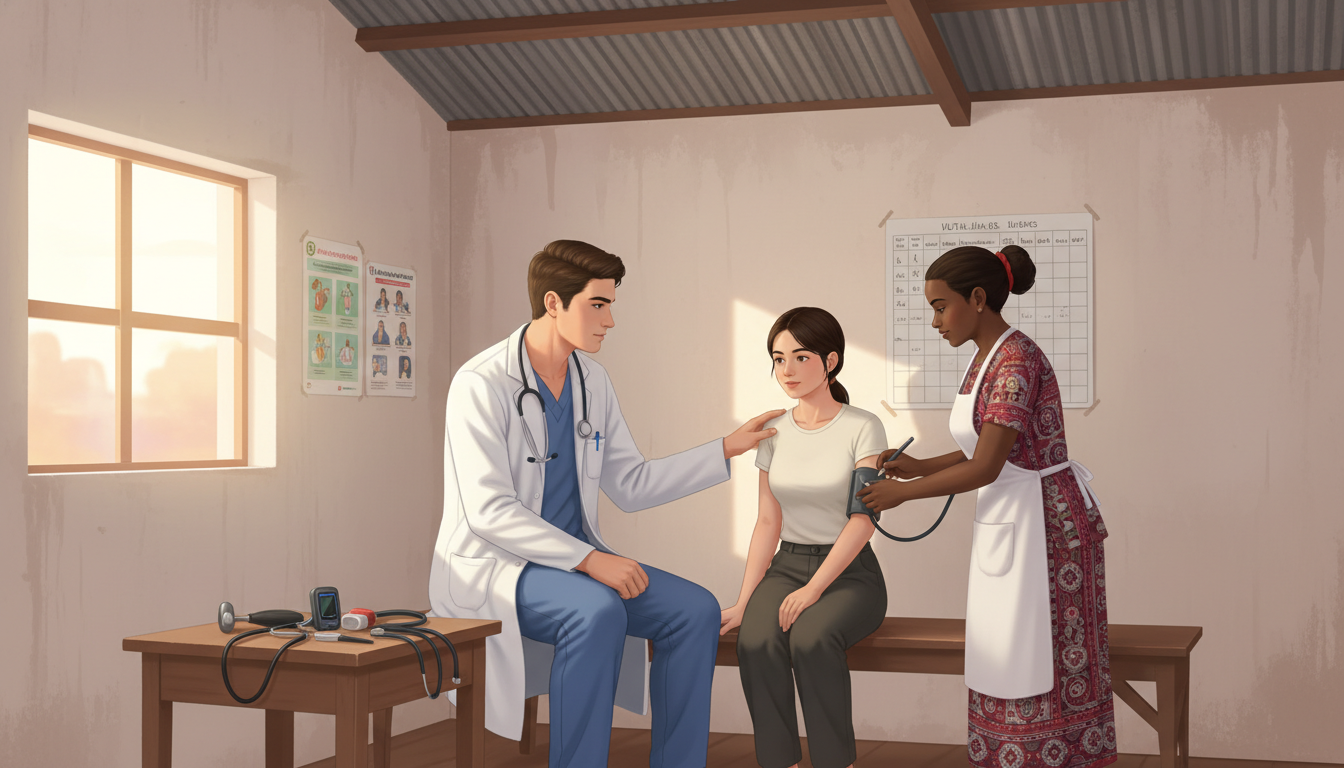
Crafting your application narrative
When residency faculty evaluate an MD graduate residency applicant for a global health residency track, they look for coherence among:
- Step scores
- Clinical evaluations
- Global health experiences
- Personal statement
- Letters of recommendation
You want all of these elements to answer one core question:
“Is this applicant prepared, committed, and likely to thrive in a global health–oriented residency?”
Practical ways to integrate Step performance into your story
In your personal statement
- If your scores are average or strong:
- Mention them only briefly, if at all; focus on clinical and global health dimensions.
- If you have a weaker Step history:
- One short paragraph can:
- Acknowledge the challenge.
- Emphasize what you learned about disciplined study and resilience.
- Pivot quickly to your current strengths and readiness.
- One short paragraph can:
- If your scores are average or strong:
In your CV and experiences section (ERAS)
- Highlight global health roles that demonstrate:
- Systems thinking (e.g., setting up triage protocols in a rural clinic).
- Adaptable clinical reasoning in environments where advanced diagnostics are limited.
- These experiences tell program directors that you can apply knowledge beyond exams.
- Highlight global health roles that demonstrate:
Through your LORs
- Ask mentors (especially those involved in global health) to:
- Comment explicitly on your medical knowledge and problem-solving.
- Compare you favorably to other residents or fellows they have supervised.
- Describe your performance in high‑responsibility, complex global or underserved settings.
- Ask mentors (especially those involved in global health) to:
Strategic program targeting
Use your scores to shape where you apply:
If Step 2 CK is relatively strong:
- Target academic programs with established global health centers, especially those that:
- List no strict minimum Step cutoff, or
- Emphasize “holistic review” in their program descriptions.
- Target academic programs with established global health centers, especially those that:
If scores are modest:
- Apply broadly to:
- Community-based programs with strong service missions or global health electives.
- University-affiliated but less name-brand programs that value global health engagement over Step numbers.
- Apply broadly to:
If scores are low or include a failure:
- Increase application volume.
- Prioritize programs known for:
- Training physicians to work in underserved communities.
- Mission‑driven selection criteria (e.g., emphasis on social justice, primary care access, or rural health).
Concrete Study Tactics for a High‑Yield Step 2 CK Strategy
Since Step 2 CK is crucial for your allopathic medical school match prospects and global health track competitiveness, use efficient, structured strategies.
1. Question‑bank–first, textbook‑second
- Use a major QBank (e.g., UWorld) as your primary learning tool:
- 40–80 questions/day, mixed and timed, to simulate real test conditions.
- For each block:
- Review thoroughly—understand why each option is right or wrong.
- Make concise notes or flashcards only on:
- Concepts you repeatedly miss.
- High-yield or “core clinical” algorithms.
2. Systematic practice exam schedule
Plan 3–4 full practice tests:
- First NBME: 8–12 weeks before exam (baseline).
- Second NBME: 4–6 weeks before exam (check trajectory).
- UWSA or NBME: 2–3 weeks before exam (final check).
Use the results to:
- Identify weak systems (e.g., cardiology, infectious disease, OB) for targeted review.
- Decide whether to delay the exam if your projected score is far below your target or program thresholds.
3. Global health–informed content emphasis
For a future in global health or international medicine, you should pay particular attention to:
Infectious diseases:
- TB, HIV (adult and pediatric), malaria, helminths, diarrheal diseases.
- Tropical medicine syndromes (fever in the returning traveler).
Maternal and child health:
- Obstetric emergencies, postpartum hemorrhage.
- Neonatal sepsis, prematurity, vaccine-preventable illnesses.
Emergency and triage principles:
- Airway, breathing, circulation.
- Initial management without immediate access to advanced imaging.
These topics are Step 2 CK high-yield and centrally relevant to global health practice, linking your exam prep with your future clinical environment.
4. Time management and burnout prevention
Global health–oriented MD graduates are often juggling:
- Ongoing field projects
- Research commitments
- Clinical rotations
To protect your performance:
- Schedule protected, non-negotiable study blocks each day (even if short).
- Build weekly recovery time (at least one half‑day with no studying).
- Use active recall (flashcards, teaching peers) rather than passive reading.
FAQs: Step Score Strategy for MD Graduates in Global Health
1. If my Step 1 score is low, can I still match into a global health residency track?
Yes. A low Step 1 does not exclude you from a global health residency track, especially if:
- You achieve a stronger Step 2 CK score.
- You demonstrate sustained commitment to global or underserved populations.
- You secure strong letters of recommendation highlighting clinical excellence, resilience, and alignment with global health missions.
You may need to apply more broadly and be strategic about program selection, but your global health profile can significantly offset a weaker Step 1.
2. How high should my Step 2 CK score be to be competitive?
There is no universal cutoff, but as a broad guide:
- At or above the national mean is favorable for many IM, FM, and pediatrics programs with global health tracks.
- Higher scores become more important if:
- You are targeting very competitive academic centers.
- Your Step 1 was significantly below average.
Think of Step 2 CK as both a chance to demonstrate growth and a way to reassure programs about your ability to pass future board exams.
3. Should I delay Step 2 CK to improve my chances, even if it means applying later?
It can be wise to delay Step 2 CK if:
- Practice tests consistently predict a score that is much lower than your target.
- You clearly see that additional dedicated study time would significantly raise your projected score.
However, balance this against:
- The importance of having your Step 2 CK result available by the start of application season.
- The risk of burnout from prolonged preparation.
For MD graduates targeting global health, a well‑prepared Step 2 CK taken slightly later is often better than a rushed exam that results in a low score you cannot easily offset.
4. How can I explain a Step failure or major score drop in my application?
Use a brief, professional, forward‑looking explanation:
- Acknowledge the issue plainly (e.g., “I failed Step 1 on my first attempt due to underestimating the exam and managing multiple responsibilities poorly.”).
- Describe specific changes you made:
- Structured study plan, faculty guidance, practice exam schedule.
- Highlight your improved performance (if applicable) and sustained strong clinical evaluations since then.
- Emphasize what the experience taught you about discipline, self-reflection, and resourcefulness—qualities essential in global health.
Residency committees for global health–oriented programs often value maturity and honest self-assessment, especially when combined with clear evidence of growth.
By approaching your USMLE journey as part of a larger Step score strategy—rather than a series of isolated exams—you can align your testing performance with your long‑term goal: matching into a residency that will prepare you for impactful, sustainable work in global health and international medicine.